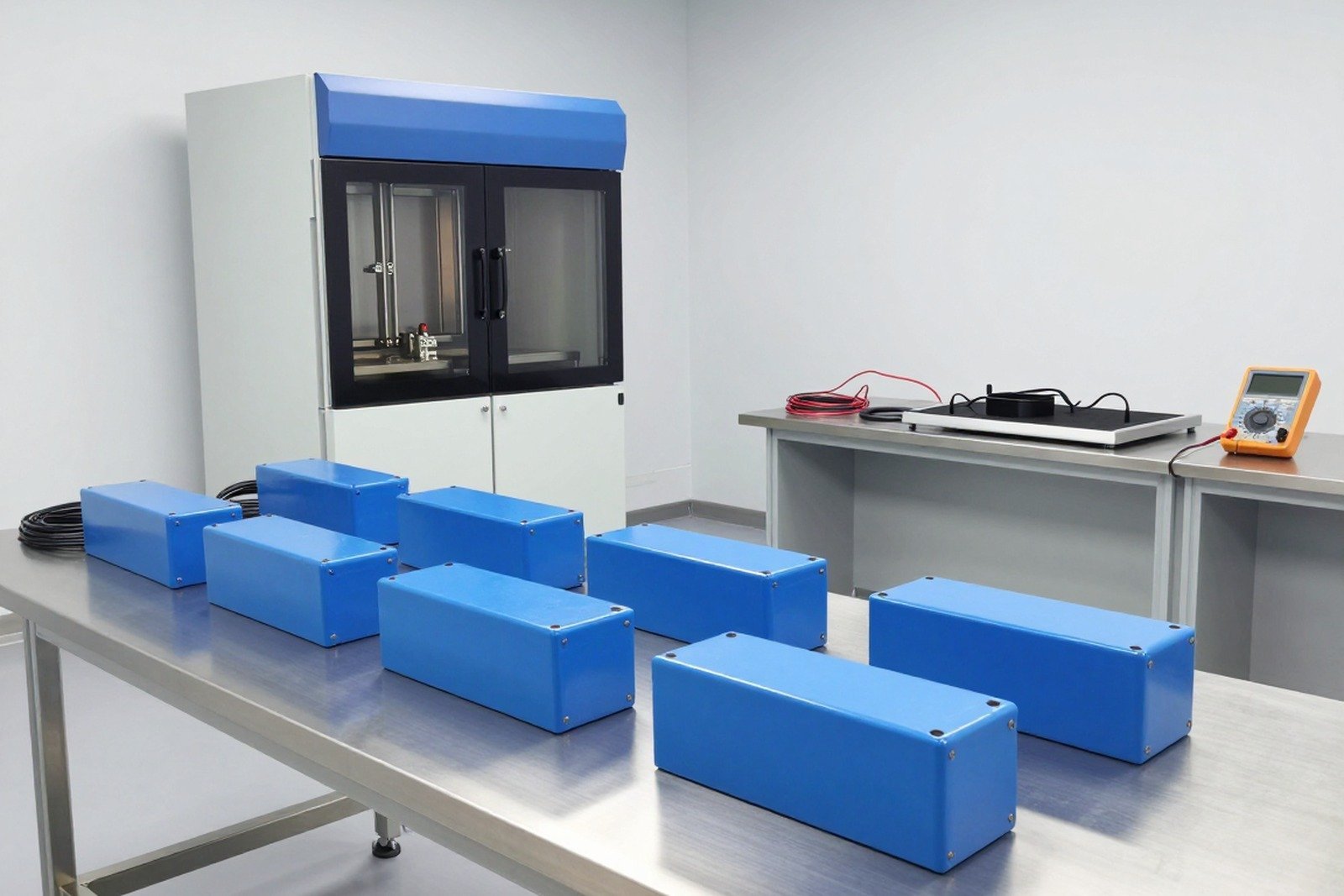
Almost every company that makes batteries, builds battery packs, or imports equipment powered by lithium batteries runs into the same question: “The carrier is asking for a UN 38.3 file — what is that, and how do we get one?”
With lithium batteries, sturdy packaging is not enough. An entire shipment can be held at the border or refused outright by an airline simply because one document is missing. This article summarises the core of UN 38.3 — the set of eight tests every lithium cell and battery must pass before it is allowed to travel — together with the practical points that are most often missed.
Quick answers
- What is UN 38.3? Clause 38.3 in Part III of the UN Manual of Tests and Criteria (ST/SG/AC.10/11), which defines eight safety tests that lithium cells and batteries must pass before transport.
- The eight tests (T1–T8): altitude simulation, thermal cycling, vibration, shock, external short circuit, impact/crush, overcharge and forced discharge.
- Who has to apply it? Cell makers, pack integrators, shippers and distributors — the obligation follows the battery, not the brand.
- The test summary (38.3.5): since 1 January 2020, manufacturers and distributors must make this summary available down the supply chain.
- In Vietnam: road transport of dangerous goods is governed by Decree 42/2020/ND-CP (replacing Decree 104/2009/ND-CP from 1 June 2020); air follows IATA DGR/ICAO and sea follows the IMDG Code.
Where does UN 38.3 sit, and why is it mandatory?
UN 38.3 is clause 38.3 of the UN Manual of Tests and Criteria, document symbol ST/SG/AC.10/11, in Part III. It defines a sequence of safety tests for lithium cells and batteries — both rechargeable (lithium-ion) and non-rechargeable (lithium-metal). The edition most widely applied today is the 8th revised edition (Rev.8, November 2023) together with Amendment 1.
A common misunderstanding: the Manual itself has no direct legal force. It becomes mandatory only when the transport rulebooks cite it:
- IATA DGR – air transport;
- IMDG Code (IMO) – sea transport;
- ADR / RID – road and rail in Europe;
- the corresponding national rules in each country.
In other words, UN 38.3 is the “source standard”, while those rulebooks are the “enforcers”. When a battery shipment is rejected by an airline or shipping line, the stated reason usually points straight to the IATA DGR or the IMDG Code — but the substance being checked is UN 38.3.
Why is lithium scrutinised so closely? Lithium batteries are Class 9 dangerous goods under all three regimes (IATA, IMDG, ADR). The central risk is thermal runaway — a self-amplifying heat reaction when a cell is mechanically damaged, short-circuited or overcharged; once triggered, the temperature inside the cell can spike within seconds and spread fire through the whole consignment. UN 38.3 therefore recreates the conditions of transport itself — low pressure in an aircraft hold, thermal swings on intercontinental routes, road vibration and the electrical abuse cases — rather than reproducing normal use.
The eight tests T1–T8
The tests run in sequence on defined sample sets. A full programme can consume cells and packs in double digits — which is why the rules allow evidence to be built at cell level and reused to reduce the test load at pack level.
| Code | Test | Main conditions | Applies to |
|---|---|---|---|
| T1 | Altitude simulation | ≤ 11.6 kPa (~15,000 m), 6 h, 20 °C | Cells & batteries |
| T2 | Thermal test | 10 cycles 72 °C ↔ −40 °C, ≥ 6 h each, 24 h rest at 20±5 °C | Cells & batteries |
| T3 | Vibration | Sine sweep 7→200→7 Hz, 15 min/sweep, 12 sweeps × 3 axes | Cells & batteries |
| T4 | Shock | Half-sine 150 gn / 6 ms, 3 shocks per direction × 3 axes (18 total) | Cells & batteries |
| T5 | External short circuit | 55±2 °C, external resistance < 0.1 Ω, held ≥ 6 h | Cells & batteries |
| T6 | Impact / Crush | Ion: crush up to ~13 kN — Metal: impact Ø15.8 mm bar, 9.1 kg from 61 cm | Cells & batteries |
| T7 | Overcharge | Twice the recommended charge current and twice the voltage | Rechargeable only |
| T8 | Forced discharge | Forced discharge at 1/3 of rated capacity | Rechargeable only |
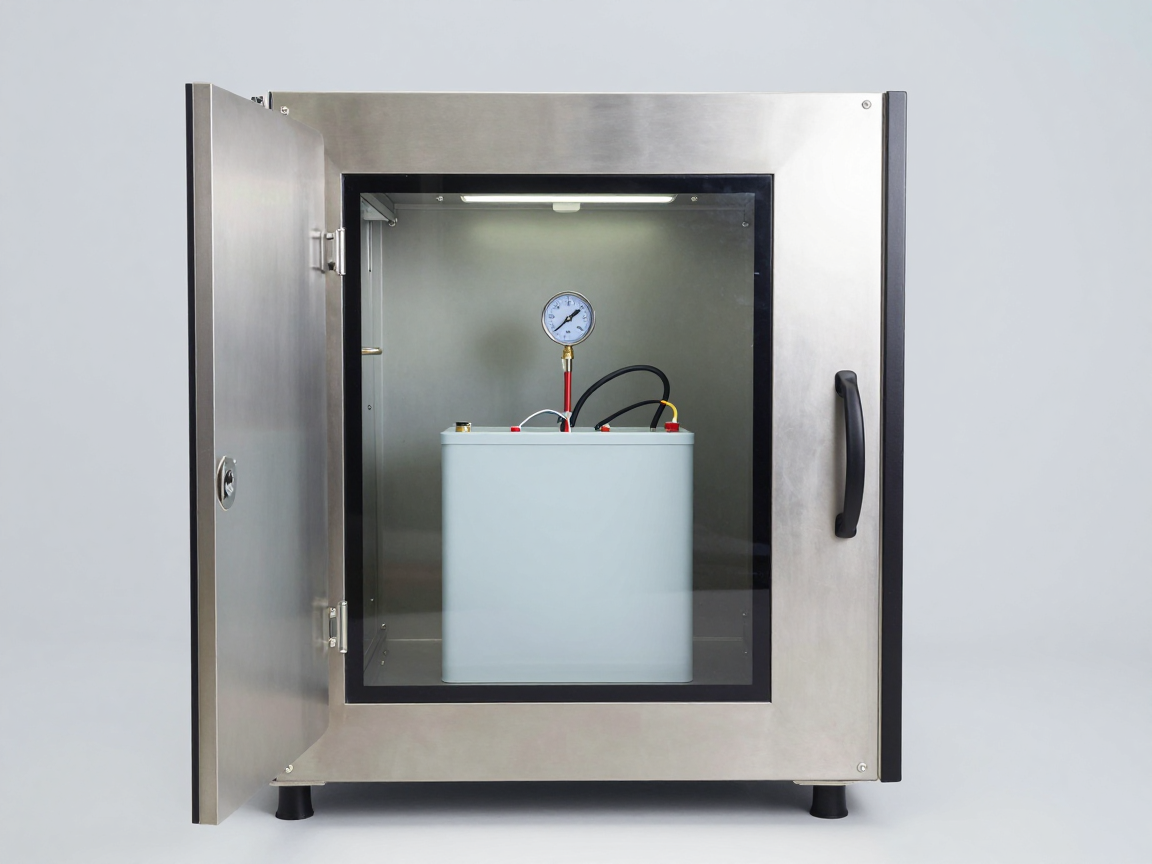
T1 – Altitude simulation. The cell/battery is held at ≤ 11.6 kPa (equivalent to an altitude of about 15,000 m) for at least 6 hours at 20 °C. It checks the seal under the pressure differential typical of an aircraft cargo hold.
T2 – Thermal test. The sample undergoes 10 cycles between 72 °C and −40 °C, holding at least 6 hours at each level, then rests 24 hours at 20±5 °C.
T3 – Vibration. A sinusoidal sweep from 7 Hz up to 200 Hz and back to 7 Hz (logarithmic), 15 minutes per sweep, repeated 12 times per axis on 3 mutually perpendicular axes.
T4 – Shock. Half-sine pulses of 150 gn peak, 6 ms duration, 3 shocks per direction on 3 axes (18 pulses in total), simulating handling and transport impacts.
T5 – External short circuit. At 55±2 °C, the terminals are shorted through an external resistance of < 0.1 Ω, held until the voltage drops or the case temperature returns to the 55 °C band, plus at least 6 hours. Specific criterion: case temperature no higher than 170 °C, no fire, no disassembly within 6 hours after the test.
T6 – Impact / Crush. For ion cells, a crush force up to about 13 kN. For metal cells, impact by a 15.8 mm diameter bar, 9.1 kg dropped from 61 cm.
T7 – Overcharge. Only for rechargeable batteries: charged at twice the recommended current up to twice the recommended voltage (or the specified equivalent conditions).
T8 – Forced discharge. Only for rechargeable batteries: forced discharge at 1/3 of rated capacity, simulating a weak cell being driven into reversal by stronger cells in the same pack.
Pass / fail criteria
Results are judged against a common set of criteria. During and after the test the sample must not:
- catch fire or explode;
- disassemble or rupture;
- leak or vent beyond the permitted limits;
- lose mass beyond the limit (applies to the thermal/pressure tests such as T1, T2, T5);
- for T1 and T2: the open-circuit voltage (OCV) after the test must not fall below 90% of the pre-test value.
Minimum sample counts: generally ≥ 5 cells or ≥ 5 batteries per test (some tests such as T6 have exceptions — e.g. 5 cells or 3 batteries). Following recent amendments, most tests are performed at 100% state of charge (SOC), closer to real transport conditions than the 50% used previously.
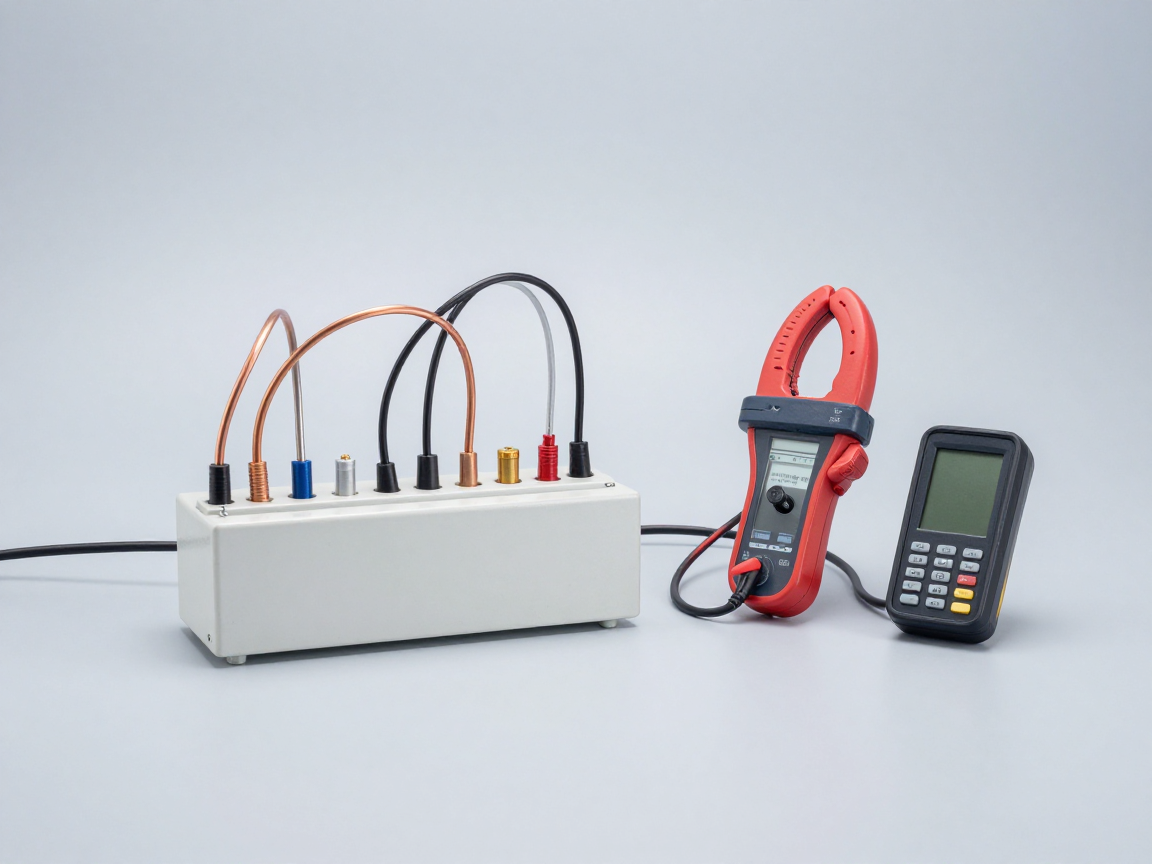
The test summary (clause 38.3.5) — the part most often missed
Required since 1 January 2020, this is where many shipments stumble: besides the full test report (usually an internal document dozens of pages long), the manufacturer must also prepare a compact test summary and make it available down the supply chain — to distributors, dealers and carriers on request.
A test summary under clause 38.3.5 must state:
- The name and contact details of the manufacturer of the cell/battery;
- A description of the cell/battery: mass, watt-hour (Wh) rating, physical description and the types of electrochemical cell;
- The test report number and its date;
- The testing laboratory’s name and address and the person responsible for the report;
- The list of tests performed (T1–T8) and their results;
- The edition of the Manual used (e.g. Rev.8/Amendment 1);
- If applicable, approval or competent-authority information.
The summary must be updated whenever the cell/battery design changes and must remain valid for as long as that battery is offered for transport. The duty usually sits with the manufacturer, but distributors/resellers may have to produce it instead — if it is not ready, the shipment is easily held at the border.
Who must do UN 38.3 — and at what level?
The UN 38.3 obligation follows the battery, not the brand. The responsible party may be the cell maker, the pack integrator, the shipper or the distributor, depending on their place in the chain.
A key cost saver: cell-level evidence can be reused at pack level if the cells are unchanged. In practice, if the cell supplier has solid UN 38.3 evidence, the pack-level programme narrows to what changed (circuitry, mechanical structure, BMS…). Conversely, assuming “the cell file covers the whole pack” is one of the most common mistakes — a pack that adds energy, circuitry and structure must be assessed in its own right.
The objects to be tested also differ:
- Cells (the electrochemical unit) — tested separately;
- Batteries/packs (multiple cells) — tested at pack level;
- Equipment containing batteries and batteries packed with equipment — scope adjusted to the packing configuration.
State of charge (SOC) at test — a change to note
One important change in recent amendments is the move to 100% SOC for most tests, instead of the 50% used before. This makes the tests more severe and closer to the real transport risk.
| Test | State of charge at test (new amendment) |
|---|---|
| T1 – Altitude | 100% SOC |
| T2 – Thermal | 100% SOC |
| T3 – Vibration | 100% SOC |
| T4 – Shock | 100% SOC |
| T5 – External short circuit | 100% SOC (at 55 °C) |
| T6 – Crush / impact | 100% SOC |
| T7 – Overcharge | Per the specified test conditions |
| T8 – Forced discharge | Per the specified test conditions |
Note: this point has been adjusted across amendments; when compiling a file, verify the exact clause 38.3 of the Manual edition applicable to each battery type.
UN 38.3 in Vietnam: which rules apply?
In Vietnam, lithium batteries are classified as dangerous goods, and transport is governed according to the mode:
- Road: the current framework is Decree 42/2020/ND-CP on the list of dangerous goods and their transport by motor vehicles. It replaces Decree 104/2009/ND-CP, which lapsed entirely on 1 June 2020. Classification, packaging and declaration follow the goods’ UN number.
- Air: the ICAO Technical Instructions / IATA DGR apply; lithium-ion batteries shipped as cargo must meet the energy limits and a state of charge ≤ 30% SOC.
- Sea: the IMDG Code (IMO) applies for classification, packaging and declaration.
The UN numbers must be distinguished (wrong numbering is a common cause of shipments being held at the border):
| UN number | Chemistry | State |
|---|---|---|
| UN3480 | Lithium-ion | Standalone, not in equipment |
| UN3481 | Lithium-ion | In equipment or packed with equipment |
| UN3090 | Lithium-metal | Standalone, not in equipment |
| UN3091 | Lithium-metal | In equipment or packed with equipment |
LiFePO4 batteries use lithium-ion chemistry, so they fall under UN3480/UN3481 (not lithium-metal — a frequent confusion because the names look similar).
Process, timeline and cost
A pack-level UN 38.3 programme, assuming cell-level evidence already exists, typically runs 6–10 weeks from kickoff to report: sample build and conditioning → environmental and mechanical sequence → electrical abuse tests → reporting.
Three factors drive cost:
- Sample count — the biggest cost driver, which is why reusing cell/module evidence pays off;
- Pack size — small packs fit standard chambers, but large packs (e.g. hundreds of kWh) need facilities able to vibrate, heat and short-circuit safely at that scale;
- Schedule risk — from re-making samples or design changes mid-programme.
For prototype / pre-production batteries (no complete UN 38.3 file yet), the dangerous-goods rules provide a special provision allowing transport under specific packaging and approval conditions — but it is paperwork with lead time, so plan ahead. (See also: cost and timeline of transport packaging testing.)
Common mistakes
- Assuming the cell file covers the pack — the pack must be assessed separately when energy, circuitry or structure is added.
- Testing the wrong design revision — the file describes revision B while revision C ships; the mismatch surfaces at the carrier’s desk.
- Ignoring state-of-charge rules — a pack charged for internal convenience may be an invalid shipment by air (30% SOC limit).
- Improvised packaging — dangerous-goods packaging must be certified, not just “sturdy”; a strong crate without the correct UN marking still fails inspection.
- Forgetting the people — staff preparing battery shipments need certified dangerous-goods training.
Conclusion
UN 38.3 is the mandatory gateway for lithium batteries to travel — by road, sea or air. Getting the eight tests T1–T8 right, mastering the test summary (38.3.5), distinguishing cell from pack and UN3480/3481/3090/3091, and updating the correct Manual edition (Rev.8/Amendment 1) all help keep a shipment from being stopped at the border. Doing it right from the start is always cheaper than fixing an incident mid-route.
References: UN Manual of Tests and Criteria (ST/SG/AC.10/11), Part III, clause 38.3 — 8th revised edition (Rev.8, 2023) + Amendment 1. Citing rulebooks: IATA DGR, IMDG Code (IMO), and Vietnam’s Decree 42/2020/ND-CP.
Related articles
- Cost and timeline of transport packaging testing
- What is ISTA 1B? Packaging test procedure for packages over 68 kg
Disclaimer
This article is our own explanatory content; it is not legal advice. Businesses should verify the original text of the relevant documents/standards before applying them to a specific product.
See also: Copyright Policy & Disclaimer of ticforall.com.