Summary — On 29 October 2026 the Federal Communications Commission (FCC) adopted the Third Report and Order in ET Docket No. 24-136, FCC 26-73. The order does more than restrict test lab recognition by location. It defines precisely which activities count by location — covered activity — and sets 30 November 2028 as the last day a test lab in a non-Reciprocal Economy remains eligible for recognition.
Key points
- Covered activity for a test lab covers four tasks: test setup and operation, the required measurements, technical analysis of results, and preparation or approval of the test report relied on for certification.
- Four exclusions: pre-compliance and R&D testing not used in a certification application; manufacture, maintenance or calibration of measurement equipment; administrative work such as sales, accounting, payroll, scheduling and IT support; and parts of a global organisation wholly segregated from its FCC function.
- Two effective dates: the rules take effect 60 days after publication in the Federal Register; the test lab provisions are deferred to 1 December 2028.
- No retroactivity: grants already issued and applications received before 1 December 2028 are unaffected. No retesting is required.
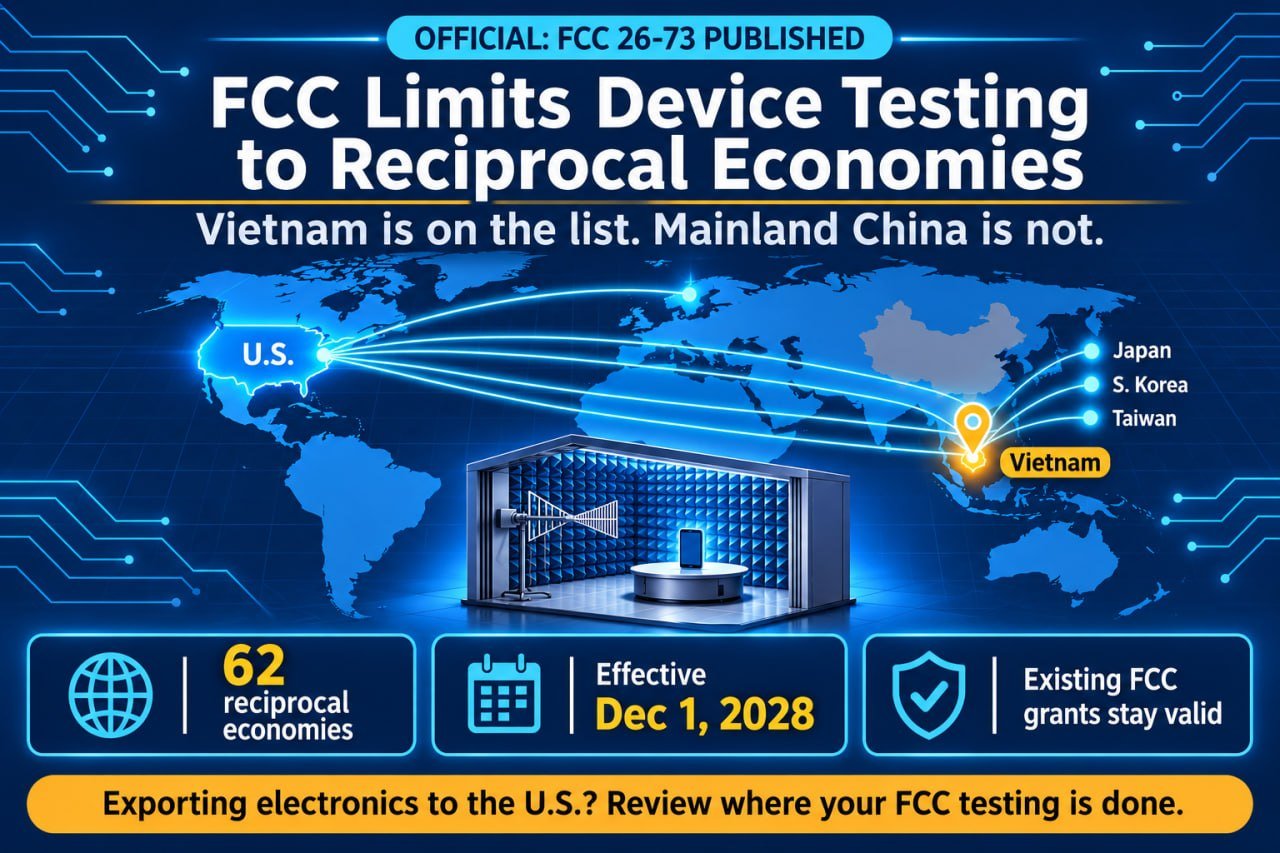
- Vietnam is listed among Reciprocal Economies in the order. What remains is that the lab must be FCC-recognised and must perform covered activity on Vietnamese territory.
What covered activity means
Section 2.902 of the FCC rules is amended to add a definition of covered activity, written separately for each type of body. The definition matters because the new rules do not rest on legal address alone. A body headquartered in the United States or a Reciprocal Economy that performs covered activity in a non-Reciprocal Economy is still excluded.
| Body | Covered activity |
|---|---|
| Test lab | Test setup and operation, required measurements, technical analysis of results, and preparation or approval of the test report relied on for certification |
| Telecommunications certification body (TCB) | Application evaluation, technical review, the certification decision, grant or dismissal, and FCC-required post-market surveillance |
| Laboratory accreditation body | Assessment, technical evaluation and the decision to accredit a laboratory for a scope used to obtain FCC recognition |
One detail deserves attention: approving the test report is itself covered activity. A lab located in a Reciprocal Economy that lets an affiliate elsewhere sign off the report does not meet the condition.
Four things not counted by location
The order excludes four categories. This is the part companies most often read too strictly.
- Pre-compliance and R&D testing — provided it is not represented as FCC-recognised testing and is not relied on in a certification application. In-house labs, R&D centres and engineering teams can sit anywhere.
- Manufacture, maintenance and calibration of measurement equipment — no location restriction.
- Administrative work — sales, accounting, payroll, scheduling, IT support and similar back-office functions.
- Facilities and personnel of a global organisation — where wholly segregated from the FCC function.
In short, the rule targets the test itself and the test report, not the whole operation of a company or a group.
Three situations companies ask about
A Chinese lab opens a Vietnamese entity
This does not qualify if the testing still runs in China. Covered activity takes place in a non-Reciprocal Economy, so the body is not eligible for recognition regardless of where the legal entity is registered.
A Vietnamese lab forwards samples to an affiliated lab abroad
This does not qualify. Measurement, analysis of results and preparation of the report are all covered activity. Moving the test elsewhere is precisely the arrangement the rule is designed to block.
A manufacturer runs pre-compliance testing in its own factory
This qualifies. Pre-compliance testing not used in a certification application is not restricted by location. The formal test still has to be performed at a recognised lab in the United States or a Reciprocal Economy.
Timeline
| Date | What happens |
|---|---|
| 29 October 2026 | FCC adopts FCC 26-73 (released 30 October 2026) |
| 30 days after Federal Register publication | Comment deadline for the Further Notice; replies within 60 days |
| 60 days after Federal Register publication | The rules take effect following OMB review. The TCB and accreditation body provisions apply from this date |
| 30 November 2028 | Last day a test lab in a non-Reciprocal Economy remains eligible for recognition (Section 2.950(f)) |
| 1 December 2028 | The FCC stops recognising test labs located in, or performing covered activity from, a non-Reciprocal Economy (Section 2.951) |
The rules apply to applications received on or after 1 December 2028. Grants issued before that date, including model certifications still in force, are not revoked and do not require retesting.
The data behind the decision
The FCC currently recognises 609 test labs. Mainland China accounts for 25.1%, Taiwan 18.4%, the United States 17.9%, Japan 9.4%, South Korea 6.6%, Germany 3.3%, Canada 2.8% and the United Kingdom 2.6%.
The distribution of labs does not match the distribution of work. In 2007, US labs handled about 31% of testing, Taiwan 20%, China 13% and South Korea 10%. By 2025, China held more than 82% of applications, the United States under 4%, Taiwan about 8% and South Korea about 2%. Annual applications rose from about 9,400 in 2007 to 46,900 in 2025.
About 27% of recognised labs sit in non-Reciprocal Economies, yet that group processes the bulk of applications. The FCC Chairman cites 82.3% of testing performed in China and 3.6% in the United States, after 32 labs controlled by foreign adversaries were removed from the system in the preceding phase.
The order also cites a specific case: a certification body sanctioned on 11 September 2026 for claiming a Minnesota facility while operating from a non-Reciprocal Economy. The FCC uses the case to argue that without government-to-government cooperation it cannot verify conduct or enforce its rules.
What the FCC did not do
- No prohibition based on ownership or control. A proposal to ban labs owned or controlled by entities in non-Reciprocal Economies was not adopted. The FCC keeps the record open in the Further Notice. Its stated reasons: existing rules already bar entities tied to foreign adversaries, and a broader ban would conflict with commitments under MRAs already in force.
- No revocation of existing grants and no retesting of already authorised equipment.
- No restriction on pre-compliance testing, R&D, calibration or administrative work.
- No application to equipment authorised under SDoC yet. Whether SDoC equipment should be tested in US or Reciprocal Economy labs is a question for comment, not a rule already adopted.
On cost: how far the FCC goes
Some associations and labs forecast testing costs rising two to three times with delays of 8 to 12 weeks. Others cite increases of 20% to 400% and delays from several weeks to several months. The FCC rejects those figures as a basis for an aggregate estimate, because they use different units, products and baselines, and most come without underlying data.
The Commission nonetheless acknowledges that the rule may impose material adjustment costs on some firms. Four reasons are given for treating the cost as acceptable: the rule covers only formal certification testing; testing can move to any Reciprocal Economy, not only to the United States; the rule is prospective; and the 24-month transition gives time to qualify alternatives. The FCC also says it will monitor test capacity throughout the transition.
Where Vietnam stands
Appendix D lists Vietnam as a Reciprocal Economy, on the basis of participation in the APEC Telecom MRA published at 64 Fed. Reg. 4984 on 2 February 1999. In principle, a lab in Vietnam remains eligible for FCC recognition after 1 December 2028. That is an advantage over labs in mainland China, which does not appear on the list.
Being on the list settles only the country condition. Three practical conditions remain:
- The lab must appear in the FCC’s recognition database, assessed by an accreditation body the FCC has designated.
- Covered activity must take place on Vietnamese territory, not merely a legal entity registered there.
- No facility performing covered activity may be maintained in a non-Reciprocal Economy under any affiliation.
For exporters of radio equipment to the United States, the practical consequence is that testing currently placed in China will have to move before the end of 2028. Vietnam is one valid destination alongside South Korea, Taiwan, Japan, Europe and the United States.
Five questions still open
The Further Notice seeks comment on: a Legal Entity Identifier under ISO 17442 for labs, certification bodies and accreditation bodies; extending the prohibition to ownership and control; improving post-market surveillance; whether SDoC equipment should also be tested in US or Reciprocal Economy labs; and protecting intellectual property during testing and certification. Anything adopted there would widen the scope to product groups not currently covered.
What companies should do now
- Build a lab register: lab name, FCC recognition number, where the testing actually takes place, and when the recognition expires.
- Review contracts: state which lab performs the test and where, with a clause covering the loss of that lab’s recognition.
- Map products that will need new or renewed certification after 1 December 2028, starting with short product cycles.
- Plan a second source: one lab in Vietnam, one in another Reciprocal Economy, to avoid single-point dependence.
- Track the Further Notice, especially the two items that could widen scope: the LEI requirement and applying the rules to SDoC equipment.
Frequently asked questions
What if testing finished before 1 December 2028 but the application is filed after?
The date test applies to when the FCC receives the application. Applications filed on or after 1 December 2028 must rest on testing at a lab that meets the location condition. Check both the test date and the filing date.
Must testing move to the United States?
No. Testing may be performed in any Reciprocal Economy. The order states the expectation that manufacturers will spread testing across the United States and Reciprocal Economies based on cost, proximity to operations and other business factors.
What should a lab in Vietnam prepare?
Maintain FCC recognition through the reassessment cycle, keep all covered activity inside Vietnamese territory, and do not accept work subcontracted to affiliates in non-Reciprocal Economies. Capacity and reassessment timing are the two points the FCC says it will monitor during the transition.
Sources
- FCC, Third Report and Order and Third Further Notice of Proposed Rulemaking, ET Docket No. 24-136, FCC 26-73, adopted 29 October 2026. PDF.
- FCC, news release “FCC Proceeds on Device Test Lab Onshoring, Reciprocity Rules”, 29 October 2026. PDF.
- 47 CFR § 2.902, § 2.949, § 2.950, § 2.951, § 2.960 (amended rules, Appendix A of FCC 26-73).
- APEC Telecom MRA, published at 64 Fed. Reg. 4984, 2 February 1999.
Related reading
- FCC limits test labs to the US or reciprocal economies
- Bản tiếng Việt: FCC 26-73: covered activity là gì và mốc 30/11/2028
- What is CISPR 32? Emission for multimedia devices
- IEC/IEEE 62209-1528:2020: SAR testing of handheld devices
Talk to us
If you need to review the labs behind your FCC filings or plan a move before 1 December 2028, leave your details and we will follow up.
Disclaimer
This article is our own interpretation of the official FCC text; it is not legal advice. Verify against the original document and FCC guidance before applying it to a specific product.
See also: Copyright & Disclaimer of ticforall.com.