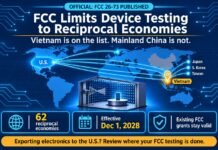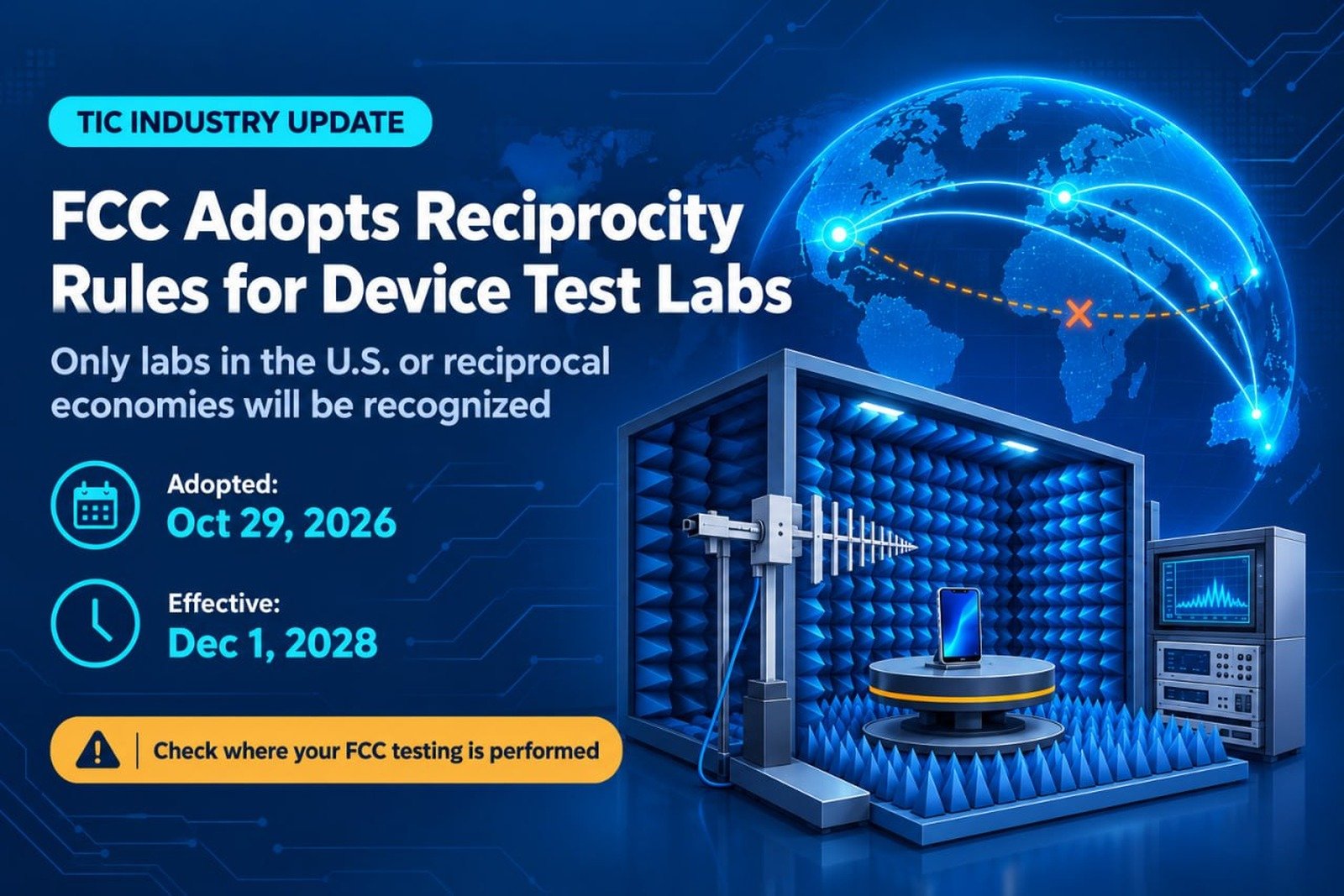
What happened — On 29 October 2026 the US Federal Communications Commission (FCC) adopted final rules that restrict which test laboratories it will recognize for radiofrequency equipment. From 1 December 2028, the FCC will only recognize test labs, telecommunications certification bodies and laboratory accreditation bodies located in the United States or in a reciprocal economy.
Key points
- Scope: every radiofrequency device that needs FCC certification before it can be used or sold in the United States.
- Core change: the FCC will recognize only test laboratories located in the United States or in a Reciprocal Economy.
- Effective date: 1 December 2028. Recognition granted during the transition also ends on that date.
- Vietnam: listed among reciprocal economies in the document, as a participant in the APEC Telecom MRA since 1999.
- Watch out: testing must physically take place on US or reciprocal-economy territory, not merely under a legal entity registered there.
What changes from 1 December 2028
The FCC limits recognition by geography. It will grant and maintain recognition only for test laboratories, certification bodies (TCBs) and lab accreditation bodies located in the United States or in a reciprocal economy.
The rule goes beyond the registered address. The prohibition also covers an entity based in the US or a reciprocal economy that carries out testing, certification or accreditation activity in a non-reciprocal economy. That closes the route of registering in a favourable jurisdiction while renting bench space elsewhere.
The transition period runs until 1 December 2028. Labs in non-reciprocal economies keep their recognition during that window, and the Office of Engineering and Technology continues to grant new recognition. All such recognition terminates automatically on 1 December 2028, regardless of the grant date.
Why the FCC acted
The FCC gives three reasons. First, the agency lacks confidence in testing integrity in non-reciprocal economies, where it has documented repeated serious violations. Second, dropping reciprocity concentrates test capacity in a few locations and creates systemic risk for the entire equipment authorization programme.
Third, reciprocity is a basic principle of international trade. The FCC argues it should apply to the testing market so that US firms compete on equal terms.
Figures from the press release: fewer than 4% of electronic devices are tested at laboratories on US soil. The new rules follow last year’s “Bad Labs” package. According to the FCC, 29 test labs lost recognition over national security concerns. The agency also revoked recognition for two labs in non-reciprocal economies and opened proceedings against two others for copying test results.
What a reciprocal economy is, and which ones qualify
A reciprocal economy has signed a mutual recognition agreement (MRA) or an equivalent reciprocity arrangement with the United States. The annex to the document lists three groups.
The first group covers participants in the APEC Telecom MRA under 64 Fed. Reg. 4984 of 2 February 1999: Australia, Canada, Chinese Taipei, Hong Kong China, Malaysia, New Zealand, Korea, Singapore, Vietnam, Iceland, Liechtenstein, Norway, Austria, Belgium, Finland, France, Germany, Ireland, Italy, the Netherlands, Slovenia, Spain, Sweden, Israel, Japan, Mexico and the United Kingdom.
The second group covers countries with a free trade agreement with the United States. The third covers countries with a separate reciprocity arrangement, including Argentina, Bangladesh, Cambodia, Indonesia, Jordan and Ecuador.
Mainland China appears in none of the three groups. It is the main target of the rule, given that a large share of labs serving the US market are located there.
Where Vietnam stands
Vietnam belongs to the APEC Telecom MRA group, so in principle it remains eligible for FCC recognition after 1 December 2028. Vietnamese exporters of radio equipment are not pushed out of the system.
The attached condition matters more. The laboratory must hold FCC recognition, and testing must actually happen on Vietnamese territory. A lab based in Vietnam that ships samples to a facility in a non-reciprocal economy will not satisfy the new rule.
Two consequences follow. Companies currently using labs in China because of lower cost must move testing to Vietnam, Korea, Taiwan, Japan, Europe or the United States before the end of 2028. Accredited domestic labs gain a three-year window to build capacity.
Who is directly affected
| Party | Impact | Deadline |
|---|---|---|
| Manufacturers of RF devices exporting to the US | Testing must be performed at a recognized lab located in the US or a reciprocal economy | Before 1 December 2028 |
| Companies using labs in China | Lose the recognition of that lab; retest or relocate | Before 1 December 2028 |
| Test laboratories in Vietnam | Keep their position if already FCC-recognized and testing locally | Opportunity window to 2028 |
| TCBs and lab accreditation bodies | Same geographic conditions as test labs | Before 1 December 2028 |
| Non-radio devices, SDoC equipment | Not covered by this order; raised in the FNPRM | Monitor the next stage |
Timeline to track
The order was adopted on 29 October 2026 as the Third Report and Order and Third Further Notice of Proposed Rulemaking, FCC 26-73, in ET Docket 24-136. Once published in the Federal Register, the comment period runs 30 days and reply comments 60 days.
The Further Notice seeks comment on incentives to expand testing capacity in the US and reciprocal economies, Legal Entity Identifiers for labs and TCBs, stronger post-market surveillance, a requirement that SDoC testing be performed at recognized labs, and modernization of the FCC database.
What exporters should do now
- Check whether your lab appears in the FCC recognition list. Record the recognition code and expiry date.
- Confirm where the testing physically takes place. The contract should name the lab that runs the tests and state its location.
- Review every certification that stays valid beyond 1 December 2028. Existing grants do not expire automatically, but new testing must follow the new rule.
- Build a fallback plan per product line. Include cost and lead time for moving tests to a lab in Vietnam or a reciprocal economy.
- Follow the Further Notice. Legal Entity Identifier and SDoC requirements may extend the rule to product groups not covered today.
Frequently asked questions
Does the rule cover every electronic device?
No. It covers radiofrequency devices subject to FCC licensing, together with the testing, certification and accreditation work behind that licence. Equipment handled only under SDoC is not covered yet, but the FNPRM asks whether to extend the rule.
Are Vietnamese laboratories excluded from the FCC system?
No. Vietnam is on the reciprocal economy list in the document. The conditions are FCC recognition and testing performed on Vietnamese territory.
Do certificates granted before 1 December 2028 have to be redone?
Existing grants do not lapse because of that date. New testing or renewal after it must come from a lab that meets the geographic conditions.
What should a company using Chinese labs do?
Move testing to a lab in Vietnam or another reciprocal economy. Roughly two years remain from publication in the Federal Register.
Are Taiwan and Hong Kong on the list?
Yes. The document uses “Chinese Taipei” for Taiwan, following APEC Telecom MRA practice, and lists Hong Kong China in the same group.
Why restrict geography instead of tightening technical standards?
The FCC frames the problem as oversight and enforcement capacity, not standard content. Geographic limits tie recognition to jurisdictions with government-level cooperation, where the agency can inspect and act on violations.
References
- FCC press release, “FCC Proceeds on Device Test Lab Onshoring, Reciprocity Rules”, 29 October 2026. PDF.
- FCC, Third Report and Order and Third Further Notice of Proposed Rulemaking, ET Docket No. 24-136, FCC 26-73. PDF.
- APEC Telecom MRA, published at 64 Fed. Reg. 4984, 2 February 1999.
Related articles
- QCVN 18:2022/BTTTT: general EMC for radio equipment
- QCVN 117:2023/BTTTT: RF standard for mobile terminals
- What is CISPR 32? Emission for multimedia devices
- QCVN 55:2023/BTTTT: short range devices 9 kHz to 30 MHz
- Which EMC standards apply to your product?
Talk to us
If your team needs to review FCC certification files or plan a move of testing before the 2028 deadline, leave your details and we will follow up.
Disclaimer
This article is our own interpretation of official FCC documents; it is not legal advice. Companies should check the original text and FCC guidance before applying it to a specific product.
See also: Copyright & Disclaimer policy of ticforall.com.