QCVN 134:2024/BTTTT is the Vietnamese national technical regulation on the specific absorption rate (SAR) of hand-held and body-worn wireless devices, issued with Circular No. 19/2024/TT-BTTTT dated 31 December 2024 of the Ministry of Information and Communications, and in force since 15 February 2025. It closes a legal gap that had existed for years: wireless devices used close to the body now have to show that the electromagnetic energy absorbed by the user stays within the permitted limits, instead of being tested only for their radio frequency behaviour. This article sets out the scope of application, the SAR limits, the measurement method by reference to IEC/IEEE 62209-1528:2020, the HS codes, the conformity route and the transition dates. The conformity and transition sections are updated to Circular No. 36/2026/TT-BKHCN and Circular No. 14/2026/TT-BKHCN.
1. What the specific absorption rate is
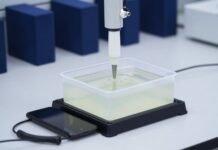
SAR is the electromagnetic energy absorbed by the human body per kilogram of tissue, expressed in watts per kilogram. Because SAR is not distributed uniformly, the quantity compared with the limit is the peak spatial-average SAR, written psSAR: the highest SAR value after averaging over a defined mass of tissue, usually 1 g or 10 g shaped as a cube. In a tissue-equivalent medium, SAR is derived either from the electric field strength or from the initial rate of temperature rise. In EMC documents the same three letters also stand for semi-anechoic room, an unrelated meaning.
Two definitions in the regulation are easy to confuse. Time-averaged SAR is the value measured over an integration time long enough for the result to be stable against the modulation of the signal. Time-period averaged SAR, abbreviated TPAS, is the value averaged over a defined time period when the device applies a power control algorithm. The second appears only on devices whose output power varies with time.
2. Scope and addressees
The regulation applies to radio equipment with an equivalent isotropically radiated power above 20 mW that the manufacturer designs to be used at a distance of less than 200 mm from the human body. Implantable medical devices are excluded. The HS codes of the products in scope are listed in Annex E.
It binds Vietnamese and foreign organisations and individuals that manufacture, import, trade in or operate these devices on Vietnamese territory. In other words the obligation falls not only on the manufacturer but also on the importer and on whoever places the product on the market.
3. SAR limits
The regulation sets SAR limits for the frequency range from 30 MHz to 6 GHz and distinguishes two positions of use: head and torso on one side, limbs on the other. The values follow the 2020 ICNIRP guidelines for limiting exposure to time-varying electric, magnetic and electromagnetic fields up to 300 GHz, one of the two normative references of the regulation.
| Frequency range | Head and torso SAR limit | Limb SAR limit |
|---|---|---|
| 30 MHz to 6 GHz | 2 W/kg averaged over 10 g of tissue | 4 W/kg averaged over 10 g of tissue |
Two points matter when reading this table. First, the limit is averaged over 10 g of tissue and not over 1 g as in certain other markets, so the figure of 2 W/kg cannot be compared directly with a result reported for a 1 g averaging mass. Second, the limit for limbs is twice as high as for head and torso, reflecting the lower sensitivity of limb tissue.
4. Products in scope and HS codes
Annex E is a normative annex listing four product groups with their HS codes and a technical description. Finding the right HS code is the first step in deciding whether a product must be declared compliant, and it is also mandatory data in the declaration file.
| Product group | Identifying features | HS code |
|---|---|---|
| Terrestrial mobile telephone | E-UTRA (4G) device, optionally with W-CDMA FDD, 5G, 2,4 GHz wideband data, 5 GHz radio access or short range radio above 20 mW EIRP | 8517.13.00 8517.14.00 |
| Terrestrial mobile telephone | 5G device, with or without the features listed above | 8517.13.00 8517.14.00 |
| DECT cordless telephone | Base station with one or more handsets; applies to the handset only | 8517.11.00 |
| Laptop computer | Integrating one or more of: terrestrial mobile, 5G, 2,4 GHz wideband data, 5 GHz access, short range radio above 20 mW | 8471.30.20 |
| Tablet computer | With processor, keyboard and display, excluding laptops, notebooks and subnotebooks | 8471.30.90 |
The list does not cover every wireless device used near the body. Products that do not appear in Annex E still have to be checked against the power threshold and the intended use distance, and may fall under another regulation in the same family of radio equipment rules.
5. Measurement method: IEC/IEEE 62209-1528:2020
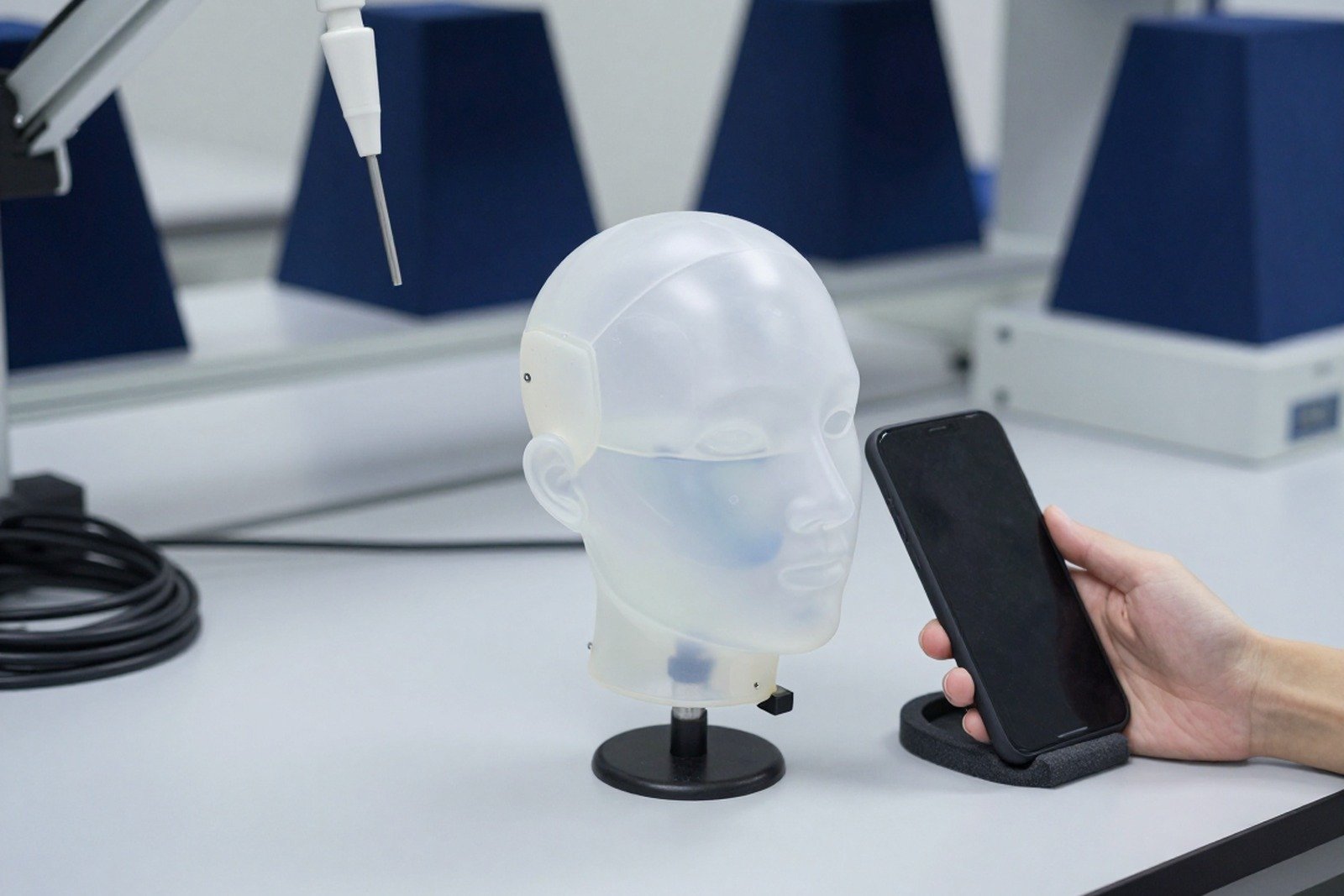
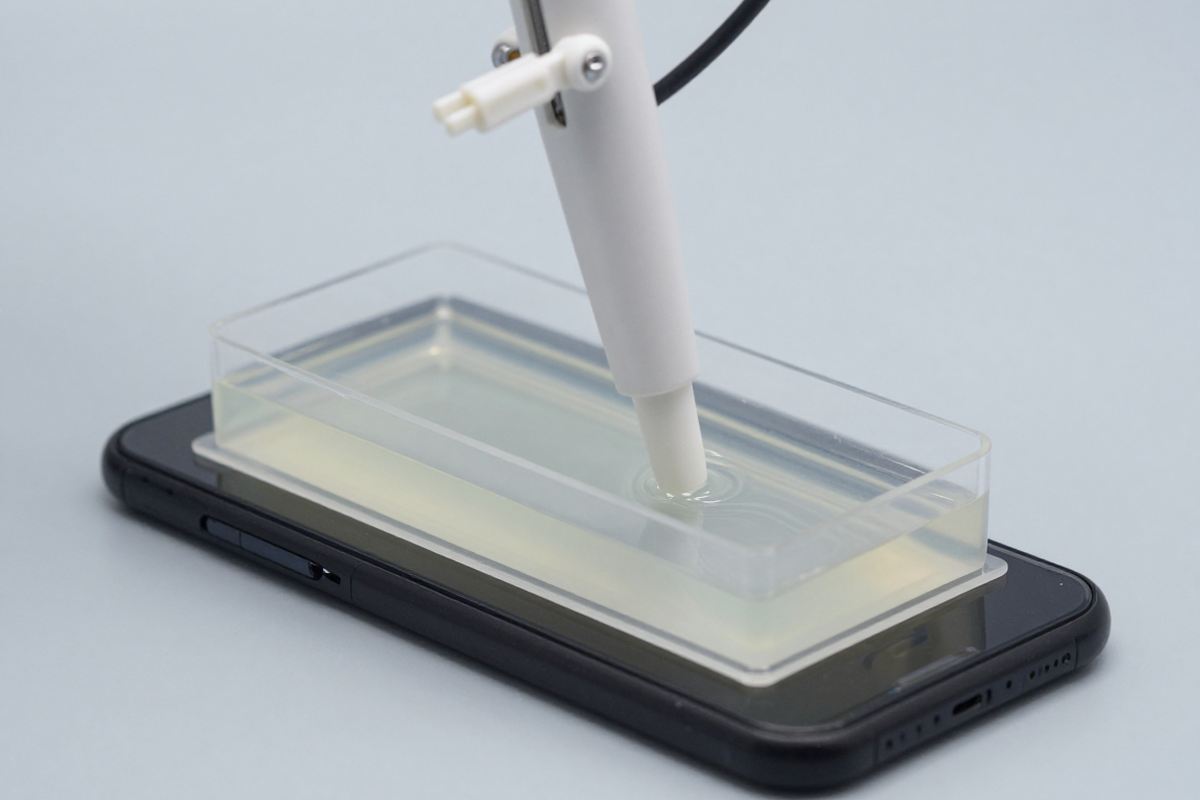
The regulation does not create its own measurement method; it refers the whole procedure to the international standard IEC/IEEE 62209-1528:2020. Clauses 3.1 to 3.9 require compliance with clauses 7.1 to 7.9 of that standard respectively: test preparation, tests to be carried out, the SAR test procedure, data processing, time-period averaged SAR, testing with sensors, SAR correction and the methods that shorten test time.
IEC/IEEE 62209-1528:2020 covers the range from 4 MHz to 10 GHz and consolidated the earlier parts of the 62209 series together with IEEE Std 1528. For the structure of the standard, the measurement system requirements, device positioning and uncertainty, see the article IEC/IEEE 62209-1528:2020: SAR testing of handheld devices.
The most consequential point is a normative deviation from the international standard. The regulation replaces clause 7.2.4.1.2 with its own rule: the gap between the device under test and the flat phantom is less than 5 mm when body SAR is assessed, and 0 mm when limb SAR is assessed. That makes measurements in Vietnam stricter than positioning the device at the separation distance declared by the manufacturer, and it is the reason why many SAR reports produced for other markets cannot be reused directly.
The remaining requirements of the standard are referred to unchanged: tissue-equivalent medium and measurement system (7.2.1), wireless connections to the device (7.2.2), operating modes (7.2.3), device positions (7.2.4), antenna configurations (7.2.5), options and accessories (7.2.6), test samples and their coefficients (7.2.7), and operating frequencies (7.2.8).
6. Test procedure and data processing
On procedure, clauses 3.3 and 3.4 require compliance with clauses 7.3 and 7.4 of the standard, covering the basic tests, the full SAR test procedure, area scans and testing of devices with multiple antennas or transmitters. On data processing, clause 3.5 requires compliance with clause 7.5 in four steps: interpolation, extrapolation, determination of the averaging mass and determination of the maximum value.
These four steps decide the final number in the report. Interpolation fills the gaps between measurement points, extrapolation brings the result from the outermost measured point to the phantom surface, the averaging mass defines the volume over which the values are averaged, and the maximum search locates the local peak inside the scanned area. Two laboratories testing the same sample with different software versions can therefore differ by a few percent.
7. Time-period averaged SAR and testing with sensors
Clause 3.6 deals with time-period averaged SAR: conducted power, test configurations, absorption conditions and test positions, simultaneous transmission, transmit factor assessment, the SAR test itself and the associated uncertainty, all by reference to the 7.6.x requirements of the standard. This group applies to devices that control their output power over time, where an assessment based on peak power would lead to the wrong conclusion.
Clause 3.7 covers testing with proximity sensors by reference to the 7.7.x requirements: determining the sensor triggering distance, determining the sensor coverage area and the SAR test with the sensor active. For phones and tablets that reduce power when held against the body, this part decides whether the file is valid: both the full power state with the sensor inactive and the reduced power state with the sensor triggered have to be demonstrated.
8. SAR correction and shortened test methods
Clause 3.8 requires compliance with clause 7.8 of the standard on SAR correction, including the correction formula and the uncertainty of that formula. The formula corrects results when the measured permittivity of the tissue-equivalent liquid deviates from the target value, a situation common at higher frequencies.
Clause 3.9 allows one of two methods to shorten test time: fast SAR testing under clause 7.9.2 and reduced SAR testing under clause 7.9.3. Fast SAR testing uses hardware that meets the requirements but applies faster checking methods, and is split into two types: type 1 uses equipment fully compliant with the standard while applying faster test methods, type 2 uses equipment and procedures that do not fully meet the requirements for full SAR testing. When reading a report, check which type was used and whether the matching uncertainty was added.
9. Test equipment, reporting and uncertainty
Annex A is normative and refers to clauses 6.1 to 6.6 of the standard: general requirements, phantom specifications, hand effects on head SAR, scanning system requirements, holder specifications and readout equipment parameters. It is the basis for judging a laboratory, not merely an equipment list.
Annexes B and C are informative. They set out the content of the test report under clauses 9.1 and 9.2, and the uncertainty requirements under clauses 8.1 to 8.4. Annex D is the evaluation and test flowchart, referring to clause 5 of the standard to establish the sequence from device classification to conclusion.
Although informative, the annexes on reporting and uncertainty have practical weight: a report that omits content required by Annex B or does not state the expanded uncertainty is difficult to defend in an inspection, even when the measured values are within the limits.
10. Certification and declaration of conformity
The regulation creates two different obligations. For terrestrial mobile telephones, the organisation or individual must declare conformity based on certification by a designated certification body, which means third-party involvement. For DECT cordless telephones, laptops and tablets, the regulation allows a declaration based on the enterprise’s own assessment supported by test results (clauses 4.4 to 4.6).
Update under the new legal framework. From 1 July 2026 the conformity route for these products is governed by Circular No. 36/2026/TT-BKHCN dated 30 June 2026, in force from 1 July 2026. That Circular replaces Circular No. 29/2025/TT-BKHCN as well as Circulars No. 30/2011/TT-BTTTT, No. 15/2018/TT-BTTTT and No. 10/2020/TT-BTTTT; it sorts products into medium-risk and high-risk lists, and the conformity assessment methods move to Circular No. 14/2026/TT-BKHCN dated 9 April 2026. Clause 3 of Article 5 of Circular 36/2026 provides that where a national technical regulation issued earlier sets different quality-management requirements, the Circular prevails, so the dates and routes below are the ones to follow.
| Product group (HS code) | Risk level | QCVN 134 applies | Conformity route under Circular 36/2026/TT-BKHCN |
|---|---|---|---|
| Terrestrial mobile telephones, including 5G handsets (8517.13.00, 8517.14.00) | Medium (Annex II) | From 01/01/2027 | Based on certification results from a certification body that is recognised or designated by the Ministry of Science and Technology |
| DECT cordless telephones (8517.11.00) | High (Annex I) | From 01/07/2027 | Based on certification results from a designated certification body |
| Laptops with radio functions (8471.30.20); tablets with radio functions (8471.30.90) | Medium (Annex II) | From 01/07/2027 | Based on certification results from a recognised or designated certification body, or on the self-assessment results of the organisation or individual |
Three technical points matter when the file is assembled. First, the assessment methods for all three groups are method 3 and method 7 under Circular No. 14/2026/TT-BKHCN, replacing the earlier set of methods 1, 5 and 7. Second, test results used as the basis for certification (high-risk group) or for self-assessment and certification (medium-risk group) must come from a testing organisation that is recognised, designated by the Ministry of Science and Technology or otherwise accepted, with a testing scope that covers the regulation. Third, a note to the lists exempts certification bodies from assessing the production process under method 3 where the product is made on a production line already certified to a valid quality management system standard with a suitable scope.

11. Transition dates
The regulation entered into force on 15 February 2025 and applies to testing, certification and declaration of conformity from that date. The later dates govern the obligation to comply before placing products on the market:
- From 1 July 2026: terrestrial mobile telephones must comply with QCVN 134:2024/BTTTT before being placed on the market, under Article 3 of the regulation.
- From 1 July 2027: all products and goods within the scope of the regulation must comply before being placed on the market, including laptops, tablets and DECT telephones.
The list annexed to Circular No. 36/2026/TT-BKHCN gives 1 January 2027 as the date from which QCVN 134:2024/BTTTT applies to terrestrial mobile telephones, later than the 1 July 2026 date set by Article 3 of the regulation, while the 1 July 2027 date for DECT telephones, laptops and tablets is the same in both documents. Because Circular 36/2026 was issued later and its Article 5(3) makes the Circular prevail where an earlier regulation sets different quality-management requirements, companies should follow the official guidance of the competent authority and, to avoid being caught out, complete the SAR file for mobile telephones before the earlier date of 1 July 2026.
12. What companies should prepare
Four checks are worth running before the compliance dates. First, establish whether the device has an EIRP above 20 mW and is designed for use at less than 200 mm from the body; if so, identify the HS code under Annex E. Second, verify that the intended laboratory has a SAR measurement system according to IEC/IEEE 62209-1528:2020 inside its scope of accreditation, and confirm that it applies the regulation’s own rule on the distance between device and flat phantom.
Third, decide the conformity route under Circular No. 36/2026/TT-BKHCN: terrestrial mobile telephones and DECT telephones are declared on the basis of certification by a designated certification body, while laptops and tablets may be declared on the basis of certification results or self-assessment, using method 3 and method 7 under Circular No. 14/2026/TT-BKHCN. Fourth, prepare the file, including test results, a report covering the content of Annex B with the expanded uncertainty, and the manufacturer’s technical documentation. Devices that already hold a SAR report prepared for a foreign market with a 1 g averaging mass will need retesting at 10 g using the positioning rule of this regulation.
13. Related articles
- Circular 36/2026/TT-BKHCN: lists of medium-risk and high-risk goods
- IEC/IEEE 62209-1528:2020: SAR testing of handheld devices
- QCVN 117:2023/BTTTT: RF standard for mobile terminals
- QCVN 86:2025/BKHCN: EMC for mobile terminals
- QCVN 127:2021/BTTTT: standalone 5G UE requirements
- QCVN 129:2021/BTTTT: non-standalone 5G UE
- QCVN 132:2022/BTTTT: electrical safety for telecom terminals
- Circular 08/2021: radio frequency licence exemptions
14. References
- QCVN 134:2024/BTTTT, National technical regulation on specific absorption rates for hand-held and body-worn wireless communication devices, issued with Circular No. 19/2024/TT-BTTTT dated 31 December 2024 of the Minister of Information and Communications, in force since 15 February 2025.
- IEC/IEEE 62209-1528:2020, Measurement procedure for the assessment of specific absorption rate of human exposure to radio frequency fields from hand-held and body-worn wireless communication devices, frequency range 4 MHz to 10 GHz, referred to in full for the measurement procedure.
- ICNIRP Guidelines for limiting exposure to time-varying electric, magnetic and electromagnetic fields (up to 300 GHz), 2020.
- Circular No. 36/2026/TT-BKHCN dated 30 June 2026 of the Minister of Science and Technology issuing the lists of medium-risk and high-risk products and goods under the responsibility of the Ministry of Science and Technology, in force from 1 July 2026.
- Circular No. 14/2026/TT-BKHCN dated 9 April 2026 on declaration of conformity with standards, declaration of conformity with technical regulations and conformity assessment methods.
- Decree No. 37/2026/ND-CP dated 23 January 2026 detailing the Law on Product and Goods Quality.
- Circular No. 28/2012/TT-BKHCN on conformity assessment methods and its amendments and replacements (the framework of methods 1, 5 and 7 previously referred to by the regulation).
- The legal texts and international standards above are summarised for reference purposes; always check the original published version before applying them.
15. Contact
If you need to determine whether a device falls within the scope of QCVN 134:2024/BTTTT, advice on choosing the right conformity assessment method, or support in preparing a declaration of conformity for hand-held and body-worn wireless devices, please send the details using the form below.
Note: This article is published for general information and reference and does not replace the legal text or constitute advice on a specific case. Before applying it, check the full text of QCVN 134:2024/BTTTT, Circular 19/2024/TT-BTTTT and any amendments or replacements in force.