QCVN 132:2022/BTTTT is the Vietnamese national technical regulation on electrical safety for telecommunication and information technology terminal equipment, issued together with Circular No. 24/2022/TT-BTTTT dated 30 November 2022 by the Ministry of Information and Communications. It takes effect on 1 January 2024 and is built on IEC 62368-1:2018, the safety standard for audio/video, information and communication technology equipment.
Two points are worth remembering up front. First, QCVN 132 does not replace all of QCVN 22:2010/BTTTT — it replaces only the technical requirements in clause 2.4 of the old regulation. Second, Circular 24/2022/TT-BTTTT repeals clause 21, Article 1 of Circular No. 18/2010/TT-BTTTT dated 30 July 2010, which had issued QCVN 22:2010/BTTTT.
QCVN 132 covers electrical safety, which is different from electromagnetic compatibility (EMC). Its content deals with protection against electric shock, protection against electrically-caused fire, thermal and mechanical safety, and component requirements. The approach follows hazard-based safety engineering: classify the energy source first, then require the corresponding safeguard.
This article analyses: the scope and subjects of application, the list of 09 product groups with HS codes, the structure of the technical requirements, and above all how the regulation is managed under Circular 36/2026/TT-BKHCN — which goods must be tested to QCVN 132, at what risk level and with what management measures.
A note on scope: the analysis below is how we read and organise the document; it is not a legal instrument. For official citation or application to a specific file, readers should check the version published in the Official Gazette or the National Legal Database.
Quick summary
- Document: Circular 24/2022/TT-BTTTT dated 30/11/2022, issuing QCVN 132:2022/BTTTT on electrical safety for telecommunication and IT terminal equipment.
- Effective date: 1 January 2024.
- Replaces: the technical requirements in clause 2.4 of QCVN 22:2010/BTTTT; repeals clause 21, Article 1 of Circular 18/2010/TT-BTTTT.
- Technical basis: IEC 62368-1:2018; drafted by the Authority of Telecommunications (Cục Tần số Vô tuyến điện).
- Scope: electrical safety of the equipment itself; it does not cover the electrical safety of network-connection interfaces.
- Product list: 09 product groups with HS codes in Annex T.
- Management: from 1 July 2026, goods within the scope of QCVN 132 are managed under Circular 36/2026/TT-BKHCN — high risk (Annex I) or medium risk (Annex II) — using Method 3 and Method 7.
1. What is QCVN 132:2022/BTTTT?
QCVN 132:2022/BTTTT is the national technical regulation that sets electrical safety requirements for telecommunication and information technology terminal equipment, issued with Circular 24/2022/TT-BTTTT and effective from 1 January 2024.
The regulation was drafted by the Authority of Telecommunications, reviewed by the Department of Science and Technology, appraised by the Ministry of Science and Technology, and issued by the Minister of Information and Communications. In substance, it localises the safety requirements of IEC 62368-1:2018 for telecommunication and IT terminal equipment placed on the Vietnamese market.
The document runs to about 224 pages, comprising general provisions, technical requirements, management provisions and annexes A to T covering test methods (normal/abnormal operation checks, test generators, measurement of air clearances and creepage distances, mechanical strength testing, HS codes, and more).
2. Scope and subjects of application
The regulation applies to the terminal equipment itself, and does not set electrical safety requirements for the interfaces designed and intended to connect to telecommunication and IT networks.
Subjects of application: Vietnamese and foreign organisations and individuals that manufacture or trade equipment within the regulation’s scope of regulation on Vietnamese territory.
The important boundary: a network interface (for example, a port connecting to a telecommunication network) is outside the electrical-safety scope of QCVN 132. The regulation focuses on the equipment as a product or installed device.
3. List of 09 product groups and HS codes
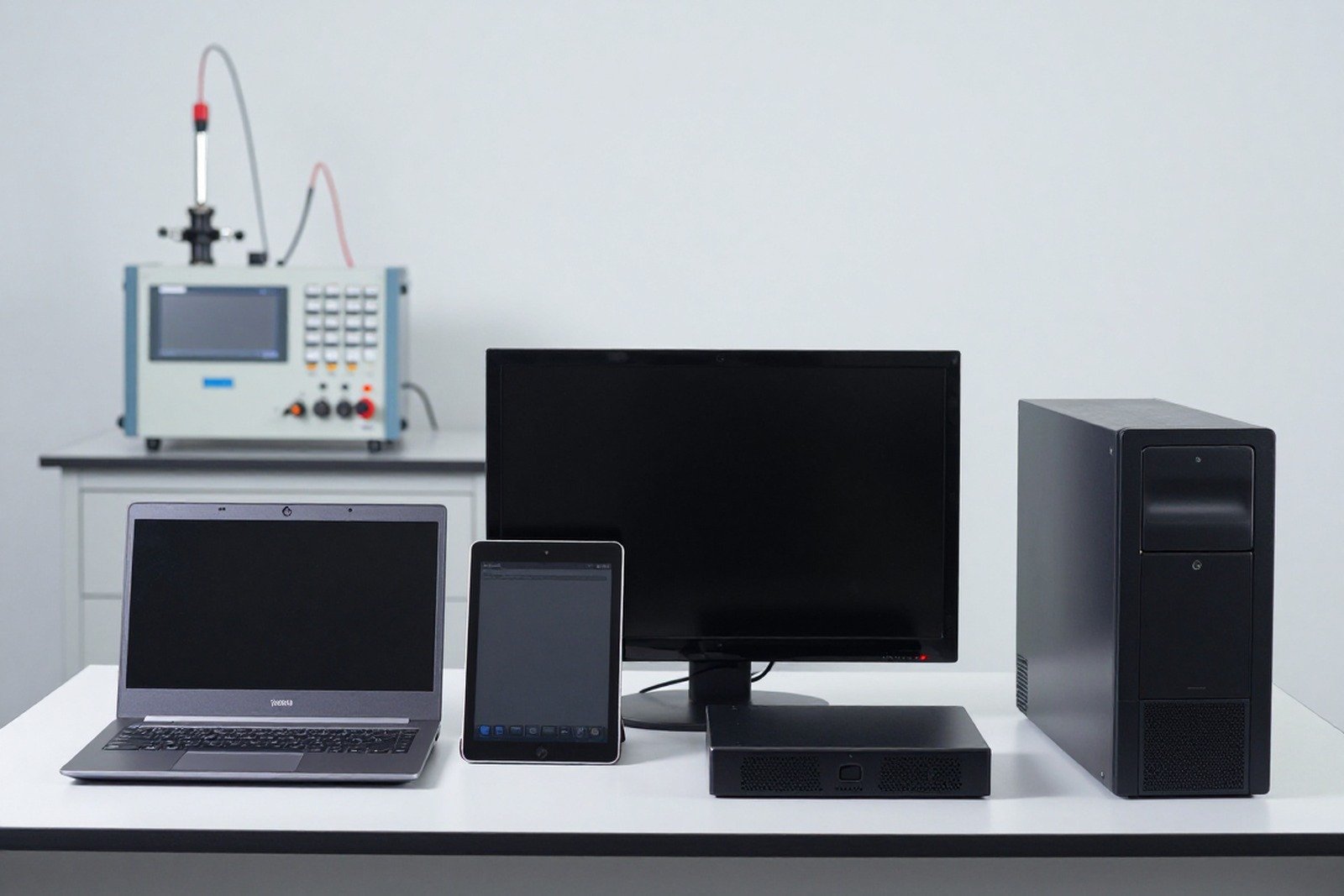
Annex T (normative) lists the HS codes of the equipment within the scope of QCVN 132. This is a closed list of 09 product groups:
| No. | Product | HS code |
|---|---|---|
| 1 | Cordless telephone equipment extending a radio subscriber line (DECT) | 8517.11.00 |
| 2 | Desktop computer | 8471.41.10 |
| 3 | Set-top box for digital cable television networks | 8528.71.11; 8528.71.19; 8528.71.91; 8528.71.99 |
| 4 | Set-top box for IPTV networks | 8528.71.11; 8528.71.19; 8528.71.91; 8528.71.99 |
| 5 | Television receiver with integrated DVB-T2 digital terrestrial reception (iDTV) | 8528.72.92; 8528.72.99 |
| 6 | Amplifier in cable television distribution systems | 8517.62.49 |
| 7 | Cordless telephone (subscriber-line extension type, excluding DECT) | 8517.11.00 |
| 8 | Laptop (notebook) computer | 8471.30.20 |
| 9 | Tablet computer | 8471.30.90 |
Most of these devices integrate radio functions (2.4 GHz and 5 GHz Wi-Fi; W-CDMA FDD; E-UTRA FDD; 5G; short-range radio transmit/receive). If your product is not in the Annex T list, it is not within the electrical-safety scope of QCVN 132.
4. Structure of the technical requirements
The technical section of QCVN 132 has three pillars: general requirements, protection against electrical energy reaching people, and protection against electrically-caused fire — each tied to three operating states (normal, abnormal and single-fault conditions).
- General requirements (2.1): classification of energy sources; protection against energy sources; safeguards; explosion; securing conductive parts; equipment intended to be plugged directly into a mains socket; risk of fire or electric shock from contact of conductive parts; component requirements.
- Protection against electrical energy reaching people (2.2): classification and limits of electrical energy sources; protection from energy sources; insulating materials and their requirements; components as safeguards; current in protective conductors; touch current, contact current and current in protective conductors.
- Protection against electrically-caused fire (2.3): classification of power sources (PS) and potential ignition sources (PIS); safeguards in normal and abnormal conditions; safeguards in single-fault conditions; internal and external wiring systems; safeguards for additional equipment.
A few core concepts appear throughout the regulation:
| Concept | Meaning |
|---|---|
| ES1 / ES2 / ES3 | Electrical energy source classes 1 / 2 / 3 — increasing hazard to people. |
| PS1 / PS2 / PS3 | Power source classes 1 / 2 / 3 — increasing fire and thermal hazard (the mains supply is PS3). |
| PIS | Potential ignition source — a location where electrical energy may cause ignition. |
| LPS | Limited power source. |
| Normal / abnormal / single-fault condition | The three states in which the equipment must be assessed for safety. |
The most practical takeaway lies in how the regulation anchors to an international standard: if you already hold test results to IEC 62368-1:2018, you have already covered most of the distance to QCVN 132.
5. QCVN 132 within the management framework of Circular 36/2026/TT-BKHCN
QCVN 132:2022/BTTTT is the national technical regulation issued by the Ministry of Information and Communications — it sets the technical requirements for electrical safety. The quality management of goods within this regulation’s scope is currently carried out under Circular 36/2026/TT-BKHCN dated 30 June 2026, effective from 1 July 2026.
In other words, to know whether your product must be tested to QCVN 132 and what to do next, businesses must consult the list annexed to Circular 36/2026/TT-BKHCN, not just read QCVN 132. Circular 36 issues the list of products and goods with medium and high risk levels under the management responsibility of the Ministry of Science and Technology, together with HS codes and the corresponding quality management requirements.
Circular 36 divides goods into two risk levels:
- High risk — the list in Annex I, with the corresponding quality management requirements;
- Medium risk — the list in Annex II, with the corresponding quality management requirements.
Each line in the list carries four items for businesses to check: the product name; the applicable national technical regulation; the HS code; and the quality management requirement. In the information technology and telecommunications field, QCVN 132:2022/BTTTT appears in both annexes, depending on the product.
6. Goods that must be tested to QCVN 132 under Circular 36/2026/TT-BKHCN
In Circular 36’s list, QCVN 132:2022/BTTTT attaches to product groups at two different risk levels, leading to two different sets of obligations.
6.1. High-risk group — Annex I
Under the information technology and telecommunications section of Annex I:
| No. | Product | HS code | Applicable QCVN |
|---|---|---|---|
| 2.1 | Cordless telephone equipment extending a radio subscriber line (DECT) | 8517.11.00 | QCVN 47:2015/BTTTT; QCVN 113:2017/BTTTT; QCVN 132:2022/BTTTT; QCVN 134:2024/BTTTT (from 1 July 2027) |
Quality management requirement (the requirement column of Annex I): conformity announcement based on the conformity certification of a designated certification body; Method 3 and Method 7 under Circular 14/2026/TT-BKHCN apply; imported goods undergo state quality inspection as prescribed.
6.2. Medium-risk group — Annex II
Under Section II (information technology and telecommunications) of Annex II:
| No. | Product | HS code | Applicable QCVN |
|---|---|---|---|
| 1.1 | Desktop computer, industrial computer | 8471.41.10; 8471.41.90 | QCVN 118:2018/BTTTT; QCVN 132:2022/BTTTT |
| 1.2 | Laptop and portable computer | 8471.30.20 | QCVN 118:2018/BTTTT; QCVN 101:2020/BTTTT; QCVN 132:2022/BTTTT; QCVN 134:2024/BTTTT (from 1 July 2027) |
| 1.3 | Tablet | 8471.30.90 | QCVN 118:2018/BTTTT; QCVN 101:2020/BTTTT; QCVN 132:2022/BTTTT; QCVN 134:2024/BTTTT (from 1 July 2027) |
| 2.3 | Set-top box for digital cable television networks | 8528.71.11; 8528.71.19; 8528.71.91; 8528.71.99 | QCVN 118:2018/BTTTT; QCVN 132:2022/BTTTT |
| 2.4 | Set-top box for IPTV networks | 8528.71.11; 8528.71.19; 8528.71.91; 8528.71.99 | QCVN 118:2018/BTTTT; QCVN 132:2022/BTTTT |
| 2.6 | Television receiver with integrated DVB-T2 digital terrestrial reception (iDTV) | 8528.72.92; 8528.72.99 | QCVN 63:2020/BTTTT; QCVN 118:2018/BTTTT; QCVN 132:2022/BTTTT |
Quality management requirement (the requirement column of Annex II): conformity announcement based on the conformity certification of a certification body that is accredited or designated by the Ministry of Science and Technology, or on the self-assessment results of the organisation or individual; Method 3 and Method 7 apply; imported goods must have conformity announced before circulation on the market.
Compared with the 09 groups in Annex T of QCVN 132: most groups overlap with Circular 36’s list, but the way they are managed is decided by Circular 36, with a clear difference in risk level between DECT telephones and IT/television-receiver equipment.
7. Management measures and conformity assessment methods
7.1. Conformity announcement
After obtaining the certification or self-assessment results, businesses carry out a conformity announcement under the law on product and goods quality and the law on standards and technical regulations (the framework of Decree 37/2026/ND-CP and Decree 22/2026/ND-CP), apply the conformity mark, and are subject to inspection by state management authorities.
7.2. Conformity assessment methods: Method 3 and Method 7
The requirement column of both Annex I and Annex II, for the products carrying QCVN 132, allows only two methods under Circular 14/2026/TT-BKHCN:
- Method 3 — sample testing combined with assessment of the production process; suited to goods manufactured or imported by product line, from the same manufacturer.
- Method 7 — testing and assessment of each specific lot of products and goods; a lot is considered conforming if the number of non-conforming samples is within the permitted limit; suited to goods imported by lot.
Businesses should note that, for the products carrying QCVN 132 in Circular 36, Method 1 (sample testing followed by self-declaration) as well as Methods 5 and 6 do not apply.
7.3. Laboratory conditions
Circular 36 sets laboratory competence requirements by risk level (Articles 3 and 4): test results serving as the basis for conformity certification (high risk), self-assessment or conformity certification (medium risk) must be produced by a testing body that is accredited, or designated by the Ministry of Science and Technology, or recognised as prescribed, with a testing scope matching the corresponding national technical regulation.
- Note (9): for QCVN 132:2022/BTTTT, test results from domestic or foreign laboratories that have not been designated or recognised may not be used, and the manufacturer’s own test results may not be used to assess conformity.
- Note (10): for products using a voltage adapter — if the adapter is supplied with the product, test QCVN 132 on the product with the adapter; if not supplied, test the product without the adapter.
- Note (12): where a high-risk product (Section II of Annex I) is integrated into a medium-risk product (Section II of Annex II), the integrated product is managed at the medium level but must still fully meet the national technical regulations applicable to both the main product and the integrated component, part or function.
- Note (13): when applying Method 3, the certification body is exempted from assessing the production process at the manufacturing site if the product is made on a line that has been certified as conforming to a valid quality management system standard, with a matching scope — applicable to both domestically produced and imported goods.
8. What should businesses prepare?
- Check against Circular 36’s list: determine whether the product falls under Annex I (high risk) or Annex II (medium risk), because the management measures differ.
- Identify the full set of QCVN: for each product, list every applicable regulation (for example a laptop: QCVN 118, QCVN 101, QCVN 132, and QCVN 134 from 1 July 2027).
- Choose a valid laboratory: one accredited, designated or recognised with a scope matching QCVN 132; do not use results from a laboratory that is not designated or recognised, nor the manufacturer’s results (Note 9).
- Decide how to treat the adapter: supplied or not supplied (Note 10).
- Determine the management measure: high risk — conformity certification by a designated body and state quality inspection on import; medium risk — certification by an accredited/designated body or self-assessment, with conformity announced before circulation.
- Transitional note: conformity certificates issued before 1 July 2026 remain valid until the expiry date stated on the certificate.
Related articles
- High-risk goods requiring QCVN 4 testing under Circular 36/2026/TT-BKHCN
- Circular 14/2026/TT-BKHCN: the 8 certification methods and how to choose by risk level
- Which EMC standards apply to your product? A selection diagram by product family
- QCVN 9:2012/BKHCN: EMC for household electrical and electronic appliances
- QCVN 19:2025/BKHCN: safety and EMC for LED lighting products
- Decree 37/2026/ND-CP: overview of 8 chapters and 99 articles
- QCVN 136:2025/BKHCN: 6 GHz Wi-Fi equipment regulation
- QCVN 127:2021/BTTTT: standalone 5G UE requirements
- QCVN 129:2021/BTTTT: non-standalone 5G UE
- QCVN 86:2025/BKHCN: EMC for mobile terminals
- QCVN 117:2023/BTTTT: RF standard for mobile terminals
Talk to us
This article is our interpretation, published to share knowledge on product certification, testing and quality management; it is not a legal instrument. The content reflects QCVN 132:2022/BTTTT, Circular 24/2022/TT-BTTTT and Circular 36/2026/TT-BKHCN as of the date of writing; the documents may later be amended, supplemented, replaced or repealed. Before applying it to a specific case, readers should consult the current official text and the competent authority. The content is for reference only and does not constitute legal advice.