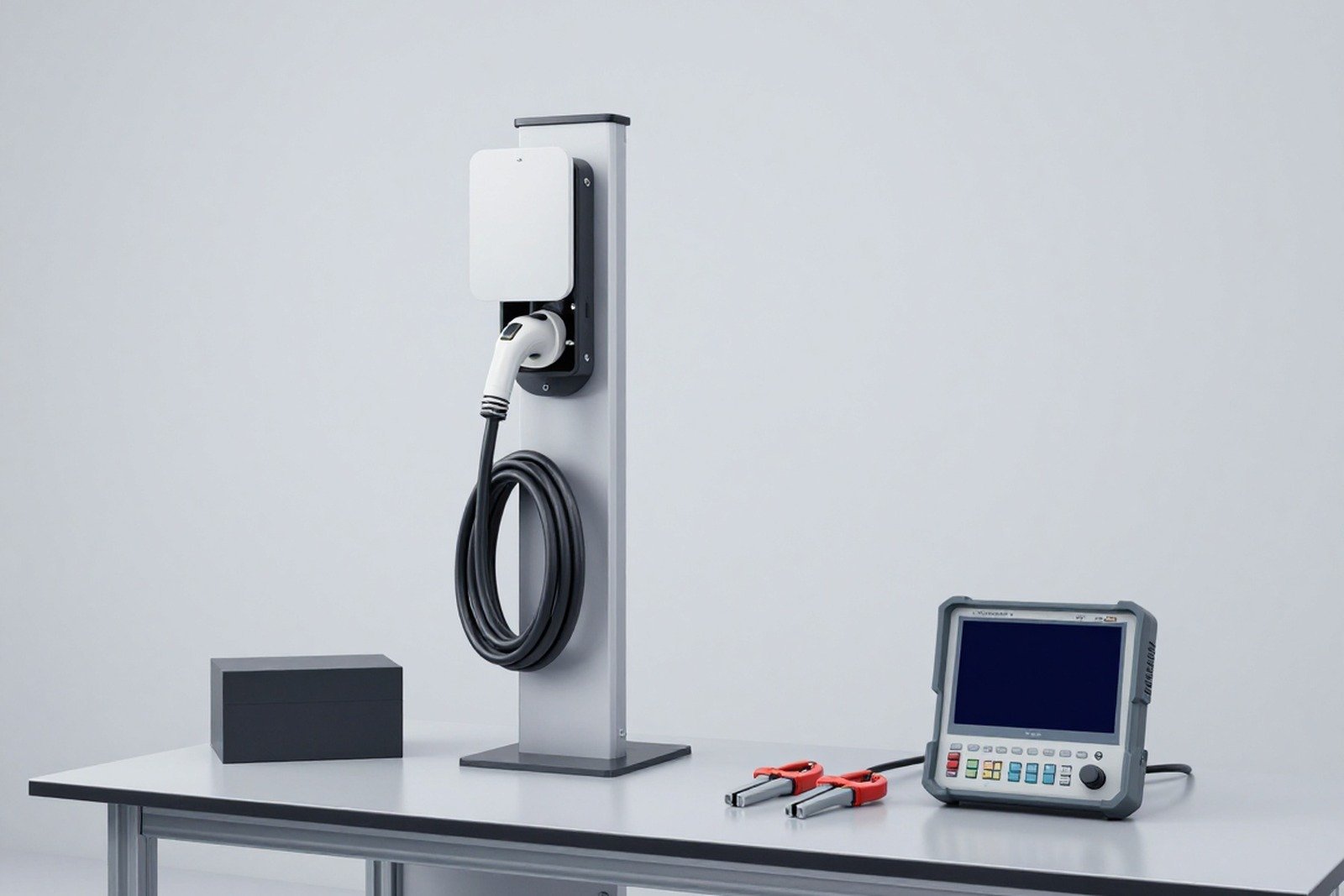
QCVN 32:2026/BCT, issued with Circular 61/2026/TT-BCT of the Ministry of Industry and Trade and effective from 1 July 2027, does not set out all technical requirements for charging posts itself; it refers to 15 standards and technical regulations listed in clause 1.4. For manufacturers and importers of charging posts, that list effectively defines the scope of testing and certification. Missing one referenced document usually means a rejected dossier or additional testing. This article sets out the 15 documents by function, the clauses that are actually referenced, and the points businesses should check before declaring conformity.
1. How the referenced standards apply
Clause 1.4 states the rule for using the reference list:
Where a referenced standard is identified by year of publication, the version stated applies. Using assessment results obtained under a different version is carried out in accordance with clause 4.3.3. Where a legal document or technical regulation is amended, supplemented or replaced, clause 6.2 applies.
Two consequences follow. First, the designation must be written in full with part number and year (TCVN 13078-1:2020, not “TCVN 13078”). Second, test results obtained under a version other than the one referenced are not automatically accepted; the business must prepare an equivalence comparison under clause 4.3.3, as described in section 7.
It is also worth separating the two scopes in the regulation. The requirements for charging posts (Part 2) are largely references to the standards. The requirements for charging stations (Part 3) are set directly by the regulation: layout and clearances, emergency disconnection, earthing and protective bonding, fire safety, energy metering, load management and monitoring systems.
2. The 15 referenced documents
| Group | Reference | Used for |
|---|---|---|
| A. Charging posts | TCVN 13078-1:2020 (IEC 61851-1:2017) | General requirements: protection against electric shock, conductive interface, adaptors, cable assemblies, construction, overload and short-circuit protection, communication |
| TCVN 13078-21-2:2020 (IEC 61851-21-2:2018) | Electromagnetic compatibility (EMC) of off-board chargers | |
| TCVN 13078-23:2020 (IEC 61851-23:2014) | Additional requirements for DC charging posts | |
| B. Electrical system and installation | QCVN 25:2025/BCT | Electrical safety of the station supply system |
| QCVN 26:2025/BCT | Electrical engineering and grid systems; power factor at the metering point | |
| TCVN 7447-7-722:2023 (IEC 60364-7-722:2018) | Residual current protection for the circuit supplying charging posts | |
| TCVN 13724-7:2023 (IEC 61439-7:2022) | Switchgear and controlgear assemblies for charging stations | |
| IEC 62423:2009 | Type B residual current devices (Type B RCD) | |
| IEC 62955:2018 | Residual direct current detecting devices (RDC-DD) for mode 3 charging | |
| C. Station layout and fire safety | QCVN 01:2020/BCT (with Circular 15/2020/TT-BCT) | Charging stations at petrol stations |
| QCVN 06:2022/BXD and Amendment 1:2023 | Fire safety for buildings and structures | |
| QCVN 10:2025/BCA | Provision and arrangement of fire fighting, rescue and salvage equipment | |
| TCVN 3890:2023 | Fire fighting equipment for buildings and structures | |
| D. Conformity assessment | TCVN ISO/IEC 17025:2017 | Competence of testing and calibration laboratories |
| TCVN ISO/IEC 17065:2013 | Requirements for bodies certifying products, processes and services |
The list in clause 1.4 has exactly 15 entries, with QCVN 06:2022/BXD accompanied by Amendment 1:2023. Beyond these, the regulation also refers to groups of documents without a specific number: regulations on radio equipment, on technical infrastructure (where charging posts are installed on sidewalks), and sector legislation on electricity, construction, fire safety, metrology, cybersecurity, personal data protection and the environment.
3. Charging posts: which clauses are referenced
The regulation does not reference the standards in full; it selects individual clauses, so the scope of testing follows those clauses.
| Standard | Clauses referenced | Documentation to prepare |
|---|---|---|
| TCVN 13078-1:2020 | Clause 7 (communication); Clause 8 (protection against electric shock); Clause 9 (conductive interface); Clause 10 (adaptors); Clause 11 (cable assemblies); Clause 12 (construction); Clause 13 (overload and short-circuit protection); clauses 16.1–16.2 (installation and operating instructions) | Protective circuit design documents, cable and connector data, adaptor documentation if supplied, installation and operating instructions |
| TCVN 13078-21-2:2020 | Clause 5 (immunity), Clause 6 (emission) | EMC data for both directions: immunity and emission |
| TCVN 13078-23:2020 | Additional requirements for DC charging posts | A separate dossier for DC posts; AC test results cannot be reused |
Three points are commonly missed in this group:
- Cable assemblies and adaptors supplied with the post are also in scope, yet many dossiers only cover the post itself.
- For posts with large power converters, EMC is usually the item requiring the most design changes, so it should be planned from the first hardware revision rather than handled at certification.
- A DC post does not inherit the test results of an AC post.
4. Electrical system, installation and protective devices
A charging post with a product certificate is not yet sufficient for the station to be fit for operation if the supply, residual current protection and switchgear do not meet the requirements.
| Document | What applies |
|---|---|
| QCVN 25:2025/BCT | Design, installation and operation of the station supply system |
| QCVN 26:2025/BCT | Power quality, power factor at the metering point, limits on export to the grid |
| TCVN 7447-7-722:2023 | Residual current protection for the circuit supplying charging posts |
| TCVN 13724-7:2023 | Switchgear and controlgear assemblies for charging stations, within its scope |
| IEC 62423:2009 | Type B RCD |
| IEC 62955:2018 | Residual direct current detecting device (RDC-DD) for mode 3 charging |
During charging, residual direct current may appear when power components fail in an unintended mode. This type of residual current reduces or removes the ability of ordinary alternating current residual current devices to trip. The regulation therefore requires Type B RCDs (to IEC 62423:2009) or a combination of an RCD with an RDC-DD (to IEC 62955:2018), and the ability to detect, coordinate and disconnect must be verified against the actual installation configuration.
Two items are difficult to add after a station is in operation: residual current protection on the circuit supplying the posts, and the power factor at the metering point, because both depend on the switchboard and the connection layout.
5. Station layout and fire safety
| Installation case | Governing document |
|---|---|
| Charging stations at petrol stations, refuelling points and rest stops | QCVN 01:2020/BCT (with Circular 15/2020/TT-BCT) and sector rules on safety distances and fire safety |
| Buildings and structures with charging stations | QCVN 06:2022/BXD and Amendment 1:2023 |
| Fire fighting, rescue and salvage equipment | QCVN 10:2025/BCA and TCVN 3890:2023 |
| Charging posts on sidewalks | National technical regulation on technical infrastructure (minimum continuous clear width for pedestrians) |
The three fire safety documents apply in parallel and do not replace one another. For outdoor stations near residential areas, rest stops or car parks, fire safety requirements should be established before the site is selected.
6. Conformity assessment: test laboratories and certification bodies
The last two documents in the list determine whether a dossier has legal value.
- TCVN ISO/IEC 17025:2017 sets out the competence of testing laboratories. Clause 4.3.2 states that laboratory accreditation to this standard does not replace the recognition mechanism and conformity conclusions under Vietnamese law.
- TCVN ISO/IEC 17065:2013 is mandatory for certification bodies, which must certify within the scope assigned or recognised under law.
When selecting testing and certification partners, check the following in order:
- Whether the required test is covered by the laboratory’s scope of accreditation. Accreditation certificates issued by VILAS, BoA or another accreditation body registered to operate in Vietnam can all be considered, but what matters is whether that specific test falls within the scope of accreditation.
- Whether the testing body is designated or recognised for conformity certification purposes under current rules.
- Whether the certification body meets TCVN ISO/IEC 17065:2013 and is designated for charging posts and charging stations.
Certification follows method 5 or method 7 under Circular 14/2026/TT-BKHCN. Recognition of test and certification results issued by foreign bodies follows Circular 16/2026/TT-BKHCN and the law on product and goods quality. Foreign results may only be used within the corresponding scope, validity period and conditions of recognition, and the dossier must identify the body that performed the work, the test, the type, the version and the product configuration.
7. When test results do not match the referenced version
A common situation for importers: the product was tested against a newer version of an international standard while the reference list cites an older version. Clause 4.3.3 sets out the rules:
- Prepare and keep a comparison between the version used and the version referenced, identifying the equivalent content.
- Results may only be used for the technical requirements whose level of requirement is equivalent or stricter and whose test methods are equivalent.
- All remaining mandatory requirements must be tested or assessed additionally.
The comparison should be prepared at the stage of negotiating the testing contract and kept with the dossier for explanation during inspections by the competent authority.
8. Two requirements that are easy to miss
Beyond the referenced standards, clauses 2.6 and 2.7 of the regulation set two direct requirements that are often overlooked when the source dossier comes from abroad.
The charging post label must carry at least 10 items: manufacturer; type and model; input voltage; input current; output voltage; output current; output power; IP degree of protection; operating temperature; year of manufacture. The information must be clear and durable for the service life.
The user interface must be in Vietnamese (additional languages may be used). Installation and operating instructions must be provided in Vietnamese in accordance with clauses 16.1 and 16.2 of TCVN 13078-1:2020.
One management requirement is also worth noting: charging posts installed in a station must have technical documentation and certification or conformity declaration records. Posts of unknown origin, without technical documents, or that do not meet safety requirements may not be installed or put into use.
9. Milestones to plan for
| Milestone | What it means |
|---|---|
| Before 1 July 2027 | Charging posts manufactured, assembled in Vietnam or imported must be declared conformant and carry the conformity mark before being placed on the market |
| From 1 July 2027 | The regulation takes effect. Posts lawfully installed before that date may continue in use, but owners and operators must maintain safe operation, inspect, maintain, remedy defects and deal immediately with direct risks |
| Within 6 months from 1 July 2027 | Stations already in operation before the effective date must review their compliance with the safety requirements |
| Within 24 months from 1 July 2027 | Remediation of any non-compliant items must be completed |
| From 1 July 2027 | Repair, upgrading and expansion work must comply with the regulation. Stations under construction but not yet accepted must review the design and the work already executed, and may only be accepted once compliant |
For manufacturers and importers, the first step is to build a comparison table of the 15 referenced documents, marking which parts already have results and which are still missing, in order to estimate the cost and time before 1 July 2027. For owners and operators, three items worth reviewing early are residual current protection for the circuit supplying the posts, power factor at the metering point and the fire safety dossier under all three documents.
Related reading
- QCVN 32:2026/BCT on EV charging posts and stations: what to prepare before 1 July 2027
- Eight certification methods under Circular 14/2026/TT-BKHCN
- Circular 16/2026/TT-BKHCN: recognition of conformity assessment results issued abroad
- High-risk goods requiring testing under Circular 36/2026/TT-BKHCN
- Choosing a testing laboratory for compliance in Vietnam
- Which EMC standard applies to your product
References
- Circular 61/2026/TT-BCT dated 29 September 2026 of the Ministry of Industry and Trade, issuing QCVN 32:2026/BCT, the national technical regulation on electric vehicle charging posts and charging stations. Full text on the Government portal: vanban.chinhphu.vn – Circular 61/2026/TT-BCT.
- QCVN 32:2026/BCT, clauses 1.4 (referenced documents), 1.5 (terms), 2.2–2.7 (charging post requirements), 3.2–3.6 (charging station requirements), 4.1–4.7 (management, conformity declaration, recognition of results), 6.2 (application of referenced versions).
- Circular 14/2026/TT-BKHCN (certification methods) and Circular 16/2026/TT-BKHCN (recognition of conformity assessment results issued abroad).
- Referenced standards and regulations: TCVN 13078-1:2020; TCVN 13078-21-2:2020; TCVN 13078-23:2020; QCVN 25:2025/BCT; QCVN 26:2025/BCT; TCVN 7447-7-722:2023; TCVN 13724-7:2023; IEC 62423:2009; IEC 62955:2018; QCVN 01:2020/BCT; QCVN 06:2022/BXD and Amendment 1:2023; QCVN 10:2025/BCA; TCVN 3890:2023; TCVN ISO/IEC 17025:2017; TCVN ISO/IEC 17065:2013.
This article is provided to disseminate knowledge and share experience; it does not replace legal normative documents or legal and technical advice for any specific case. When applying, please check the original Circular 61/2026/TT-BCT and QCVN 32:2026/BCT together with any amendments or replacements in force.