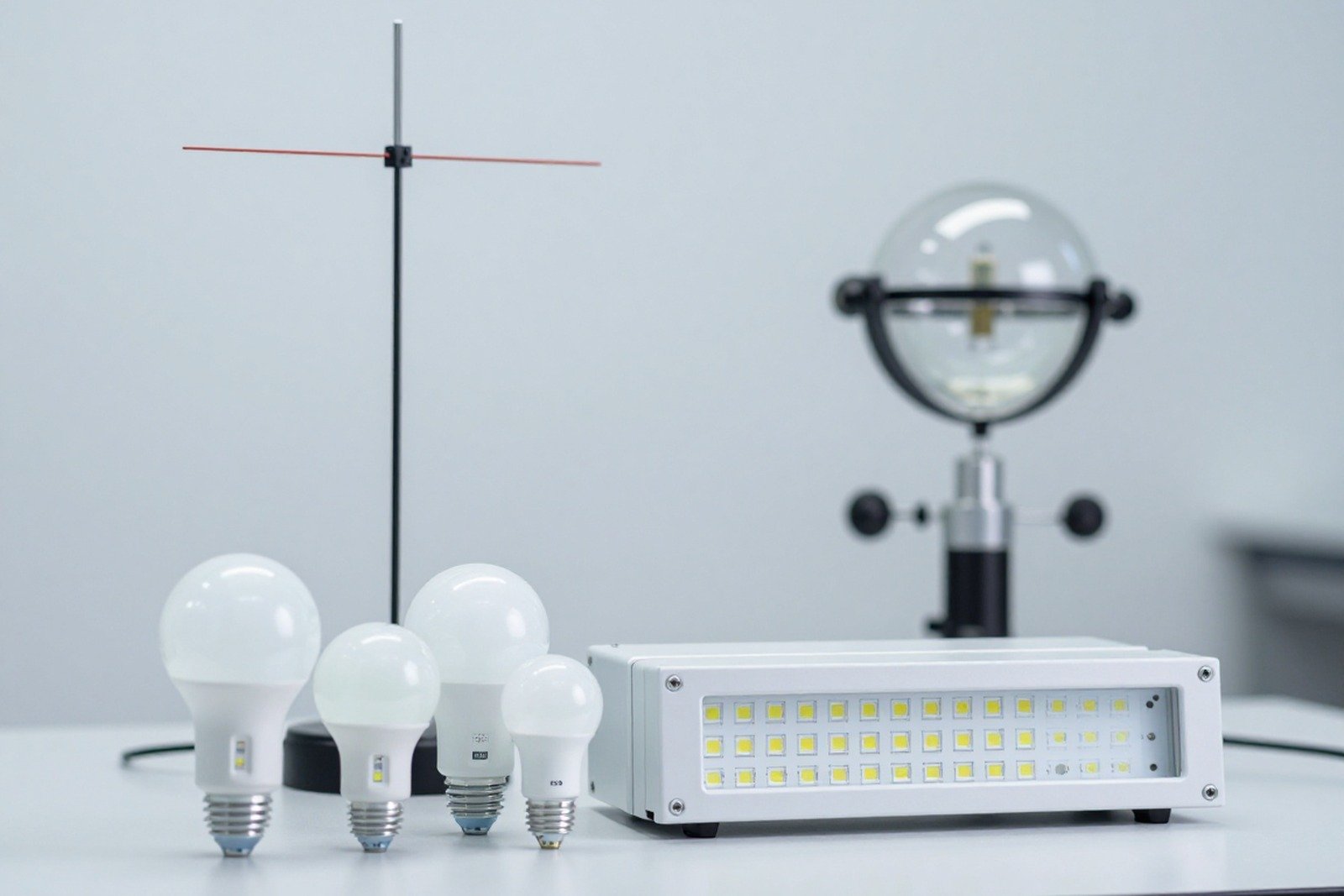
QCVN 19:2025/BKHCN is the national technical regulation on the safety and electromagnetic compatibility (EMC) of LED lighting products, issued under Circular No. 56/2025/TT-BKHCN dated 31 December 2025 by the Ministry of Science and Technology. It replaces QCVN 19:2019/BKHCN, takes effect on 1 June 2026, and applies to LED lamps and general-purpose LED luminaires placed on the Vietnamese market.
The notable point is that, for the first time, a regulation for LED lighting products merges two requirement groups — safety (electrical, photobiological, construction) and electromagnetic compatibility (emission and immunity) — into a single document, alongside a two-stage application roadmap and guidance on product families and representative samples that helps cut testing costs. For manufacturers, importers and sellers of LED lighting, this is a document to act on now, not to wait for the effective date.
This article analyses: the scope and subjects of application, the effective-date roadmap, the safety and EMC technical requirements, the Annex A product list with the corresponding standards, the conformity declaration and CR-mark procedure, how to group product families and select representative samples under Annex B, and the points businesses most often overlook.
Scope note: the analysis below is how we read and structure the document; it is not the legal text itself. For official citation or for applying to a specific case, readers should check the version published in the Official Gazette or the national legal database.
Quick summary
- Document: Circular 56/2025/TT-BKHCN dated 31 Dec 2025, issuing QCVN 19:2025/BKHCN on the safety and EMC of LED lighting products.
- Replaces: QCVN 19:2019/BKHCN (issued under Circular 08/2019/TT-BKHCN).
- Effective: 1 June 2026 — except products with HS code 9405.11.99, from 1 Jan 2027.
- Scope: integrated LED lamps >50 V, double-capped retrofit LED lamps, general-purpose fixed / recessed / portable LED luminaires (Annex A).
- Requirements: safety standards (TCVN 7186, TCVN 7722-1, IEC 62471-1) and EMC (TCVN 8782 / CISPR 15, TCVN 12679 / IEC 61547).
- Market control: conformity declaration, CR mark and labelling before circulation.
1. What is QCVN 19:2025/BKHCN and what does it replace?
QCVN 19:2025/BKHCN is a national technical regulation setting the requirements for safety, electromagnetic compatibility and market management of the LED lighting products listed in Annex A. It was drafted by the drafting committee, appraised and submitted by the National Commission for Standards, Metrology and Quality, and issued by the Minister of Science and Technology under Circular 56/2025/TT-BKHCN.
Compared with QCVN 19:2019/BKHCN, the new document changes both its title (adding electromagnetic compatibility) and its content: EMC requirements (emission and immunity) become a separate section, the application roadmap is differentiated by HS code, and a new Annex B gives guidance on product families and representative samples. Circular 08/2019/TT-BKHCN ceases to have effect from the date Circular 56/2025/TT-BKHCN takes effect.
2. Scope: which products must comply?
The regulation applies to LED lighting products within the scope of the standards listed in Annex A, for organisations and individuals that manufacture, assemble locally, import or trade in them (referred to as Enterprises), as well as conformity assessment bodies and relevant state management agencies.
Out of scope:
- LED lighting products for road, urban-centre, residential-cluster and public-space lighting (playgrounds, squares, parks and flower gardens);
- LED lighting products for means of transport;
- Explosion-proof LED lighting products used in mines and tunnels.
3. Application roadmap 2026 – 2027
The roadmap is differentiated by HS code, giving one product group extra transition time:
| Date | Products that must meet QCVN 19:2025/BKHCN |
|---|---|
| 1 June 2026 | All products in Annex A, except those with HS code 9405.11.99 |
| 1 Jan 2027 | All products in Annex A, including HS code 9405.11.99 |
Transitional provision: products manufactured, assembled locally or imported that were conformity-certified under QCVN 19:2019/BKHCN before the above roadmap may continue to circulate on the market.
4. Product list and applicable standards (Annex A)
Annex A lists the products that must meet the regulation’s requirements, with the HS code (under Circular 31/2022/TT-BTC) and the corresponding safety and EMC standards:
| No. | Product | HS code | Safety standard | EMC standard (EMI & EMS) |
|---|---|---|---|---|
| 1 | Integrated LED lamp operating above 50 V | 8539.52.10 | TCVN 7186:2018 (IEC 62560:2011, AMD1:2015) | TCVN 8782:2017 (CISPR 15:2018); TCVN 12679:2019 (IEC 61547:2009) |
| 2 | Double-capped LED lamp for replacing linear fluorescent lamps | 8539.52.90 | TCVN 7186:2018 (IEC 62776:2014) | TCVN 8782:2017 (CISPR 15:2018); TCVN 12679:2019 (IEC 61547:2009) |
| 3 | General-purpose fixed LED luminaire | 9405.11.91 | TCVN 7722-1:2017 (IEC 60598-1:2014, AMD1:2017); IEC 60598-2-1:2020 | TCVN 8782:2017 (CISPR 15:2018); TCVN 12679:2019 (IEC 61547:2009) |
| 4 | General-purpose recessed LED luminaire | 9405.11.99 | TCVN 7722-1:2017 (IEC 60598-1:2014, AMD1:2017); IEC 60598-2-2:2023 | TCVN 8782:2017 (CISPR 15:2018); TCVN 12679:2019 (IEC 61547:2009) |
| 5 | General-purpose portable LED luminaire | 9405.21.90 | TCVN 7722-1:2017 (IEC 60598-1:2014, AMD1:2017); IEC 60598-2-4:2017 | TCVN 8782:2017 (CISPR 15:2018); TCVN 12679:2019 (IEC 61547:2009) |
Where an IEC standard cited in the table has been adopted as a TCVN, the corresponding TCVN may be applied; where a TCVN or IEC standard has a newer edition, that newer edition may be applied.
5. Safety requirements
LED lighting products must comply with the safety standard corresponding to them in Annex A:
- LED lamps (integrated, and double-capped retrofit): TCVN 7186:2018 (corresponding to IEC 62560:2011 for integrated lamps >50 V and IEC 62776:2014 for double-capped lamps).
- LED luminaires: TCVN 7722-1:2017 (IEC 60598-1:2014, AMD1:2017) together with the specific standard for each luminaire type (IEC 60598-2-1, -2-2, -2-4).
- Photobiological radiation: TCVN 13079-1:2020 (IEC 62471-1:2006) is applied to determine the UV radiation level specified in the corresponding safety TCVNs.
6. Electromagnetic compatibility (EMC) requirements
Products must cover both sides of EMC: electromagnetic emission (EMI) — not emitting above the allowed limits — and electromagnetic immunity (EMS) — withstanding environmental disturbance. The applicable standards per Annex A are:
- EMI: TCVN 8782:2017 (CISPR 15:2018) — limits and measurement methods for lighting equipment, with its characteristic frequency range starting at 9 kHz. See also our article CISPR 15: interference limits for lighting equipment.
- EMS: TCVN 12679:2019 (IEC 61547:2009) — immunity requirements for general lighting equipment (ESD, electromagnetic field, EFT/burst, surge, voltage dips and short interruptions).
7. Conformity declaration, CR mark and dossier
Products in Annex A must be conformity-declared, bear the CR conformity mark and be labelled as required before circulation. Points to note:
- Basis: the declaration must be based on the certification result of an accredited certification body.
- Method: certification under Method 5 (type testing) of Circular 28/2012/TT-BKHCN, as amended by Circular 02/2017/TT-BKHCN.
- Testing laboratory: testing must be performed by a designated testing organisation whose scope covers the regulation’s requirements.
- Validity: the conformity certificate is valid for no more than 3 years.
- Filing: the conformity declaration is registered via the National Database on Standards, Metrology and Quality.
- No double certification: an integrated LED lamp operating above 50 V that is already EMC-certified under this regulation does not need certification under QCVN 9:2012/BKHCN (and Amendment 1:2018) on EMC for household electrical and electronic equipment.
8. Practical experience: product families & representative samples (Annex B)
Annex B is the part that saves testing time and cost, guiding how to group product types into one product family and test only one or a few representative types. Its main reference is IECEE OD-G-2041 Ed 2.0 on product families.
Grouping rules for safety testing
Follow Annex S of TCVN 7722-1:2017 (IEC 60598-1:2014, AMD1:2017). Group only types of the same kind. Types in the same family must share the same basic design: the same circuit structure, component layout, protection against electric shock, IP rating, terminal type and heat-resistant parts. The luminaire with the highest power (highest risk of loss of safety) is chosen as the representative type for the family.
Grouping rules for EMC testing
Electromagnetic disturbance usually originates from the supply circuit of the luminaire (LED driver, DC/DC adaptor). So product families for EMI/EMS testing are grouped mainly on the supply circuit:
- The supply circuit and the luminaire housing material of the types in the same family must be identical; where there is an EMI filter, its design and components must also be the same.
- Choose the luminaire with the highest power as the representative sample.
- If different LED drivers are used, test on enough types so that every driver type is tested.
9. Recognition of conformity assessment results and small consignments
The regulation has specific rules on recognising foreign conformity assessment results, useful for importers:
- A certification body may review and recognise conformity assessment results issued by foreign bodies within the framework of mutual recognition agreements Vietnam has signed.
- For imported LED products in quantities below 10 units or where the testing cost exceeds the consignment value, the certification body may consider using foreign testing results for conformity certification. The foreign testing laboratory must be accredited by an APAC or ILAC member under ISO/IEC 17025, with a scope covering exactly the standards and products in the results used.
- Annually, the certification body must report its recognition and use of conformity assessment results to the National Commission for Standards, Metrology and Quality.
10. Points businesses often overlook
- Seeing only the HS code and forgetting the roadmap: code 9405.11.99 gets seven extra months — but only until 1 Jan 2027, not an exemption.
- Treating every “LED” as “LED lighting”: the regulation excludes road/urban LED lighting, LED of transport vehicles and explosion-proof LED — but those groups usually fall under other regulations or standards.
- Overlooking photobiological radiation: TCVN 13079-1:2020 (IEC 62471-1) is the part most often missed in the safety dossier, especially for high-power/high-intensity luminaires.
- Choosing the wrong representative sample: product-family grouping must be based on the supply circuit and construction — picking “a small sample to save time” can invalidate the results for the whole family.
- Double certification: an integrated LED lamp >50 V already EMC-certified under this regulation need not repeat QCVN 9:2012/BKHCN.
- Laboratory not designated: results are only valid when certification is done at an accredited certification body and testing at a designated organisation with the right scope.
11. Frequently asked questions
When does QCVN 19:2025/BKHCN take effect?
From 1 June 2026 for all products in Annex A, except products with HS code 9405.11.99. HS code 9405.11.99 applies from 1 Jan 2027.
What does QCVN 19:2025/BKHCN replace?
It replaces QCVN 19:2019/BKHCN (issued under Circular 08/2019/TT-BKHCN). Circular 08/2019/TT-BKHCN ceases to have effect when Circular 56/2025/TT-BKHCN takes effect.
Which products are in scope?
Integrated LED lamps >50 V; double-capped LED lamps replacing linear fluorescent lamps; general-purpose fixed, recessed and portable LED luminaires (Annex A).
Which LED lighting products are NOT in scope?
LED lighting for roads, urban centres and public spaces; LED lighting of means of transport; explosion-proof LED lighting used in mines and tunnels.
Which EMC standards apply to LED lighting?
Emission (EMI): TCVN 8782:2017 (CISPR 15:2018). Immunity (EMS): TCVN 12679:2019 (IEC 61547:2009).
Does an integrated LED lamp >50 V also need QCVN 9:2012/BKHCN?
No. If it is already EMC-certified under QCVN 19:2025/BKHCN, it does not need certification under QCVN 9:2012/BKHCN (and Amendment 1:2018).
How long is a conformity certificate valid?
No more than 3 years.
Can small import consignments use foreign test results?
Yes. For imported products below 10 units, or when the testing cost exceeds the consignment value, the certification body may consider using foreign testing results (from a laboratory accredited by an APAC/ILAC member under ISO/IEC 17025).
Related articles
- CISPR 15: interference limits for lighting equipment
- QCVN 32:2026/BCT – EV charging posts and stations
- Decree 37/2026/ND-CP: overview of 8 chapters – 99 articles
- Designation of conformity assessment bodies under Decree 37/2026/ND-CP
- QCVN 86:2025/BKHCN: EMC for mobile terminals
- QCVN 18:2022/BTTTT: general EMC for radio equipment
Talk to us
This article is our interpretation for the purpose of sharing knowledge on certification, testing and product quality management; it is not a legal document. The dates, referenced standards and conditions in the article correspond to the content of QCVN 19:2025/BKHCN and Circular 56/2025/TT-BKHCN at the time of writing; the documents may be amended, supplemented, replaced or repealed afterwards. Before applying to a specific case, readers should check the current legal text and consult the competent authority. The content is for reference only and does not constitute legal advice.