QCVN 55:2023/BTTTT is Vietnam’s national technical regulation on short range devices (SRD) in the 9 kHz to 25 MHz frequency range and inductive loop systems operating in the 9 kHz to 30 MHz frequency range. It was issued under Circular 17/2023/TT-BTTTT dated 27 November 2023, in force from 1 July 2024, and replaces QCVN 55:2011/BTTTT.
This is the “low-frequency part” of the short range radio world: it governs LF/HF devices such as inductive devices, RFID tags, NFC, electronic article surveillance EAS gates, warning and detection devices, remote controls and general-purpose SRD systems.
This article explains what QCVN 55:2023 covers, lists the products that must be tested under QCVN 55 (with HS codes), and adds the 2026 update from Circular 36/2026/TT-BKHCN — the circular that classifies goods by risk and applies it to QCVN 55.
Scope note: this is an interpretive article for reference only and does not replace the legal text.
Quick summary
- Document: QCVN 55:2023/BTTTT, issued under Circular 17/2023/TT-BTTTT dated 27 November 2023.
- Scope: general-purpose SRD 9 kHz – 25 MHz; inductive loop systems 9 kHz – 30 MHz (RFID, NFC, EAS).
- In force: 1 July 2024; replaces QCVN 55:2011/BTTTT.
- Products to test: 5 groups (general-purpose SRD; warning & detection; remote control; RFID; inductive loop systems).
- HS codes: 8517.62.59, 8517.62.69, 8526.92.00, 8504.40.19, 8504.40.90 (Annex J).
- 2026 update (Circular 36/2026/TT-BKHCN): high-risk / medium-risk classification for QCVN 55 product groups.
- Relief: from 1 July 2025, the technical requirements under extreme/limit conditions no longer apply to QCVN 55:2023.
- Source standard: ETSI EN 300 330 V2.1.1 (2017-02).
What is QCVN 55:2023/BTTTT?
QCVN 55:2023 sets technical requirements for two groups of equipment: (a) general-purpose short range radio devices operating in the 9 kHz – 25 MHz range; and (b) inductive loop systems operating in the 9 kHz – 30 MHz range, including radio identification (RFID) devices, near field communication (NFC) devices and devices used in electronic article surveillance (EAS) systems in the LF and HF bands.
The regulation was drafted by the Authority of Telecommunications, reviewed by the Department of Science and Technology, appraised by the Ministry of Science and Technology and issued by the Ministry of Information and Communications; its technical content is based on the European standard ETSI EN 300 330 V2.1.1.
In essence it is the “RF part” regulation for low-frequency devices: it checks the magnetic field (H), the electric field (E), carrier current, frequency range, modulation bandwidth and spurious emissions — complementing EMC and safety regulations.
In force and application roadmap
- Date of issue: 27 November 2023 (Circular 17/2023/TT-BTTTT).
- In force: 1 July 2024. From that date, clause 15 of Article 1 of Circular 29/2011/TT-BTTTT ceases to apply and QCVN 55:2023/BTTTT replaces QCVN 55:2011/BTTTT.
- Applicable parties: Vietnamese and foreign organisations and individuals that manufacture or trade the covered equipment in Vietnam.
Scope: what it covers and what it excludes
Within scope: general-purpose SRD 9 kHz – 25 MHz; inductive loop systems 9 kHz – 30 MHz (RFID, NFC, EAS) — with any type of modulation, using dedicated or integral antennas, in fixed, mobile or portable forms.
Out of scope: SRD operating above 25 MHz (for example the 26.957 – 27.283 MHz band, which is treated under separate groups in some cases; the 40 MHz, 433 MHz, 2.4 GHz bands, etc. are managed by other regulations such as QCVN 73 and QCVN 74) and mobile telecommunications equipment (QCVN 117).
Permitted frequency bands (Table 1)
The short range bands within 9 kHz – 30 MHz:
| Band / frequency | Application |
|---|---|
| 9 kHz – 90 kHz | Inductive devices, general purpose |
| 90 kHz – 119 kHz | Inductive devices, general purpose |
| 119 kHz – 140 kHz | Inductive devices, general purpose |
| 140 kHz – 148.5 kHz | Inductive devices, general purpose |
| 148.5 kHz – 190 kHz | Inductive devices, general purpose |
| 3 155 kHz – 3 400 kHz | Inductive devices, general purpose |
| 3 234 kHz – 5 234 kHz | Inductive devices, for transport |
| 6 765 kHz – 6 795 kHz | Inductive devices, general purpose |
| 10.200 MHz – 11.000 MHz | Inductive devices, general purpose |
| 13.553 MHz – 13.567 MHz | Inductive devices, general purpose (RFID/NFC) |
| 26.957 MHz – 27.283 MHz | Inductive devices, general purpose |
Products that must be tested under QCVN 55 (Annex J)
The regulation applies to goods that are short range devices with the HS codes set out in Annex J, in 5 groups:
| # | Product group | HS code |
|---|---|---|
| 1 | Transmitting, transmitting-receiving short range devices for general purposes (including active NFC devices) | 8517.62.59 8517.62.69 |
| 2 | Radio warning and detection devices | 8526.92.00 |
| 3 | Radio remote control devices (models, industrial and domestic control) | 8526.92.00 |
| 4 | Radio identification (RFID) devices — powered tags and RF readers | 8517.62.59 |
| 5 | Inductive loop systems (RFID, NFC, EAS in the LF/HF bands) | 8504.40.19 8504.40.90 |
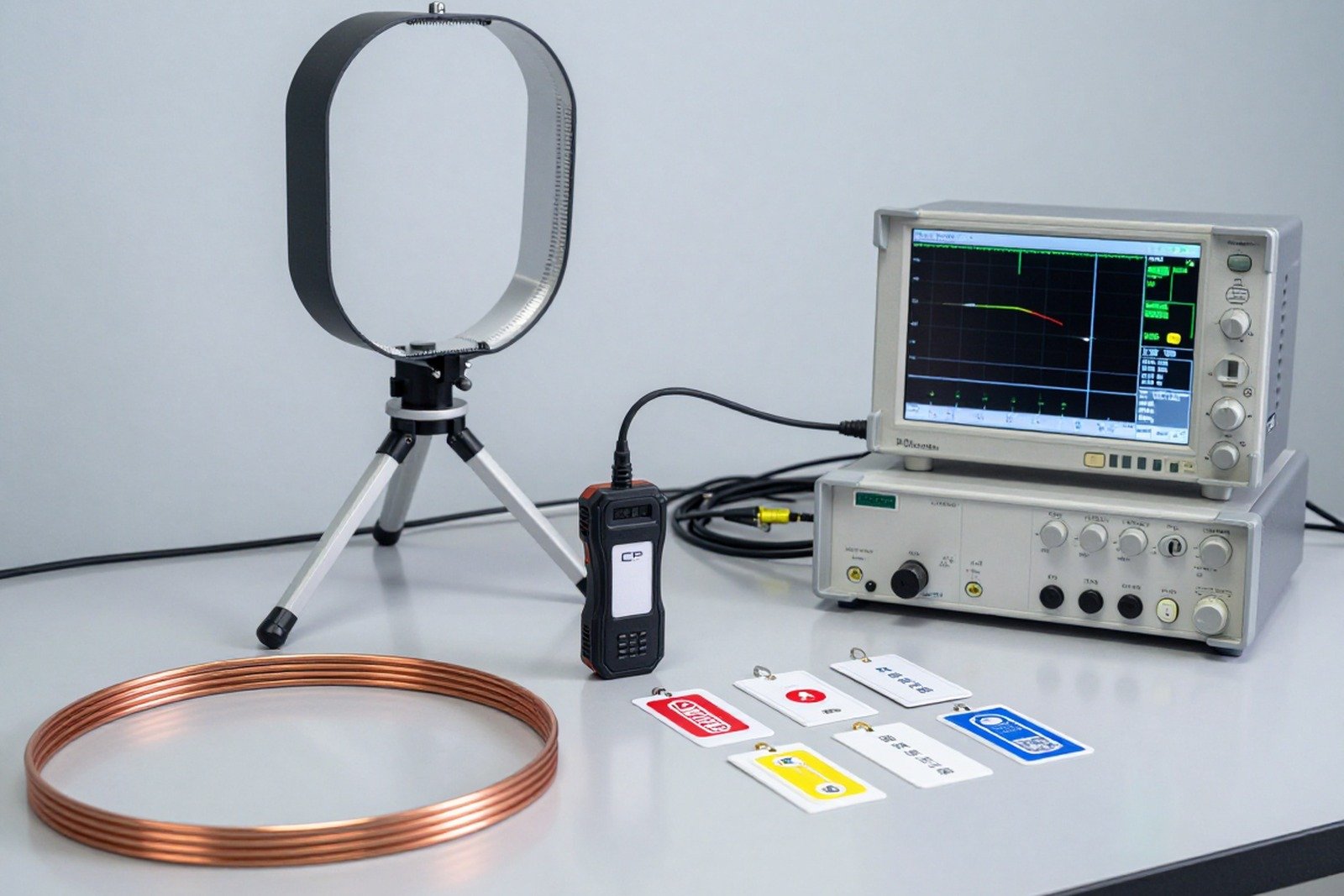
Real-world examples: RFID tags and readers, NFC devices, EAS security gates, anti-theft warning devices, low-frequency wireless remote controls, sensor/detection devices, magnetic card time-attendance systems, etc.
2026 update under Circular 36/2026/TT-BKHCN
Circular 36/2026/TT-BKHCN (in force 1 July 2026) publishes the list of high-risk goods (Annex I) and medium-risk goods (Annex II), with HS codes and applicable QCVN regulations. For QCVN 55:2023, the short range radio product groups are classified as follows:
| Risk level | Item | Product group to be tested under QCVN 55 |
|---|---|---|
| High risk (Annex I) |
2.2 | Transmitting, transmitting-receiving general-purpose short range devices — for equipment operating in the 9 kHz – 25 MHz range |
| High risk | 2.7 | Radio warning and detection devices — 9 kHz – 25 MHz |
| High risk | 2.8 | Radio remote control devices — 9 kHz – 25 MHz |
| High risk | 2.9 | Radio identification (RFID) devices — 9 kHz – 25 MHz |
| Medium risk (Annex II) |
4.1 | Transmitting, transmitting-receiving general-purpose short range devices — 13.553 – 13.567 MHz band (including active NFC) |
| Medium risk | 4.2 | Radio identification (RFID) devices — 13.553 – 13.567 MHz band |
Important relief: Annex I and Annex II of Circular 36 state clearly: “For QCVN 55:2023/BTTTT: the technical requirements under extreme/limit conditions shall not apply from 1 July 2025.” This means the limit-condition measurements (temperature/power supply, clause 2.2.4 of the regulation) are no longer mandatory when testing under QCVN 55; businesses only need to meet the requirements at normal test conditions.
Because Circular 36 tiers risk by level of state control (high-risk goods are typically tied to conformity certification at a designated organisation), businesses should check whether their product falls under Annex I or Annex II to choose the right procedure.
Transmitter classification by antenna type (clause 2.4.1)
The regulation classifies transmitters into 4 product types, which determine the measurement method and applicable limits:
- Type 1: transmitters with an inductive loop antenna, tested with the integral antenna or the dedicated antenna supplied; 9 kHz – 30 MHz; loop area < 30 m²; H-field limits at 10 m apply.
- Type 2: transmitters with an inductive loop antenna that allows the antenna field to be changed; tested with two standard antennas (largest and smallest area) following the manufacturer’s design rules.
- Type 3: only large custom-made loop antennas; 9 kHz – 135 kHz; loop area > 30 m²; a single loop; tested with an artificial antenna (carrier current × area).
- Type 4: E-field transmitters; tested with each type of antenna used.
What technical requirements does it contain?
For transmitters (clause 2.4):
| Clause | Requirement |
|---|---|
| 2.4.2 | H field (radiated) — product types 1 and 2 |
| 2.4.3 | RF carrier current — product type 3 |
| 2.4.4 | Radiated E field — product type 4 |
| 2.4.5 | Permitted operating frequency range |
| 2.4.6 | Operating frequency range |
| 2.4.7 | Modulation bandwidth |
| 2.4.8 | Conducted spurious emissions of the transmitter (below and above 30 MHz) — type 3 |
| 2.4.9 | Radiated spurious emissions of the transmitter (< 30 MHz) — all types |
| 2.4.10 | Radiated spurious emissions of the transmitter (> 30 MHz) — all types |
| 2.4.11 | Transmitter frequency stability |
For receivers (clause 2.5): adjacent channel selectivity (2.5.1); blocking or receiver desensitisation characteristics (2.5.2); receiver spurious emissions (2.5.3). The requirements depend on the technology: tag systems do not require adjacent channel selectivity or blocking; systems in the 27 MHz band require all three; other systems require spurious emissions and blocking.
Some representative limits
H-field limits measured at 10 m (Table 5):
| Band | Device type | Limit Hf (dBµA/m) at 10 m |
|---|---|---|
| 9 kHz – 90 kHz | Inductive, general purpose | ≤ 42 |
| 90 kHz – 119 kHz | Inductive, general purpose | ≤ 42 |
| 119 kHz – 135 kHz | Inductive, general purpose | ≤ 66 (decreasing 10 dB/decade above 119 kHz) |
| 135 kHz – 140 kHz | Inductive, general purpose | ≤ 42 |
| 140 kHz – 148.5 kHz | Inductive, general purpose | ≤ 37.7 |
| 148.5 kHz – 190 kHz | Inductive, general purpose | ≤ 30 |
| 3.155 MHz – 3.400 MHz | Inductive, general purpose | ≤ 13.5 |
| 3.234 MHz – 5.234 MHz | SRD for transport applications | ≤ 9 |
| 6.765 MHz – 6.795 MHz | Inductive, general purpose | ≤ 42 |
| 10.2 MHz – 11 MHz | Inductive, general purpose | ≤ 9 |
| 13.553 MHz – 13.567 MHz | Inductive loop / RFID | ≤ 42 / ≤ 60 |
| 26.957 MHz – 27.283 MHz | Inductive, general purpose | ≤ 42 |
Other limits:
- RF carrier current × antenna area (Table 6, type 3): ≤ 40 dBAm² over 0.009 – 0.135 MHz, decreasing 3 dB/oct above 30 kHz.
- Radiated spurious emissions < 30 MHz (Table 7): transmit state 27 dBµA/m at 9 kHz (decreasing 3 dB/oct) and −3.5 dBµA/m (10 – 30 MHz); standby state 5.5 dBµA/m at 9 kHz and −25 dBµA/m (10 – 30 MHz).
Test conditions and limit temperatures
Normal test conditions: temperature +15°C to +35°C, humidity 20% – 75%. For limit-temperature testing the regulation defines three groups: group I (general) −20°C to +55°C; group II (portable) −10°C to +55°C; group III (indoor equipment) 0°C to +35°C.
This is exactly the part affected by the Circular 36 note: the technical requirements under extreme/limit conditions (clause 2.2.4) no longer apply from 1 July 2025 when testing under QCVN 55.
What should businesses do?
- Determine whether the product falls within the 5 groups of Annex J of QCVN 55 (RFID, NFC, EAS, low-frequency SRD…).
- Match the operating band against Table 1 (9 kHz – 25 MHz; inductive loop systems up to 30 MHz).
- Identify the transmitter type (1 – 4) to know the applicable measurements and limits.
- Check Circular 36/2026/TT-BKHCN: whether the product is high risk (Annex I) or medium risk (Annex II) to choose the right procedure.
- Note the extreme/limit-condition relief (from 1 July 2025) when preparing the test dossier.
- Choose a suitable test laboratory for the measurements under QCVN 55:2023.
Frequently asked questions
Which regulation does QCVN 55:2023/BTTTT replace?
QCVN 55:2023/BTTTT replaces QCVN 55:2011/BTTTT, in force from 1 July 2024.
Which frequency range does QCVN 55:2023 apply to?
General-purpose SRD 9 kHz – 25 MHz, and inductive loop systems (RFID, NFC, EAS) 9 kHz – 30 MHz.
Which products must be tested under QCVN 55?
The 5 groups with HS codes in Annex J: general-purpose SRD; warning & detection devices; remote controls; RFID; inductive loop systems.
What does Circular 36/2026/TT-BKHCN say about QCVN 55?
It classifies QCVN 55 product groups as high risk (Annex I: items 2.2, 2.7, 2.8, 2.9) and medium risk (Annex II: items 4.1, 4.2), and notes that the technical requirements under extreme/limit conditions no longer apply from 1 July 2025.
Do the extreme/limit conditions still apply?
No. Under the note in Circular 36/2026/TT-BKHCN, for QCVN 55:2023/BTTTT the technical requirements under extreme/limit conditions do not apply from 1 July 2025.
What are the HS codes for equipment under QCVN 55?
8517.62.59, 8517.62.69, 8526.92.00, 8504.40.19 and 8504.40.90 (Annex J).
How does QCVN 55 differ from QCVN 73 and QCVN 74?
QCVN 55 governs low-band SRD (9 kHz – 30 MHz), whereas QCVN 73 and QCVN 74 apply to SRD in higher bands (25 MHz to 1 GHz and 1 GHz to 40 GHz).
References
- QCVN 55:2023/BTTTT — National technical regulation on short range devices in the 9 kHz to 25 MHz frequency range and inductive loop systems in the 9 kHz to 30 MHz frequency range.
- Circular 17/2023/TT-BTTTT dated 27 November 2023 issuing QCVN 55:2023/BTTTT.
- Circular 36/2026/TT-BKHCN — list of medium-risk and high-risk goods (Annex I, Annex II).
- Referenced standards: ETSI EN 300 330 V2.1.1 (2017-02), ETSI TR 100 028, CISPR 16-1-4, ITU-T O.41, ITU-T O.153, CEPT/ERC/REC 70-03.
Related articles
- QCVN 117:2023/BTTTT: RF standard for mobile terminals
- High-risk goods requiring QCVN 4 testing under Circular 36/2026/TT-BKHCN
- QCVN 136:2025/BKHCN: 6 GHz Wi-Fi equipment regulation
- QCVN 18:2022/BTTTT: general EMC for radio equipment
- QCVN 86:2025/BKHCN: EMC for mobile terminals
- Circular 08/2021: radio frequency licence exemptions
Get in touch
If you need to determine whether your product falls under QCVN 55:2023, or need to prepare a test dossier under Circular 36/2026/TT-BKHCN, leave your details. We will respond shortly.
This article is for reference and interpretation only and does not replace the legal text. When filing, please check the version published in the Official Gazette or the national legal database. Updated 10 October 2026.