Low-voltage wires and cables sold in Vietnam must meet the quality requirements of QCVN 4:2009/BKHCN and Amendment 1:2016, the labelling requirements of Decree 37/2026/NĐ-CP, and — for cables installed in buildings with fire-safety requirements — the fire-resistance requirements of QCVN 06:2022/BXD.
This article sets out how to classify a cable, which conformity assessment route applies, what must appear on the label, and which records to keep, so that a shipment can be checked before it leaves the warehouse.
Key points
- Risk class: PVC-insulated wires up to 450/750 V (TCVN 6610) and extruded cables at 0.6/1 kV (TCVN 5935-1) fall under group 5 of Annex I to Circular 36/2026/TT-BKHCN — certification is mandatory and imports face state quality inspection. Low-voltage cables outside those two standards fall under item 8.10 of Annex II and may be self-assessed.
- Technical rules: QCVN 4:2009/BKHCN and Amendment 1:2016 refer to TCVN 6610-1, -3, -4 and -5; products carry the CR mark; a method 5 certificate lasts at most three years; records are kept for ten years.
- Labelling: Decree 37/2026/NĐ-CP applies from 1 July 2026; group 40 of Annex I requires the year of manufacture, technical specifications, warning information and instructions for use and storage; labels printed under the old rules may be used for up to two years.
- Fire safety: QCVN 06:2022/BXD, clause A.2.28.8, requires fire-rated cable with at least 120 minutes of fire resistance for fire protection circuits; the regulation issues no product certificate for cables.
- Timeline: Amendment 01:2026 to QCVN 21:2023/BCT (mine cables) applies from 1 November 2026; QCVN 25:2025/BKHCN applies from 1 April 2027.
I. Risk classification and conformity assessment routes
Since 1 July 2026, products under the management of the Ministry of Science and Technology are regulated by risk level under Circular 36/2026/TT-BKHCN. Low-voltage wires and cables appear in both annexes of that Circular.
1. Group 5, Annex I — high risk
Under item 5 of Annex I to Circular 36/2026/TT-BKHCN, the group of low-voltage wires and cables used in electrical installations comprises: a) PVC-insulated wires with rated voltage up to and including 750 V, within the scope of TCVN 6610; b) extruded-insulation cables with rated voltage 0.6/1 kV, within the scope of TCVN 5935-1.
Products in this group must be declared conformant on the basis of certification by a designated or recognised certification body; assessment follows method 5 or method 7 under Circular 14/2026/TT-BKHCN; imported goods must pass state quality inspection under Article 83 of Decree 37/2026/NĐ-CP before customs clearance. The corresponding HS codes are 8544.49.41 and 8544.49.42.
2. Item 8.10, Annex II — medium risk
Where a low-voltage wire or cable falls outside the scope of TCVN 6610 and TCVN 5935-1, it is classified under item 8.10 of Annex II to Circular 36/2026/TT-BKHCN. Manufacturers apply method 1, 5 or 7, may self-assess conformity, and must declare conformity before placing the goods on the market.
For this group, imported goods are not subject to state quality inspection at the border.
3. Exclusions and voltage limit
Group 5 does not cover control cables and signal cables; wires and cables installed inside equipment, pre-fitted in equipment, or fitted with connectors; cables for transport vehicles; bare conductors and magnet wire; cable lengths too short for testing; specialty cables with an operating temperature above 90 °C; cables for offshore works and ships; and specialty cables for areas with a high explosion risk or for underground mines.
The group is limited to 1000 V AC or 1500 V DC. Medium-voltage cables above that threshold fall outside group 5 and must be classified under the relevant sector list.
4. Requirements by product group
| Product group | Technical standard | Method | Requirement before sale |
|---|---|---|---|
| Single-core wires, flexible wires, multicore PVC cables, U0/U ≤ 450/750 V | TCVN 6610-1 with TCVN 6610-3 / -4 / -5 | 5 or 7 | Conformity declaration based on certification by a designated body; state quality inspection for imports |
| Power cables with extruded insulation, U0/U = 0.6/1 kV | TCVN 5935-1:2013 | 5 or 7 | As above |
| Low-voltage wires and cables outside TCVN 6610 and TCVN 5935-1 | Determined by the manufacturer (IEC 60245, IEC 60502, another TCVN, or a company standard) | 1, 5 or 7 | Self-assessment; conformity declaration before sale |
NOTES:
(*) TCVN 6610 has five parts and corresponds to IEC 60227. It covers wires and cables with PVC insulation and sheath at rated voltage up to 450/750 V. QCVN 4:2009/BKHCN refers to TCVN 6610-1:2007, TCVN 6610-3:2000, TCVN 6610-4:2000 and TCVN 6610-5:2007.
(**) TCVN 5935-1:2013 (IEC 60502-1:2009) covers power cables with extruded insulation and sheath of PVC, XLPE or EPR at rated voltage 0.6/1 kV.
(***) Products outside the two standards above include rubber-insulated flexible cables for portable equipment and welding machines; halogen-free (LSZH) cables; flat and aerial cables; silicone-insulated cables; and other specialty cables whose construction does not correspond to TCVN 6610 or TCVN 5935-1.
II. Technical requirements and certification under QCVN 4:2009/BKHCN
1. Technical requirements
Under clause 2.10 of QCVN 4:2009/BKHCN, PVC-insulated wires with rated voltage up to and including 450/750 V must comply with the standards listed below.
| Product | Standard | Content |
|---|---|---|
| Cables and wires with PVC insulation — general requirements | TCVN 6610-1:2007 | Construction, materials, test criteria and marking |
| Cables without sheath, fixed installation | TCVN 6610-3:2000 | Specific requirements for unsheathed single-core and multicore cables |
| Cables with sheath, fixed installation | TCVN 6610-4:2000 | Specific requirements for sheathed cables |
| Flexible cables and cords | TCVN 6610-5:2007 | Specific requirements for flexible cables for portable equipment |
| Power cables 0.6/1 kV | TCVN 5935-1:2013 | Extruded insulation and sheath cables |
Manufacturers should cite the part that matches the product construction. Citing TCVN 6610-2 has no basis, because QCVN 4 does not refer to that part.
2. Certification and the CR mark
Under clause 3.1 of QCVN 4:2009/BKHCN, goods must carry a label, be certified as conformant, and bear the conformity mark (CR mark) before being placed on the market.
Certification follows method 5, and the certificate is valid for no more than three years (clause 3.2.1). Where an import lot has no method 5 certificate, assessment follows method 7, and that certificate covers only the lot in question (clause 3.2.2). Certification must be carried out by a designated or recognised body (clause 3.3).
3. Registration and record retention
Under clause 3.5 of QCVN 4:2009/BKHCN, a domestic manufacturer registers its conformity declaration with the provincial Department of Standards, Metrology and Quality where it is registered for business. An importer registers for quality inspection with the assigned inspection body.
Records must be kept for 10 years from the date the last product was manufactured or imported. Certification bodies keep records for six years.
QCVN 4 was issued in 2009 and refers to procedures in Decision 24/2007/QD-BKHCN and Circular 17/2009/TT-BKHCN. Current procedures follow Circular 14/2026/TT-BKHCN and Decree 37/2026/NĐ-CP. The technical requirements in QCVN 4 remain in force.
4. Products without a standard designated by the regulation
For the group described in item 8.10 of Annex II, the regulation designates no specific technical standard. The manufacturer selects the standard on which the declaration is based, builds its own test programme, and takes responsibility for that choice.
Third-party certification is not mandatory for this group, but a conformity declaration and record retention are.
III. Labelling under Decree 37/2026/NĐ-CP
1. Mandatory contents for this product group
From 1 July 2026, Decree 37/2026/NĐ-CP replaces Decree 43/2017/NĐ-CP and Decree 111/2021/NĐ-CP. Under group 40 of Annex I — postal, telecommunications, information technology, network security, electrical and electronic equipment — the label must show the following.
| Content | Requirement |
|---|---|
| Year of manufacture | Four digits of the calendar year |
| Technical specifications | Rated voltage, number of cores, cross-section, insulation and sheath material, standard of manufacture |
| Warning information | Shown on the physical label for high-risk and medium-risk goods |
| Instructions for use and storage | Supplied with the product or provided through an electronic label |
The label must also show, in Vietnamese, the product name, the name and address of the organisation responsible for the goods, and the origin.
2. Original label and auxiliary label
Imported goods need an original label plus an auxiliary label in Vietnamese. The auxiliary label must not obscure mandatory contents of the original label. Where the original label already carries the full technical specifications, the auxiliary label only needs the missing Vietnamese content and the importer’s details.
3. Transition period
Goods manufactured or imported before Decree 37/2026/NĐ-CP took effect, and labelled in line with Decree 43/2017/NĐ-CP, may continue to circulate until the expiry date printed on the label.
Labels and packaging already printed under the old rules may be used for no more than two years from the effective date of Decree 37/2026/NĐ-CP.
4. Frequent mismatches
The mismatch found most often is not a missing label. It is a label whose specifications do not match the conformity file: model code, voltage U0/U, cross-section, number of cores, insulation material, or standard of manufacture.
Check the label, the technical file and the declaration together, product code by product code, before ordering a print run.
IV. Cables in construction works and fire-safety systems
1. Documents that apply
| Document | Scope | Status |
|---|---|---|
| QCVN 12:2014/BXD (Circular 20/2014/TT-BXD) | Electrical systems of dwellings and public buildings | In force since 1 July 2015 |
| QCVN 06:2022/BXD (Circular 06/2022/TT-BXD) | Fire safety for buildings and structures | In force since 16 January 2023 |
| Amendment 1:2023 to QCVN 06:2022/BXD (Circular 09/2023/TT-BXD) | Amendments | 2023 |
| Consolidated text 92/2026/VBHN-TT-BXD | QCVN 06:2022 with Amendment 1:2023 | 28 September 2026 |
| TCVN 7447 series | Electrical installations of buildings | In force |
Draft QCVN 04-4:202x/BXD on electrical systems in dwellings and public buildings has not been issued. QCVN 12:2014/BXD continues to apply.
2. Requirements in Annex A of QCVN 06:2022/BXD
| Clause | Requirement |
|---|---|
| A.2.28.1 | Supply to fire-fighting lifts, fire protection system equipment, automatic fire alarm, automatic extinguishing and fire-fighting water supply, and escape lighting must be maintained for at least three hours from the start of a fire, from two independent sources |
| A.2.28.2 | Cables from the transformer station and from the independent source to the incoming distribution board of each fire compartment must run in a dedicated fire-rated channel or enclosure, or must be fire-rated cables |
| A.2.28.5 | Where a cable passes through a structure with a fire-resistance requirement, the penetration seal must have a fire resistance not lower than that of the structure |
| A.2.28.7 | Cables from the floor distribution board to rooms must run in a channel or in building elements of non-combustible material |
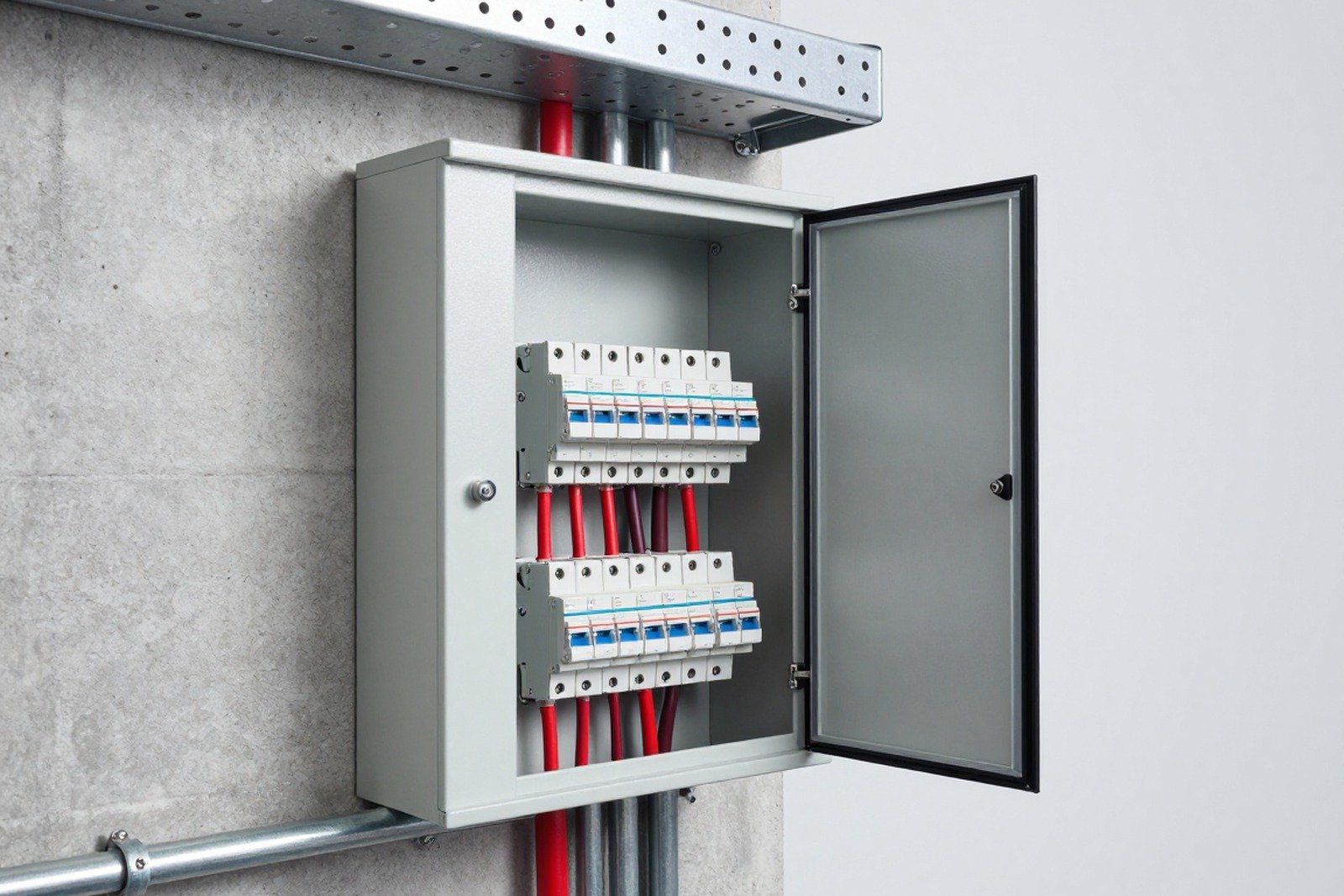
| A.2.28.8 | Wires and cables from the incoming distribution board to fire protection systems must be fire-rated: mineral-insulated cables, or other cables with a fire resistance of at least 120 minutes |
These requirements apply to dwellings and public buildings under Annex A of QCVN 06:2022/BXD.
3. How conformity is demonstrated
QCVN 06:2022/BXD regulates construction works. It provides no product certification for cables, and no conformity certificate is issued to a cable under this regulation.
Conformity is demonstrated by test reports from an accredited laboratory, following the standards cited in the design and tender documents. The standards usually requested are: a) fire resistance — IEC 60331-1, IEC 60331-2, IEC 60331-21, IEC 60331-23 or BS 6387 (CWZ classification); b) flame propagation in bunched cables — IEC 60332-3; c) corrosive gases — IEC 60754-1 and IEC 60754-2; d) smoke density — IEC 61034-1 and IEC 61034-2.
For halogen-free (LSZH) cables, files usually require results from all three groups b, c and d.
V. Special cases and effective dates
1. Explosion-proof cables
Explosion-proof cables for underground mines fall under the Ministry of Industry and Trade. QCVN 21:2023/BCT, issued with Circular 35/2023/TT-BCT, has applied since 1 July 2024.
QCVN 21:2023/BCT was amended by Amendment 01:2026, issued with Circular 44/2026/TT-BCT, effective 1 November 2026, and consolidated in document 101/2026/VBHN-TT-BCT. The product is high-risk under the list in Circular 33/2026/TT-BCT.
2. Extension cord sets
Extension cord sets rated up to 32 A fall under group 6 of Annex I to Circular 36/2026/TT-BKHCN and are subject to QCVN 25:2025/BKHCN, assessed by methods 5 and 7, effective 1 April 2027. The same regulation covers sockets, plugs, socket adaptors, switches, miniature circuit breakers and RCBOs.
3. Cables sold with equipment
Where a cable is sold together with electrical or electronic equipment, the certification duty follows the regulation for that equipment. Equipment with electromagnetic compatibility requirements falls under QCVN 9:2012/BKHCN and Amendment 1:2018.
4. Environmental duties
Packaging of wires and cables — cartons, reels, PE film and pallets — is subject to recycling responsibility under Decree 110/2026/NĐ-CP.
Wires and cables are not among the ten hazardous substances listed in Annex XIX to Decree 26/2026/NĐ-CP and Circular 01/2026/TT-BCT, so no chemical information disclosure applies to the product.
5. Effective dates
| Date | Change |
|---|---|
| 1 July 2026 | Circular 36/2026/TT-BKHCN takes effect; Decree 37/2026/NĐ-CP replaces Decree 132/2008/NĐ-CP, Decree 43/2017/NĐ-CP and Decree 111/2021/NĐ-CP |
| 1 July 2026 | Two-year period begins for using labels and packaging printed under the previous rules |
| 1 November 2026 | Amendment 01:2026 to QCVN 21:2023/BCT takes effect |
| 1 April 2027 | QCVN 25:2025/BKHCN takes effect |
VI. Steps and records
| Step | Action | Basis |
|---|---|---|
| 1 | Determine HS code, voltage U0/U, insulation and sheath material, number of cores, cross-section | Manufacturer’s technical file |
| 2 | Compare against Annex I and Annex II of Circular 36/2026/TT-BKHCN | Circular 36/2026/TT-BKHCN |
| 3 | Check the exclusions and the voltage limit of group 5 | Item 5, Annex I |
| 4 | Fix the applicable standard: TCVN 6610, TCVN 5935-1, or a standard chosen by the manufacturer | QCVN 4:2009/BKHCN |
| 5 | Type-test at an accredited laboratory | TCVN 6610, TCVN 5935-1 |
| 6 | Certify by method 5 or method 7 | Circular 14/2026/TT-BKHCN |
| 7 | Register the conformity declaration (domestic) or the quality inspection (import) | Clause 3.5, QCVN 4; Article 83, Decree 37/2026 |
| 8 | Apply the CR mark and the label under group 40, Annex I, Decree 37/2026/NĐ-CP | Decree 37/2026/NĐ-CP |
| 9 | Register packaging recycling responsibility; keep records for 10 years; track certificate expiry | Decree 110/2026/NĐ-CP; clause 3.5, QCVN 4 |
For lots supplied to works with fire-safety requirements, add the fire-resistance reports and the smoke and corrosive-gas reports called for in the design documents before delivery.
Two mistakes account for most faulty files. The first is misclassification: a cable in group 5 declared under item 8.10 fails when the inspector compares the two. The second is timing: a method 5 certificate lasts at most three years, while records must be kept for ten.
This article explains the rules as we read them and is not legal advice for a specific shipment. Check Circular 36/2026/TT-BKHCN, Decree 37/2026/NĐ-CP, QCVN 4:2009/BKHCN and QCVN 06:2022/BXD before you apply them.
Related articles
- 10 hazardous chemicals: mandatory disclosure in products
- Battery EPR: three layers of legal duty
- Post-clearance audit and post-market checks for imports
- Circular 63/2026: used digital devices banned from import
Discuss with us
If you need to classify a cable against Circular 36/2026, review a conformity file, or assemble fire-resistance reports for a project, leave your details and we will go through the specifics with you.
Disclaimer
This article is explanatory content prepared by us from the source texts and is not legal advice. Before applying it to a specific consignment, compare the original wording of Circular 36/2026/TT-BKHCN, Decree 37/2026/NĐ-CP, QCVN 4:2009/BKHCN and QCVN 06:2022/BXD.
See also: Copyright and disclaimer policy of ticforall.com.