


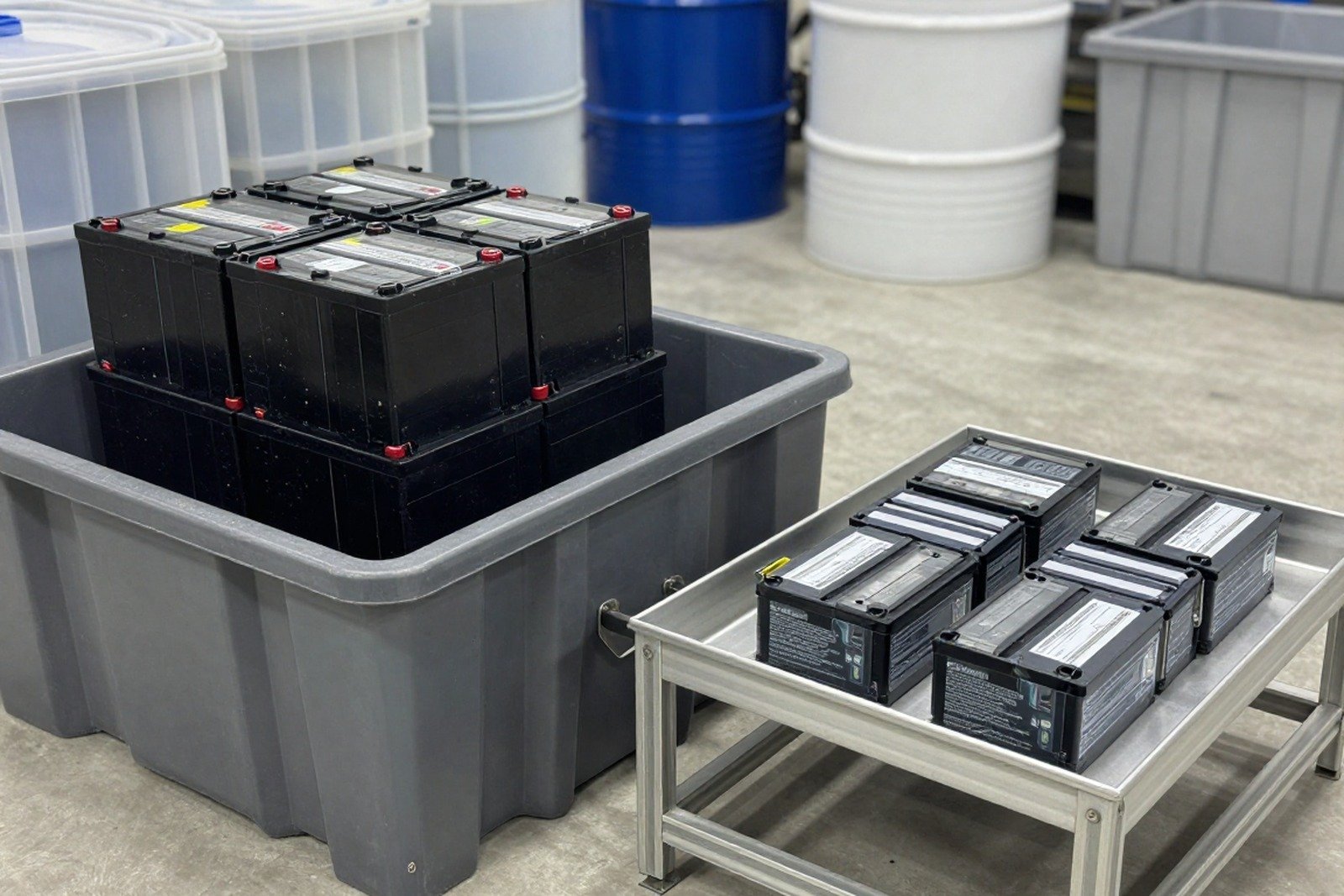
Document summary — From 2026, a battery or accumulator placed on the Vietnamese market may be subject to three layers of independent legal obligations: disclosure of information on hazardous chemicals contained in the battery (Decree 26/2026/NĐ-CP and Circular 01/2026/TT-BCT), implementation of recycling responsibility under the EPR mechanism (Decree 110/2026/NĐ-CP and Circular 24/2026/TT-BNNMT), and management of waste batteries as hazardous waste once the product reaches end of life.
These three layers are set out in three different legal documents, have three different deadlines, and do not replace one another. A company that fully complies with one layer may still be penalised for missing another. This article brings all three together in the order a battery consignment passes through: import, placing on the market, take-back and treatment.
Quick summary
- Layer 1 — Chemicals: Decree 26/2026/NĐ-CP and Circular 01/2026/TT-BCT (Annex XIX) require information disclosure for lead and chromium (VI) compounds in batteries and sulfuric acid in accumulators. Applies from 01/3/2026.
- Layer 2 — EPR: Decree 110/2026/NĐ-CP (in force 25/5/2026) sets the mandatory recycling rates at 12% for lead-acid batteries, 08% for other types of accumulators and 08% for rechargeable batteries; lithium batteries and nickel-metal hydride batteries used for means of transport are set at 0%.
- Contribution rate: Circular 24/2026/TT-BNNMT sets Fs — 17,920 VND/kg for lead-acid batteries, 49,800 VND/kg for other accumulators and 53,800 VND/kg for rechargeable batteries.
- Formula: F = R × V × Fs. For 1 tonne of lead-acid batteries the contribution is about 2.15 million VND; for 1 tonne of rechargeable batteries, about 4.3 million VND.
- Layer 3 — Hazardous waste: waste batteries and accumulators belong to the hazardous waste group; the waste source owner must classify them, store them and transfer them to a facility holding an appropriate environmental permit.
- EPR deadlines: before 01/4 each year, a recycling plan must be registered and the results of the preceding year reported through the National EPR Information System.
- Exemptions: revenue from in-scope products below 30 billion VND/year; exported goods, temporary import for re-export, research and testing.
Three layers of obligation in a single product
The table below is an overview map. Each row corresponds to one legal document, one regulator and one point at which the obligation arises.
| Layer | Legal question | Applicable document | When it arises |
|---|---|---|---|
| 1. Chemicals | Which hazardous chemicals does the battery contain, at what concentration, and have they been disclosed? | Decree 26/2026/NĐ-CP; Circular 01/2026/TT-BCT (Annex XIX) | Before the consignment is placed on the market |
| 2. EPR | Has the corresponding volume been recycled or paid for? | Decree 110/2026/NĐ-CP; Circular 24/2026/TT-BNNMT | Annually, settled before 01/4 of the following year |
| 3. Hazardous waste | Are waste batteries stored and transferred in accordance with the rules? | Decree 08/2022/NĐ-CP (Article 71), as amended by Decree 110/2026/NĐ-CP | When the battery becomes waste |
The point to remember: layer 1 asks about concentration, layer 2 asks about volume, layer 3 asks about the waste stream. Three different questions, three different sets of records.
Layer 1 — Chemicals in batteries that must be disclosed
Annex XIX to Circular 01/2026/TT-BCT lists 10 hazardous chemicals in products for which information must be disclosed. For batteries and accumulators, the list sets out exactly three links:
- Lead: applies to “batteries” and “electronic products”.
- Chromium (VI) compounds: applies to “batteries” and “electronic products”.
- Sulfuric acid: applies to “accumulators”.
Four obligations follow, under Article 29 of Decree 26/2026/NĐ-CP: declare consignment by consignment on the national chemicals database before placing the goods on the market; disclose composition, concentration and recommendations to restrict use on the website, at points of sale and on the label; keep supporting records; and be responsible for accuracy.
One point that is very easy to misread: Annex XIX does not assign cadmium to batteries. The cadmium row mentions only “electronic products” and “anti-rust paints, plated steel”. Nickel-cadmium batteries are therefore outside the scope of disclosure under the cadmium row — but that does not mean Ni-Cd batteries may be handled as ordinary waste. The obligations in layer 3 still apply in full.
Conversely, mercury is linked only to “light bulbs” in Annex XIX, so batteries containing mercury fall outside the disclosure scope of this list, although they still belong to the hazardous waste group when discarded.
Layer 2 — Recycling responsibility under the EPR mechanism
Decree 110/2026/NĐ-CP takes effect on 25/5/2026 and replaces the entire EPR mechanism of Decree 08/2022/NĐ-CP from 2026 onwards (Article 23(1)). Responsibility for 2025 and earlier years continues to follow Decree 08/2022/NĐ-CP.
Who must comply
The producers and importers that place batteries and accumulators on the Vietnamese market. Four special cases are determined under Article 4(1):
- Products bearing the same brand made by several producers: the party responsible for labelling the goods is the obligated entity.
- Processing for another party: the party placing the processing order is the obligated entity, not the processor.
- Entrusted import: the party responsible for labelling is the obligated entity; if the entrusted party labels the goods, revenue is calculated on the total import value plus the entrustment fee.
- A parent company, or a company with branches that keep separate accounts, may be authorised to perform the obligation on behalf of its subsidiaries and branches.
Mandatory recycling rates
Annex I to Decree 110/2026/NĐ-CP, group B — Accumulators and batteries, contains three lines:
| Code | Product group | Mandatory recycling rate | Mandatory recycling specification |
|---|---|---|---|
| B.1.1 | Lead-acid batteries | 12% | Dismantling, sorting, recovery of plastic materials and production of lead ingots |
| B.1.2 | Accumulators of types other than lead-acid batteries | 08% | Dismantling, sorting, recovery of plastic materials and lithium or other metals |
| B.2.1 | Rechargeable batteries — excluding lithium batteries and nickel-metal hydride batteries used for means of transport | 08% | Dismantling, sorting, recovery of plastics and lithium or other metals; or export (possibly with pre-treatment) to a recycling or refurbishment facility abroad |
| B.2.1 | Lithium batteries and nickel-metal hydride batteries used for means of transport | 0% | — |
Three practical consequences follow from this table:
- Non-rechargeable batteries (alkaline, carbon-zinc) are not in Annex I. These types are outside the scope of mandatory recycling, but they are still hazardous waste when discarded.
- Lithium batteries for electric cars, electric motorcycles and electric bicycles carry a rate of 0%. A 0% rate does not mean no declaration is required: the product is still in Annex I, and the volume must still be declared to demonstrate that the obligation is nil.
- The recycling specification for rechargeable batteries allows export. This is an important route for Vietnamese companies, because domestic lithium recycling capacity is still limited.
How the financial contribution is calculated
Article 8 of Decree 110/2026/NĐ-CP sets out the formula:
F = R × V × Fs
- F — total contribution payable, in VND.
- R — mandatory recycling rate of the product group, in %.
- V — volume of product placed on the market in the year of responsibility, in kg.
- Fs — financial contribution rate per unit of volume, in VND/kg.
Fs is set in Annex I to Circular 24/2026/TT-BNNMT and is calculated as the recycling cost multiplied by the adjustment factor:
| Group | Recycling cost (VND/kg) | Adjustment factor | Fs (VND/kg) |
|---|---|---|---|
| Lead-acid batteries | 44,800 | 0.4 | 17,920 |
| Accumulators of types other than lead-acid batteries | 49,800 | 1.0 | 49,800 |
| Rechargeable batteries | 53,800 | 1.0 | 53,800 |
Three examples show the scale of the figures:
- 10,000 kg of lead-acid batteries placed on the market in a year: F = 12% × 10,000 × 17,920 = 21,504,000 VND.
- 2,000 kg of lithium accumulators for electric bicycles: F = 8% × 2,000 × 49,800 = 7,968,000 VND.
- 500 kg of rechargeable batteries: F = 8% × 500 × 53,800 = 2,152,000 VND.
One point deserves attention: the Fs for lead-acid batteries is far lower than for other accumulators and rechargeable batteries, because the adjustment factor is only 0.4 — reflecting the lead recycling infrastructure already established in the country. For lithium batteries, the factor of 1.0 makes the EPR cost per kilogram almost three times higher than for lead-acid batteries.
Three ways to discharge recycling responsibility
Under Article 6 of Decree 110/2026/NĐ-CP, a company chooses one of the forms set out in Article 54(2) of the Law on Environmental Protection:
- Organise recycling itself — perform recycling directly or use waste batteries and accumulators as input material; it may contract a recycling facility.
- Authorise a recycling responsibility organization — the authorised party performs the obligation and certifies the volume; it may not re-authorise another organisation.
- Pay a financial contribution into the Vietnam Environmental Protection Fund — the simplest in procedural terms, but a company choosing this route is not required to register a recycling plan or to report recycling results (Article 7(2)).
A note on documentation: records of collection, transfer, receipt and warehouse issue of material fed into recycling must be prepared and tracked separately from other recycled material. Documents and handover minutes follow the hazardous waste document templates or the handover minutes for ordinary industrial solid waste (Article 6(6)).
Timeline
- 25/5/2026 — Decree 110/2026/NĐ-CP takes effect; Circular 24/2026/TT-BNNMT takes effect on the same day.
- Before 01/4 each year — register the recycling plan and report the results of the preceding year through the National EPR Information System.
- 2027 — producers and importers of road means of transport begin to perform recycling responsibility for vehicles placed on the market from 01/01/2027.
- 2029 — the first adjustment of the mandatory recycling rates and of Fs; the cycle is once every 03 years, with each increase not exceeding 10 percentage points.
Companies in the electric vehicle battery chain should note: lithium batteries for means of transport are currently at 0%, but the mechanism that adjusts the rates every 03 years means this rate is not fixed forever.
Layer 3 — Waste batteries are hazardous waste
When a battery leaves the cycle of use it is no longer a “product” subject to layers 1 and 2 but becomes a waste stream subject to layer 3. Waste batteries and accumulators belong to the hazardous waste group and are usually looked up under code group 16 01 (waste from electrical and electronic equipment), in which the code most commonly used for waste batteries and accumulators is 16 01 12 — the group treated by recovering metals such as lead and nickel.
The obligations of the waste source owner under Article 71 of Decree 08/2022/NĐ-CP comprise four tasks: classify and segregate hazardous waste at source; store it in accordance with the requirements on packaging, containment equipment and storage areas; declare and transfer it to a facility holding an appropriate environmental permit; and prepare and retain hazardous waste documents using the prescribed templates.
Important change introduced by Decree 110/2026/NĐ-CP
Article 22(1) amends point b of clause 1 of Article 69 of Decree 08/2022/NĐ-CP so that organisations and individuals that collect products and packaging which are hazardous waste arising from households, individuals, offices of state agencies, schools and public places in order to perform recycling responsibility do not need an environmental permit containing hazardous waste treatment, but must perform the responsibilities of a hazardous waste source owner under Article 71.
This provision opens the way for household battery collection models — collection points at supermarkets, schools and offices — which previously ran into the hazardous waste treatment permit requirement. In return, the collector must still fulfil the obligations of a waste source owner in full: classification, storage and documentation.
Article 22(2) repeals Chapter VI and Annexes XXII and XXIII of Decree 08/2022/NĐ-CP. On the forms side, Circular 24/2026/TT-BNNMT repeals Article 78, Article 79 and Annexes IX and IXa of Circular 02/2022/TT-BTNMT (as amended by Circular 07/2025/TT-BTNMT and Circular 09/2026/TT-BNNMT).
Practical consequence: companies still using the old templates to compile hazardous waste records should review the current list and document templates before signing the transfer of the next consignment. This type of error causes no immediate consequence, but it undermines the file when an inspection takes place.
The boundary between “product” and “waste” — where companies get confused
The three layers of obligation are most often confused in two places:
First, confusing “EPR fees have been paid” with “we may dispose of it as we wish”. An EPR financial contribution only settles the recycling obligation for the corresponding volume. Waste batteries generated at the factory, office or shop must still be transferred in accordance with hazardous waste procedures. The two obligations do not offset each other.
Second, confusing “the battery is a component of the device” with “the battery is a separate product”. Article 5(1) of Decree 110/2026/NĐ-CP allows a volume deduction: if electrical and electronic equipment contains a component covered by the list subject to recycling and the supplier of that component has performed recycling responsibility, the volume used to calculate the rate for the equipment is reduced by the volume of the corresponding component. But this deduction only takes effect where there is evidence that the battery supplier has performed — without documents, the equipment importer is still assessed on the full volume.
Five points companies commonly miss
- Revenue below 30 billion VND does not exempt everything. The exemption threshold in Article 4(3) is calculated on total revenue from products within the scope of responsibility, not on the company’s total revenue. A diversified company can exceed the threshold because of a single battery product line.
- A 0% rate still requires declaration. Lithium batteries for means of transport carry a 0% rate, but the product is still in Annex I — the volume must still be reported to demonstrate that the obligation is nil.
- Import for export is exempt, but it must be distinguishable. The exemption applies only to exported goods, temporary import for re-export, research and testing. Goods imported and then sold domestically do not fall within it, even if part of the volume is exported later.
- Authorisation does not transfer legal responsibility. Hiring a recycling responsibility organization to act on your behalf does not remove the responsibility of the producer or importer. The regulator will still act against the producer or importer if the volume falls short.
- Recycling documents must be kept separate. Article 6(6) requires records and documents for the recycled volume used to calculate EPR results to be prepared and tracked separately from other recycled material. Mixing them is a common error when a recycling facility receives material from several sources.
What companies should check
- Compile a list of all battery and accumulator products being manufactured and imported, classified under the three lines B.1.1, B.1.2 and B.2.1.
- Determine the volume placed on the market during the year for each line — this is the base figure both for the EPR declaration and for calculating the financial contribution.
- Check the content of lead, chromium (VI) and sulfuric acid and complete information disclosure under Annex XIX for each product code.
- Calculate F = R × V × Fs for each group to establish the cost, and compare it with the cost of organising recycling in-house.
- Choose the implementation route and keep the corresponding supporting records — the recycling contract, acceptance minutes, or fund payment documents.
- Review the hazardous waste process at the factory, warehouse and shop: segregation, containment packaging, and contracts with a facility holding an environmental permit.
- Check that the hazardous waste document templates in use comply with the rules currently in force after Circular 24/2026/TT-BNNMT repealed a number of annexes to Circular 02/2022/TT-BTNMT.
- Register an account and complete the declaration on the National EPR Information System before 01/4 each year.
Frequently asked questions
Who bears EPR responsibility for batteries inside imported equipment?
The producers and importers that place the product on the market. If the battery is a component and the battery supplier has performed recycling responsibility, the equipment importer may deduct the battery volume when calculating the rate, under Article 5(1) of Decree 110/2026/NĐ-CP — provided there is documentary evidence.
Do small batteries (alkaline batteries) have to comply with EPR?
Annex I to Decree 110/2026/NĐ-CP covers only lead-acid batteries, other types of accumulators and rechargeable batteries. Non-rechargeable batteries are outside the mandatory recycling list, so no EPR obligation arises — but when discarded they still belong to the hazardous waste group.
If lithium batteries for electric motorcycles are at 0%, is there anything to do?
Yes. The product is still in Annex I, so the volume must still be declared and reported to demonstrate that the obligation is nil. Without a declaration, the company has no supporting records and is still treated as not having complied.
Does paying into the Vietnam Environmental Protection Fund require reporting recycling results?
No. Under Article 7(2) of Decree 110/2026/NĐ-CP, a company that chooses the form of a financial contribution into the Fund does not have to register a recycling plan and does not have to report recycling results. The remaining obligation is to declare the contribution amount before 01/4 each year.
Does exporting waste batteries abroad for recycling count?
Yes, for the rechargeable battery group. The mandatory recycling specification in Annex I includes “export (possibly with pre-treatment) to a recycling or refurbishment facility abroad”. Note also the requirements of the law on transboundary waste control when completing export procedures.
What revenue level qualifies for exemption from recycling responsibility?
Below 30 billion VND per year, calculated on total revenue from products within the scope of recycling responsibility under Article 4(3) of Decree 110/2026/NĐ-CP, not on the total revenue of the whole company.
References
- Decree No. 110/2026/NĐ-CP dated 01/4/2026 of the Government, in force 25/5/2026 — Articles 4, 5, 6, 7, 8, 22, 23 and 24 and Annex I.
- Circular No. 24/2026/TT-BNNMT dated 25/5/2026 of the Ministry of Agriculture and Environment — Annex I (Fs rates), Annex II (forms).
- Decree No. 26/2026/NĐ-CP dated 17/01/2026 — Article 29 on disclosure of information on hazardous chemical content in products.
- Circular No. 01/2026/TT-BCT dated 17/01/2026 of the Ministry of Industry and Trade — Article 11 and Annex XIX.
- Decree No. 08/2022/NĐ-CP dated 10/01/2022, as amended and supplemented by Decree 05/2025/NĐ-CP, Decree 48/2026/NĐ-CP and Decree 110/2026/NĐ-CP — Articles 69 and 71 on the responsibilities of hazardous waste source owners.
- Law on Environmental Protection No. 72/2020/QH14 — Article 54 (recycling responsibility), Article 55 (responsibility for waste collection and treatment).
Related articles
- 10 hazardous chemicals in products that must be disclosed
- QCVN 91:2024/BGTVT: technical requirements for batteries of electric motorcycles and mopeds
- What is UN 38.3? 8 tests for lithium batteries (T1–T8)
- Batteries and RoHS: why the EU battery regulation is the main framework that applies
- RoHS and WEEE: one restricts substances, the other imposes take-back responsibility
- Quality inspection of imported electronics (Decree 37/2026)
Discuss with us
If your company needs to review its battery and accumulator portfolio against the three layers of obligation above, or needs to determine the EPR volume and cost for each product line, please leave your details so that we can discuss the specifics with you.
Disclaimer
This article is explanatory content prepared by us from the source legal texts and is not legal advice. Before applying it to a specific consignment, companies should compare the original wording of Decree 110/2026/NĐ-CP, Circular 24/2026/TT-BNNMT, Decree 26/2026/NĐ-CP and Circular 01/2026/TT-BCT, and also check the hazardous waste lists and templates currently in force.
See also: Copyright and disclaimer policy of ticforall.com.






