
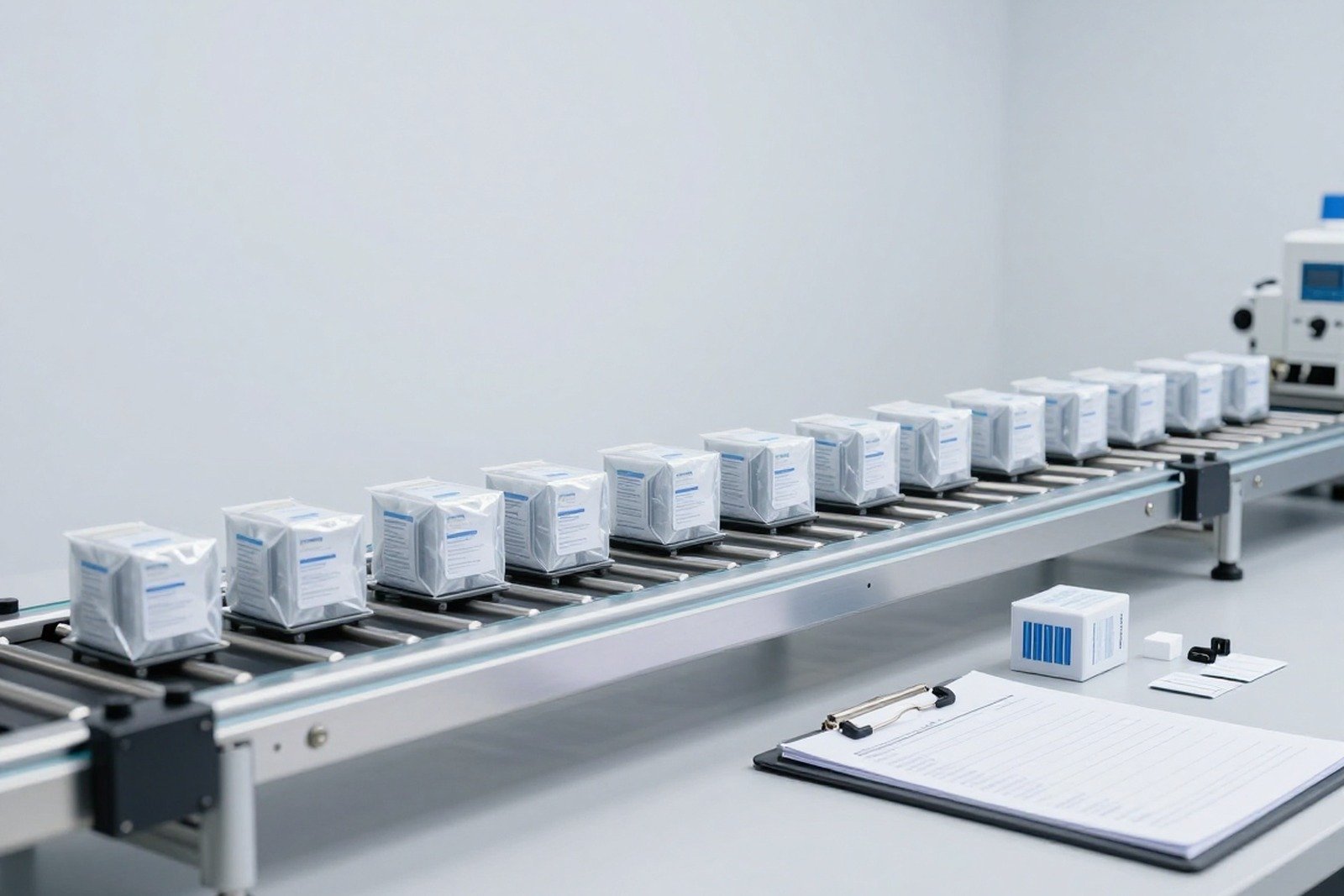
A very common situation: a business has a test report on a product sample, but the customer requests a “batch report” or “report for each delivery batch”. So is the report on the form valid?
The answer has two parts. According to the RoHS conformity assessment mechanism, Reporting on a representative sample is the usual and valid form of evidence, provided the sample is representative of the manufactured goods and the manufacturer maintains controls to ensure that the produced goods remain as sampled. What about the “batch reporting” requirement? contractual requirements or risk requirements, not the provisions of the Directive.
This article analyzes when on-sample reporting is sufficient, when it is not, and how to build intermediary mechanisms to satisfy customers without having to retest the entire batch.
1. Assess conformity by design or by batch?
RoHS requires manufacturers to evaluate the compliance of devices before placing them on the market, based on the device’s structure and materials. Commonly used evidence is:
- Materials analysis on a representative sample of each homogeneous material.
- Supplier’s material declaration for purchase details.
- Technical profile summary for product code.
At the same time, manufacturers must maintain measures to ensure that mass-produced goods remain true to the evaluated sample — often through input control, change control and periodic inspection.
In other words: The report on the form answers the question “is this design compliant”, while production control answers the question “are the products sold the same as the evaluated design?”.
2. When is reporting on the form sufficient?
| Conditions | Why is it important? | Evidence should be there |
|---|---|---|
| Sample representative of manufactured goods | If the sample is not representative, the report does not say anything about sales | Sample taken from production batch or production line, with batch code |
| The list of homogeneous materials is complete | Missing a material is missing a risk point | Material take-off has approved person |
| Supplier has confirmed the ingredients | Shift the burden of proof to the purchase details | Material declaration has an effective date |
| There is change control | Unannounced material changes are the leading cause of limit exceedances | Change process, confirmation records |
| Input materials are relatively stable | Fixed source, little component fluctuation | Contracts, input inspection data |
When the above conditions are met, the report on the form is suitable evidence for inclusion in the technical file.
3. When is reporting on the form not enough?
| Situation | Risk | How to handle |
|---|---|---|
| Recycled plastic or variable input materials | Ingredients may vary from batch to batch | Screen input materials in batches and test periodically at a determined frequency |
| Multiple suppliers for the same details | Each supplier may use different materials | Report or declare separately for each supplier |
| The product had a problem that exceeded the limit | Risk of recurrence in later batches | Increase the frequency of testing and isolation of unconfirmed materials |
| Customers have specific contract requirements | Failure to comply will result in return of goods | Agree on batch sampling plans right from the contract |
| Plating, glue, and ink vary by processing batch | This is where the hexavalent chromium and phthalate risks are concentrated | Control processing suppliers and screen periodically |
4. What exactly is “batch reporting”?
When customers say “batch reporting,” they typically want one of three things — and these three things have very different costs:
- Test report for each delivery batch — highest level of requirements, highest cost, often found in the automotive, medical device, or high-risk product industries.
- Batch screening results with periodic test reports – intermediate level, suitable for most cases: each batch has screening results, complete wet testing periodically.
- Confirm the production batch is according to the tested material — just the commit and traceback, no further retries.
Distinguishing these three levels helps businesses negotiate correctly: many “batch reporting” requirements can in fact be satisfied by level 2 or level 3, with evidence of production control.
5. Intermediate mechanism: risk-based control
| Material group | Recommended level of control | Frequency |
|---|---|---|
| Welding, plating, brass alloy | Screen each incoming batch and periodically wet test | By batch and quarterly |
| Soft plastic, cable cover, gasket | Screen and test for phthalates at a specified frequency | Quarterly or when changing suppliers |
| Materials from suppliers with good systems | Based on material declaration, check probability | By year |
| Recycled plastic | Tightest control: screening each batch of raw materials | Each batch |
| Glue, ink, stamps, packaging | Declare materials, try when changing suppliers | When there are changes |
6. How to respond when customers request batch reports
- Confirm the request content: Do you want a full test report for each batch, screening results for each batch, or a commitment to traceability?
- Presenting the existing control mechanism: bill of materials, supplier declaration, input screening, periodic testing, change process.
- Proposed specific plan: Frequency of screening and wet testing by risk group, with reporting form.
- Record in the contract: The control plan should be an appendix to the contract for both parties to implement together, instead of debating each batch.

7. Frequently asked questions
Is just reporting on the form considered invalid?
No, if the sample is representative and the business has production controls. The report on the form is standard evidence in the technical file following the design review approach.
Customers request a test report for each batch, is it mandatory?
This is a contractual requirement, not a legal requirement. If accepted, the scope, number of samples, substance group and who bears the costs should be clearly stated. If the cost is not reasonable, a batch screening mechanism with periodic testing can be proposed.
Does XRF screening replace test reporting?
No. XRF indicates total and limited elemental content for hexavalent chromium as well as organic compounds such as PBB/PBDE and phthalates. XRF is used for batch control, concluding conformity still requires appropriate methods.
What should I do if the product uses recycled plastic?
Treat recycled plastic as a high-risk material: control the input source, screen each batch, and keep a traceable record of the plastic source. This is the group of materials that is most difficult to achieve RoHS.
Does batch reporting make technical records “stronger”?
Yes, but does not replace evaluation by design. Technical documents must still demonstrate compliance at the product code level; Batch data is additional evidence of maintaining compliance.
8. Conclusion
“Form reports” and “batch reports” answer two different questions. Report according to the form proving design compliance; Batch control proves that the products sold are still as designed. Both are needed, but only one is required by law in reporting form.
The sustainable way is to develop a control plan according to the material risk level, write it into the contract with the customer, and maintain traceability according to the production batch. Then the question “whether to report in batches” will have a clear answer instead of becoming a dispute.
References
- Directive 2011/65/EU and amending documents (conformity assessment, technical dossier).
- EN IEC 63000 standard on conformity assessment documents for electrical and electronic equipment.
- IEC 62321 test method standard series (screening and determination).
- Customer technical requirements in industries with a high-risk of substance restriction.
Related articles
- Is the RoHS report from 2 years ago still available? When to try again?
- How many samples are enough for a RoHS test kit? Principles for selecting samples, stored samples and control samples
- Checklist of 20 RoHS control points for electronics factories (input – production – output)
- When is XRF only needed, when is wet testing required? Batch RoHS control strategy
Discuss further
Disclaimer
This article is an interpretive content compiled by us; not legal advice. Enterprises need to compare relevant documents/standards verbatim before applying them to specific products.
See more: Copyright Policy & Disclaimer by ticforall.com.