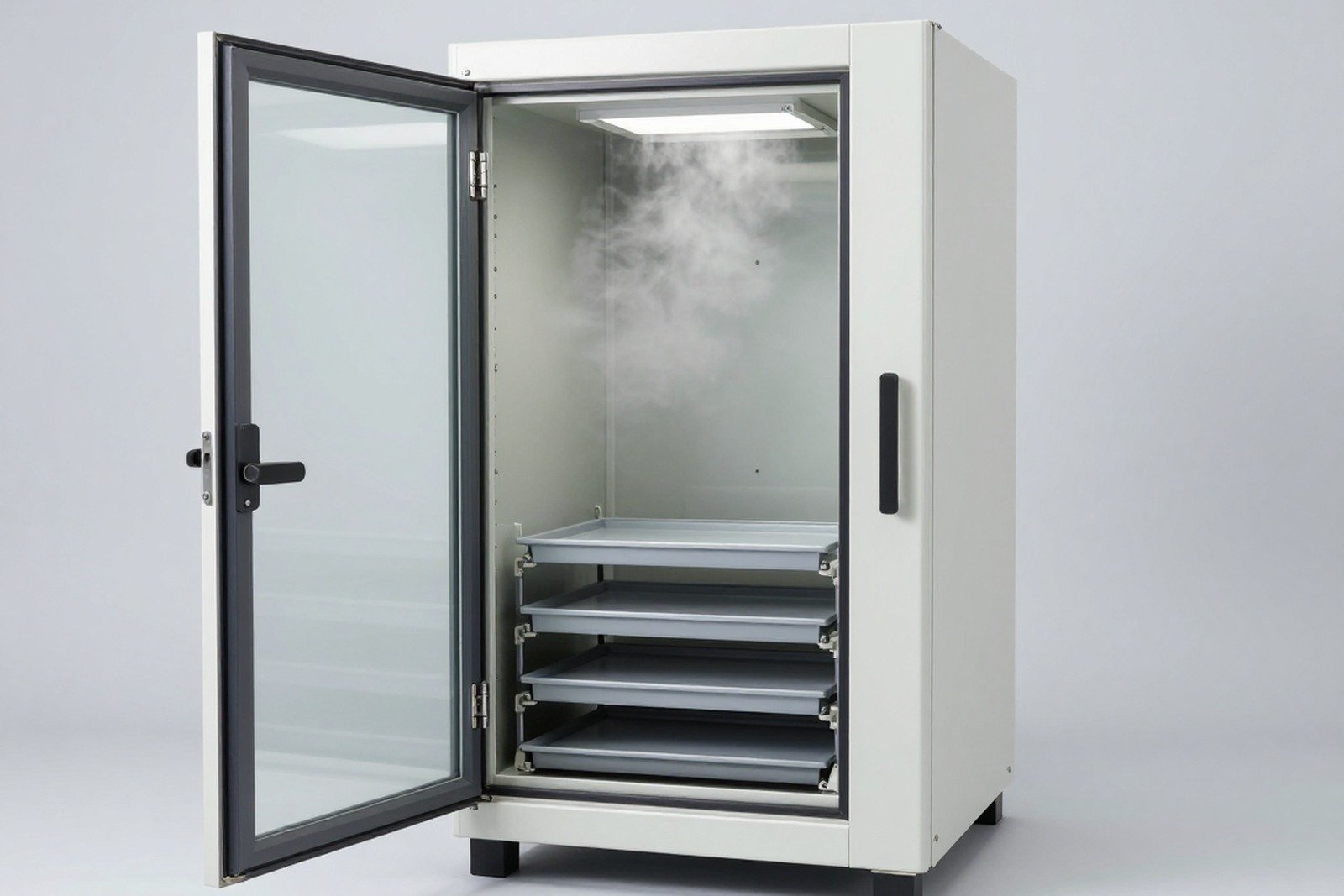
Within the IEC 60068 group of humidity tests, the Cab test — steady hot humidity according to IEC 60068-2-78 — is the most specified but also the most misunderstood: many people use it to “measure the humidity” of a product, when the real goal of the test is to evaluate the long-term effects of moisture on materials, insulation, and circuits.
This article explains what Cab testing is used for, how it differs from Db and Cy, how to write test requests correctly, and errors that prevent results from being compared to standards.
1. What question does the Cab test answer?
Cab is a damp heat, steady state test: the sample is placed in a chamber where the temperature and relative humidity are kept constant throughout the test, and the moisture is in a non-condensed form on the sample surface. Test question answered:
- Is insulation still sufficient when the material absorbs moisture over long periods of time?
- Are electrical circuits, contacts, and welding materials subject to electrochemical corrosion under the influence of moisture and voltage?
- Are polymer materials, adhesives, labels, and coatings peeling, swelling, or discolored?
- Does the product still maintain functionality after hundreds to thousands of hours in hot and humid environments?
Important point: Cab is a steady-state test, so it does not create cyclic stresses. If the product’s risk comes from repeated expansion and contraction — cracked welds, condensation on the day-night cycle, moisture penetration into the sealed enclosure — then stability testing doesn’t capture that risk.
2. How is Cab different from Db and Cy?
| Characteristics | Cab (60068-2-78) | DB (60068-2-30) | Cy (60068-2-67) |
|---|---|---|---|
| Nature of conditions | Stable heat and humidity, no condensation | Humidity and heat cycle, with condensation period | Stable heat and humidity, accelerated form |
| Main object | Products and assemblies in general | Products, assemblies, complete equipment | Mainly components |
| Stress created | Moisture absorption, electrochemical corrosion, insulation deterioration | Adds thermal cycling stress and condensation on the surface | Absorbs moisture quickly at higher harshness levels |
| Time | Long, measured in days under stable conditions | Multiple 24-hour cycles | Hundreds to over a thousand hours |
| When to use? | Need long-term stable evidence, quantitative comparison | Need to simulate a realistic humid tropical environment | Need to shorten the time to evaluate component reliability |
These three tests are not interchangeable. If the contract says Cab, the Db result cannot be used to conclude otherwise, and vice versa. Details on how to read and write test codes are presented in the article Read the IEC 60068 test designations correctly.
3. Implementation sequence
- Initial stability: Bring the sample to standard conditions, check appearance, measure moisture-sensitive parameters (insulation resistance, leakage current) to establish a comparison benchmark.
- Insert sample into chamber: maintain power supply or de-power status as required; clearly stated because this is a variable that strongly affects electrochemical corrosion.
- Switch to test conditions: Raise temperature and humidity to specified levels. Transfer speed needs to be controlled to avoid unwanted condensation — with Cab, condensation on the sample is something to avoid.
- Maintain stability: Keep temperature and humidity within tolerances for the specified time, with continuous data recording.
- Check while trying: On request, functionality can be checked between intervals, but opening the chamber must be limited because it disturbs the conditions.
- Recovery: Bring the sample to standard conditions, condense and dry according to regulations before final inspection.
- Conclusion: Compare with the original benchmark according to the agreed upon criteria before testing.
4. Severity and duration
IEC 60068-2-78 offers a number of temperature-humidity-time combinations to choose from; Common levels in practice are hot and humid at approximately 40 °C with very high relative humidity (about 93 % RH) and duration from several days to several dozen days. Choosing the right combination must come from the actual usage environment, not from habit — the principle of choosing tests according to the usage environment is presented in the article. Select the environmental test according to the usage environment. Specific values need to be compared verbatim to the standard at the time of application.
| Elements to include in the request | Influence on results |
|---|---|
| Temperature and relative humidity | Determines moisture absorption rate and corrosion mechanism |
| Maintenance time | With hygroscopic materials, time is the main variable, not temperature |
| Power supply status | Test with voltages that cause electrochemical corrosion and flashover |
| Recovery conditions | Decide whether re-measurement of insulation parameters is valid or not |
| Whether or not to cover the sample to protect it | Correctly evaluate the effectiveness of coatings, labels, and adhesives |
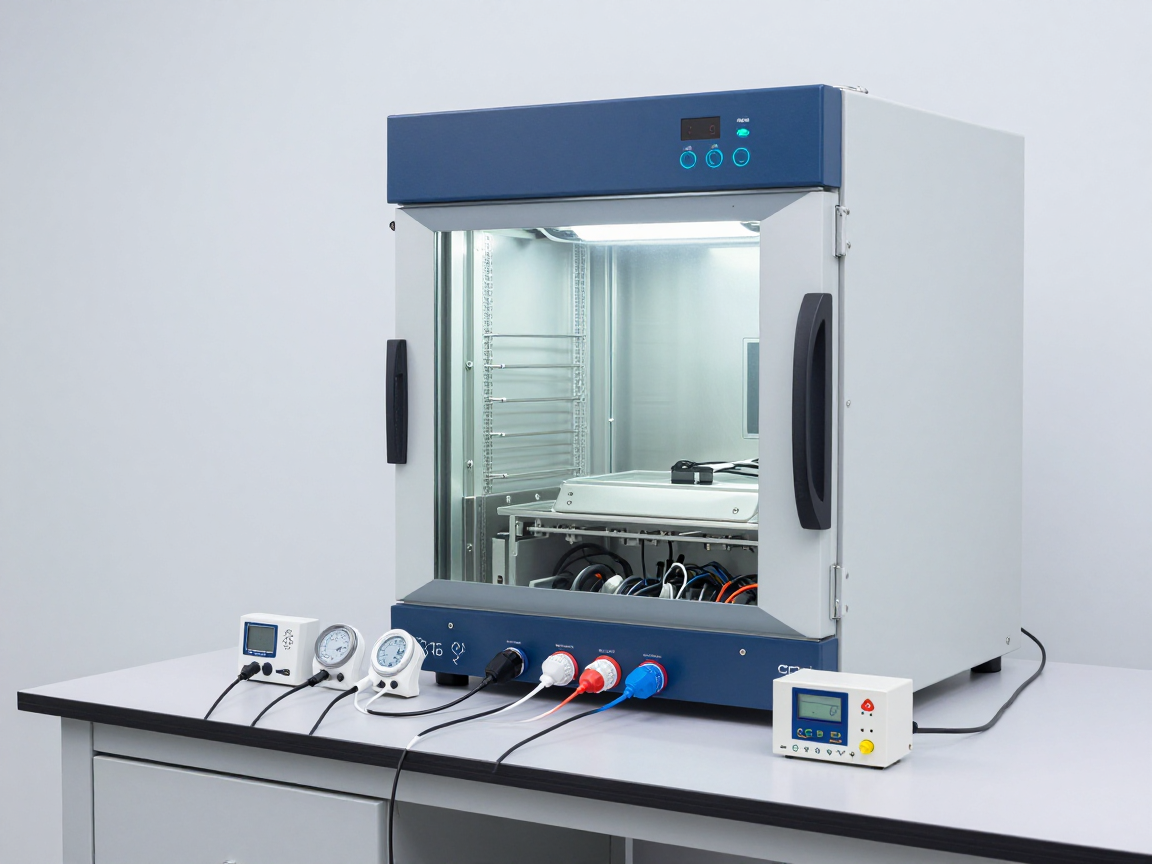
5. How to evaluate: what to measure to see the impact of humidity
Visual inspection is not enough to conclude with moisture testing. You should choose parameters that are sensitive to humidity and measure both before and after:
- Insulation resistance — the most sensitive index to surface and internal moisture in the material.
- Leakage current at the specified working voltage or test voltage.
- Functional decline — sensor error, signal loss, loss of component function.
- Appearance has classification — on a scale of severity (no damage, minor damage, unacceptable damage).
The most common mistake is measuring the insulation resistance immediately after removing the sample from the chamber, when the surface is still wet. The results then reflect the moisture on the surface and do not reflect the actual deterioration of the product.
6. Common mistakes and how to avoid them
- Write “humidity test” without recording the test code, temperature, humidity, or time — results cannot be compared to standards.
- Measure insulation while the surface is still wet — wrong conclusion in the direction of being too bad (or too good to ignore).
- Ignore power supply status — complete loss of ability to assess galvanic corrosion risks.
- Use Cab and then conclude about the tropical environment — real environments have day-night cycles, requiring Db or heat-humidity combination.
- Open the chamber several times to check functionality — interfere with humidity and create unplanned condensation.
- The sample position in the chamber is not recorded — humidity can vary from location to location, causing disputes when comparing samples.
7. Frequently asked questions
Does the cab cause condensation on the sample?
Cab’s goal is for the sample to be free of condensation during the stabilization period. Condensation can occur when the temperature changes or when the chamber is opened; Therefore, the transfer rate and recovery treatment need to be clearly specified.
Does hot humidity testing require power supply for the sample?
Depends on the goal. Unpowered testing evaluates the moisture resistance of materials and structures; Testing with power supply can evaluate electrochemical corrosion, leakage current and flashover. Many programs require both states, in different forms.
How long will the sample be affected?
There is no general answer: it depends on the material, the severity level and whether there is a protective coating or not. Therefore, the time must be chosen by the prescriber based on the evaluation objective, and the results are only meaningful within the tested time range.
Can 85/85 be used instead of Cab?
These are two different variations of the humidity test family: one is stable hot humidity at high harshness levels used for many components, one is stable hot humidity at environmental levels used for products in general. Should not be used interchangeably if requirements do not allow; Limitations of interpretation of hot and humid results are discussed in the “Related articles” section at the end of the article.
After the moisture test, will the sample run normally again and pass?
Not enough. Moisture testing often aims to evaluate long-term changes; The sample can be rerun immediately after testing but may degrade rapidly afterward. The passing criteria must be predetermined by the allowable variation of the measurement parameters, not just by “can still run”.
Can multiple samples be tested in one chamber?
Yes, if the chamber is confirmed for uniformity and records clearly state the location of each sample. It is necessary to avoid letting the samples block each other, changing the local moisture exchange.
8. Conclusion
The Cab test is the standard test to evaluate the long-term effects of moisture under steady-state conditions. It is only valid when required to record the test code, temperature, humidity, time and power supply status of the sample; At the same time, the records must contain condition data over time and results of measuring moisture-sensitive parameters before and after the test.
Three things should be done before placing the Cab in a test program: confirm the chamber is competent according to IEC 60068-3-6; clearly specify recovery conditions and measurement times; and agree with customers on passing criteria based on measured parameters, not on visual perception.
References
- IEC 60068-2-78 — Cab testing: damp heat, steady state.
- IEC 60068-2-30 — Test Db: hot-humidity cycle.
- IEC 60068-2-67 — Cy test: steady heat and humidity, mainly accelerated form for components.
- IEC 60068-3-6 and 60068-3-11 — Capacity validation and uncertainty calculation of environmental chambers.
- IEC 60068-1 — General provisions and guidance.
- TCVN 7699-2-78 — Corresponding national version (if issued).
Related articles
- Test Db: hot and humid cycle 12h+12h according to IEC 60068-2-30
- Z/AD combined heat-humidity cycle (IEC 60068-2-38) for electronic components
- Confirmation of heat-humidity chamber capacity according to IEC 60068-3-6 and 60068-3-11
- Is 85/85 enough of a conclusion? Limits of hot damp test in reliability assessment
Discuss further
Disclaimer
This article is an interpretive content compiled by us; not legal advice. Enterprises need to compare relevant documents/standards verbatim before applying them to specific products.
See more: Copyright Policy & Disclaimer by ticforall.com.