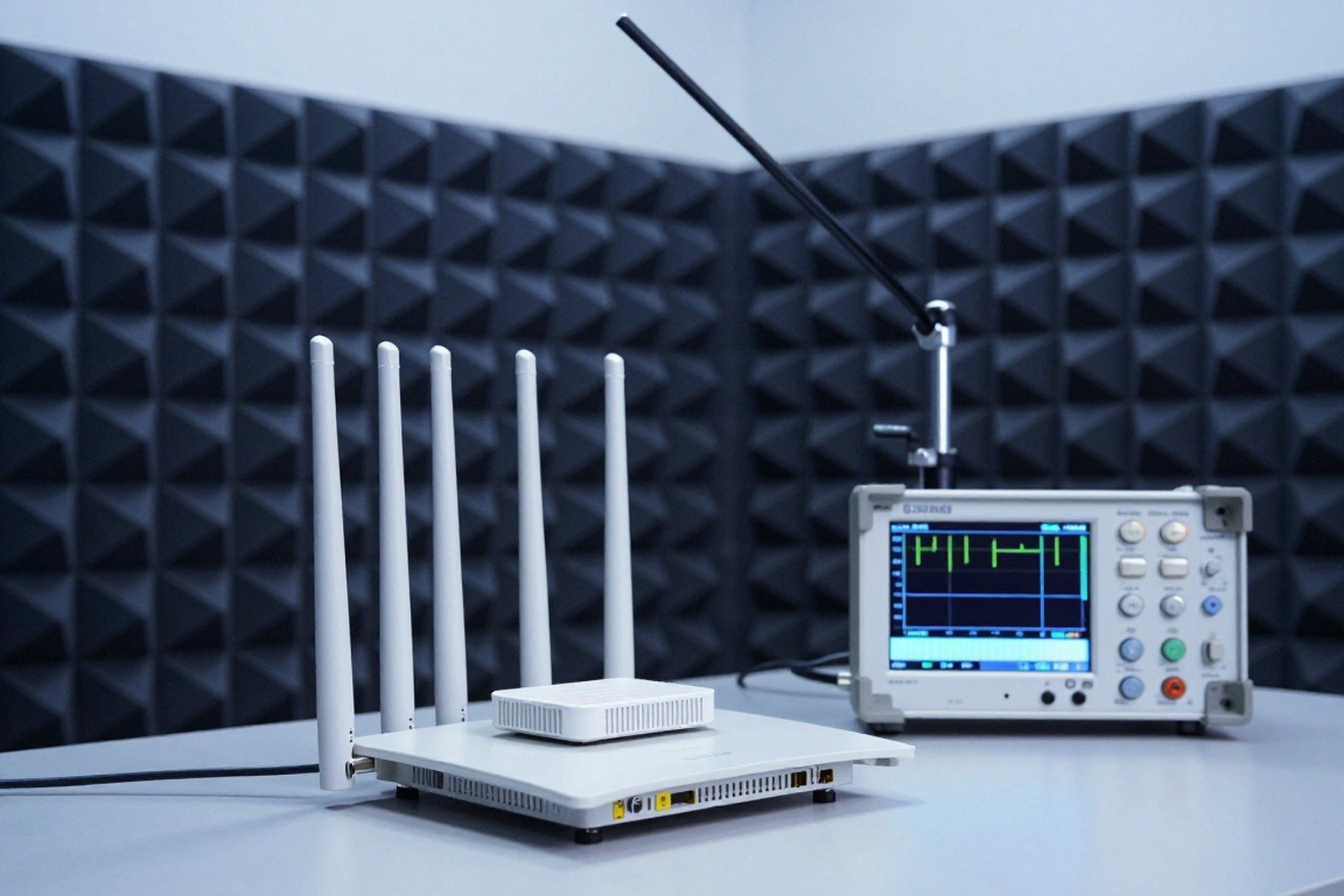
QCVN 136:2025/BKHCN is Vietnam’s national technical regulation on radio access equipment operating in the 6 GHz band — wideband wireless access systems (WAS/RLAN), meaning Wi-Fi 6 GHz, Wi-Fi 6E and Wi-Fi 7. It was issued with Circular 41/2025/TT-BKHCN dated 30 November 2025 by the Ministry of Science and Technology and takes effect on 1 January 2027. The regulation sets technical requirements and measurement methods for equipment operating in the 5 945 – 6 425 MHz band, excluding narrowband devices.
This article puts the QCVN 136 requirements into one easy-to-read matrix table, then explains them in plain language. You do not need to be a radio engineer to understand how your product will be assessed before the 1 January 2027 deadline.
A note on scope: this is our own explanation to spread knowledge, not a legal document. For an official filing, check the published version on the Official Gazette or the national legal database.
Quick summary
- Document: QCVN 136:2025/BKHCN, issued with Circular 41/2025/TT-BKHCN dated 30 November 2025, effective 1 January 2027.
- Frequency band: transmit and receive both within 5 945 – 6 425 MHz.
- Scope: organisations and individuals that produce, trade in or operate 6 GHz WAS/RLAN devices in Vietnam.
- Two device types: LPI (low power, indoor use) and VLP (very low power, indoor and outdoor); plus a narrowband NB branch.
- Main requirements: nominal centre frequency, RF output power (EIRP), power spectral density, unwanted emissions, channel access, receiver characteristics.
- Certification: Methods 1, 5 and 7; HS code 8517.62.51.
Which devices fall under QCVN 136:2025/BKHCN?
QCVN 136 applies to WAS/RLAN equipment operating in the 6 GHz band, covering two types: LPI and VLP. LPI may only be used and fixed inside buildings; VLP may be used both indoors and outdoors at short range.
| Type | Characteristics | Where it may be used |
|---|---|---|
| LPI (Low Power Indoor) | Low-power Wi-Fi, including LPI access point/bridge and LPI client | Indoors only: buildings, trains with metal-coated windows, aircraft |
| VLP (Very Low Power) | Very low power Wi-Fi | Indoors and outdoors, short range, small area |
| NB (Narrowband) | Narrowband branch of VLP, bandwidth below 20 MHz | Under separate rules for VLP NB devices |
The device type must be stated clearly in the test report, because each type has its own power and emission limits.
Main technical requirements of QCVN 136
QCVN 136 limits output power, power spectral density, unwanted emissions, channel access and receiver characteristics. All limits apply to both integral and dedicated antenna configurations.
| # | Requirement group (clause) | Key limits and rules | What it means for business |
|---|---|---|---|
| 1 | Nominal centre frequency and bandwidth (2.3.1) | 20 MHz channels; fc = 5 935 + (nch × 20) MHz; 1 ≤ nch ≤ 24 | The device must sit on the defined channel grid, with centre frequency tolerance within 0.002% |
| 2 | RF output power (EIRP) (2.3.2, Table 2) | LPI ≤ 23 dBm; VLP ≤ 14 dBm | The most important power limit, driving coverage and interference potential |
| 3 | Power spectral density (PSD) (2.3.3, Table 3) | LPI ≤ 10; VLP ≤ 1; VLP NB ≤ 10 dBm/MHz | The PSD limit stops devices from concentrating power in a narrow channel to extend range |
| 4 | Out-of-band emissions (2.3.4.1, Table 4) | LPI −22; VLP −37 dBm/MHz | Keeps signals from spilling outside the 6 GHz band and interfering with nearby services |
| 5 | Spurious emissions (2.3.4.2, Table 5) | −36 to −54 dBm by band; 1–26 GHz: −30 dBm | Harmonics and unwanted signals must be suppressed below the allowed threshold |
| 6 | Radiated spurious emissions (2.3.5, Table 6) | 30 MHz–1 GHz: −57 dBm; 1–26 GHz: −47 dBm | Applies to emissions escaping the enclosure or from devices with integral antennas |
| 7 | Channel access mechanism (2.3.6) | FBE or LBE; listen before talk (LBT/CCA), energy detect threshold, priority classes | This is the spectrum-sharing mechanism that lets many devices share the band without crowding each other |
| 8 | Receiver characteristics (2.3.7 – 2.3.8) | Receiver blocking (Tables 9, 10); selectivity (Table 11) | The receiver must withstand strong signals from other devices without losing connection |
| 9 | Mechanical and electrical design (2.3.9) | Power supply; integral or dedicated antenna design | The antenna must be fixed or dedicated so power and emissions stay within the declared levels |
| 10 | User access restrictions (UAR) and VLP NB (2.3.10) | Conditions for VLP NB with PSD above 1 dBm/MHz | Narrowband devices must use frequency hopping and duty-cycle limits so they do not hog spectrum |
How to read the table: column two points to the clause in the regulation, column three gives the figure or rule to remember, and the last column turns the technical limit into a business concern. The number of applicable requirements changes with the device type, LPI or VLP.
Key numbers to remember
If you only need a few numbers from QCVN 136, these are the most important thresholds. They shape both hardware design and the certification file.
- 5 945 – 6 425 MHz: the operating band for transmit and receive.
- 23 dBm and 14 dBm: EIRP limits for LPI and VLP.
- 10 / 1 / 10 dBm/MHz: PSD limits for LPI, VLP and VLP NB.
- 20 MHz and 24 channels: nominal bandwidth and maximum number of channels in the centre frequency formula.
- 8517.62.51: HS code for 6 GHz radio access equipment.
- 1 January 2027: the date the regulation takes effect.
Testing and conformity certification under QCVN 136
6 GHz Wi-Fi devices must be certified under Method 1, 5 or 7. Testing is performed by a designated or recognised testing body as required by the regulation.
- Measurements: per clause 3 of the regulation, covering both conducted and radiated measurement.
- Test conditions: normal and extreme conditions for temperature, humidity and power supply.
- Test systems: per Annex B, including open area test site (OATS), semi-anechoic room (SAR), fully anechoic room (FAR) and test coupling devices.
- Certification methods: Method 1 (type testing), Method 5 (type testing plus assessment of the production process), Method 7 (testing of samples taken at the factory or on the market).
- Testing body: must be designated or recognised under clause 4 of the regulation.
What should businesses prepare before 1 January 2027?
Work through the following sequence to keep the conformity file lean and reduce the number of sample submissions.
- Determine whether the product is LPI or VLP and confirm HS code 8517.62.51.
- Check power, PSD and emission figures against Tables 2 to 6 of the regulation.
- Review the channel access mechanism (FBE or LBE) and the energy detect threshold parameters.
- Review the parallel regulations for telecom terminal equipment, such as electrical safety under QCVN 132:2022/BTTTT and the EMC standards that apply to your product.
- Choose a designated or recognised testing body and confirm the right conformity assessment method.
Frequently asked questions
Which products does QCVN 136:2025/BKHCN apply to?
Wireless local area network (WAS/RLAN) equipment operating in the 6 GHz band, such as routers, access points and 6 GHz Wi-Fi client devices. Narrowband devices follow a separate branch and sit outside the main scope.
When does QCVN 136 take effect?
Circular 41/2025/TT-BKHCN was issued on 30 November 2025, and QCVN 136:2025/BKHCN takes effect on 1 January 2027. Businesses have more than a year to prepare the file and testing.
How is QCVN 136 different from QCVN 65:2021/BTTTT?
They cover two different bands. QCVN 65:2021/BTTTT applies to radio access equipment in the 5 GHz band; QCVN 136:2025/BKHCN applies to the 6 GHz band from 5 945 to 6 425 MHz.
Does an indoor Wi-Fi 6E desktop router need certification?
Yes. An LPI device fixed indoors still falls within scope and must be certified before it can be placed on the Vietnamese market.
Which technical limit usually drives the design?
The three most influential are EIRP (23 dBm for LPI, 14 dBm for VLP), PSD and out-of-band emissions. They determine the RF power stage and the filtering of the device.
Who must obtain conformity certification?
Organisations and individuals that produce, import and trade 6 GHz WAS/RLAN devices in Vietnam.
References
- QCVN 136:2025/BKHCN, issued with Circular 41/2025/TT-BKHCN dated 30 November 2025: radio access equipment operating in the 6 GHz band.
- QCVN 65:2021/BTTTT: radio access equipment operating in the 5 GHz band.
- Circular 28/2012/TT-BKHCN: conformity assessment methods (Methods 1, 5, 7).
Related articles
- QCVN 132:2022/BTTTT: electrical safety for telecom terminals
- QCVN 132:2022/BTTTT test items
- Which EMC standards apply to your product?
- 8 certification methods under Circular 14/2026/TT-BKHCN
- QCVN 117:2023/BTTTT: RF standard for mobile terminals
- QCVN 55:2023/BTTTT: short range devices 9 kHz–30 MHz
- Circular 08/2021: radio frequency licence exemptions
Talk to us
Need testing and conformity certification for your 6 GHz Wi-Fi equipment before 1 January 2027? Leave your details and the GSTV team will advise on device type, test scope and the file to prepare.
This article is our own explanation to spread knowledge about product testing and quality management; it is not a legal document. The content relates to QCVN 136:2025/BKHCN, Circular 41/2025/TT-BKHCN dated 30 November 2025, QCVN 65:2021/BTTTT and Circular 28/2012/TT-BKHCN at the time of writing; these documents may be amended, supplemented, replaced or repealed later. Before applying this to a specific case, the reader should check the current version and consult a competent authority. The content is for reference only and does not constitute legal advice.