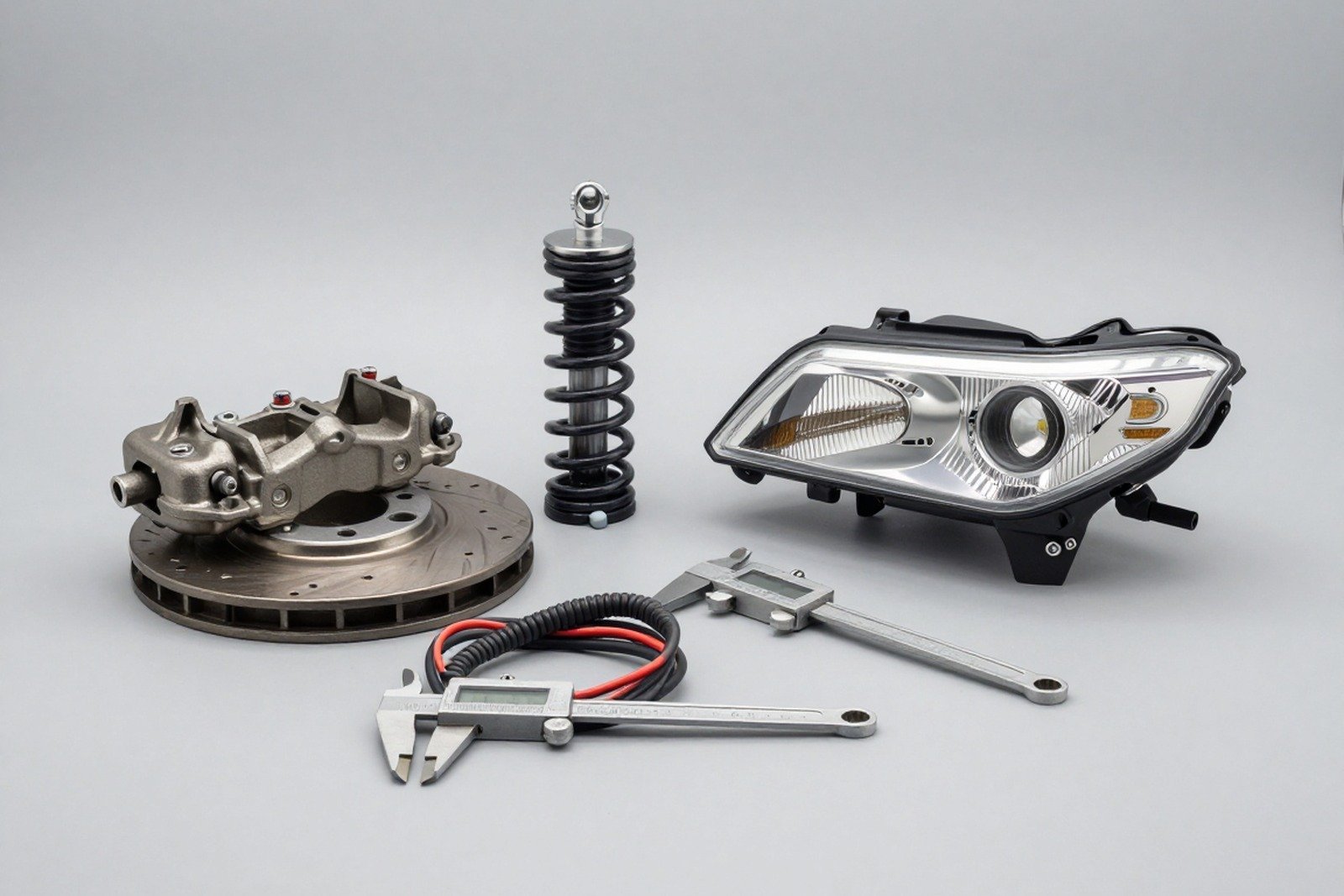
On 15 November 2024, the Ministry of Transport issued two circulars that both take effect on 1 January 2025. Circular 54/2024/TT-BGTVT sets out the procedure for certifying the technical safety quality and environmental protection of imported motor vehicles, special-purpose machinery and motor vehicle parts; Circular 55/2024/TT-BGTVT sets out the corresponding procedure for products manufactured or assembled in Vietnam. Together they replace nearly twenty older circulars on vehicle inspection and place parts under the same management logic as vehicles: type approval, factory capability assessment and pre-delivery inspection. For importers, one missing document can lead to a notice of non-conformity after the 45-day mark; for manufacturers and assemblers, a batch above the defect threshold triggers supervised inspection.
1. Two circulars, two different control gates
Circular 54/2024/TT-BGTVT applies to goods crossing a border checkpoint, and the applicant is the importer; Circular 55/2024/TT-BGTVT applies to products completed at a factory, and the applicant is the manufacturer. Both tie the certificate to the outcome of the factory quality assurance assessment, known as the COP assessment. Without a valid COP result the file does not move to the certification step, even when the test report already passes.
| Item | Circular 54/2024/TT-BGTVT | Circular 55/2024/TT-BGTVT |
|---|---|---|
| Scope | Imported parts | Manufactured or assembled parts |
| Where the file is submitted | National Single Window portal | In person, by post or through the online public service portal |
| Certificate issued for parts | Type approval certificate or batch certificate | Part type approval certificate |
| Validity of the type approval certificate | 36 months | 36 months |
| Document review | 07 working days from receipt of the complete documents | 07 working days from receipt of the complete file and fee |
| Issuance of the result | 04 working days from a valid file | 03 working days from a passing result |
2. Which parts are subject to certification
Article 1 of Circular 55/2024/TT-BGTVT excludes products under the management of the Ministry of Defence and the Ministry of Public Security, as well as products used for scientific research or displayed at trade fairs and exhibitions; Circular 54/2024/TT-BGTVT additionally excludes goods imported under international treaties to which Vietnam is a party. The certification body may return a file if the parts are not on the list of goods capable of causing unsafety under the state management responsibility of the Ministry of Transport.
Article 3 of Circular 55/2024/TT-BGTVT defines parts as assemblies, systems, sub-assemblies and individual components of a vehicle. Assemblies include the engine, frame, cab, body and cargo box; systems include transmission, running gear, suspension, braking, steering, fuel, electrical, the energy storage system supplying the drive system, lighting and signalling. For electric vehicles, batteries and energy storage systems are classified as parts rather than vehicles, so they follow the parts certification procedure; this is also why QCVN 91:2024/BGTVT and QCVN 90:2024/BGTVT were drafted as standards for parts.
3. File for imported parts inspection registration
Article 10 of Circular 54/2024/TT-BGTVT sets out a file of five groups of documents, each with its own timing and method of submission.
| Item | Document | Timing and submission requirement |
|---|---|---|
| a | Registration form for quality inspection of imported parts in the form set out in Section II of Appendix VI | Submitted with the file so that the system issues an inspection registration number |
| b | Information sheet on the parts under Appendix XIV, with photographs of both opposite sides and of the label and markings on the product | Within 15 working days from customs clearance or from the date the goods are allowed into storage |
| c | Notice of a satisfactory COP assessment result issued to the parts manufacturer | Used only when type approval is requested |
| d | Commercial invoice with the goods list | Copy confirmed by the importer |
| e | Import customs declaration; electronic file recording the number and date of the declaration | Within 15 working days from customs clearance or from the date the goods are allowed into storage |
| f | Parts test report issued to the importer itself | Submitted before the issuance procedure |
A company may submit the COP assessment report while waiting for the notice, but within 90 days it must add the notice confirming a satisfactory COP assessment result. The document at point f is waived for parts imported for recall, repair or warranty, or where the imported batch is fewer than 15 units and is of the same type as parts that already have a test report or certificate.
4. Two certification routes and processing deadlines
Article 9 of Circular 54/2024/TT-BGTVT allows certification by part type or by batch. Type certification requires the documents at points a, b, c, e and f and is valid for 36 months; during that period the importer is exempt from opening an inspection registration file but must report import activity every 12 months under Appendix XV. Batch certification requires the documents at points a, b, d, e and f, has no expiry date, but each batch needs its own file.
The certification body accepts and returns the result of the completeness check within 01 working day at most. The review of the file content and the issue of the quality certificate follow the 07-day and 04-day marks shown in the comparison table; for a batch file the clock runs from the moment documents b, e and f are complete, while for a type file it runs from the moment documents b, c, e and f are complete.
The 45-day mark counted from the opening of the inspection registration file, or from the date of customs clearance, is a hard deadline for adding documents. Beyond it, and outside cases of force majeure, ongoing sample testing or an ongoing factory quality assurance assessment, the file is returned or a notice of non-conformity is issued. The certification body may also refuse to accept a file where the parts are not on the list of goods capable of causing unsafety, where they are on the list of prohibited imports, where the documents are still incomplete after 45 days, and where the company is under suspension.
On the form of the certificate, Article 12 of Circular 54/2024/TT-BGTVT provides that certificates and notices are issued without an expiry date, except that a certificate issued for a part type is valid for 36 months; the paper file comprises an archive copy and a user copy for customs procedures.

5. COP assessment of a foreign parts factory
For imported parts, the entity assessed is the factory abroad and not the importer. Article 11 of Circular 54/2024/TT-BGTVT sets out four groups of content: review of the legal file of a manufacturer being assessed for the first time, covering business registration documents, the right to use the factory premises and valid certifications such as IATF 16949, ISO 9001 and ISO 14001; assessment of production conformity with the imported type, covering incoming component quality control, pre-delivery quality inspection, equipment maintenance and calibration, product warranty and traceability; assessment of the pre-delivery quality inspection items defined by the manufacturer itself; and a supplementary COP assessment where the type is made at the same factory that already holds a COP notice but follows a different process.
If the assessment result is not satisfactory, the manufacturer has 06 months to correct it; after that period the certification body issues a notice of an unsatisfactory COP assessment result. When a first-time or periodic assessment is satisfactory, the COP notice is valid for 36 months, 24 months or 12 months from the end of the assessment. A COP assessment is waived where the part type is made at the same factory that already holds a COP notice and the process and inspection procedure have not changed fundamentally, or where the manufacturer was assessed for the first time from the effective date of Decree 116/2017/ND-CP, has not interrupted production for more than 90 days and holds a suitable ECE document.
6. Testing of the representative sample and the part type approval file
Article 4 of Circular 55/2024/TT-BGTVT requires the manufacturer to prepare a representative sample and technical documents to register testing for a product type subject to inspection. The testing body issues one of four report types: vehicle safety, vehicle emissions, parts and energy consumption, each valid for use within 36 months from the date of signature.
Article 5 of Circular 55/2024/TT-BGTVT sets out a part type quality certification file of six groups of documents, and the result of the quality assurance assessment at the manufacturing site is mandatory.
| Item | Document |
|---|---|
| a | Application for a part type quality certificate under Appendix XII |
| b | Information sheet showing the characteristic technical parameters of the part type |
| c | Copy of the parts test report together with a copy of the technical drawing |
| d | Photograph of the whole part, explanatory note on the symbols, characters and numbers stamped on the part |
| e | List of parts used for manufacture or assembly where the part is an engine for motorcycles, mopeds and four-wheeled cargo vehicles, under Appendix VI |
| f | Result of the part type quality assurance assessment at the manufacturing site, or the result of an assessment of a similar type |
Where parts are used to assemble vehicles, the vehicle type approval file must include documents proving the origin of parts subject to inspection. Article 5(3) allows one of four documents: a part type quality certificate; a notice of exemption from quality inspection for imported parts under Decree 60/2023/ND-CP; a written confirmation from the foreign manufacturer together with a conformity certification result under a mutual recognition agreement; or a written confirmation from the legal representative of the foreign manufacturer in Vietnam together with a part type certificate for vehicles subject to Decree 116/2017/ND-CP.

7. Sequence and deadline for issuing a part type certificate
Article 7 of Circular 55/2024/TT-BGTVT sets out the sequence for product type certification, which applies to both parts and vehicles. The manufacturer submits in person, by post or online through the National Public Service Portal or the Ministry of Transport public service portal; if the file is incomplete, the certification body returns it within the working day for in-person submissions or within 02 working days for other methods, stating the reason so that it can be completed.
If the file is complete, the certification body reviews the COP assessment result and the file content within 07 working days from receipt of the complete file and the payment of the full fee. When the COP result and the file review are satisfactory, the certification body issues the product type certificate within 03 working days, valid for 36 months from the date of issue. If the file contains unsuitable content or the COP result is not yet available, the manufacturer must supplement and complete it and agree on a time for the COP assessment; the processing period restarts once the supplementary file is complete.
The manufacturer may supplement and complete unsuitable content within 03 months at most from the date of the first notice; after 03 months the certification body stops reviewing and assessing the file and the COP, and notifies that the product type certificate will not be issued.
8. Pre-delivery inspection and the supervised regime
Article 11 of Circular 55/2024/TT-BGTVT requires the manufacturer to maintain quality assurance during manufacture and assembly and to inspect each product before delivery against the criteria registered in the certification file. Self-inspection before delivery applies to a manufacturer that holds a product type certificate, has a satisfactory COP result and has committed no violation serious enough to require supervision.
Supervised pre-delivery inspection applies where the manufacturer delivers products that fail a national technical regulation or do not match the certification file and the representative sample; commits violations in the use of the pre-delivery quality inspection sheet; erases or re-stamps the frame or engine number without authorisation; or delivers products of unstable quality.
| Indicator of one supervision period | Prescribed level |
|---|---|
| Maximum duration | 06 months, counted from the first delivered product |
| Number of products to be supervised | 2,000 for motorcycles and mopeds; 500 for cars, trailers and semi-trailers; 200 for other vehicles |
| Share of failing products still considered stable | Not more than 5% for the whole period and not more than 10% for any single month |
A supervision period ends on whichever comes first: the expiry of 06 months or the completion of the required number of products. After each period, if product quality is stable and no rule has been breached, the manufacturer returns to self-inspection before delivery; a single month with a defect rate above 10% is enough to keep supervision in place.
9. Periodic COP assessment, risk management and unannounced inspection
Article 6 of Circular 55/2024/TT-BGTVT sets out four COP assessment methods: first assessment, periodic assessment on the cycle in Appendix XI, unannounced assessment following a complaint and supplementary assessment after a change to the quality management system or a production step. Where a periodic assessment finds content that does not pass, the manufacturer must correct it within 03 months at most from the date of notice; beyond that period the certification body records an unsatisfactory COP result. Article 14 provides for risk assessment to classify manufacturers; Article 15 allows unannounced inspection following a complaint about product quality or a document from a relevant management authority. For imported parts, Article 9(5) of Circular 54/2024/TT-BGTVT allows unannounced inspection of a batch on substantiated complaints or reports; where the grounds are insufficient, the certification body takes samples for testing, at a cost governed by Article 41 of the Law on Product and Goods Quality.
10. Suspension for 06 months, certificate withdrawal, recall and record keeping
Article 12 of Circular 55/2024/TT-BGTVT provides that the certification body suspends the validity of a product type certificate and requires the manufacturer to stop issuing pre-delivery sheets for the offending type for 06 months where the manufacturer fails to maintain product quality assurance, fails to carry out pre-delivery inspection, delivers products that do not match the certification file and the representative sample, issues pre-delivery sheets improperly, fails to carry out periodic assessment, or erases or re-stamps the frame or engine number without authorisation.
Chapter III of Circular 55/2024/TT-BGTVT governs the recall of defective products and goods for cars subject to Decree 116/2017/ND-CP. Where there are grounds to suspect a defect, the certification body orders a halt to deliveries or an immediate recall; the manufacturer reports the recall outcome no later than 31 December each year.
Article 21 of Circular 55/2024/TT-BGTVT sets two record-keeping marks that are frequently breached: product quality inspection results must be kept for at least 03 years from the date of delivery, and quality certification and energy consumption certification files for at least 05 years from the moment production of the product type stops.
11. Four circulars have amended and supplemented these two texts
Both original circulars have been amended and supplemented, so the latest consolidated version should be consulted rather than the 2024 originals.
- Circular 69/2025/TT-BXD governs energy labelling for energy-using vehicles and repeals the energy labelling report rule in Article 19 of Circular 54/2024/TT-BGTVT.
- Circular 71/2025/TT-BXD cuts and simplifies administrative procedures in the fields of vehicle inspection, civil aviation and inspection work, amending Article 9(4) of Circular 54/2024/TT-BGTVT and the certificate issuance articles of Circular 55/2024/TT-BGTVT.
- Circular 24/2026/TT-BXD decentralises and simplifies administrative procedures in the fields of vehicle inspection, road and rail, amending Article 7(3), Article 8 and Article 9 of Circular 55/2024/TT-BGTVT.
- Circular 45/2026/TT-BXD of 30 June 2026 amends the circulars in the field of road vehicle inspection and affects many articles of both circulars.
12. Related reading and sources
- QCVN 91:2024/BGTVT: technical requirements for electric motorcycle and moped batteries
- QCVN 90:2024/BGTVT: technical requirements for electric motorcycle and moped motors
- Circular 49/2026/TT-BXD: list of medium-risk and high-risk goods in transport
- Law 78/2025/QH15: risk-based management, import inspection and conformity declaration
The main documents used for this article are Circular 54/2024/TT-BGTVT and Circular 55/2024/TT-BGTVT of 15 November 2024, effective from 1 January 2025, together with the amending and supplementing texts listed above and the decrees they refer to.
13. Contact
Companies that need to check an imported parts certification file or a manufactured or assembled parts file against these two circulars can send their information using the form below.
Note: this article is published for general information only and does not replace legal texts or legal and technical advice for a specific case. Before applying it, check the original circulars with their appendices and the amending and supplementing texts currently in force.