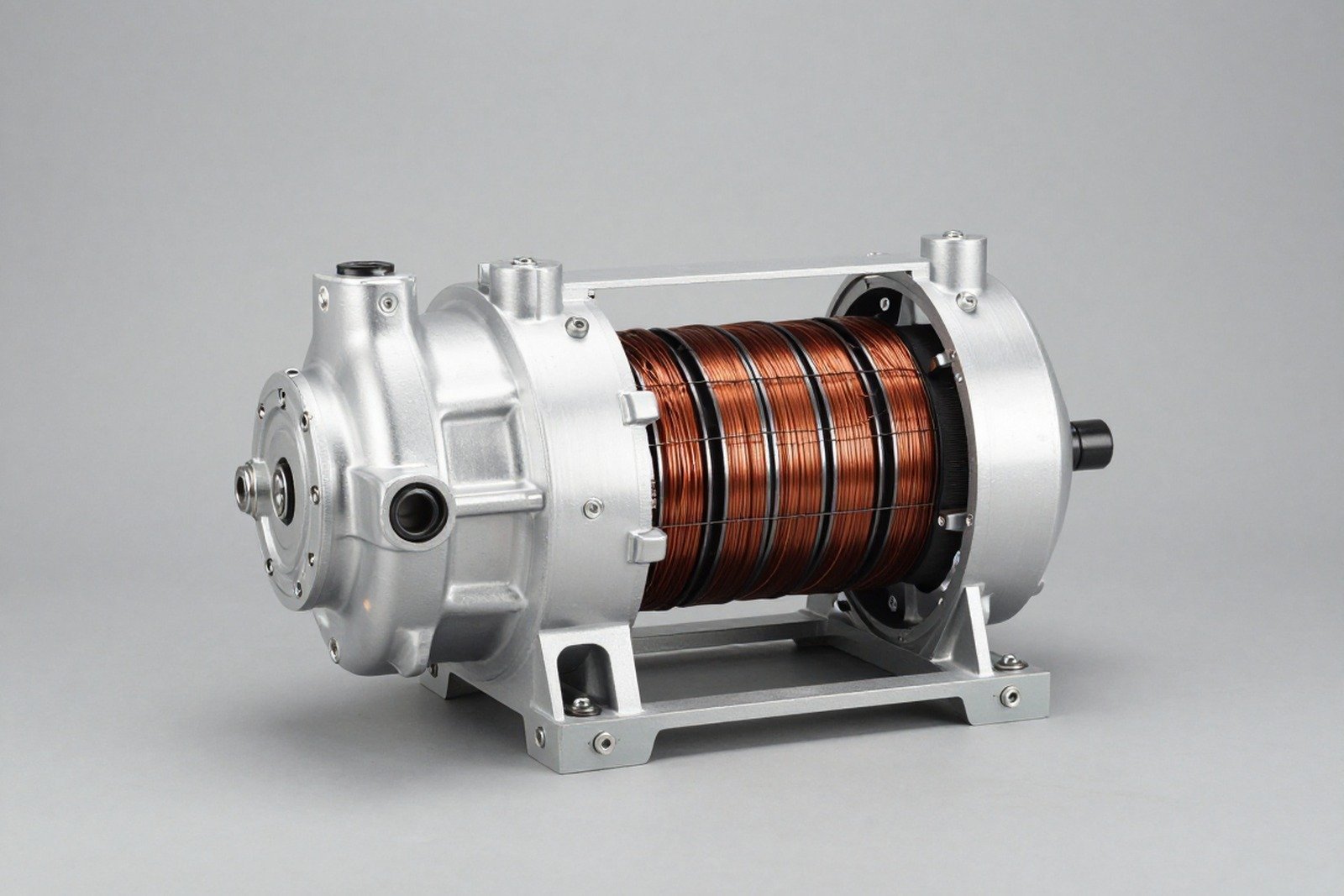
QCVN 90:2024/BGTVT was issued under Circular No. 48/2024/TT-BGTVT dated 15 November 2024, took effect on 1 January 2025 and replaced QCVN 90:2019/BGTVT; it was drafted by the Vietnam Register and applies to motors used in new electric motorcycles and mopeds that are manufactured, assembled in Vietnam or imported. The regulation sets out eight groups of technical requirements tied to eight tests, covering power, efficiency, overload capability, insulation, temperature rise, enclosure protection and controller protection functions. For assemblers of electric two-wheelers and importers of motors, three questions decide the timetable of a dossier: which technical thresholds must be met, how many samples are required, and what documents must be prepared. This article summarises sections 1 to 4 together with Appendix A and Appendix B of the regulation, and highlights the points that most often cause re-testing.
1. Issuing document, effective date and scope of application
| Item | Provision |
|---|---|
| Issuing document | Circular No. 48/2024/TT-BGTVT dated 15 November 2024 of the Ministry of Transport |
| Regulation | QCVN 90:2024/BGTVT – National technical regulation on motors used for electric motorcycles and mopeds |
| Effective date | 1 January 2025 |
| Replaces | QCVN 90:2019/BGTVT |
| Drafting body | Vietnam Register |
| Scope | Motors used for new electric motorcycles and mopeds, whether manufactured or assembled in Vietnam or imported |
| Implementing authority | Vietnam Register |
The scope is limited to motors of electric two-wheelers. Motors for electric cars fall outside QCVN 90:2024/BGTVT and are covered by other regulations on road vehicles. Importers should distinguish the two groups at the classification stage, because the dossier, the tests and the receiving authority differ.
The requirements in the regulation are the conditions for a motor to be certified for technical safety quality and environmental protection. Alongside QCVN 90:2024/BGTVT, import quality inspection is also governed by the general legal framework on product and goods quality management, currently Law No. 78/2025/QH15 with its risk-based approach.
2. Eight groups of technical requirements and the corresponding tests
Section 2 of the regulation contains eight groups of requirements. Each requirement is tied to a specific test in Appendix A, so a dossier should be prepared by reading both parts together rather than checking the specification sheet alone.
| Clause | Requirement | Threshold and content of inspection | Test (Appendix A) |
|---|---|---|---|
| 2.1 | General requirements | Construction and specifications consistent with the manufacturer’s declared data; surfaces free from rust, cracks and peeling paint; fasteners securely mounted | A.2 – visual inspection |
| 2.2 | Power | Maximum power consistent with the declared data, tolerance ±5%; measured with the motor running at maximum power | A.3 |
| 2.3 | Efficiency | At rated voltage: not less than 75% at rated torque; not less than 70% at 50% and at 160% of rated torque | A.3 |
| 2.4 | Overload capability | No visible mechanical deformation; the motor continues to operate normally | A.4 – torque of 2.5 times rated torque for 1 minute |
| 2.5 | Insulation | Normal operation after the insulation test between windings; insulation resistance between windings and housing not less than 100 MΩ | A.5.1 – 1.3 times rated voltage for 3 minutes; A.5.2 – 250 V megohmmeter (rated voltage up to 36 V) or 500 V (above 36 V) |
| 2.6 | Temperature rise | Temperature rise of the winding not more than 65 °C; of the housing not more than 60 °C | A.6 – resistance method for windings (factor k = 235 for copper, 225 for aluminium), thermometer for the housing |
| 2.7 | Enclosure protection | Protection against water jets and against ingress of solid objects larger than 1 mm in diameter (IP43) | A.7 – 1 mm steel wire at 1 N ± 0.1 N; jet spray for not less than 10 minutes, or hand-held device at 80-100 kPa, 10 l/min for a total of not less than 5 minutes |
| 2.8 | Controller protection functions | Undervoltage and overcurrent protection available; protection voltage and protection current consistent with the declared data | A.8 – gradually reduce voltage until the circuit trips; gradually increase torque until overcurrent protection operates |
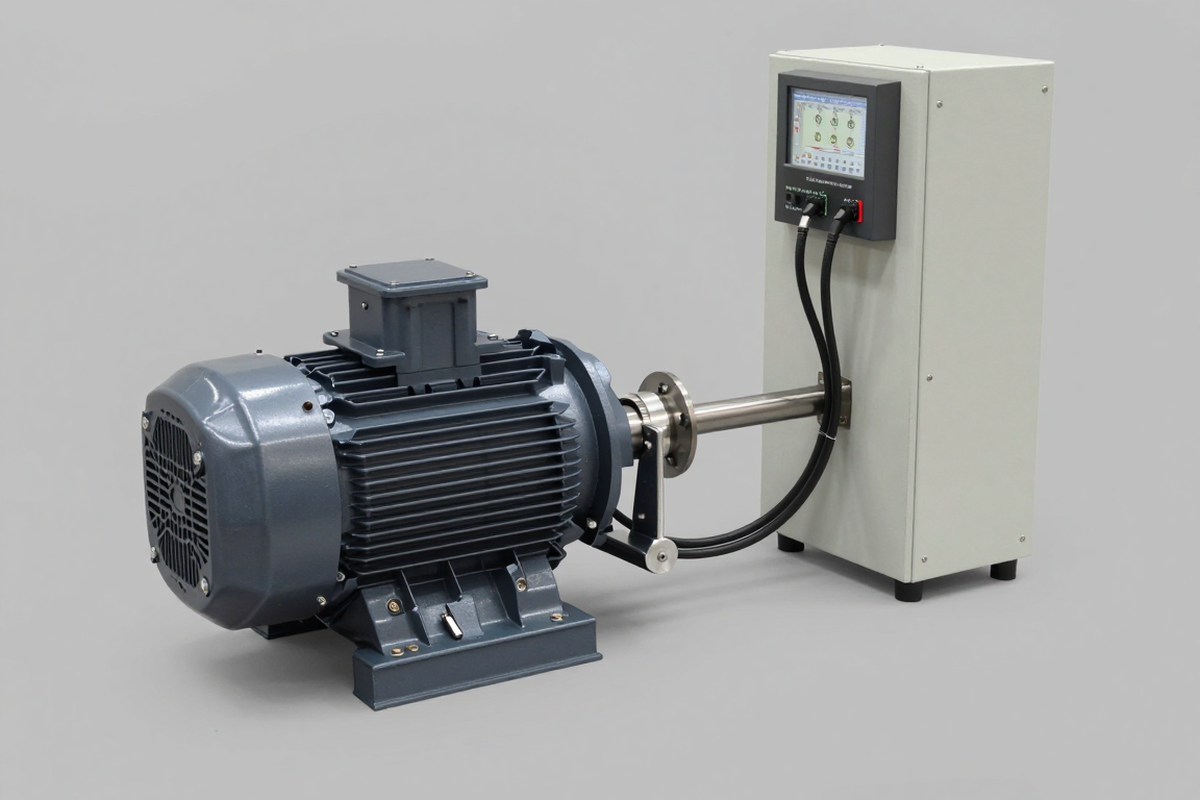
Three clauses most often cause re-testing: 2.3, 2.5 and 2.7. Efficiency is measured at three load points, and 160% of rated torque is the hardest point for many existing motor designs; optimising efficiency only in the usual load range tends to fail at that point. Insulation resistance must be measured with a megohmmeter of the correct voltage class for the rated voltage declared in the registration file, so a mismatch between the technical file and the nameplate can invalidate the result. For IP43, the test is carried out while the motor is running; afterwards no water may accumulate inside the motor and the motor must operate normally.
3. Nameplate, motor number and identification
The regulation imposes three identification requirements. The rated voltage and rated power must be marked on the motor at a position visible after the motor has been fully installed (clause 2.1.3). The motor must carry a motor number that is legible, not over-stamped or erased, placed at a position visible after full installation (clause 2.1.4). The electric controller must be marked with brand, type number, manufacturer and operating voltage (clause 2.1.5).
The condition “visible after full installation” is often handled too late. In many dossiers the motor number position passes on the test bench but is hidden by the frame, body panels or swingarm once the motor is mounted on the vehicle, and paper labels on the housing fade or peel after some time in service. A safer approach is to fix the stamping position and the marking position at the housing design stage and to use heat-resistant, oil-resistant label material.
4. Measuring equipment, test conditions and how efficiency is determined
Clause A.1 sets the accuracy of measuring instruments. Thermometers must have a scale division or step of not more than 1 °C and an accuracy of 0.5 °C. Torque measuring devices and rotational speed devices must have an error not greater than 1% of the measured value. DC voltmeters, DC ammeters and ohmmeters must have accuracy class 1. Ambient temperature during testing must not exceed 35 °C.
The power and efficiency test (clause A.3) is performed on a dynamometer: the output shaft of the motor or of the transmission is coupled to the torque measuring device, and the power measuring device is connected between the power source and the controller. The motor runs at no load at rated voltage, then torque is increased in small steps while torque and rotational speed are recorded at each measuring point. Output power is calculated from these two values and includes a correction factor α: α equals 1 when the measuring point is the motor output shaft; when the measuring point is downstream of the transmission, α is calculated from the transmission efficiency, which is the product of the efficiency of each component (spur gears 0.98; helical gears 0.97; bevel gears 0.96; roller chain 0.95; timing belt 0.95; hydraulic coupling 0.92).
Efficiency is the ratio between output power and input power, determined at three torque values: rated torque, 50% and 160% of rated torque. The result therefore depends both on motor design and on the transmission configuration supplied with it, and businesses should agree with the testing laboratory in advance on the torque measuring point so that the factor α is applied correctly.
5. Technical documentation, sampling and certification
Under clause 3.1, imported, manufactured and assembled electric motors must be inspected, tested and certified in accordance with the rules on technical safety quality and environmental protection for road vehicle spare parts; the detailed order and procedures follow the current circulars of the Ministry of Transport on certification of quality for road vehicle spare parts in production, assembly and import.
The technical documentation according to the template in Appendix B includes: name and address of the manufacturing or importing entity; brand; type number; motor number; design code; motor type; rated voltage; rated power; maximum power; rated torque; controller parameters (brand, type number, operating voltage, manufacturer, protection voltage value, protection current value, number of speed stages); transmission if any; mass; number of speed stages of the motor; explanation of the motor number stamping method and position; photographs of the motor, controller and nameplate, with an overlapping seal.
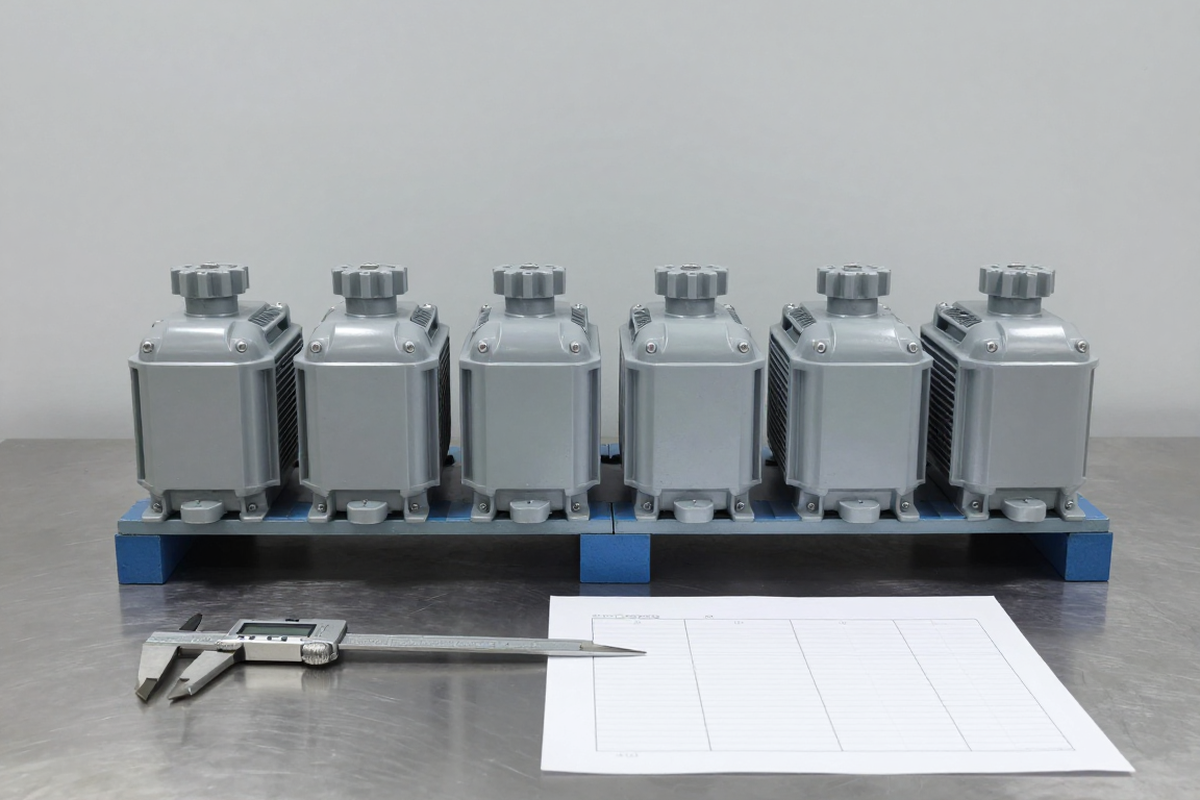
On sampling (clause 3.2.2), each sample must be accompanied by the assemblies needed for the motor to operate normally. The number of samples depends on the source of goods and the size of the batch:
| Case | Number of samples | Sampling method |
|---|---|---|
| Import, batch up to 100 units | 02 | Randomly selected from the imported batch |
| Import, batch from 101 to 500 units | 04 | Randomly selected from the imported batch |
| Import, batch over 500 units | 06 | Randomly selected from the imported batch |
| Manufacture or assembly in Vietnam – type approval | 02 | Representative sample of the registered type |
| Manufacture or assembly in Vietnam – series production | 02 | Randomly selected from products of the same type |
Test reports are issued by the testing facility under clause 3.3. For imported goods, test results are only valid when the testing laboratory is accredited for the exact scope covering the tests in Appendix A; how to verify the scope of accreditation is explained in our guide on choosing a testing laboratory for Vietnam compliance. Submitting the conformity declaration dossier and the self-assessment report follows the current templates; see the set of conformity declaration registration form and self-assessment report.
6. Transitional provisions and implementation responsibility
Section 4 of the regulation assigns implementation to the Vietnam Register. Motor types for which registration files for inspection, testing or certification were received before the regulation took effect continue to be inspected, tested and certified under the rules in force at the time of receipt. Test reports issued before the effective date, and test reports issued under the transitional arrangements above, remain valid for certification after the effective date. Where documents referred to in the regulation are amended, supplemented or replaced, the new documents apply.
7. What businesses need to prepare
- Review the technical specification registration file under Appendix B: rated power, maximum power, rated torque and rated voltage must match between the nameplate, the design documents and the registration file.
- Pre-test efficiency at the three load points (100%, 50% and 160% of rated torque) on a dynamometer; this is the item most likely to require a re-test.
- Measure and record actual insulation resistance to keep a safety margin above the 100 MΩ threshold, especially for motors that have already been run in.
- Review the housing design against IP43: sealing gaskets, cable exit, breather holes and cover joints, because this group of items usually requires tooling changes if discovered late.
- Standardise the nameplate and the motor number position according to the “visible after full installation” condition, prepare the type photographs required by Appendix B, and confirm a testing laboratory with the appropriate scope before submitting the dossier.
8. Frequently asked questions
Does QCVN 90:2024/BGTVT apply to electric car motors?
No. The regulation applies only to motors used for new electric motorcycles and mopeds. Motors for electric cars fall under other regulations on road vehicles.
At which load points is efficiency assessed?
Three points: at rated torque, not less than 75%, and at 50% and 160% of rated torque, not less than 70%, with the motor operating at rated voltage.
Which enclosure protection level is required?
IP43, meaning protection against water jets and against ingress of solid objects larger than 1 mm in diameter. The test is carried out while the motor is running; afterwards no water may accumulate inside the motor and the motor must still operate normally.
What happens to motors with test reports dated before 1 January 2025?
Files received before the regulation took effect continue under the rules in force at the time of receipt, and test reports issued earlier remain usable for certification after the effective date.
Manufacturers and assemblers should lock down the housing design, nameplate position and motor number early, because these items are difficult to change once tooling is cut; importers should confirm the correct goods group, the batch-based sample count and the accreditation scope of the testing laboratory before signing a purchase contract; and testing laboratories should prepare a torque range wide enough to reach 160% of rated torque plus jet-spray equipment as required by clause A.7.
Related reading
- QCVN 32:2026/BCT: EV charging posts and charging stations, and what to prepare before 1 July 2027
- 15 referenced standards in QCVN 32:2026/BCT for charging posts and stations
- High-risk goods requiring QCVN 4 testing under Circular 36/2026/TT-BKHCN
- What is UN 38.3? Eight lithium battery tests (T1-T8) and their relevance to electric vehicles
References
- Circular No. 48/2024/TT-BGTVT dated 15 November 2024 of the Ministry of Transport, issuing national technical regulations on technical safety quality, environmental protection and energy consumption for road vehicles, special-purpose vehicles, road vehicle spare parts and child restraint systems. Published on the Government Portal: congbao.chinhphu.vn – Circular No. 48/2024/TT-BGTVT.
- QCVN 90:2024/BGTVT – National technical regulation on motors used for electric motorcycles and mopeds: clauses 1.1-1.2, 2.1-2.8, 3.1-3.3, 4.1-4.4, Appendix A (test methods) and Appendix B (technical specification registration form).
- Law No. 78/2025/QH15 amending and supplementing a number of articles of the Law on Product and Goods Quality, applicable to import quality inspection and conformity declaration.
Note: this article is for information only and does not replace legal documents or legal and technical advice for any specific case. When applying it, always check the original text of QCVN 90:2024/BGTVT and Circular No. 48/2024/TT-BGTVT together with any amendments or replacements in force.