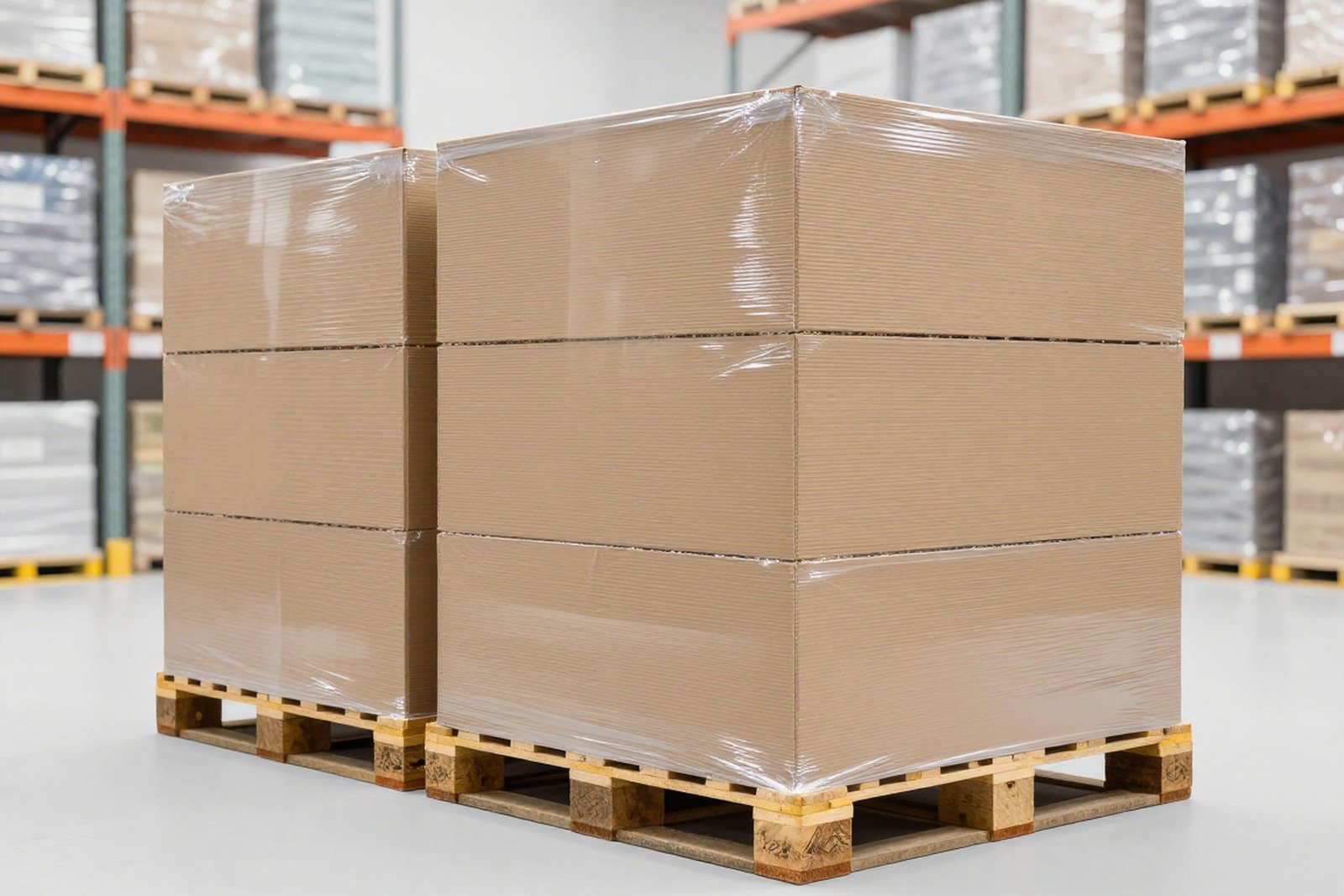
The question our laboratory hears most often before an ISTA 6-SAMSCLUB test is: what do we need to prepare. This is a programme of the Sam’s Club retail chain, where goods do not travel as single cartons to the buyer but as pallets into the distribution centre and onto the shop floor. So the information needed is not only carton strength, but also how the pallet is built and how the goods stand on the shelf. The short answer is the five groups below.
1. Information about the carton and the pallet
- Outside dimensions of the individual carton: length, width, height.
- Weight of one carton and weight of the finished pallet.
- How many cartons per layer and how many layers per pallet.
- Pallet pattern: straight stacking or interlocked, with or without slip sheets between layers.
- How the load is fixed: stretch film, corner boards, plastic strapping, or a combination.
- Whether the carton is a display carton that sells straight from the shelf once opened.
2. Information about the journey and the selling format
- Which vehicle moves the goods from the factory to the chain’s distribution centre.
- How long the goods stay in the distribution centre before going to the store.
- Whether the goods pass a transit warehouse or go directly to the store.
- Whether the pallet is handled by forklift or by hand when it goes onto the floor.
- Temperature and humidity in the distribution centre and in the selling area.
3. Information about samples
- Number of pallets to be tested, plus spare cartons to replace damaged samples.
- Whether the sample is built exactly like the pallet actually shipped, including layer count and pattern.
- Whether labels, barcodes and display trays are fitted on the sample.
- Whether samples must be retained to compare with mass production pallets.
4. Pass and fail criteria
- Acceptable level of product damage.
- Acceptable level of carton damage, especially for cartons used as display trays.
- Whether the pallet may lean, sag or delaminate after the test.
- How to inspect after the test: visual check, photos of each pallet face, or measurement of load lean.
5. Reporting and timing
- A report in the chain’s template, in English.
- Photos of the pallet before and after the test, plus close-ups of affected layers.
- Whether the carton drawing, the pallet drawing and material data must be supplied.
- The date the result is needed, including pallet transit time.
6. Why pallet build matters more than single carton strength
In this channel most damage does not happen to one carton. It happens to the whole pallet: the bottom layer sags, the load leans, the top layer slides when the truck turns or when a forklift lowers it too fast. A very strong carton can still end up inside a failed pallet. A mid-grade carton built in the right interlocked pattern with corner boards keeps the load stable for the whole journey. Our laboratory therefore asks for the pattern actually used at the factory, not a tidy sample built for a photograph. A gap between the sample pallet and the production pallet is the most common reason a report is queried, even when the test result passes.
Three articles worth reading before sending samples: what ISTA 3E is, pass and fail criteria for ISTA packaging tests, and cost and lead time of ISTA packaging tests.
You can send the five groups above through the form below, with photos of the real pallet shipped to the chain. The laboratory will reply with the test list and the number of pallets needed.
This article reflects our testing laboratory’s experience in collecting information. It does not quote the content of the ISTA standard and does not replace reading the original standard before implementation.