


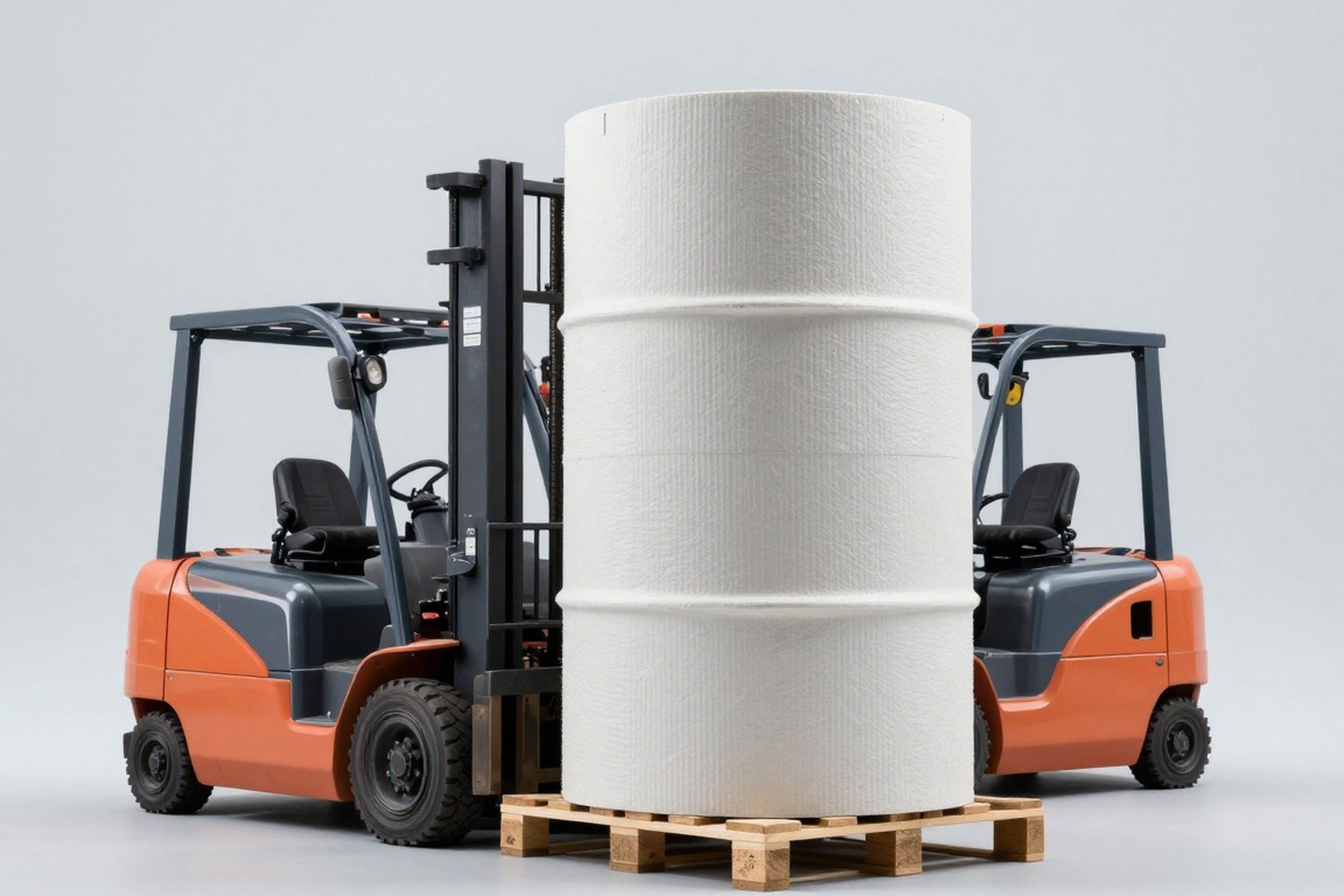
The question our testing laboratory receives most often before an ISTA 3H test is simple: what do we need to prepare. This procedure covers large bulk containers that are handled by mechanical equipment. The goods are heavy and the samples are expensive, so the information has to be more precise than usual. The short answer is the five groups below.
1. Information about the container
- Type of container: large carton, wooden crate, collapsible container, or industrial plastic bin.
- Outer dimensions and total weight when full.
- Whether there is an inner liner, a lid, or a moisture barrier.
- Single-trip or reused across many shipments.
- Whether there are vulnerable details such as valves, discharge ports, plastic caps, or a reinforcing frame.
2. Information about the contents
- Whether the contents are loose, granular, powder, or liquid.
- Weight of the contents and the fill level at shipment.
- Whether the contents have special requirements on temperature, humidity, or resistance to heavy impact.
- Whether the contents are classified as dangerous, flammable, or subject to a safety declaration.
3. Information about handling and the journey
- Handling equipment: forklift, crane, or dedicated attachment. State the fork type and how many lifting points.
- How many lifts and set-downs per trip, and the stacking height in the warehouse.
- Distance, mode of transport, and time in storage.
- Temperature and humidity along the route, especially for sea freight.
- Whether the contents are transferred from one container to another en route.
4. Pass and fail criteria
- The acceptable level of container damage: dented, cracked, lid sprung, deformed base.
- Whether leakage or loss of contents is acceptable at all, and to what extent.
- The acceptable level of contamination, moisture ingress, or foreign matter.
- How the container is examined after the test: reweighing, leak check, or visual inspection.
5. Report and timing
- Report in Vietnamese, English or bilingual.
- Video of the lifting and set-down steps, since this is the part hardest to prove afterwards.
- Test report only, or an additional association certification.
- The date the results are needed, allowing for shipping a heavy sample.
6. Why the handling method has to be stated
With large bulk containers, damage usually starts with a lift taken at the wrong point or a set-down that is not gentle, not with vibration over a long distance. For the same container, lifting with two forks instead of four puts different stress into the base; a drop from height produces a local shock that no vibration test reproduces. If the customer does not state the handling equipment and the number of lifting points, the lab has to pick an assumption, and that assumption may miss the exact weak point of the container.
Three links worth reading before you send samples: what ISTA 3H is, pass and fail criteria in packaging testing, and what testing cost and lead time depend on.
You can send the five groups above through the form below, together with photos of the container and of the lifting points. The lab will reply with the test items, safety requirements and an expected schedule.
This article reflects our testing laboratory’s experience in collecting information. It does not quote the content of the ISTA standard and does not replace reading the original standard before implementation.






