The question our testing laboratory receives most often before an ISTA 2A or 2B test is simple: what do we need to prepare. These two procedures simulate part of the journey and add climate conditioning and a compression step, so more information is needed than for a screening test. The short answer is the five groups below.
1. Information about the package
- Outer dimensions: length, width and height, including any pallet.
- Total weight, weighed as shipped, goods plus packaging.
- Whether the package is light or heavy. This is what decides between 2A and 2B.
- Outer packaging: carton, wooden crate, drum, or several layers. State whether there is a pallet.
- Whether the packages are stacked in a warehouse or on a vehicle, and typically how many layers high.
2. Climate conditions to be simulated
- The real temperature and humidity of the route: hot and dry, hot and humid, or cold.
- How long the goods are exposed to those conditions, in days or weeks.
- Whether there is a phase where goods sit in a container at the port, in an unconditioned warehouse, or on an open truck.
- Whether more than one condition has to be simulated. Each one occupies the chamber separately.
3. Information about samples
- Number of packages submitted. Three to five are recommended for one evaluation.
- Whether the samples are packed in the retail configuration.
- Whether a control sample is needed for comparison.
- Whether samples have to be kept after the test, and for how long.
4. Pass and fail criteria
- The acceptable level of product damage, described as specific symptoms.
- The acceptable level of packaging deformation after the compression step and after vibration.
- How the package is examined after the test: visual inspection, function check, or measurement of technical parameters.
- Whether there are requirements on odour, internal moisture, or mould.
5. Report and timing
- Report in Vietnamese, English or bilingual.
- Photos and video of each test step, or only before and after photos.
- Test report only, or an additional association certification.
- The date the results are needed.
6. Why the climate conditions have to be stated
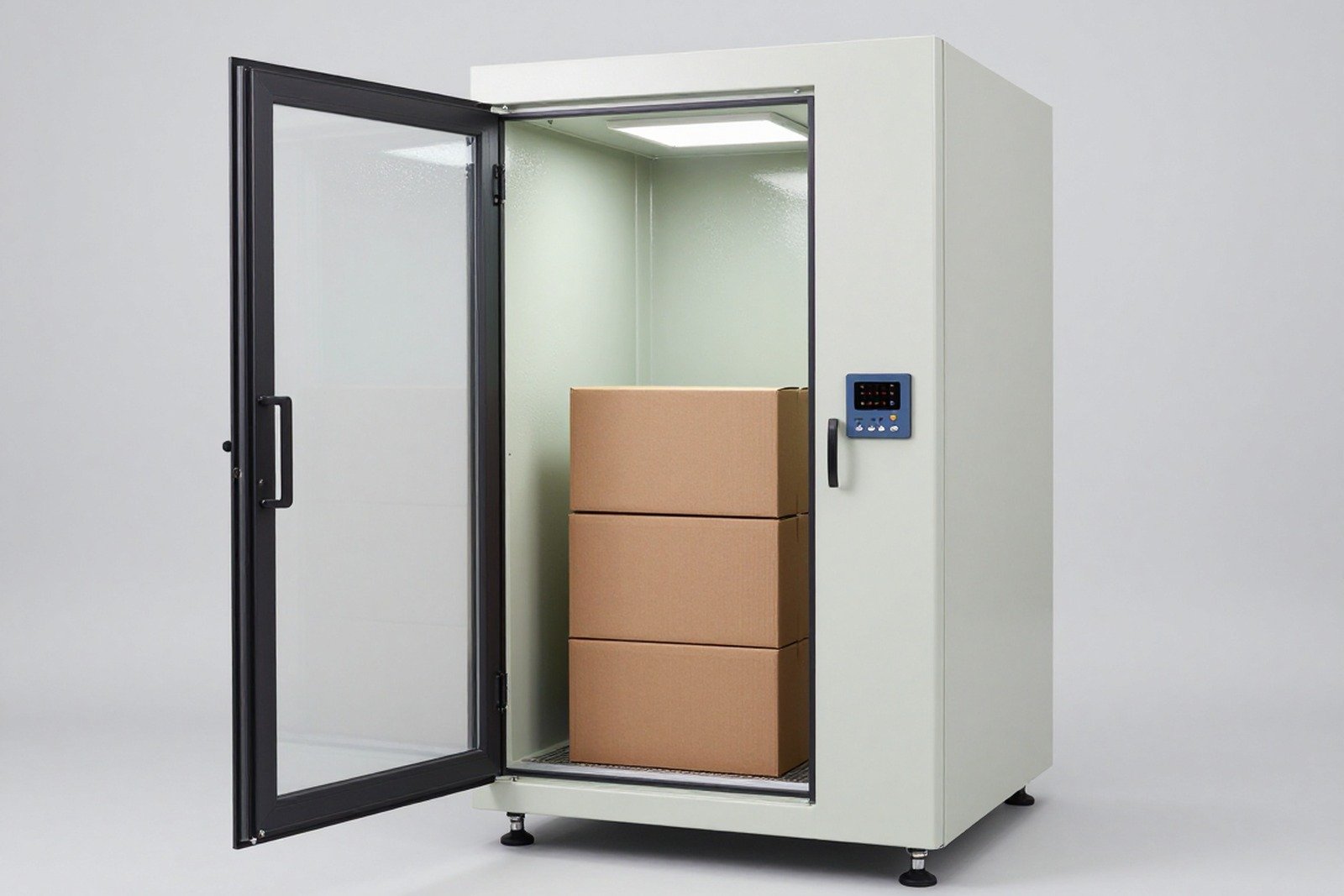
Most damage to export goods does not come from impact but from moisture. Carton board loses stiffness as it absorbs water, plastic film loses toughness, adhesive fails, and the product inside goes mouldy. If the customer only says the goods travel by sea but not the actual temperature and humidity, the lab falls back on default conditions, and the result can be lighter or harsher than reality. Stating the conditions also fixes the conditioning time, and that step occupies the chamber longer than any other part of the programme.
Three links worth reading before you send samples: what ISTA 2A is, what ISTA 2B is, and 12 or 72 hours of conditioning.
You can send the five groups above through the form below, together with photos of the package. The lab will reply with the test items and an expected schedule.
This article reflects our testing laboratory’s experience in collecting information. It does not quote the content of the ISTA standard and does not replace reading the original standard before implementation.