1. What is ISTA 2B?
ISTA 2B is the test procedure partial simulation (Partial Simulation Performance Test) of ISTA, applicable to individual packages weighing more than 150 lb (68 kg) has been packaged and ready to be sent.
ISTA describes Series 2 as the combines the basic elements of Series 1 (Non-Simulation Integrity) with enhanced Series 3 elements (General Simulation). With 2B, the “advanced” part appears in three places: yes controlled climate step, yes compression category, and yes Two vibration steps surround the impact item (total 7 steps).
Three limitations ISTA clearly states in the overview, which should be discussed with the client before using the results: Series 2 articles Challenge the tolerance of packaging and products, but only simulates some real shipping risks, and It is not necessary to comply with the shipping company’s packaging regulations.
2B is often considered for heavy goods for international distribution, bulky goods that need to compare packaging options, or as a “screening” step before deciding to invest in general simulations (Series 3).
2. Most common misunderstanding about ISTA 2B
- “2B is an upgrade of 1B so it’s definitely more suitable.” — 2B more categories 1B (7 steps vs. about 4 steps, with additional controlled conditioning and compression), but ISTA still classifies 2B as partial simulation. More items does not mean it can simulate the real journey.
- “REACHing 2B means meeting the shipping carrier’s packaging requirements.” — No. Overview of ISTA clearly states the Series 2 articles It is not necessary to comply with the shipping company’s packaging regulations.
- “For heavy goods on pallets, just use 2B.” — Not really. ISTA allows parcels on the skid/pallet is clearly visible switch to 1E or 3E — process groups dedicated to bulk cargoes. Choosing the wrong group will mischaracterize the risk.
3. What does ISTA 2B test? — 7-step sequence
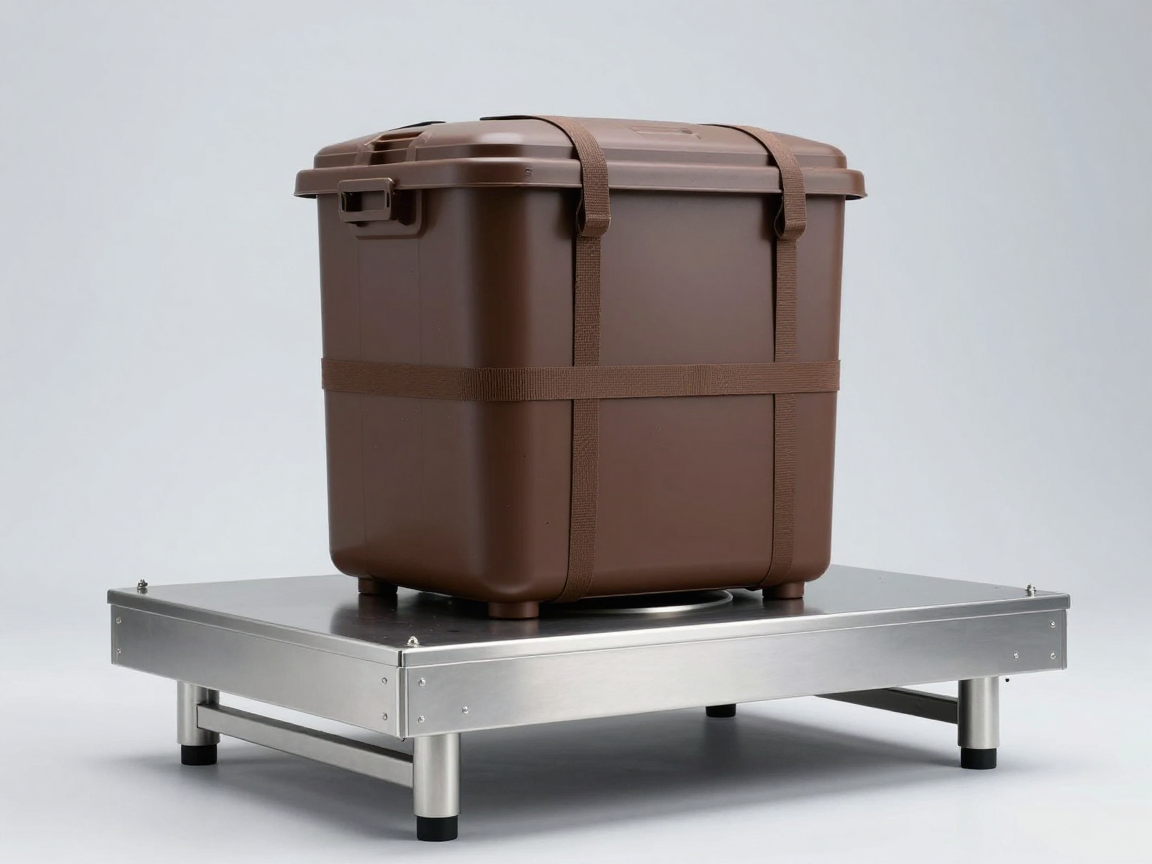
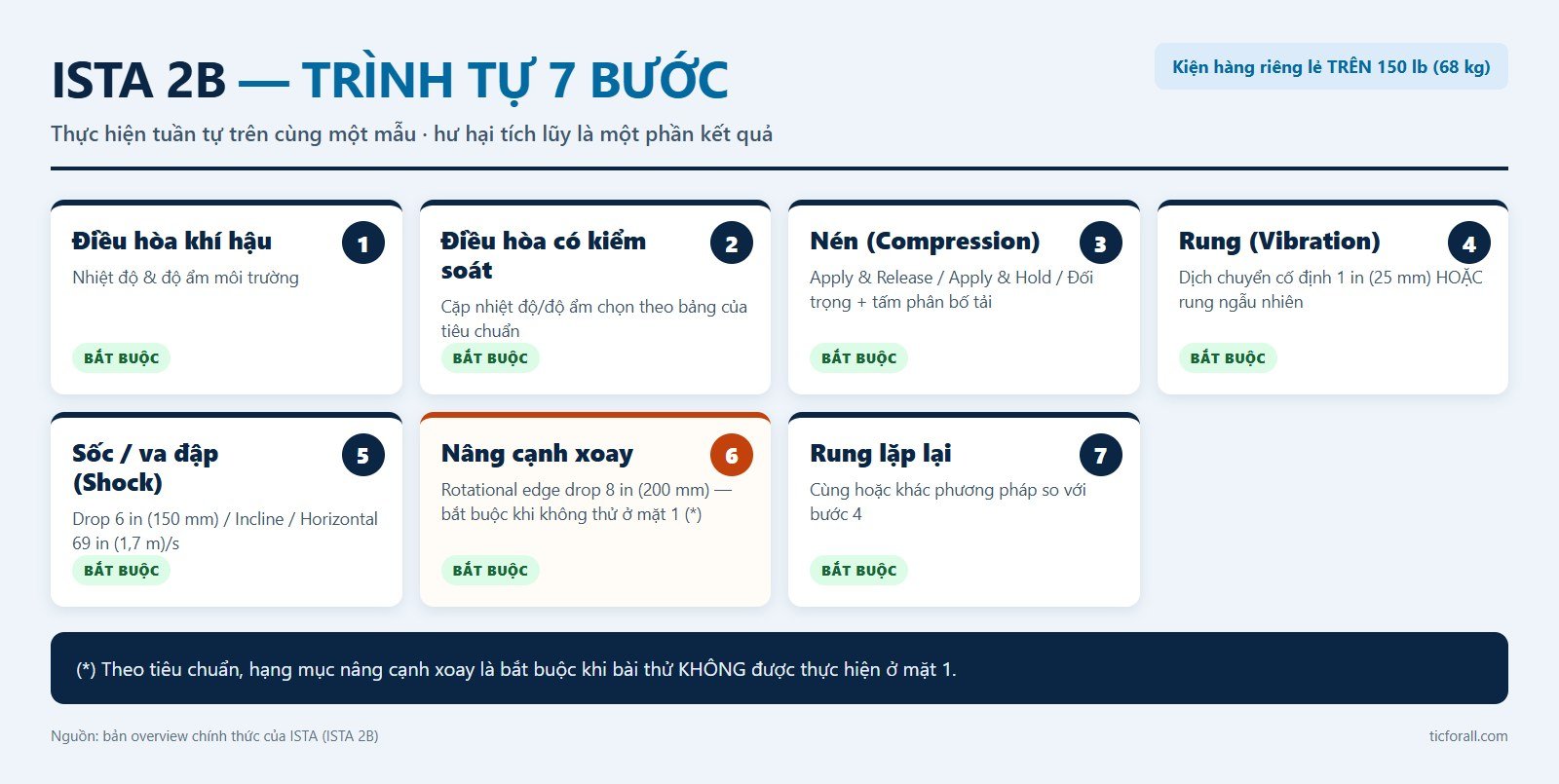
All 7 steps are done sequentially on the same sample. Accumulated damage from the previous step is part of the result.
| Step | Category | Test type | Required |
|---|---|---|---|
| 1 | Atmospheric Preconditioning | Environmental temperature and humidity | Required |
| 2 | Atmospheric Conditioning | Temperature/humidity is selected according to the standard table | Required |
| 3 | Compression | Apply & Release / Apply & Hold / Weight and Load Spreader | Required |
| 4 | Vibration | Fixed displacement or vibrate randomly | Required |
| 5 | Shock | Drop 6 in (150 mm) / Incline Impact / Horizontal Impact | Required |
| 6 | Shock — Rotational Edge Drop | 8 in (200 mm) | Required when not tested on side 1 |
| 7 | Vibration — repeat | Fixed displacement or vibrate randomly | Required |
The three parameters in bold in steps 5 and 6 are the test levels published by ISTA in the free overview of 2B. The full drop height/velocity table by mass step must still be obtained from the original document.
Standard note: steps 4 and 7 are allowed same or different vibration method; The report must clearly state which method is used for each step.
Step 1 — Atmospheric Preconditioning
Templates are saved in ambient temperature and humidity conditions of the laboratory according to the time specified in the standard. Temperature and humidity must be recorded at the beginning and at the end.
Step 2 — Atmospheric Conditioning
Sample is included air conditioning chamber with temperature/humidity couple Choose according to the table of standards. With heavy goods, this is often the step that takes up the most time and space, because bulky samples must enter and exit the chamber using lifting equipment.
Step 3 — Compression
Simulate stacked loads. The standard allows choosing one of three variations: Machine Apply & Release (press up to the calculated force with compensation factor then release immediately), Machine Apply & Hold (press and hold the load for the specified time), or Weight and Load Spreader (counterweight + load distribution plate). Test force/load is calculated according to the formula depending on the package weight and box size, then is limited to the minimum – maximum range of the standard.
⚠️ Safety: With goods over 68 kg, the operation of placing/holding the load and counterweight is the highest risk point for occupational accidents in the test. There must be lifting procedures and a safe distance before starting.
Step 4 — Vibration
Choose one of two methods, and other methods than step 7 are allowed:
- Fixed displacement vibration — the vibrating table has moved forward 1 in (25 mm) peak–peak according to ASTM D 999 (Method A1 or A2); Rotational or vertical movements are acceptable; The test frequency must be determined.
- Vibrate randomly — according to ASTM D 4728, with total Grms level as prescribed by the standard.
Step 5 — Shock
Choose one of three methods: Drop — for packages over 150 lb, the specified drop height is 6 in (150 mm); Incline Impact (Conbur) — change velocity 69 in (1.7 m)/second; Horizontal Impact — also changes velocity 69 in (1.7 m)/second. For other mass levels, height/velocity is taken from the table in the original document.
Step 6 — Rotational Edge Drop
The sample is lifted at one edge and dropped rotated to the ground, the test level 8 in (200 mm). Point to note: this item Required when the test is not performed on side 1. This is a specific category of the heavy goods group – simulating the situation of the package tilting and falling on its sides when loading and unloading, something that the flat falling card cannot simulate.
Step 7 — Vibration
After the two impact items, the sample is vibrated again in a degraded state. With heavy goods, this is a step that easily reveals accumulated damage to the pallet bottom structure, straps and corner joints.
4. Accompanying equipment and method standards
| Category | Equipment | Method standards |
|---|---|---|
| Climate conditioning | Air conditioning chamber + temperature and humidity recording device | ASTM D 4332 |
| Compression | Apply & Release / Apply & Hold compression system; or load distribution plate + counterweight | ASTM D 642 (counterbalancing variant only: not referenced) |
| Fixed displacement vibration | 1 in (25 mm) vibration table, ~0.06 in (1.5 mm) metal base plate, frequency meter, timer | ASTM D 999 (Method A1/A2) |
| Vibrate randomly | Random vibrating table system | ASTM D 4728 |
| Free fall | The machine falls freely | ASTM D 5276 |
| Vertical shock | Shock machine | ASTM D 5487 |
| Incline (conbur) | Inclined impactor | ASTM D 880 |
| Horizontal impact | Horizontal impact system | ASTM D 4003 |
| Raise the rotating edge | Rotational drop device | ASTM D 6179 |
With heavy goods, three technical questions determine the ability to perform the test: the falling machine/impact device has enough load and table size, the vibrating table has enough travel to reproduce the amplitude or spectrum, and the lab has a lifting facility to move the sample in and out of the air conditioning chamber. This is a parameter that should be checked before Register to try.
5. Number of samples and sample preparation
2B is for packages over 68 kg (150 lb), and it changes sample preparation in three specific ways.
- Model Number: a template for all seven steps; ISTA Recommended repetitions 5 times or more with new samples each time. Loading and unloading costs make repetition more expensive than lighter exercises, so the number of repetitions needs to be agreed upon in advance.
- Sample shipping: Must use appropriate vehicles and tie-downs; A sample that is misaligned on the way to the lab is considered to have finished testing before entering the test chamber. If possible, Repackage with new packaging at the lab instead of shipping packaging that has already endured the journey.
- Declaring configuration and load center: mass, size, center of gravity position and method of securing goods. Step Raise the rotating edge at the end of the sequence depends directly on the focus, so this information must be correct from the beginning.
- If the test does not take side 1 as the standard, the sample must be intact enough to complete the rotating edge lift at the end — this is why samples that show signs of pre-existing damage should not be used.
💡 With heavy packages, packaging damage is more dangerous: Just one flattened corner can destabilize an entire column of goods stacked in a warehouse or container. If the goods have been stored, they should be classified as “flattened packaging causing stacking collapse”. failed right from the criteria.
Pass/fail criteria predetermined by the business: see 4 criteria businesses must determine for themselves before trying.
6. When should ISTA 2B not be used?
| Situation | Recommended procedure | Why? |
|---|---|---|
| Package over 150 lb on exposed skid/pallet | ISTA 1E / ISTA 3E | ISTA allows switching to process groups for bulk/pallet loads |
| Just basic strength testing, no controlled conditioning or compression required | ISTA 1B | Fewer items, lower costs |
| Want to use random vibration in the form “vibration + shock only” | ISTA 1H | The correct component needs to be checked, not dragging other items |
| Need to forecast performance according to specific distribution channels | ISTA 3 Series (e.g. 3E) | General simulation, taking into account the transport channel |
| The carrier/customer requires a specific process | According to that request | 2B does not necessarily comply with the carrier’s packaging regulations |
7. Common mistakes when implementing ISTA 2B
- Skip step 6 (raising the rotating edge) because “step 5 has already fallen”. The two categories simulate two different risks; Rotational edge drop is also required when the test is not performed on side 1.
- The wrong process group was selected for the goods on the pallet. Bales on skids/pallets are clearly visible so consider 1E or 3E instead of 2B.
- Miscalculation of compression force due to mixing inch–pound and SI units. The formula accepts only one consistent system of units.
- Did not check device load/size before registering. Heavy goods can exceed the load or exceed the size of the lab table; Late discovery causes the entire scheduling session to be lost.
- Use the same pattern for all 5 iterations or use shipped samples without repackaging.
- Finalize pass/fail criteria after testing. The four criteria must be determined in advance, otherwise the result will only be an opinion.
8. What does the cost and time of the ISTA 2B test depend on?
2B is for bales over 68 kg (150 lb) so heavy lifting equipment and vibrating tables are required. Also, step Raise the rotating edge — performed when the test does not take side 1 as the standard — requires separate operations and equipment; This is an item 2A does not have, and is also an easily overlooked part when asking for a quote.
The remaining two variables are the choice of vibration method at each step and the number of iterations. Summary of common factors: What does the cost and time of ISTA packaging testing depend on?
9. Frequently asked questions
How is ISTA 2B different from ISTA 1B?
1B is a monolithic durability test for loads over 150 lb: environmental conditioning, fixed displacement vibration, impact, and rotating edge lift. 2B add Controlled atmospheric conditioning, extra compression category, and one more step of vibration after impact — total 7 steps.
Why does 2B have a mandatory rotating edge step?
Because with packages over 68 kg, the actual risk is not just “falling flat” but also tilted and fallen edges when loading and unloading, getting on and off vehicles or storing in warehouses. A flat drop card does not simulate this situation. The standard requires this item when the test is not performed on side 1.
My goods are 200 kg, packed on pallets with wrapping film — use 2B or 3E?
Need to distinguish visible skid/pallet with single packages. For whole unit loads on pallets, ISTA allows use 1E or 3E — 3E simulates the distribution channel more closely. Should be finalized according to actual channels and end-customer requirements.
Does reaching 2B mean that the goods are not damaged during transportation?
No. The result means that the sample has withstood the specified test sequence, compared with Failure criteria are determined by yourself before testing. 2B is still a partial simulation.
Can step 4 and step 7 use two different vibration methods?
Okay. The standard allows for both steps with fixed displacement vibration, with random vibration, or one type each — as long as the report clearly states which method each step uses.
10. Conclusion
ISTA 2B is a partial simulation procedure for individual packages over 150 lb (68 kg), incl 7 sequential steps on the same sample: atmospheric conditioning at ambient conditions, controlled conditioning, compression, vibration, impact, rotating edge lift and repetitive vibration.
Two points determine the quality of the result: Four pass/fail criteria must be finalized before testing, and The rotating edge lift item must not be overlooked when the test does not perform on side 1. And like all Series 2 tests, the result is 2B no automatically meets the shipping company’s packaging regulations.
References
- ISTA — Test Procedures (list of current series and procedures)
- ISTA — Procedure 2B — Overview and equipment required (free overview published by ISTA)
- ISTA — Certify Your Lab (information about laboratory certification)
- ASTM — method standards cited in the procedure: D 4332, D 642, D 999, D 4728, D 5276, D 5487, D 880, D 4003, D 6179
Related articles
- What Is the ISTA Standard? How to Choose the Right Transport Packaging Test (3A, 6-Amazon, ASTM D4169)
- What Is ISTA 1B? The Complete Packaging Test Procedure for Packages Over 150 lb (68 kg)
- What Is ISTA 1D? The Extended Packaging Test Procedure for Packages Over 150 lb (68 kg)
- What Is ISTA 1E? The Test Procedure for Unitized Loads on Pallets
- What Is ISTA 1H? Random Vibration Testing for Packages Over 150 lb (68 kg)
- What is ISTA 2A? Partially simulated packaging test procedures for packages up to 150 lb (68 kg)
- What is ISTA 2C? Packaging test procedure for furniture (Case Goods)
- ISTA Packaging Test Pass/Fail Criteria: 4 Things You Must Decide Yourself
- What is ISTA 3B? Packaging test procedure for LTL shipping (joint shipments)
- What is ISTA 3E? Procedure for testing unitized load traveling by full truck (FTL)
Discuss further
Disclaimer and acknowledgment of intellectual property rights
This article is an explanatory content compiled by us for the purpose of introducing and disseminating knowledge. Article is not a translation, copy, abridgement or replacement of the original standard, and is not evaluated, approved or sponsored by ISTA (International Safe Transit Association)..
The entire content of ISTA standards is copyrighted by the International Safe Transit Association, Inc. (East Lansing, Michigan, USA) — All rights reserved. ISTA® and the ISTA logo are registered trademarks of the International Safe Transit Association, Inc.; Mentioned in this article are for guidance purposes only and do not imply any affiliation, partnership or sponsorship.
Article content For reference only; Before applying for any purpose — testing, evaluation, certification or commercial decision-making — the reader should refer directly to the original ISTA document (the most complete and up-to-date version) and consult an accredited testing facility when necessary.
When performing testing, it is mandatory to use the official, current version of the standard, obtained directly from ISTA. We do not redistribute ISTA materials in any form. Information in this article may be out of date with the current version of the standard.
See more: Copyright Policy & Disclaimer by ticforall.com.