1. What is ISTA 2A?
ISTA 2A is the test procedure partial simulation (Partial Simulation Performance Test) of ISTA, applicable to Individual packages weigh up to 150 lb (68 kg) has been packaged and ready to be sent.
Points to understand correctly from the beginning: 2A no a stronger test than 1A of the same type, also no an abridged version of 3A. ISTA describes Series 2 as the combines the basic elements of Series 1 (Non-Simulation Integrity — monolithic durability test) with enhanced Series 3 elements (General Simulation — general simulation). That means 2A has both a “durability test” part and a “transportation risk simulation” part, but only simulates part actual risks.
ISTA clearly states in the overview: Series 2 articles Challenge the tolerance of packaging and products, but only simulates some real shipping risks, and It is not necessary to comply with the shipping company’s packaging regulations. Those three limitations must be made clear to customers before they use 2A results for any commercial purpose.
2A is often considered when goods are expected for international distribution, when it is necessary to compare packaging options before finalizing the design, or when the goal is “screening” rather than accurately predicting performance on each line.
2. Most common misunderstanding about ISTA 2A
- “2A is in series number 2 so it is definitely better than 1A, using 2A is safe.” — Incorrect in nature. 2A adds a category and adds a simulation element, but ISTA still classifies 2A as a group partial simulation: it only simulates part of the risk. “More items” does not mean “predicting the real journey”.
- “REACHing 2A means meeting the shipping carrier’s packaging requirements.” — No. The ISTA overview clearly lists Series 2 articles do not necessarily comply with the shipping company’s packaging regulations. If the end customer or carrier requires a specific procedure, it must be matched to that procedure.
- “One passing sample is enough to conclude that the packaging is okay.” — ISTA minimum requirements 1 sample, but Recommended to repeat 5 times or more with new sample for each test, to have a basis for talking about the “representative performance” of the packaging. A sample gives only one data point.
3. What does ISTA 2A test? — 6-step sequence

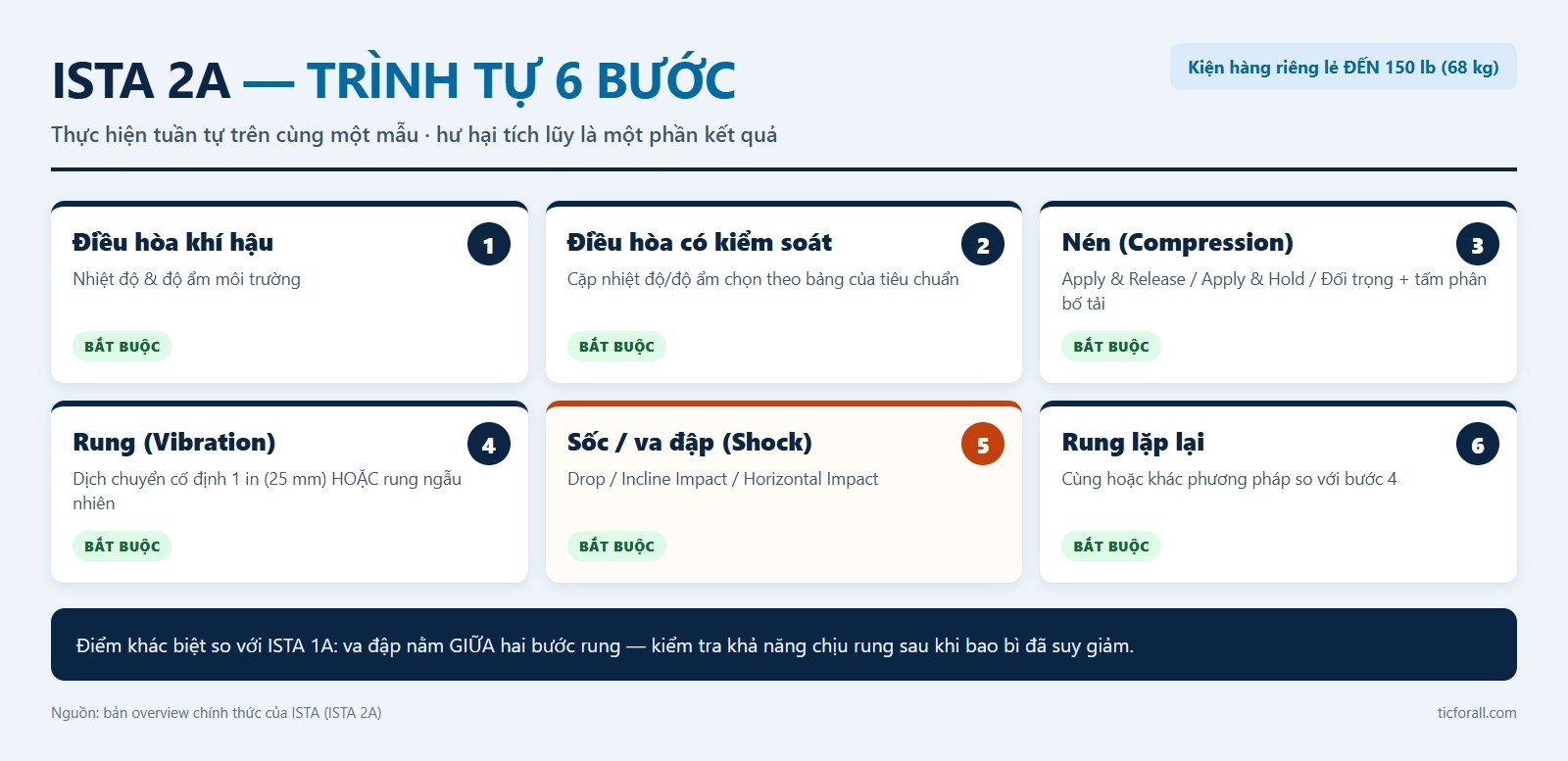
All 6 steps are performed sequentially on the same sample, do not change samples midway. Accumulated damage from the previous step is part of the result.
| Step | Category | Test type | Required |
|---|---|---|---|
| 1 | Atmospheric Preconditioning | Environmental temperature and humidity | Required |
| 2 | Atmospheric Conditioning | Temperature/humidity is selected according to the standard table | Required |
| 3 | Compression | Apply & Release / Apply & Hold / Weight and Load Spreader | Required |
| 4 | Vibration | Fixed displacement or vibrate randomly | Required |
| 5 | Shock | Drop / Incline Impact / Horizontal Impact | Required |
| 6 | Vibration — repeat | Fixed displacement or vibrate randomly | Required |
Important note of the standard: steps 4 and 6 are allowed same or different vibration method; The test report must clearly state which method is used for each step.
Step 1 — Atmospheric Preconditioning
Templates are saved in ambient temperature and humidity conditions of the laboratory within the time specified by the standard before testing. Temperature and humidity must be recorded at the beginning and at the end. This is a mandatory conditioning step, not a performance measure.
Step 2 — Atmospheric Conditioning
Unlike 1A (which only conditions under ambient conditions), 2A has an additional step of sample introduction air conditioning chamber with temperature/humidity couple Choose according to the table of standards. This is the first “advanced simulation” that Series 2 takes from Series 3. Temperature, humidity and time must be noted in the report.
Step 3 — Compression
Simulate stacked loads in warehouses. The standard allows choosing one of three variations:
- Machine Apply & Release — the compressor presses to the calculated force with compensation factor and then releases immediately.
- Machine Apply & Hold — the compressor presses to the calculated force and holds the load for the specified time.
- Weight and Load Spreader — Use load distribution plates and counterweights according to calculated load.
Test force/load is calculated from the formula depending on package weight and box size, then limited to the minimum – maximum range specified by the standard. Full parameter tables and formulas taken directly from the original ISTA document.
Step 4 — Vibration
Choose one of two methods, and Other methods are allowed compared to step 6:
- Fixed displacement vibration — the vibrating table system has moved forward 1 in (25 mm) peak–peak according to ASTM D 999 (Method A1 or A2); Rotary or vertical linear movements are acceptable; The test frequency must be determined.
- Vibrate randomly — according to ASTM D 4728, with total Grms level as prescribed by the standard.
Step 5 — Shock
Choose one of three methods: Drop (drop height varies according to package weight), Incline Impact (Conbur) or Horizontal Impact (impact velocity varies with package weight). The specific fall height and velocity are taken from the table in the original document.
Step 6 — Vibration
After impact, the sample is vibrated again. This is the clearest distinction between 2A and 1A: 1A vibrates once and then impacts, while 2A places the impact in between two vibration steps. Purpose: after the packaging has suffered mechanical damage from a fall, the packaging’s ability to withstand vibration is tested again in a reduced state.
4. Accompanying equipment and method standards
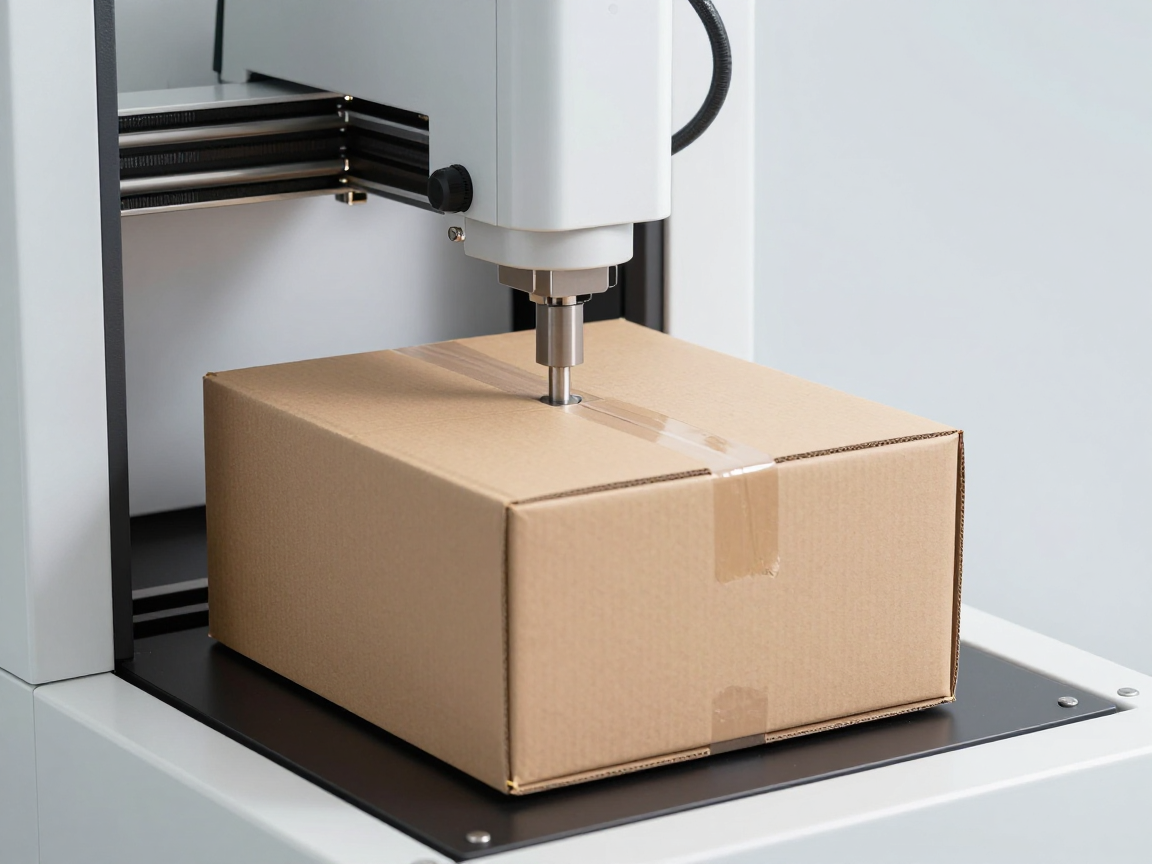
| Category | Equipment | Method standards |
|---|---|---|
| Climate conditioning | Air conditioning chamber + temperature and humidity recording device | ASTM D 4332 |
| Compression | Apply & Release / Apply & Hold compression system; or load distribution plate + counterweight | ASTM D 642 (counterbalancing variant only: not referenced) |
| Fixed displacement vibration | 1 in (25 mm) vibration table, ~0.06 in (1.5 mm) metal base plate, frequency meter, timer | ASTM D 999 (Method A1/A2) |
| Vibrate randomly | Random vibrating table system | ASTM D 4728 |
| Free fall | Free fall drop tester | ASTM D 5276 |
| Vertical shock | Shock machine | ASTM D 5487 |
| Incline (conbur) | Inclined impactor | ASTM D 880 |
| Horizontal impact | Horizontal impact system | ASTM D 4003 |
For the compression category, the standard allows both fixed platen and floating platen. This is a point that needs to be confirmed in advance with the laboratory if the customer has specific requirements for device configuration.
5. Number of samples and sample preparation
In 2A, all six steps run above same sample, and that sample goes through a compression step before entering vibration and then impact. Therefore, the sample needs to be selected and recorded as a benchmark, not just a “goods for testing”.
- Model Number: one sample for the entire sequence; ISTA Recommended repetitions 5 times or more, one new sample at a time.
- Sample must be in correct retail configuration — the same type of box, packing material and sealing method as when shipped. Small delivery packages are often reinforced when sent; do not include the same reinforcement layer in the test sample.
- Record status before testing: weight, external dimensions, six-sided photo and packaging condition. This is the only landmark to attribute future damage.
- Repackage when sending to the lab: Excessive packaging or Repackage with new packaging at the lab.
💡 As for the compression category of 2A: If the package may be stored In the distribution chain, the packaging is so flattened that it can cause damage stacking collapse considered failed. If the goods are not stored, flattened packaging is still acceptable with conditions The product is still within specified tolerances and the packaging is still in sealed condition.
The set of pass/fail criteria is determined in advance by the business, the standards are not defined instead: see 4 criteria businesses must determine for themselves before trying.
6. When should ISTA 2A not be used?
2A has a very real minus: Packages over 100 lb (45 kg) placed on visible skids/pallets then ISTA allows switching to another more suitable process. The table below shows cases where another procedure should be considered:
| Situation | Recommended procedure | Why? |
|---|---|---|
| Just need “can the goods withstand the basic level”, minimum budget | ISTA 1A | Fewer items, still testing monolithic durability |
| Packages over 100 lb (45 kg) on exposed skids/pallets | ISTA 1E / ISTA 2B / ISTA 3E | Correct group of monolithic/pallet goods, more closely simulated |
| Goods go to small delivery systems (parcel) such as UPS/FedEx/DHL | ISTA 3A | ISTA recommends it directly in the overview of 2A |
| Need to forecast performance according to specific journey/distribution channel | ISTA 3 Series | General simulation, taking into account the transport channel |
| The customer/carrier requests a specific process | According to that request | 2A does not necessarily comply with the carrier’s packaging regulations |
7. Common mistakes when implementing ISTA 2A
- Skip step 2 (controlled air conditioning) because “1A is also not available”. This is the core difference between 1A and 2A — removing it is no longer 2A.
- Use the same pattern for all 5 iterations. The sample tested is no longer representative; The recommendation of 5 new samples is to get the distribution of results.
- Finalize pass/fail criteria after testing. The four criteria in section 5 must be determined before at the start; otherwise, the results become the judge’s opinion.
- Mistaken vibration method between step 4 and step 6. The standard allows the use of different methods, but the report must clearly state each step which type is used — confusion here makes the report unreproducible.
- Miscalculation of compression force due to mixing inch–pound and SI units. The formula accepts only one consistent system of units; Mixing the unit system distorts the compression force greatly.
- Send shipped samples without repackaging. Pre-existing damage distorts the entire result and cannot prove the cause.
8. What does the cost and time of ISTA 2A testing depend on?
2A has more items than a corresponding Series 1 article: in addition to vibration and impact, the procedure also has a climate step and a mandatory impact sequence according to package mass. The more items run on the same model, the longer the equipment occupancy time — this is why quotes for 2A are often higher than 1A even for the same group of packages up to 68 kg (150 lb).
Details also depend on the choice of vibration at each step (fixed or random movement) and the number of iterations. Summary of common factors: What does the cost and time of ISTA packaging testing depend on?
9. Frequently asked questions
How is ISTA 2A different from ISTA 1A?
1A only regulates environmental conditions then fixed vibration and impact — about 3 categories. 2A added Controlled air conditioning, added compression category, allowed vibrate randomly, and Place the impact in between the two vibration steps (total 6 steps).
Why does 2A have two vibration steps?
Because this is a way to check the packaging’s ability to withstand vibration after has been impaired by an impact – a common situation in practice when the goods fall on one stage and then continue to shake on the vehicle in the following stages.
Is it mandatory to use random vibration in both vibration steps?
No. The standard allows both steps to use fixed displacement vibration, both to use random vibration, or one step of each type — as long as the report clearly states which method each step uses.
Can 2A replace 3A?
No. 2A is simulation part; 3A is simulation general, taking into account distribution channels and risks that 2A does not simulate. For goods sent to small delivery systems, ISTA itself suggests using 3A.
Does reaching 2A mean that the goods will not be damaged during transportation?
No. A result of 2A means that the sample has withstood the specified test sequence, compared with Failure criteria are determined by yourself before testing. It is not a commitment for every journey.
Should a 120 lb package be placed on a visible pallet use 2A or another process?
ISTA allows: sue above 100 lb (45 kg) located on a clearly visible skid/pallet possible Try following 2B or 3E. Should be chosen according to actual distribution channels and end customer requirements.
10. Conclusion
ISTA 2A is the logical step between “durability testing” (Series 1) and “general simulation” (Series 3) for Individual packages up to 150 lb (68 kg): 6 sequential steps on the same model, with controlled atmospheric conditioning, with compression, with two vibration steps surrounding the impact section.
Bottom line: 2A no the upgrade automatically replaces 3A, and no automatically meets the shipping company’s packaging regulations. Results are only valid when the four pass/fail criteria are predetermined, the number of samples is sufficient to represent representative performance, and the test sample has not been shipped.
References
- ISTA — Test Procedures (list of current series and procedures)
- ISTA — Procedure 2A — Overview and equipment required (free overview published by ISTA)
- ISTA — Certify Your Lab (information about laboratory certification)
- ASTM — method standards cited in the procedure: D 4332, D 642, D 999, D 4728, D 5276, D 5487, D 880, D 4003
Related articles
- What Is the ISTA Standard? How to Choose the Right Transport Packaging Test (3A, 6-Amazon, ASTM D4169)
- What Is ISTA 1A? A Detailed Look at the ISTA 1A Packaging Test Procedure
- What Is ISTA 1C? The Extended Packaging Test Procedure for Packages Up to 150 lb (68 kg)
- What Is ISTA 1G? Random Vibration Testing for Packages Up to 150 lb (68 kg)
- What is ISTA 2B? Partially simulated packaging test procedures for packages over 150 lb (68 kg)
- What is ISTA 2C? Packaging test procedure for furniture (Case Goods)
- ISTA Packaging Test Pass/Fail Criteria: 4 Things You Must Decide Yourself
- What is ISTA 3A? Packaging test procedure for parcel delivery system (Parcel Delivery)
- What is ISTA 3B? Packaging test procedure for LTL shipping (joint shipments)
Discuss further
Disclaimer and acknowledgment of intellectual property rights
This article is an explanatory content compiled by us for the purpose of introducing and disseminating knowledge. Article is not a translation, copy, abridgement or replacement of the original standard, and is not evaluated, approved or sponsored by ISTA (International Safe Transit Association)..
The entire content of ISTA standards is copyrighted by the International Safe Transit Association, Inc. (East Lansing, Michigan, USA) — All rights reserved. ISTA® and the ISTA logo are registered trademarks of the International Safe Transit Association, Inc.; Mentioned in this article are for guidance purposes only and do not imply any affiliation, partnership or sponsorship.
Article content For reference only; Before applying for any purpose — testing, evaluation, certification or commercial decision-making — the reader should refer directly to the original ISTA document (the most complete and up-to-date version) and consult an accredited testing facility when necessary.
When performing testing, it is mandatory to use the official, current version of the standard, obtained directly from ISTA. We do not redistribute ISTA materials in any form. Information in this article may be out of date with the current version of the standard.
See more: Copyright Policy & Disclaimer by ticforall.com.