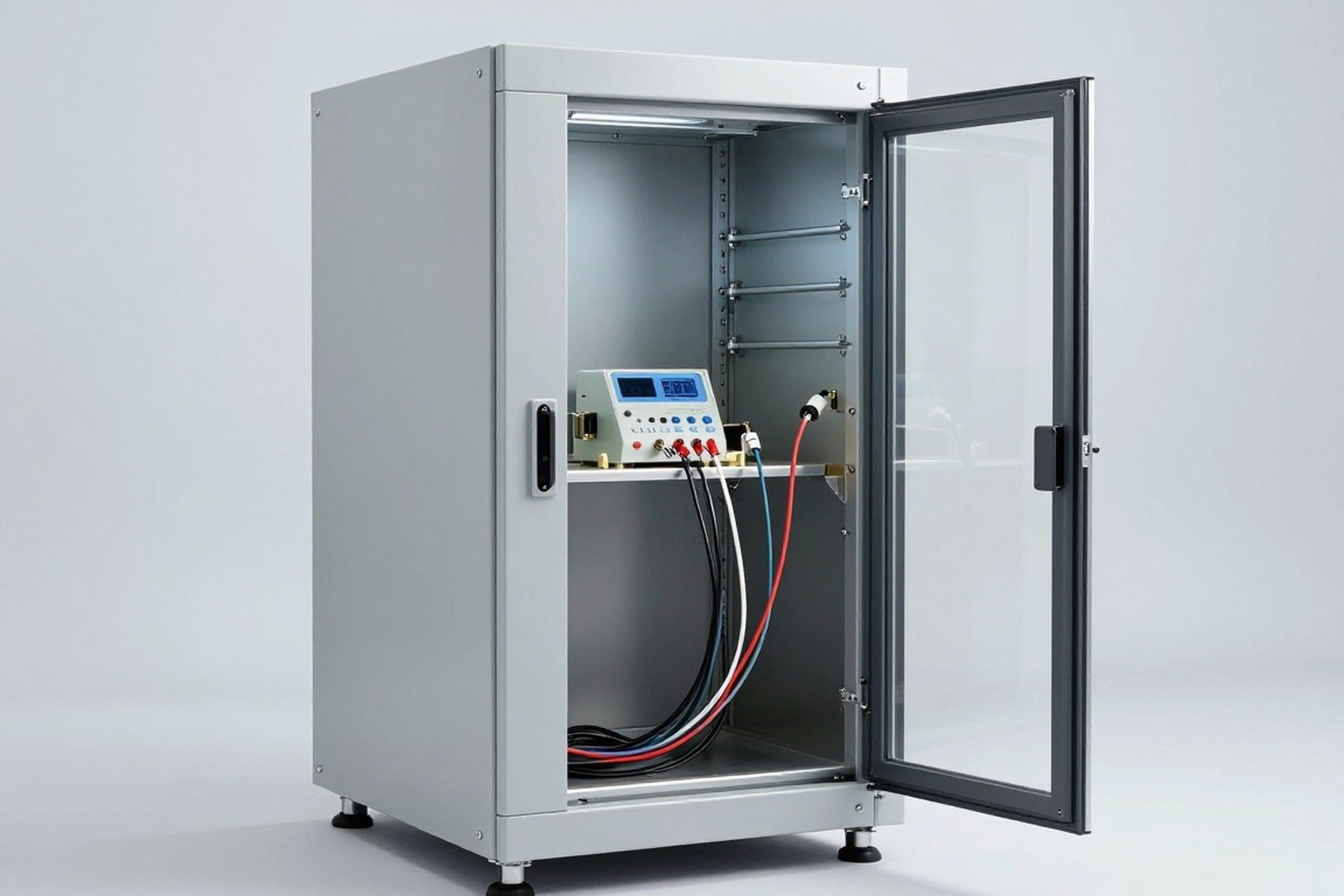
A running device can have an internal temperature 10–30 °C or even more higher than the test chamber temperature. If this phenomenon is ignored, test results can be misinterpreted in both directions: as “pass” when the device has been subjected to more severe conditions than required, or as “fail” when the total temperature has exceeded the design limit.
This article demonstrates how to determine self-heating and how to use it to select the appropriate chamber temperature.
1. What is self-heating and why is it important?
Self-heating is the phenomenon where a device automatically heats up when powered, due to power loss in components, sources, motors or power circuits. The result is the actual temperature at a point on the device:
Actual temperature of sample = chamber temperature + temperature rise due to self-heating
Therefore, “testing at X temperature” with the device in operation does not mean that the sample is subjected to X temperature. This is especially important for:
- Equipment with large capacity sources: power supplies, inverters, chargers, lighting equipment.
- The unit is sealed, with no fans or ventilation holes.
- The device is installed in a closed cabinet when actually used.
- The device has a battery or battery, because high temperatures directly affect safety and longevity.
2. How to determine spontaneous heating
- Select measurement point: representative points and points of highest risk — power components, close to the source, in the most confined locations.
- Set the sensor: securely attached to the part to be measured, isolated from chamber walls and direct air flow.
- Measurement in no-power mode: After the sample reaches equilibrium with the chamber temperature, record the temperature at each point.
- Measurement in power supply mode: for a sample operating in a representative state (standby, nominal load, planned peak load).
- Wait for thermal stability: temperature no longer increases significantly over time; This is the time to record the results.
- Calculate temperature rise: difference between the steady state temperature and the corresponding chamber temperature.
- Repeat at different chamber temperatures if necessary, as the temperature rise may vary with the ambient temperature.
3. Load states to be tested
| Status | Thermal characteristics | When to evaluate? |
|---|---|---|
| No power supply (off) | The sample temperature approaches the chamber temperature | Evaluate viability, storage, and transportation |
| Wait (idle / standby) | Small heat generation, mainly from standby source | The device is often in standby mode |
| Operates at nominal load | Average heat generation, representative of typical use | Most programs try |
| Operates at maximum load | Highest heat generation, hottest spot | The device has a high load mode; Evaluate safety margin |
| Charge/discharge mode (for devices with battery) | Concentrated heat generation in the battery | Mobile devices, energy storage devices |
In the report, it is necessary to clearly state the load status in each test, because the same device in different states has significantly different temperature increases.
4. Use the self-heating results to select the chamber temperature
| Target | How to set the chamber temperature | Notes |
|---|---|---|
| Evaluate equipment operating in X temperature environment | Set the chamber to temperature X and let the device generate its own heat; Measure the actual temperature on the sample | Reflects correct conditions of use; Sample temperature can be higher than X |
| Make sure the sample is subjected to the correct temperature X at the hottest point | Set the chamber at temperature X minus the expected temperature rise at that point | Must clearly state the compensation method and basis; Avoid misleading results |
| Assess viability (inactivity) | Set the chamber at temperature X, the device does not supply power | Eliminates the effects of self-heating |
| Burn-in reliability screening | Often use combined load temperature to speed up fault detection | Usually according to specific product standards, not according to IEC 60068 |
Point of caution: chamber temperature compensation is an engineering decision, which must be clearly documented in the test plan and report. If it only says “test at 40 °C” but the sample actually reaches 60 °C due to self-heating, the results are no longer transparent.
5. Interaction with other tests
| Combine | Effects | Note |
|---|---|---|
| Spontaneous heat generation + hot moisture test | Higher temperatures cause a local decrease in relative humidity; otherwise it may cause condensation when the device is turned off | The power supply status should be recorded throughout the test |
| Self-heating + low pressure | The ability to dissipate heat by convection decreases, the sample temperature increases higher | Especially important for equipment operating at high altitudes |
| Self-heating + cold test | The local hot spot may still be higher than the allowable limit even in a cold environment | Need to measure at the hot spot, not just the environment |
| Spontaneous heating + condensation | On/off cycles create localized humidity cycles within the device | Record the duty cycle if the test has an on/off cycle |
6. Common errors
- Only measure chamber temperature then conclude about the sample temperature.
- Does not record load status when tested — results are not reproducible.
- Measure immediately after turning on the device, Thermal stability has not yet been reached.
- Chamber temperature compensation without recording the basis, loss of transparency of records.
- Do not consider self-heating when testing low pressure, leading to an underestimation of the actual temperature of the sample.
- Ignore material limits: Compensating to reach the target temperature can push the chamber temperature beyond the capacity of the gasket, plastic, or battery in the sample.
- Not checking chamber capabilities: Large self-heating equipment may cause the chamber to not be able to maintain the set temperature.
7. Frequently asked questions
Does the temperature rise due to self-heating change with ambient temperature?
Yes. Component performance and heat dissipation mechanisms are both temperature dependent, so temperature rise may vary at different chamber temperatures. Therefore, measurements should be made at the temperature relevant to the test.
Is chamber temperature compensation required when testing equipment in operation?
Not required, but must clearly state how to do it. If the goal is to evaluate the ability to operate in a temperature environment of
How do you know that thermal stability has been reached?
When the temperature at the measuring points changes very little over time over a long enough period. This time depends on the heat mass and capacity of the device.
What should you pay attention to when measuring if the device has a battery?
Measure the temperature at the battery separately. High temperatures affect safety and longevity; Some industry standards have specific requirements regarding cell and system temperature limits.
What if the chamber does not maintain temperature while the device is operating?
The test result is invalid. It is necessary to choose a chamber with greater capacity compensation, or reduce the sample load and record it.
Which load state should I choose?
Choose a state that is representative of actual use, and state it clearly in the test plan. For safety-critical equipment, it should be tested at the highest prescribed load level.
8. Conclusion
Self-heating is a parameter that must be known before interpreting temperature test results. Ignoring it leads to two types of errors: assuming the device “passes” when in fact the hot spot has exceeded the limit, or concluding “fail” when the device is subjected to test conditions that are not as described by the document.
Three things to do: measure the temperature rise at a representative load state; clearly state the loading status and spontaneous heating treatment method in the test plan; and check the chamber’s capabilities before testing high-power equipment.
References
- IEC 60068-1 — General provisions and guidance.
- IEC 60068-2-1, 2-2, 2-14 — Temperature tests.
- IEC 60068-2-13 and 2-39 — Low pressure and temperature/humidity combinations with low pressure.
- IEC 60068-3-7 — Measurement in loaded temperature chamber.
- IEC 60068-3-11 — Uncertainty of climatic conditions in the test chamber.
Related articles
- Load cold/hot test: how to place the sensor and measure sample temperature according to IEC 60068-3-7
- How are thermal shock and temperature change different? How to choose the right test
- Test B (Dry heat): dry heat test according to IEC 60068-2-2, Bb and Bd
- Solar radiation test (Sa) according to IEC 60068-2-5 and outdoor material degradation
Discuss further
Disclaimer
This article is an interpretive content compiled by us; not legal advice. Enterprises need to compare relevant documents/standards verbatim before applying them to specific products.
See more: Copyright Policy & Disclaimer by ticforall.com.