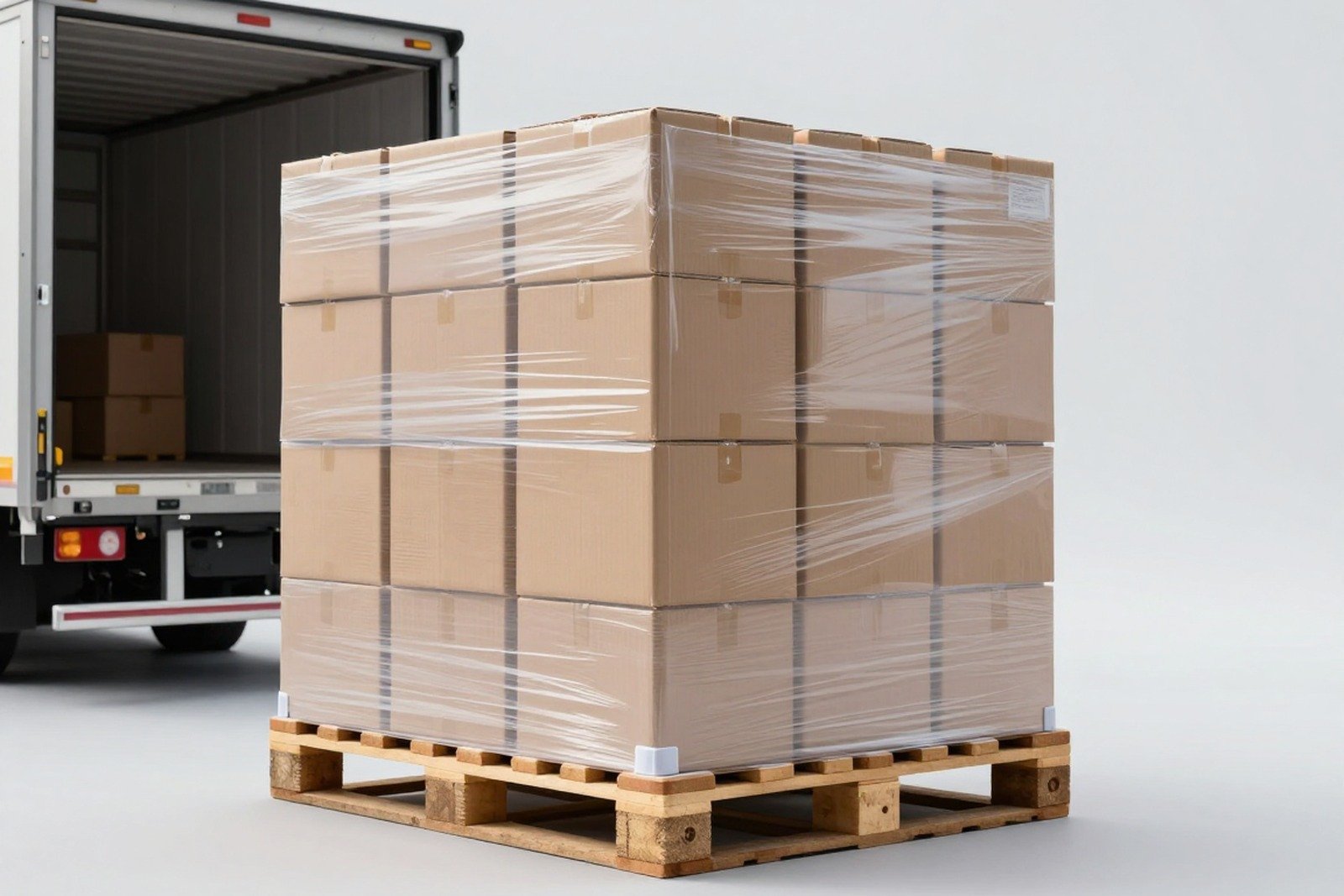
The question our testing laboratory receives most often before an ISTA 3E test is simple: what do we need to prepare. This procedure applies to unitised goods, meaning a whole pallet load that travels as one block on a full truck. The short answer is the five groups below.
1. Information about the load
- Dimensions of the whole load, measured from the pallet deck to the top, including length, width and height.
- Total weight of the load, weighed as shipped.
- How many layers are stacked on the pallet, and roughly how much each layer weighs.
- Wooden or plastic pallet, two-way or four-way entry, single-trip or returnable.
- How the load is secured: stretch film, plastic strapping, corner boards, adhesive, or stacking alone.
- Whether the load stands on its own, or needs a frame, support, or protective corners.
2. Information about the journey
- Which warehouse the load travels from and to, and roughly how many kilometres.
- Whether there is a sea or rail container leg, and if so how long the load stays inside.
- Whether pallets are stacked on top of each other in the container or on the truck, and how many layers high.
- How long the goods stay in a warehouse, in a yard, or outdoors.
- Whether there are hot and humid phases, rain, or large temperature swings.
3. Information about samples
- Number of loads submitted. One can be tested, but three or more give a fuller picture of stability.
- Whether the load is built and secured exactly as it is when shipped.
- Who rebuilds the pallet at the lab if the load shifts during testing.
- Whether the sample has to be kept after the test, and for how long.
4. Pass and fail criteria
- The acceptable level of product damage, described as specific symptoms.
- The acceptable level of pallet deformation.
- How far the load may shift, lean, or lose its film.
- How the load is examined after the test: visual inspection, function check, or measurement of technical parameters.
5. Report and timing
- Report in Vietnamese, English or bilingual.
- Whether video of the compression and vibration steps is required.
- Test report only, or an additional association certification.
- The date the results are needed, allowing for shipping a full pallet load.
6. Why the stacking pattern has to be stated
For unitised goods, the main risk is not impact but superimposed load and loss of stability. If the lab knows exactly how many layers of pallets sit on top of each other in the warehouse and on the truck, and what each layer weighs, it can use the real load instead of a calculated one, which brings the result closer to reality and shortens preparation. If the customer only says the goods travel by full truck without describing the stacking, the lab has to assume, and the assumption usually lands on the harsher case, which adds cost that was never needed.
Three links worth reading before you send samples: what ISTA 3E is, pass and fail criteria in packaging testing, and what testing cost and lead time depend on.
You can send the five groups above through the form below, together with photos of the built load and of the pallet. The lab will reply with the test items and an expected schedule.
This article reflects our testing laboratory’s experience in collecting information. It does not quote the content of the ISTA standard and does not replace reading the original standard before implementation.