The draft national standard on the energy efficiency of non-ducted air conditioners is currently under consultation. It is provisionally numbered TCVN 7830:xxxx, marked “Fifth edition”, and its foreword states that it will replace TCVN 7830:2021. The title is “Non-ducted air conditioners – Energy Efficiency”; it was drafted by national technical subcommittee TCVN/TC/E1/SC5 “Energy efficiency of refrigerating equipment”, proposed by the Vietnam Directorate for Standards, Metrology and Quality, appraised by the National Committee for Standards, Metrology and Quality and published by the Ministry of Science and Technology. This is the underlying standard for energy labelling and for setting minimum energy performance for household air conditioners in Vietnam, so the revision directly affects almost every wall-mounted air conditioner on the market.
1. What this fifth edition is
TCVN 7830 is an old standard that has been revised several times, and this is its fifth edition. The draft runs to seven pages, six clauses, two numerical tables and one note. The structure is the familiar one for energy efficiency standards: scope, normative references, terms, technical requirements, determination method, test report.
What sets this revision apart lies in Clause 4.2 and the tables: the draft offers two options for the energy efficiency level table and states explicitly that the bodies consulted will give an opinion on whether Table 1 or Table 2 should be the official table. In both tables, the red struck-through text is the content specified in TCVN 7830:2021, retained so readers can compare the new and previous versions.
One point deserves emphasis from the outset: this is a draft, it has no legal effect, and the figures below are the content of the draft at the time of analysis, not rules currently in force.
2. Why this revision matters
Three reasons. First, the efficiency levels in the draft are markedly higher than the TCVN 7830:2021 content shown in red struck-through text in the tables themselves, meaning that if the draft is issued substantially as it stands, many models now on the market would no longer meet the minimum. Second, the draft changes the way cooling capacity bands are divided: the previous version used thresholds of the form 15,000 / 24,000 / 41,000 in the red text, while the new one uses 4,500 W / 7,100 W / 12,000 W. Third, choosing Table 1 or Table 2 is not a minor technical detail: the two differ by several tenths of a CSPF point in every row, equivalent to tightening one efficiency level.
3. Where TCVN 7830 sits in the energy labelling picture
A national standard is the technical basis: it sets efficiency levels and the determination method, while the mandatory energy labelling duty and the minimum energy performance level come from the corresponding regulatory documents. The draft should therefore be read alongside the list of products requiring energy labelling in Vietnam, together with the rules on certification, conformity declaration and quality inspection of imported goods.
4. Relationship with the draft TCVN on semi-commercial air conditioners
Alongside this revision there is another draft on the energy efficiency of semi-commercial air conditioners, with a scope up to 18,000 W. The two form a pair: the semi-commercial draft excludes air conditioners within the scope of TCVN 7830, and this fifth edition defines exactly that scope. Reading them together shows a fairly clear boundary: the non-ducted group, up to 12,000 W (41,000 BTU/h), one or two units, single-phase falls under TCVN 7830; the semi-commercial group is what remains within the 18,000 W limit. The drafting teams of the two documents should settle this together, because it is precisely the point the semi-commercial draft left open by citing “TCVN 7830:xxxx” without a publication year.
5. Scope
The draft sets energy efficiency levels and the method for determining energy efficiency for non-ducted air conditioners using a hermetic compressor and an air-cooled condenser, in one or two units, with or without an inverter, with a rated cooling capacity up to 12,000 W (41,000 BTU/h).
Four features need to be clear: a hermetic compressor; an air-cooled condenser; one or two units; a rated cooling capacity up to 12,000 W.
The exclusions are longer than the scope, and this is where businesses often go wrong: the standard does not apply to water-cooled air conditioners, ducted types, portable types, floor-standing types, ceiling-recessed types, ceiling-suspended types, air conditioners with more than two units, or air conditioners using three-phase power. In other words, the scope is narrowed to non-ducted, single-phase air conditioners for household and small spaces.
Note a small terminology mismatch: Clause 1 calls the subject “non-ducted air conditioners”, while the note in Clause 4.2 says the chosen table will apply to “household air conditioners”. The two wordings are not identical, and when quoting, follow Clause 1.
6. Structure
The draft has six clauses: Clause 1 scope; Clause 2 normative references; Clause 3 terms and definitions; Clause 4 technical requirements; Clause 5 determination method; Clause 6 test report. There is no annex. For those preparing dossiers, Clause 4 states what must be achieved, Clause 5 how it is measured, Clause 6 what the report must record: the three clauses are the three parts of a test dossier.
7. Normative references
The draft references two standards, both with publication years:
- TCVN 6576:2020 (ISO 5151:2017), Non-ducted air conditioners and heat pumps – Testing and rating for performance;
- TCVN 10273-1:2013 (ISO 16358-1:2013), Air-cooled air conditioners and air-to-air heat pumps – Testing and calculating methods for seasonal performance factors – Part 1: Cooling seasonal performance factor.
Unlike the semi-commercial draft, there is no TCVN 6577 for ducted units here, consistent with the narrower scope of TCVN 7830. The approach remains to borrow the existing test methods entirely and set additional efficiency levels.
8. Terms: cooling capacity and CSPF
Clause 3 refers to the definitions in the two referenced standards and adds two of its own.
Cooling capacity is the total sensible and latent heat that the product can remove from a specified conditioned space in a given time, expressed in watts (W).
The energy efficiency of an air conditioner is determined by the cooling seasonal performance factor, denoted CSPF, and the draft states the source of this definition as TCVN 10273-1:2013 (ISO 16358-1:2013), 3.4. This confirms the seasonal approach: it accounts for multiple load and temperature conditions across the cooling season rather than a single rated operating point.
9. Cooling capacity and full-load power requirements
Clause 4.1 has two requirements, effectively identical in meaning to those in the semi-commercial draft:
- Cooling capacity must be greater than or equal to 95 % of the capacity declared by the manufacturer;
- Full-load power input must be within ± 10 % of the rated power input declared by the manufacturer.
Both thresholds guard against inflated figures: the 95 % floor prevents declaring a capacity higher than actual, while the ± 10 % band blocks declaring a consumption lower than actual. Only when both measured values fall inside these limits is the resulting CSPF credible and comparable with the levels in the tables.
10. The five efficiency levels and how to read the two tables
Clause 4.2 divides product energy efficiency into five levels. For levels 1 to 5, energy efficiency must not be lower than the value set in the table; level 1 is the lowest level and the basis for determining minimum energy performance standards (MEPS); level 5 is the highest.
Both tables share the same layout: a “type” column (one unit or two units), a rated cooling capacity column and five level columns. The one-unit type has no capacity sub-bands and uses a single set of values. The two-unit type is split into three bands. Each cell in the draft contains two numbers: the red struck-through one is the TCVN 7830:2021 value, the other is the proposed new value. The tables below show only the new values; the comparison with the previous version is in section 13.
11. Table 1 – Option 1
| Type | Rated cooling capacity | Level 1 | Level 2 | Level 3 | Level 4 | Level 5 |
|---|---|---|---|---|---|---|
| One unit | no sub-bands | ≥ 3.40 | ≥ 3.60 | ≥ 3.80 | ≥ 4.00 | ≥ 4.20 |
| Two units | < 4,500 W | ≥ 3.70 | ≥ 4.10 | ≥ 4.60 | ≥ 5.20 | ≥ 5.80 |
| Two units | 4,500 W ≤ φ < 7,100 W | ≥ 3.60 | ≥ 4.10 | ≥ 4.60 | ≥ 5.10 | ≥ 5.60 |
| Two units | 7,000 W ≤ φ < 12,000 W | ≥ 3.40 | ≥ 3.90 | ≥ 4.40 | ≥ 4.90 | ≥ 5.40 |
12. Table 2 – Option 2
| Type | Rated cooling capacity | Level 1 | Level 2 | Level 3 | Level 4 | Level 5 |
|---|---|---|---|---|---|---|
| One unit | no sub-bands | ≥ 3.60 | ≥ 3.80 | ≥ 4.00 | ≥ 4.20 | ≥ 4.60 |
| Two units | < 4,500 W | ≥ 4.00 | ≥ 4.50 | ≥ 5.00 | ≥ 5.50 | ≥ 6.00 |
| Two units | 4,500 W ≤ φ < 7,100 W | ≥ 3.80 | ≥ 4.30 | ≥ 4.80 | ≥ 5.30 | ≥ 5.80 |
| Two units | 7,000 W ≤ φ < 12,000 W | ≥ 3.60 | ≥ 4.10 | ≥ 4.60 | ≥ 5.10 | ≥ 5.60 |
13. Comparing the two options and the change from TCVN 7830:2021
The table below sets out the level 1 threshold under both options next to the corresponding threshold in TCVN 7830:2021 (taken from the red struck-through content of the draft). Level 1 is the most important because the draft states it is the basis for determining MEPS.
| Type | Level 1 in TCVN 7830:2021 | Level 1 – Option 1 | Level 1 – Option 2 |
|---|---|---|---|
| One unit | ≥ 2.80 | ≥ 3.40 | ≥ 3.60 |
| Two units, < 4,500 W | ≥ 3.10 | ≥ 3.70 | ≥ 4.00 |
| Two units, 4,500 W to under 7,100 W | ≥ 3.00 | ≥ 3.60 | ≥ 3.80 |
| Two units, 7,000 W to 12,000 W | ≥ 2.80 | ≥ 3.40 | ≥ 3.60 |
Three comments follow directly from the figures. First, Option 2 is always higher than Option 1, by about 0.20 to 0.30 CSPF at level 1 depending on the row, equivalent to one efficiency level. Second, under both options the new level 1 threshold is higher than the level 3 threshold of TCVN 7830:2021 in every row; this means products currently at level 2 or 3 under the old version would not meet the new minimum if the standard is issued substantially as drafted. For the one-unit type, the new level 1 threshold (3.40 or 3.60) sits exactly between level 4 (3.40) and level 5 (3.60) of the old scale. Third, for the small two-unit band below 4,500 W the draft proposes the highest threshold of all rows, reflecting the fact that smaller units generally achieve higher CSPF values.
14. Determination method
Clause 5 specifies three things and one exception:
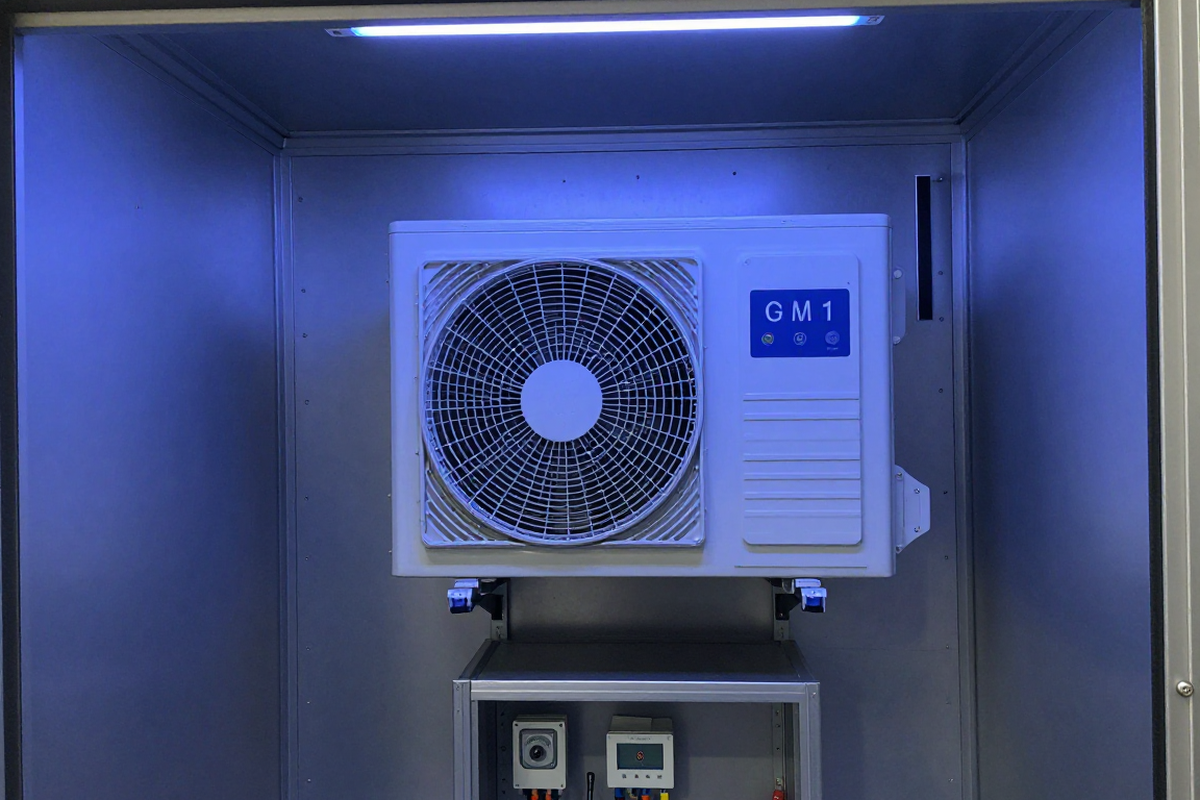
- Tests are carried out under test condition T1 specified in TCVN 6576:2020 (ISO 5151:2017);
- Cooling capacity is determined in accordance with TCVN 6576:2020 (ISO 5151:2017);
- Energy efficiency is determined in accordance with TCVN 10273-1:2013 (ISO 16358-1:2013).
Condition T1 is the standard condition for air-cooled equipment and is familiar to testing laboratories in Vietnam. The exception follows: for equipment with fixed cooling capacity, energy efficiency may be tested only at the standard cooling capacity mode without testing at the low-temperature cooling capacity mode; in that case the energy efficiency value is calculated from the standard mode result multiplied by 1.062. This matters to both businesses and laboratories, because it removes one test but requires the conversion factor to be applied correctly; using the wrong factor shifts the CSPF figure by about 6 % and can push a result over or under a level threshold.
15. Test report

Clause 6 lists the minimum information for the test report:
- Power input values P50 % (where applicable) and P100 %;
- Cooling capacity values at 50 % (where applicable) and 100 %;
- The energy efficiency index CSPF, rounded to two decimal places.
Requiring both load levels matches the seasonal calculation of CSPF; for fixed-capacity equipment that uses the 1.062 factor in Clause 5, the words “where applicable” allow a report containing only standard mode results. The two-decimal rounding rule makes results from different laboratories directly comparable with the thresholds in the tables.
16. Five points to keep in mind
First, no table has been chosen yet. The draft presents two options and asks consultees. The outcome on Table 1 versus Table 2 will decide the actual tightening, so businesses have a stake and should comment at this stage.
Second, Clause 4.2 points only to Table 1. The sentence “energy efficiency must not be lower than the value set in Table 1” sits alongside a note saying consultees will choose Table 1 or Table 2. This needs editorial correction to avoid misapplication.
Third, two capacity bands overlap. The second band is “4,500 ≤ φ < 7,100” and the third is “7,000 ≤ φ < 12,000”; the range from 7,000 W to under 7,100 W falls into both. For equipment exactly in that range, the tester cannot tell which threshold applies. The overlap most likely results from converting BTU/h thresholds to watts (24,000 BTU/h is about 7,030 W), and the correct boundary is most likely 7,000 W for both bands.
Fourth, the standard number is blank and inconsistent. The cover and inner pages read “TCVN 7830:xxxx” while the foreword contains “TCVN 7830:xxx”. A small point, but it should be consistent before publication.
Fifth, the bracketed red thresholds. The old bands are written as 15,000 / 24,000 / 41,000 (in BTU/h) while the column heading for rated cooling capacity is in watts. When comparing old and new versions, convert units first, so that 4,500 W is not read as 4,500 BTU/h.
17. What businesses should prepare
For manufacturers and importers of non-ducted air conditioners up to 12,000 W, four things to do early: identify whether the product is a one-unit or two-unit type and which capacity band it falls into; take the current CSPF and check it against both tables to see whether the product would still reach level 1; review the declared cooling capacity and full-load power input against the 95 % and ± 10 % limits; and follow the consultation outcome, because the gap between the two tables is equivalent to one efficiency level.
For testing laboratories, three areas need review: capability to test under TCVN 6576:2020 at condition T1; capability to compute CSPF per TCVN 10273-1:2013, including the 1.062 factor for fixed-capacity equipment; and a report template covering all items in Clause 6 with the two-decimal rounding rule.
For consultants and dossier preparers, place this draft correctly in the chain of obligations: air conditioners face not only energy efficiency requirements but also electrical safety and electromagnetic compatibility, on top of conformity declaration duties under the risk-based goods lists. The example of high-risk goods requiring QCVN 4 testing shows that this side operates independently of energy efficiency. Choosing the right laboratory and dossier matters just as much, as set out in choosing a testing laboratory for Vietnam compliance, and the Ministry of Industry and Trade risk-based goods list illustrates the wider framework.
18. Frequently asked questions
Is the draft in force?
No. It is under consultation, provisionally numbered TCVN 7830:xxxx; its content may change before publication and it has no legal effect.
Which version does it replace?
According to the foreword, TCVN 7830:xxxx replaces TCVN 7830:2021, and this is the fifth edition.
Does my product fall under TCVN 7830 or the semi-commercial draft?
If it is a non-ducted air conditioner, one or two units, single-phase, with a rated cooling capacity up to 12,000 W, it falls under TCVN 7830. Ducted, portable, floor-standing, ceiling-recessed, ceiling-suspended types, units with more than two units and three-phase equipment are excluded from this standard.
Is level 1 the best level?
No. In the draft, level 1 is the lowest efficiency level and the basis for determining minimum energy performance; level 5 is the highest.
Why do the tables contain red struck-through numbers?
They are the content specified in TCVN 7830:2021, retained for comparison between the new and previous versions. For application, use only the values that are not struck through.
Are the figures in this article final?
No. This article records the content and thresholds present in the draft at the time of analysis; once the standard is issued, the official text should be consulted.
19. Related reading
- Draft TCVN on the energy efficiency of semi-commercial air conditioners
- List of products requiring energy labelling in Vietnam: current documents and timetable
- High-risk goods requiring QCVN 4 testing under Circular 36/2026/TT-BKHCN
- Choosing a testing laboratory for Vietnam compliance
- Circular 33/2026/TT-BCT: the Ministry of Industry and Trade risk-based goods list
20. References
- Draft TCVN 7830:xxxx (fifth edition), “Non-ducted air conditioners – Energy Efficiency”, drafted by national technical subcommittee TCVN/TC/E1/SC5 “Energy efficiency of refrigerating equipment”, proposed by the Vietnam Directorate for Standards, Metrology and Quality, appraised by the National Committee for Standards, Metrology and Quality and published by the Ministry of Science and Technology. The draft has no legal effect; this article summarises the content without reproducing the full clause text.
- Standard replaced: TCVN 7830:2021.
- Standards referenced by the draft: TCVN 6576:2020 (ISO 5151:2017); TCVN 10273-1:2013 (ISO 16358-1:2013).
- Related rules on energy labelling, certification and conformity declaration in Vietnam.
21. Contact
Manufacturers, importers and distributors of non-ducted air conditioners, as well as testing laboratories and consultants preparing energy efficiency dossiers, can send a request through the form below to discuss scope, how to check CSPF against the two tables, the choice of test standard and the steps to prepare before the standard is issued.
This article analyses a draft standard that has not been issued, for information purposes only, and does not replace the standard or technical and legal advice for a specific case. The draft content may change before publication; the figures and thresholds quoted are those present in the draft at the time of analysis. Once the standard is issued, use the official text together with the legal instruments in force.