The draft national standard on the energy efficiency of semi-commercial air conditioners is currently under consultation, provisionally numbered TCVN xxxx:2026 and titled “Semi-commercial air conditioners – Energy Efficiency”. It was drafted by national technical subcommittee TCVN/TC/E1/SC5 “Energy efficiency of refrigerating equipment”, proposed by the Directorate for Standards, Metrology and Quality, appraised by the National Committee for Standards, Metrology and Quality and published by the Ministry of Science and Technology. This is a short document of only seven pages, but it matters directly to manufacturers, importers and testing bodies, because it sets the energy efficiency levels and the method for determining them. This article summarises the scope, structure, technical requirements and points to watch when reading the draft.
1. What this document is and where it stands
This is a draft: the number is blank, the content may change and the draft has no legal effect. The foreword sets out the drafting subcommittee, the proposing body, the appraising committee and the publishing ministry.
Unlike the long technical drafts of several dozen pages we have analysed before, this document belongs to the energy efficiency family: the content is compact, essentially consisting of efficiency levels and a determination method, without going into product design or functions. The draft has six clauses and no annex.
2. Where the draft sits in the energy labelling picture
In Vietnam, appliance energy efficiency is managed through energy labelling guidance and minimum energy performance standards (MEPS) set for each product group. A national standard on energy efficiency plays the role of the underlying technical basis: it sets thresholds and the determination method, while labelling and inspection follow the corresponding regulatory documents.
The draft should therefore not be read as a standalone mandatory instrument. The appropriate reading is that the draft supplies the efficiency scale and the measurement method, while the specific legal obligation depends on the list of products requiring energy labelling and on the regulations in force. Businesses should read it alongside the list of products requiring energy labelling in Vietnam to see where their product stands.
3. Scope
The scope is described in a relatively narrow sentence: the standard sets energy efficiency levels and the method for determining energy efficiency for air conditioners using a hermetic compressor and an air-cooled condenser, in two units, with or without an inverter, with a rated cooling capacity up to and including 18,000 W.
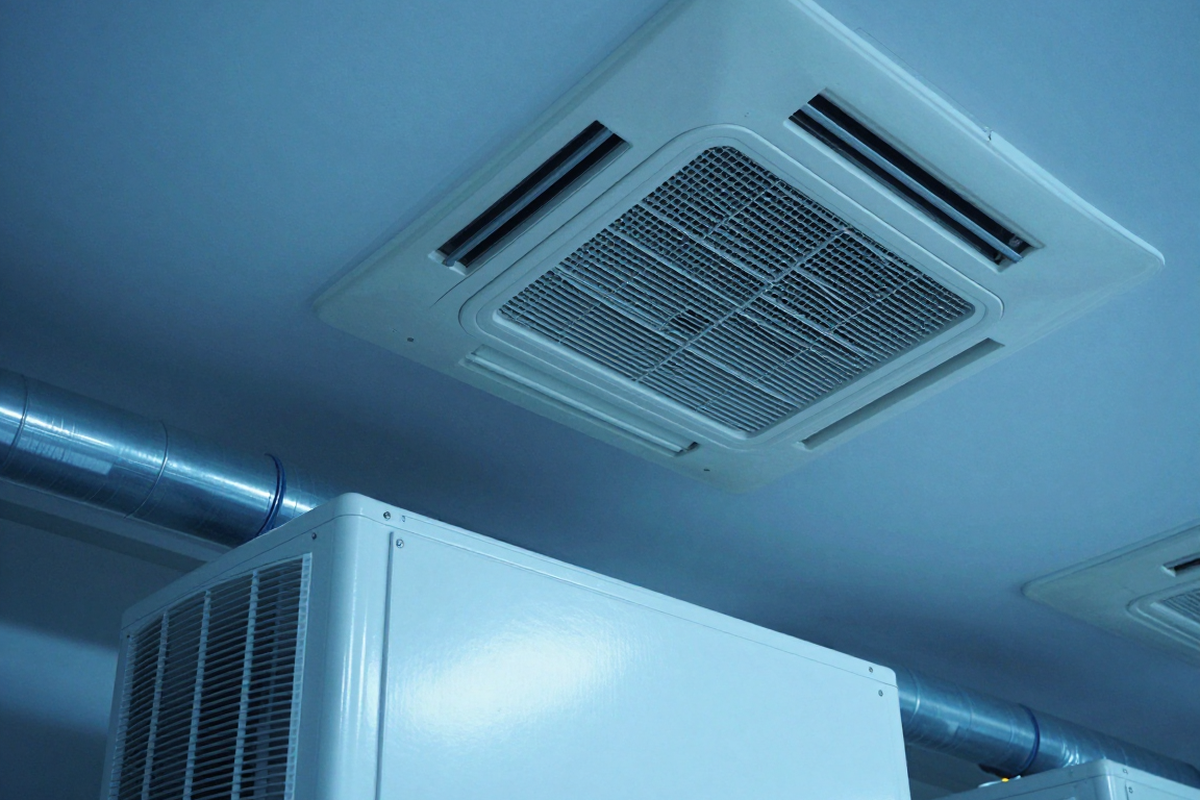
Four features need to be clear: first, a hermetic compressor; second, an air-cooled condenser, so not water-cooled; third, a two-unit type; fourth, a rated cooling capacity not exceeding 18,000 W. The draft notes that products within scope include ducted, portable, floor-standing, ceiling-recessed and ceiling-suspended air conditioners.
The exclusions are equally clear: the standard does not apply to air conditioners within the scope of TCVN 7830:xxxx, to water-cooled air conditioners or to air conditioners with more than two units. The point to note is that the draft cites TCVN 7830 without a publication year (the old convention used “xxxx”), so the boundary between the two standards needs checking once the official text is issued, especially for products near the 18,000 W threshold.
4. Structure
The draft has six clauses, short and in the usual order of a method standard: Clause 1 scope; Clause 2 normative references; Clause 3 terms and definitions; Clause 4 technical requirements; Clause 5 determination method; Clause 6 test report. There is no annex and no table other than the two energy efficiency level tables.
For those preparing dossiers the order is convenient: Clause 4 states what must be achieved, Clause 5 how it is measured, Clause 6 what the report must record. These three clauses are effectively the three parts of a test dossier.
5. Normative references
The draft references three standards, all with publication years, meaning the versions cited apply:
- TCVN 6576:2020 (ISO 5151:2017), Non-ducted air conditioners and heat pumps – Testing and rating for performance;
- TCVN 6577:2020 (ISO 13253:2017), Ducted air-conditioners and air-to-air heat pumps – Testing and rating for performance;
- TCVN 10273-1:2013 (ISO 16358-1:2013), Air-cooled air conditioners and air-to-air heat pumps – Testing and calculating methods for seasonal performance factors – Part 1: Cooling seasonal performance factor.
That the draft has only three references shows the approach: borrow the existing test methods entirely and set additional efficiency levels. For businesses already testing against TCVN 6576 and TCVN 10273-1, the methodological change is small; what is new is mainly the level thresholds.
6. Terms: cooling capacity and energy efficiency
Clause 3 is brief: the standard uses the terms and definitions of the three referenced standards and adds two of its own.
First, cooling capacity is the total sensible and latent heat that the product can remove from a specified conditioned space in a given time, expressed in watts (W).
Second, the energy efficiency of a semi-commercial air conditioner is determined by the cooling seasonal performance factor, CSPF. This is the most important conceptual point: the standard does not use an instantaneous efficiency ratio at a single operating point, but a seasonal factor, taking into account multiple load and temperature conditions across the cooling season, which suits inverter-driven equipment.
7. Cooling capacity and full-load power requirements
Clause 4.1 has two requirements that look simple but are the quality control on declared values:
- Cooling capacity must be greater than or equal to 95 % of the capacity declared by the manufacturer;
- Full-load power input must be within ± 10 % of the rated power input declared by the manufacturer.
The two work differently. The 95 % floor for cooling capacity prevents declaring a capacity higher than actual, which is a common way of flattering an efficiency figure. The ± 10 % band for power input allows normal engineering tolerance but blocks declaring a consumption lower than actual. Together they ensure the CSPF figure is calculated on measured values that do not drift too far from what was declared.
8. The five energy efficiency levels
Clause 4.2 divides product energy efficiency into five levels, with the rule that for levels 1 to 5 the energy efficiency must not be lower than the value set in Table 1 or Table 2 as applicable; level 1 is the lowest level and the basis for determining minimum energy performance standards (MEPS); level 5 is the highest efficiency level.
Table 1 applies to non-ducted air conditioners, Table 2 to ducted air conditioners. Both tables cover a single rated cooling capacity band, up to and including 18,000 W, that is, the whole scope.
| Rated cooling capacity | Energy efficiency level (CSPF, not lower than) | ||||
|---|---|---|---|---|---|
| Level 1 | Level 2 | Level 3 | Level 4 | Level 5 | |
| ≤ 18,000 W (non-ducted) | 3.20 | 3.40 | 3.80 | 5.50 | 6.10 |
| ≤ 18,000 W (ducted) | 2.80 | 3.00 | 3.20 | 4.30 | 5.30 |
Three comments are useful when reading these tables. First, ducted thresholds are lower than non-ducted at every level, which is technically reasonable because duct pressure losses and the air distribution system reduce overall efficiency. Second, the gap between level 3 and level 4 is wide (3.80 to 5.50 for non-ducted), so reaching level 4 requires a technology difference rather than fine tuning. Third, because level 1 is the basis for MEPS, businesses need to watch which level the authorities select as the applicable minimum for each period when the standard is issued.
9. Determination method
Clause 5 specifies how to measure, and notably branches by product type and by external static pressure:
- For non-ducted air conditioners, or ducted air conditioners with a rated cooling capacity below 8 kW designed to operate at an external static pressure below 25 Pa, tests are carried out under test condition T1 specified in TCVN 6576:2020; cooling capacity is determined in accordance with TCVN 6576:2020;
- For ducted air conditioners, cooling capacity is determined in accordance with TCVN 6577:2020;
- Energy efficiency is determined in accordance with TCVN 10273-1:2013.
Test condition T1 is the standard condition for air-cooled equipment, widely used in air conditioner assessment in Vietnam. The 8 kW and 25 Pa thresholds are the technical boundary deciding whether TCVN 6576 or TCVN 6577 is used to test cooling capacity for ducted equipment. For businesses this is a detail to settle before booking a test, because choosing the wrong test standard will produce results that cannot be accepted.
10. Test report requirements

Clause 6 lists three groups of information the test report must contain at minimum:
- Power input values P50% (where applicable) and P100%;
- Cooling capacity values at 50 % (where applicable) and at 100 %;
- The energy efficiency index CSPF, rounded to two decimal places.
Requiring both the 50 % and 100 % load values matches the seasonal calculation of CSPF: with a single load point, a meaningful seasonal index cannot be computed, especially for inverter equipment. Requiring rounding to two decimals makes results from different laboratories directly comparable with the thresholds in Tables 1 and 2 without disputes over rounding.
11. Three points to keep in mind
First, the draft cites TCVN 7830 without a publication year while the other three references carry years. Since TCVN 7830 concerns air conditioner energy efficiency, establishing the boundary between the two scopes is worth doing early, particularly for equipment near the 18,000 W threshold or equipment that could be classed either as domestic or semi-commercial.
Second, the draft names the product in two ways: the scope speaks of “semi-commercial air conditioners” while the terms clause speaks of “small commercial air conditioners”. Both refer to the same product group, but when quoting, follow the wording of Clause 1.
Third, the draft sets no transition or staged timetable per level. In energy labelling practice, minimum levels are usually tightened in stages; if the official text follows that pattern, businesses will need to follow the timetable rather than a single figure.
12. What businesses should prepare
For manufacturers and importers, four things to do early: determine exactly which band the product falls into (non-ducted or ducted, rated cooling capacity, external static pressure if ducted); review declared cooling capacity and full-load power input against the 95 % and ± 10 % limits; establish the product’s current CSPF and compare it with the five levels in the draft to see where it stands; and review the list of products requiring energy labelling together with related regulations to establish the specific obligations for the product.
For testing bodies, three areas need review: capability to test under both TCVN 6576:2020 and TCVN 6577:2020, including tests at external static pressure; capability to compute CSPF per TCVN 10273-1:2013, including where 50 % load data is required; and a test report template containing all items in Clause 6 with the correct two-decimal rounding.
For consultants and conformity dossiers, the point is that this draft is one mesh in a chain: air conditioners typically also face electrical safety and electromagnetic compatibility requirements, on top of conformity declaration duties under the risk-based goods list. A good dossier places energy efficiency correctly alongside the other requirements rather than handling them piecemeal. Some rules on the Ministry of Industry and Trade risk-based goods list illustrate that obligation side.
13. Frequently asked questions
Is the draft in force?
No. It is under consultation and appraisal, provisionally numbered TCVN xxxx:2026, and its content may change before publication.
Is the standard mandatory?
A national standard applies voluntarily. Any mandatory obligation comes from the regulations on energy labelling and minimum energy performance for each product group, together with conformity declaration rules.
How does CSPF differ from familiar efficiency ratios?
CSPF is a cooling seasonal performance factor, calculated across a season with multiple load and temperature conditions rather than at a single rated operating point. It therefore reflects real-world efficiency more closely, especially for inverter equipment.
Is level 1 the best level?
No. In this draft, level 1 is the lowest efficiency level and the basis for determining minimum energy performance; level 5 is the highest.
Are the figures in this article final?
No. This article records the content and thresholds present in the draft at the time of analysis; once the standard is issued, the official text should be consulted.
14. Related reading
- List of products requiring energy labelling in Vietnam: current documents and timetable
- Circular 33/2026/TT-BCT: the Ministry of Industry and Trade medium-risk and high-risk goods list
- Choosing a testing laboratory for Vietnam compliance
- TCVN 14538:2025: fire alarm transmission systems, scope and key requirements
- Draft TCVN on NIPS: general requirements for network intrusion protection system products
15. References
- Draft TCVN xxxx:2026, “Semi-commercial air conditioners – Energy Efficiency”, drafted by national technical subcommittee TCVN/TC/E1/SC5 “Energy efficiency of refrigerating equipment”, proposed by the Directorate for Standards, Metrology and Quality, appraised by the National Committee for Standards, Metrology and Quality and published by the Ministry of Science and Technology. The draft has no legal effect; this article summarises the content without reproducing the full clause text.
- Standards referenced by the draft: TCVN 6576:2020 (ISO 5151:2017); TCVN 6577:2020 (ISO 13253:2017); TCVN 10273-1:2013 (ISO 16358-1:2013).
- Related rules on energy labelling and the risk-based goods lists in Vietnam.
16. Contact
Manufacturers, importers and distributors of air conditioners, and bodies preparing energy efficiency test dossiers, can send a request through the form below to discuss scope, the choice of test standard and the documentation to prepare before the standard is issued.
This article analyses a draft standard that has not been issued, for information purposes only, and does not replace the standard or technical and legal advice for a specific case. The draft content may change before publication; the figures and thresholds quoted are those present in the draft at the time of analysis. Once the standard is issued, use the official text together with the legal instruments in force.