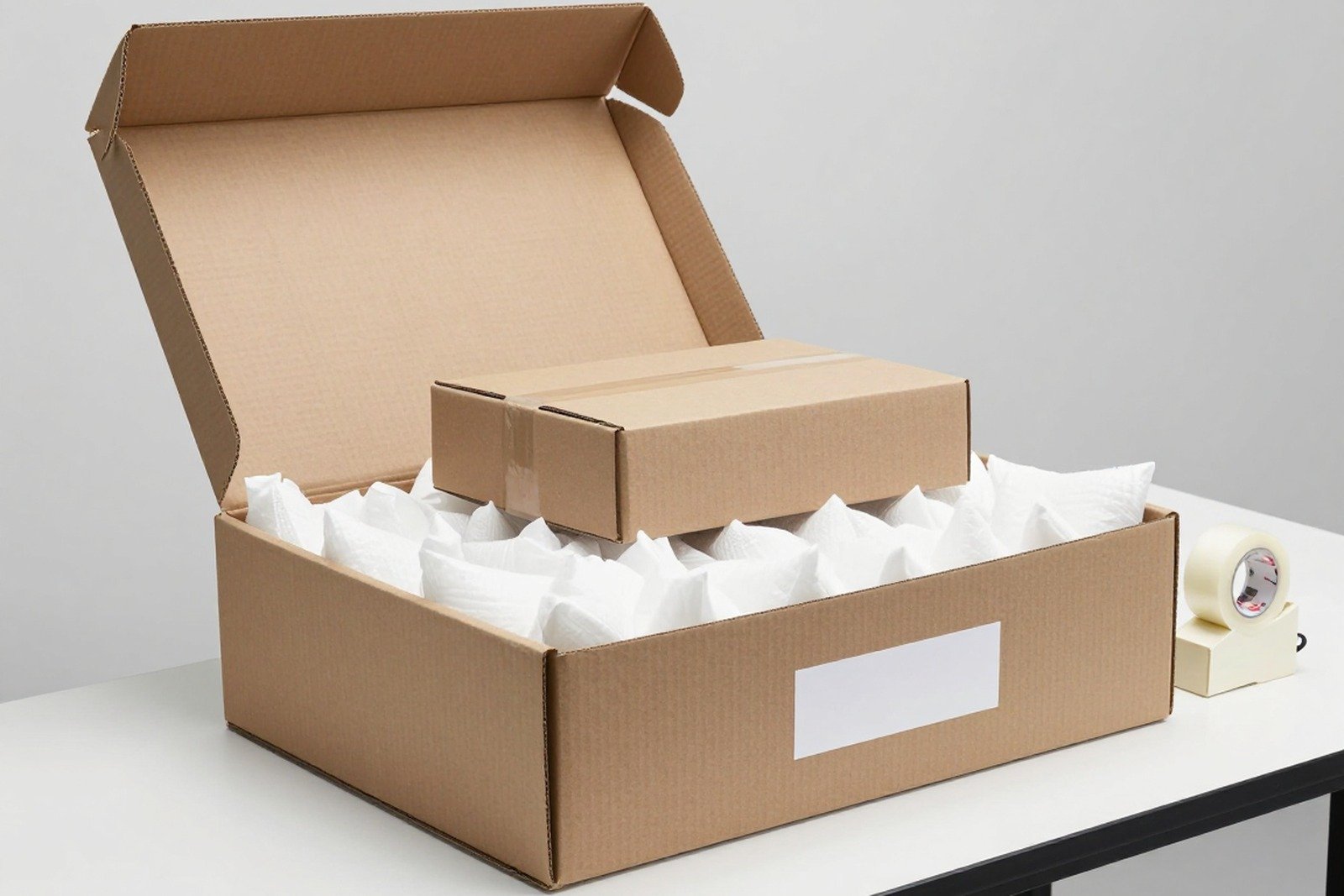
ISTA® 6-AMAZON.COM – Over Boxing is a group test procedure Member Performance — built by Amazon.com with ISTA and only used for goods sold into the Amazon system. Full name: e-Commerce Fulfillment for Parcel Delivery Shipment — 6-AMAZON.COM Over Boxing, 2018 edition.
The bottom line: this process applies when the product cannot be shipped in its own retail box, which must be placed into one over box accompanied by inserting material (dunnage — air pillow or Kraft paper), then sent to consumers via delivery system. This is the “other side” of the 6-AMAZON.COM process pair: if the goods can be sent using the product box, use SIOC; If you have to box outside, use Over Boxing.
This is also the same process Pass/fail criteria are predetermined by Amazon rather than leaving it up to the manufacturer to define — an important difference from conventional ISTA processes. The article goes over: definition, 32 kg range, proper packaging (including a set of “hazard products” that simulate other products in a multi-item order), a 6-stage sequence with 17 drops and 2 hours of vibration, passing criteria, model number, equipment and common errors.
1. ISTA 6-AMAZON.COM – What is Over Boxing?
According to the original document, Project 6-Amazon.com-Over Boxing is the article General simulation for e-commerce order fulfillment. Goods are placed Over Box — can be a single product with dunnage, or multiple retail products with dunnage — to send from Amazon.com to the consumer via parcel system (which can include air, rail, or ground).
The document defines very specifically the terms that packaging workers need to understand:
- Dunnage — loose material used to support and protect the product in the box, for example air pillow or Kraft paper.
- Air pillow — airbag inserts, usually made from LDPE #4 or HDPE #2 plastic; Document specifying dimensions 8 × 4 in (203 × 102 mm) and maximum thickness 1.0 mil.
- Fragile products — Fragile goods when dropped without protective packaging: glass, ceramic, porcelain, terracotta, electronics…
- Hazard products — reusable “mimics” that act as other products in a multi-item order.
- Liquids — liquids, semi-liquids or solids that can liquefy at temperatures above 70 °F, may leak from the primary packaging.
- Tertiary carton — shipping box made from corrugated cardboard (Over Box).
The General Considerations section of the document has four caveats to tell customers: test levels are based on general data and may not be representative of a particular distribution system; Product and packaging are considered together; certain conditions such as humidity, pressure or unusual handling may not be covered; and for dangerous goods, pass this test no This means it meets international/national dangerous goods requirements — it does not replace UN standards, it can only be used in conjunction with them.
2. Range: up to 70 lb (32 kg)
Document 3 states: Over Boxing covers testing of individual packaged-products weigh 70 lb (32 kg) or less, is prepared for completing e-commerce orders by over-boxing and sending via parcel delivery company. Goods weighing more than 32 kg are outside the scope of Over Boxing — this is the first threshold to check when considering whether this process can be used.
Regarding the conditions for using Over Boxing, definition document e-Commerce Fulfillment shipments is any configuration that:
- Individual retail products no designed to be sent in its own box; and
- One or more retail products are placed in a shipping carton (“over-box”) with dunnage to be sent to the end customer from an online retailer or distribution center.
Applies to both Single Item Shipment (Single Item Shipment) and Multi-item orders (Multiple Product Shipment — multiple products ordered online are combined into one shipping box). These two configurations are available Packaging process and model number vary, and this is the easiest point to make mistakes when quoting prices.
3. Pack before testing: Over Box, dunnage and hazard products
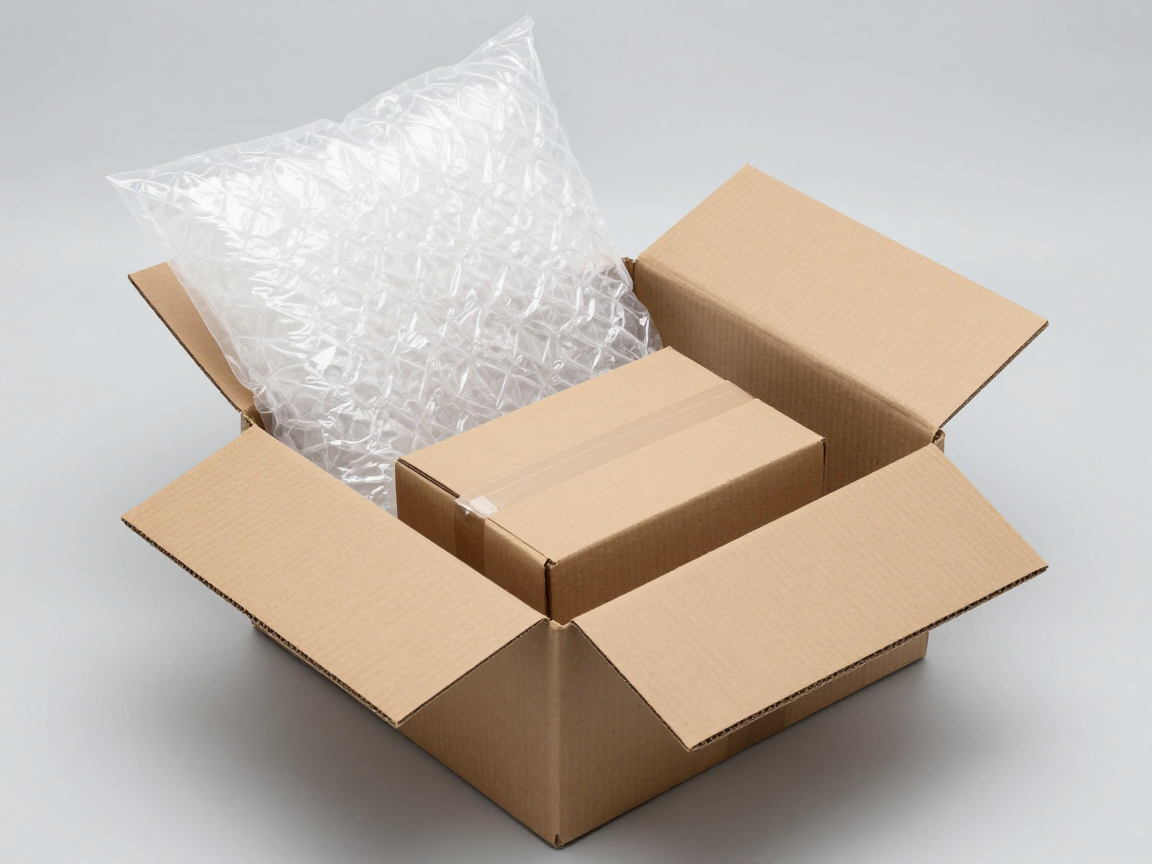
Unlike many procedures that only describe the test, Over Boxing describes it standard “pack out” way — because in the Amazon channel, the outer packaging is created by the seller/Amazon, not the product, so it must be standardized for the test results to be meaningful.
Over Box
- Over Box is made from corrugated cardboard C-Flute, sealed with wide poly tape 2 in (50.8 mm) — one strip on the top and one on the bottom.
- With heavy bale ≥ 15.0 lb (6.80 kg): Over Box must have all three sizes 2.0 in (50.8 mm) larger than Test Specimen’s largest dimension. For example in the document: if the product is 30.0 × 22.0 × 12.0 in, the Over Box is 32.0 × 24.0 × 14.0 in.
- For lighter packages, Over Box is selected according to the available table (starting with the smallest box, increasing to the next size until it fits).
- Documents note: Avoid over stuffing — the box must be able to be closed without having to press hard to hold the lid down when gluing.
Dunnage
Air pillow is Only insertion method allowed in Over Box according to the documentation; 8 × 4 in (203 × 102 mm), 1.0 mil maximum thickness. Dunnage is filled with space so that Test Specimen is possible blocked and braced (block and hold) properly.
Hazard products (multi-item orders only)
For multi-item orders, documents require creation hazard product acting as other bales in the box:
- Crafting by giving steel shot, sand or dense loose flow material into a plastic bag to the desired volume, seal the bag, place in the RSC/RET bin, and Insert paper so the heavy block doesn’t slide and does not create concentrated loads.
- Minimum board: 32 ECT C-Flute.
- If reusing hazard product, make sure the box is not severely worn (rounded edges, tired cardboard) — it should be replaced periodically for consistent results.
- Documents not allowed Replace hazard product by adding more Test Specimen.
The document has a standard table of 10 hazard products (A–J) with nominal dimensions and weight, tolerance ±3%:
| Name | Dimensions L×W×H (mm) | Dimensions (in) | Mass (kg) | Mass (lb) |
|---|---|---|---|---|
| A | 102×102×25 | 4.0 × 4.0 × 1.0 | 0.23 | 0.5 |
| B | 76×76×76 | 3.0 × 3.0 × 3.0 | 0.45 | 1.0 |
| C | 76×76×76 | 3.0 × 3.0 × 3.0 | 0.68 | 1.5 |
| D | 102×76×76 | 4.0 × 3.0 × 3.0 | 1.0 | 2.0 |
| E | 152×102×102 | 6.0 × 4.0 × 4.0 | 1.13 | 2.5 |
| F | 102×102×102 | 4.0 × 4.0 × 4.0 | 1.36 | 3.0 |
| G | 102×76×51 | 4.0 × 3.0 × 2.0 | 1.59 | 3.5 |
| H | 152×152×21 | 6.0 × 6.0 × 2.0 | 1.81 | 4.0 |
| I | Custom | Custom | 2.04 | 4.5 |
| J | Custom | Custom | 2.49 | 5.5 |
The document also includes a composite table Test Specimen volume → hazard product → Over Box (inner size, style and ECT). Example: Test Specimen 0–0.5 lb using hazard A, B, D with Over Box RSC/29 size 10.0 × 7.0 × 3.0 in; Specimens 15.0–70 lb do not use hazard (single item) and Over Box = product size + 2.0 in each dimension, RSC/32. This table needs to be looked up directly in the standard version when making a pack out application.
Place Test Specimen in the bin
- Mark the sides/edges/corners of the Over Box according to the procedure rules, determining the product orientation according to the way it lies on the vibrating table.
- Put Test Specimen in, accumulate corner 3-4-6, and oriented so that The most vulnerable area is towards the 3-4-6 corner.
- An important example that the document gives: with liquid products, the most vulnerable area is cap/spray valve/pump — the lid must be placed so that contact Face 4 and Face 6.
- Do not reuse Test Specimen of a single-item order sequence for a multi-item order sequence.
4. Over Boxing’s 6-stage series
| # | Group | Test type | Test level | Request |
|---|---|---|---|---|
| 1 | Climate | Pre-conditioning | Ambient | Required |
| 2 | Climate | Controlled air conditioning | Temperature/humidity select according to the chart | Options |
| 3 | Shock | Falling (string 1) | 9 falls | Required |
| 4 | Vibration | Random vibration — spectrum Over-the-Road | Grms total 0.53 | Required |
| 5 | Shock | Falling (sequence 2) | 8 drops | Required |
| 6 | Integrity | Leak Test | 8 o’clock | Only with liquid goods |
The sequence has an important practical detail: after finishing conditioning, the ambient temperature and humidity must be recorded. as soon as I started testing, and run the remaining string as quickly as possible — because the purpose is to evaluate the packaging in its newly released state.
5. Details of test stages
1st falling chain — 9 times (standard for bales < 32 kg)
| Times | Altitude | Posture |
|---|---|---|
| 1 | 460 mm (18 in) | Edge 3-4 |
| 2 | 460 mm (18 in) | Edge 3-6 |
| 3 | 460 mm (18 in) | Edge 4-6 |
| 4 | 460 mm (18 in) | Corner 3-4-6 |
| 5 | 460 mm (18 in) | Corner 2-3-5 |
| 6 | 460 mm (18 in) | Edge 2-3 |
| 7 | 460 mm (18 in) | Edge 1-2 |
| 8 | 910 mm (36 in) | Face 3 |
| 9 | 460 mm (18 in) | Face 3 |
Point of interest: the edge/corner drops are all 18 in., but the drop plane number 8 is 36 in (910 mm) — double. This is the “heaviest” drop of the chain and is often the decisive one for canned goods with empty spaces inside.
Random vibration — Over-The-Road spectrum, three positions
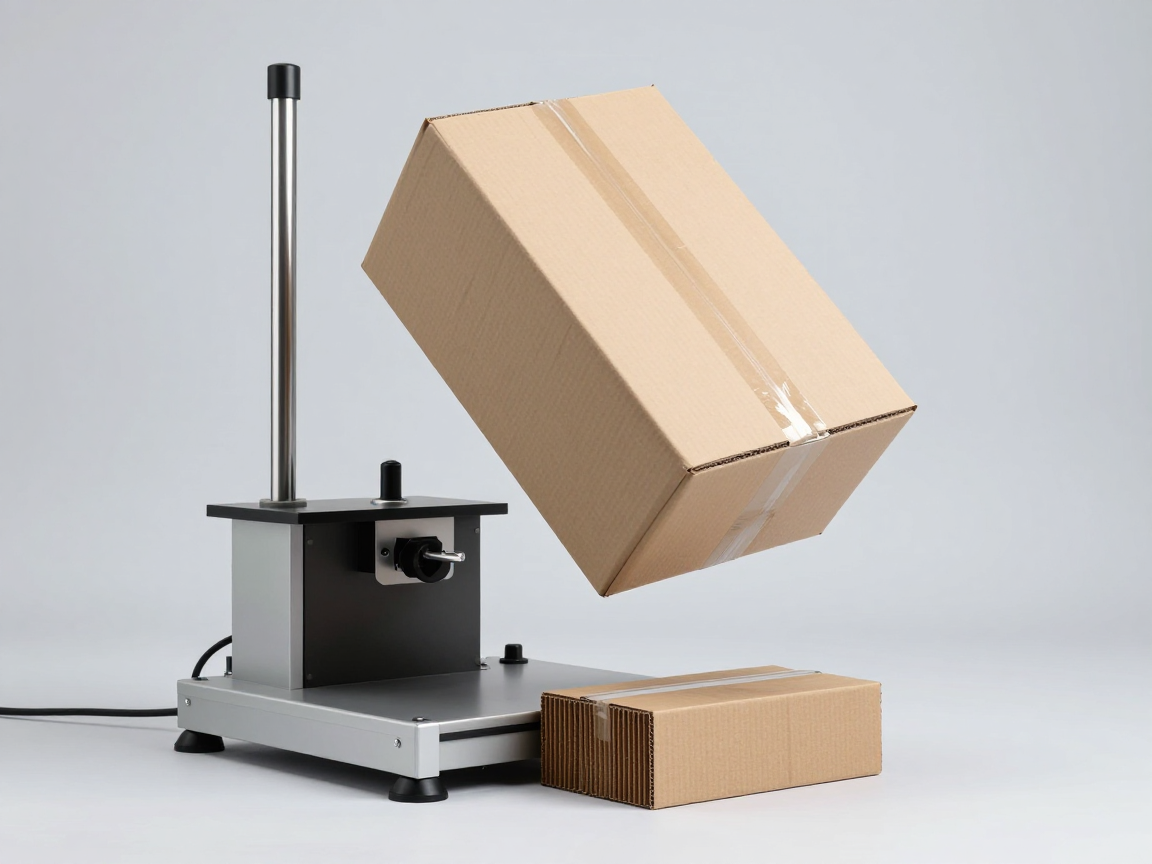
The vibrating table runs according to a random vibration spectrum Over-the-Road (Grms total 0.53) with three positions and three time periods:
- Face 3 on the vibrating table — 60 minutes.
- Face 4 on the vibrating table — 30 minutes.
- Face 6 on the vibrating table — 30 minutes.
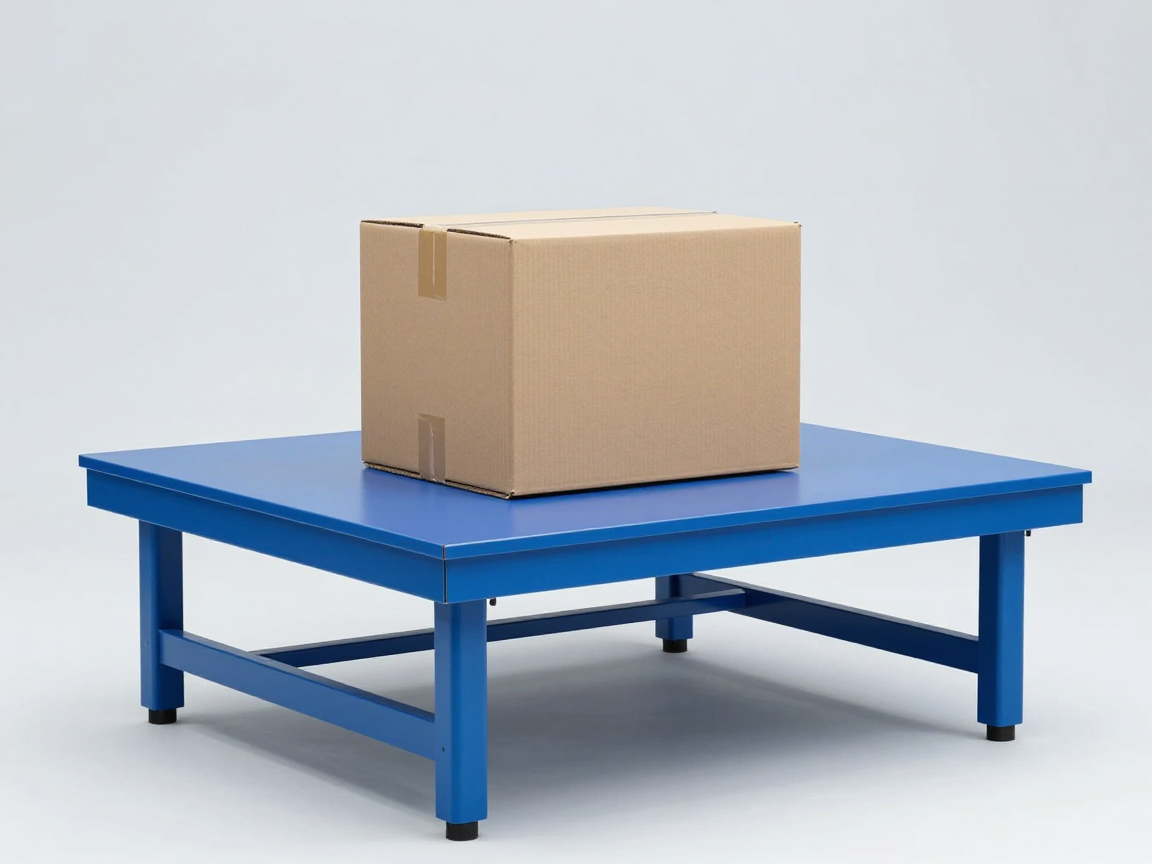
A total of 2 hours of vibration, and the packaging must hold its position No restrictions on vertical movement — meaning you can hold the bale horizontally but do not pin it down on the table.
Second chain of drops — 8 times, including drops on hazard blocks
| Times | Altitude | Posture |
|---|---|---|
| 10 | 460 mm (18 in) | Edge 3-4 |
| 11 | 460 mm (18 in) | Edge 3-6 |
| 12 | 460 mm (18 in) | Edge 1-5 |
| 13 | 460 mm (18 in) | Corner 3-4-6 |
| 14 | 460 mm (18 in) | Corner 1-2-6 |
| 15 | 460 mm (18 in) | Corner 1-4-5 |
| 16 | 910 mm (36 in) | Face 6 or Face 4 — the most dangerous flat position |
| 17 | 460 mm (18 in) | Face 3 falls on hazard |
Drop 17 has its own geometric rule: the bale must hit midpoint of hazard, vertically long edge of face and parallel to the short side of the beaten face; hazard set parallel to the short side of Face 3 or Face 2. Notable: Falling distance to the impact surface, not including the top of the hazard — if this point is measured incorrectly, the test level will be incorrect.
8 hour leak test (liquid goods)
Open the Over Box, take out the Test Specimen (liquid primary packaging) and Place it on its side so that the liquid touches the entire lid — to test the lid’s ability to stay sealed. No Place the load on top. After 8 o’clock, leak check; if leakage occurs before At 8 hours, the test can be stopped immediately and recorded as a failure.
6. Pass/fail criteria — set by Amazon, not self-defined
This is the biggest difference from conventional ISTA processes. With Over Boxing, the documentation is stated Acceptance Criteria and state clearly: Failure to meet the criteria below will result in a Fail result (Test Specimen only considered):
- Products fully operational according to expected function.
- No leaks.
- Every application Tamper evident is not affected — sealed intact.
- Secondary packaging is considered part of the product No major damage/dents/scratches.
And a very important sentence: hazard products, dunnage and tertiary packaging (outer cartons) are NOT part of the pass/fail criteria. This means that a dented outer box or a broken air pillow does not result in a failed test — only the product and primary/secondary packaging are evaluated. This is commercially reasonable (the outer box is a waste cost) but needs to be clearly stated to customers to avoid the misunderstanding that “pass = good packaging”.
The document also states: shipper and Amazon.com Four things must be determined together before testing — what constitutes product damage, the allowable damage tolerance, the method for determining product condition at the end of the test, and the acceptable packaging condition at the end of the test.
7. Model number — the most important table when creating a budget
The model number of Over Boxing depends volume and product type (Non-Fragile / Fragile), according to the table:
| Send configuration | < 15 lb (6.80 kg) — Non-Fragile | < 15 lb — Fragile | ≥ 15 lb (6.80 kg) — Non-Fragile | ≥ 15 lb — Fragile |
|---|---|---|---|---|
| Single Item | 1 | 2 | 1 | 5 |
| Multiple Items | 1 | 3 | 0 | 0 |
| Total number of samples needed | 2 | 5 | 1 | 5 |
Fragile goods include glass, ceramics, porcelain, terracotta, electronics… and even liquid goods. Here is a table explaining why fragile items < 15 lb are needed 5 samples and fragile items ≥ 15 lb also 5 samples — a number that often surprises customers when quoting prices. The document also requires samples to be of packaging and products Haven’t tried it yet; If sent to the lab, it must be fully over-packaged or repackaged with new packaging at the lab.
8. Equipment and supplies
| Category | Request | Standard |
|---|---|---|
| Climate conditioning | Record temperature and humidity; air conditioning chamber (optional) | ISO 2233 or ASTM D4332 |
| Free fall | The machine falls freely | ISO 2248 or ASTM D5276 |
| Hazard block | Made from hardwood or metal; high 20–25 mm (0.75–1.0 in), wide 150 mm (6.0 in); longer second shortest size of bales at least 200 mm (8.0 in); The two long upper edges are rounded to a radius equal to the block height ± 2.0 mm | — |
| Vibrate randomly | Vertical random vibration system, Over-the-Road spectrum | ISO 13355 or ASTM D4728 |
| Over Box | Carton C-Flute; Packages ≥ 6.80 kg are 2.0 in. larger than the speciment in each direction | — |
| Duct tape | Wide poly tape 2 in (50.8 mm), one upper band and one lower band | — |
| Dunnage | Air pillow only: 8 × 4 in (203 × 102 mm), 1.0 mil maximum thickness | — |
| Hazard products | Concentrated material flows loose in bags, RSC/RET tanks, boards with a minimum of 32 ECT C-Flute | — |
Hazard block details are easy to get wrong, and if done wrong, the 17th drop result is no longer valid: height 20–25 mm (no higher), width 150 mm, and Round the top edge with a radius equal to the block height. This is not “just any wooden stick”.
9. When to Over Boxing — and when not to?
| Situation | Process | Why? |
|---|---|---|
| The product cannot be sent in the original box, it must be packed in an outer box with dunnage, and sent to Amazon customers | 6-AMAZON.COM Over Boxing | Correct scope and Amazon requirements |
| Products can be sent in the original box (SIOC), to Amazon customers | 6-AMAZON.COM SIOC | The “other side” process of the 6-AMAZON.COM pair |
| Goods sold in the Sam’s Club system | 6-SAMSCLUB | Sam’s Club’s own process |
| Parcel goods in general do not require Amazon certification | 3A | The parcel process is more general and simpler |
| Goods weigh more than 32 kg | Outside of 6-AMAZON.COM Over Boxing | Documents limited to 70 lb (32 kg) |
| Goods going through e-commerce channels are different from packages with specific shapes | 3L | Covering long/flat bales, TV/Monitor, LTL |
Principle: Over Boxing or SIOC is a packaging decision, not a product decision. The same product can achieve both if there are two packaging options. When consulting, it is necessary to determine: whether the product can be sent automatically (SIOC) or must be over-boxed; and if over-box, is it a single item or multiple item order — because the packaging process and model number are different.
10. Common mistakes when performing Over Boxing
- Choose the wrong configuration. It seems like you order one item, but in reality the product is sold by order of many items (or vice versa) — the packaging process, product hazards, and model numbers are all different.
- Close Over Box of wrong size. For packages ≥ 6.80 kg, the speciment must be 2.0 in. larger in each direction; Closing too tight or too loose will cause the test to fail.
- Use dunnage other than air pillow. The document clearly states that air pillow is Only insertion method allowed, measures 8 × 4 in, maximum thickness 1.0 mil.
- Overstuffed with dunnage. The document clearly states to avoid over-packing dunnage: the box must be able to be closed without having to hold down the lid.
- Making hazard block incorrectly. Height 20–25 mm, width 150 mm, 200 mm longer than the second shortest side, rounded edges equal to the height.
- Measurement of falling distance 17 times was wrong. Must count to face va, does not take into account the hazard peak; The hazard must be parallel to the short side of Face 3 or Face 2, the bale hits the middle of the hazard.
- Wrong orientation of speciment. The most vulnerable area must be towards the 3-4-6 corner; With liquid goods, the cap must contact Face 4 and Face 6.
- Place a test load on the sample when testing for leakage. The document clearly states: no Set top-load to Test Specimen when testing for leaks.
- Misunderstanding of passing criteria. Outer boxes, dunnage and hazard products no counts as pass/fail — but the product, tightness, tamper-proof sealing, and secondary packaging do.
- Reuse Test Specimen between two strings. The document prohibits reusing the Test Specimen of a single-item sequence for a multi-item sequence.
- Do not record board quantity. With cartons, the documentation recommends recording the basis weight — if the nominal weight changes, even if the board is at the same performance level, try again.
- Using worn out hazard products. If reused, check that the box is not heavily worn (rounded edges, tired cardboard); If you don’t change it periodically, the results will be inconsistent.
11. What does the cost and trial time depend on?
Four key variables: model number (fragile goods need 5 samples, all must meet — maximum control); Configure single item or multiple items (multi-item orders need to create a separate hazard product set and pack out table); time chain — preconditioning, plus control conditioning if selected, 17 drops, 2 hours of vibration in three positions, and with extra loose rows 8 o’clock leak test; and sample manufacturing — Over Box with correct size/ECT, air pillow with correct specifications, hazard product with correct weight and structure. Article What does the cost and time of ISTA packaging testing depend on? Analyze further how to compare quotes.
12. Frequently asked questions
How are Over Boxing and SIOC different?
SIOC (Ships In Own Container) are goods that can be sent in the product box itself. Over Boxing means goods must be placed in an outer box with dunnage. These are two separate procedures in the 6-AMAZON.COM pair, with different test sequences and number of sampless.
How much weight does Over Boxing apply to?
Up to 70 lb (32 kg) — documentation limits the range to this.
If I don’t have an air pillow, can I use another packing material?
No. The document states air pillow is the only insertion method allowed in the Over Box, with dimensions of 8 × 4 in and a maximum thickness of 1.0 mil. Using different materials means trying a different lesson from the standard.
If the outer box is dented, will the test be marked “fail”?
No. Hazard products, dunnage and tertiary packaging are not included in the pass/fail criteria. Only the product (working, leak-free, intact seal) and its secondary packaging will be evaluated.
Who decides the pass/fail criteria?
With Over Boxing, the criteria are already available in the Amazon/ISTA document — different from the typical ISTA process where the business defines it themselves. However, the shipper and Amazon.com still have to agree in advance on the product damage tolerance and acceptable packaging conditions.
How to test liquid products?
According to the standard sequence, then add an 8-hour leak test step: place the primary packaging on its side so that the liquid touches the entire lid, do not place a load on top, and check for leaks after 8 hours (if leaks occur earlier, stop and record failure).
Is it necessary to record the paper weight of the carton?
The document strongly recommends recording the basis weight of the paper/board used to make the box; If the nominal rating changes, even if the board is at the same performance level, try again.
13. Conclusion
ISTA 6-AMAZON.COM – Over Boxing is a process for goods sold into the Amazon system Cannot be sent with original box, must be packed in an outer box with air pillow. Three things to remember: Range up to 32 kg, divided into single and multi-dish orders; test series of 17 drops (two 36 in., one on a hazard block) and 2 hours of vibration Over-the-Road Grms 0.53; and The passing criteria are specified by Amazon, only considering the product – not considering the outer box, dunnage or hazard product.
Before placing a test, businesses need to prepare: specimen mass (to determine whether it is within 32 kg); whether the goods are fragile or not (to calculate the number of samples); Configure single item or multiple items; and the three-dimensional size of the product (to choose the correct Over Box).
Reference standard version: article content based on ISTA document 6-Amazon.com – Over Boxing (2018 version) — e-Commerce Fulfillment for Parcel Delivery Shipment. The test levels are a summary for reference; When doing so, you must use the official standard, the current version of ISTA and comply with Amazon’s current requirements.
References
- ISTA 6-Amazon.com – Over Boxing, 2018 edition — e-Commerce Fulfillment for Parcel Delivery Shipment, International Safe Transit Association
- ISTA — Test Procedures & Projects (current catalog, accessed September 27, 2026)
- ISO — ISO 2233, ISO 2248, ISO 13355 (referenced methods)
- ASTM — D4332, D5276, D4728 (equivalent methods cited)
Related articles
- How are SIOC and Over Boxing different? Choose the right packaging test for Amazon products
- ISTA 6-AMAZON.COM What is SIOC? Packaging test procedure sent in the product’s own box
- What is ISTA 7D? Temperature testing procedures for shipping packaging
- What is ISTA 6-SAMSCLUB? Packaging test procedure for Sam’s Club distribution system
- What Is the ISTA Standard? How to Choose the Right Transport Packaging Test (3A, 6-Amazon, ASTM D4169)
- What is ISTA 3L? E-commerce fulfillment process
- What is ISTA 3A? Packaging test procedure for parcel delivery system (Parcel Delivery)
- What is ISTA 3K? Fast-moving consumer goods packaging test procedure in European retail chains
- ISTA Packaging Test Pass/Fail Criteria: 4 Things You Must Decide Yourself
Discuss further
Disclaimer and acknowledgment of intellectual property rights
This article is an explanatory content compiled by us for the purpose of introducing and disseminating knowledge. Article is not a translation, copy, abridgement or replacement of the parent standard, and is not evaluated, approved or sponsored by ISTA (International Safe Transit Association)..
The entire content of ISTA standards is copyrighted by the International Safe Transit Association, Inc. (East Lansing, Michigan, USA) — All rights reserved. ISTA® and the ISTA logo are registered trademarks of the International Safe Transit Association, Inc.; Mentioned in this article are for guidance purposes only and do not imply any affiliation, partnership or sponsorship.
Terms such as Amazon, Amazon.com are trademarks of their respective owners; are mentioned to indicate technical standards and do not imply affiliation or sponsorship.
Article content For reference only; Before applying for any purpose—testing, evaluation, certification, or commercial decision-making—the reader should consult the original ISTA document and applicable Amazon requirements directly, and consult an accredited testing facility as needed.
When performing testing, it is mandatory to use the official, current version of the standard, obtained directly from ISTA. We do not redistribute ISTA materials in any form. Information in this article may be out of date with the current version of the standard.
See more: Copyright Policy & Disclaimer by ticforall.com.