Quick summary
- IPX5 and IPX6 are the two “water jet” levels: same distance 2.5–3 m, same duration 1 minute per m² (minimum 3 minutes) — they differ in nozzle diameter and flow rate.
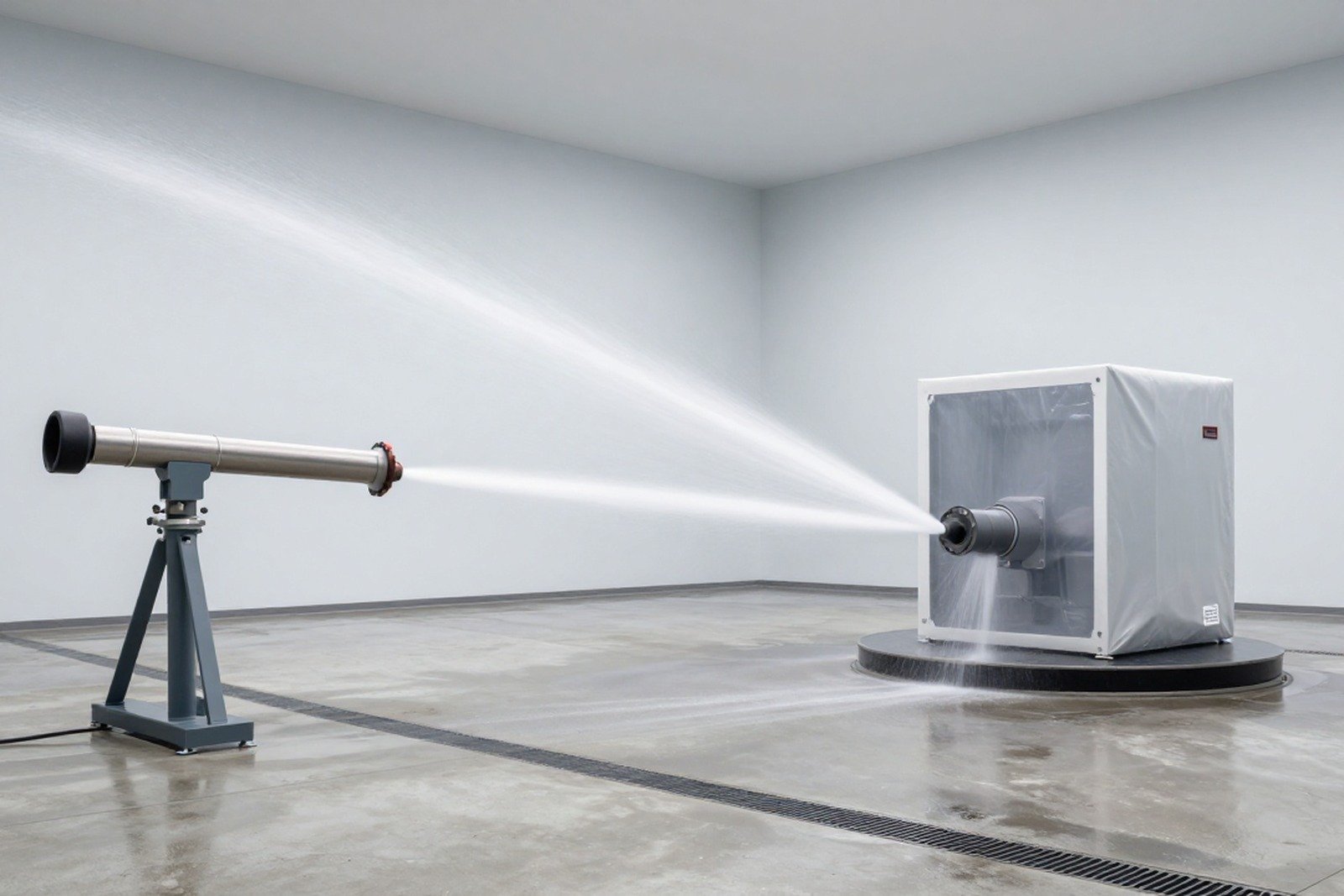
- IPX5: 6.3 mm, 12.5 l/min. IPX6: 12.5 mm, 100 l/min. Eight times the flow, twice the diameter.
- So IPX6 is not “a slightly stronger IPX5” but a different test in nature: a small high-pressure jet against a large low-pressure stream.
- Neither replaces IPX7/IPX8 — a jet and an immersion are two different ingress mechanisms.
Among the four water levels commonly printed on product labels, IPX5 and IPX6 are the two most often chosen by habit. Buyers see “6 is bigger than 5” and default to 6 to be safe; sellers print 6 because it sounds stronger. Both skip the more important question: how does water actually act on this product?
This article sets out the real parameters of the two tests, explains why the same enclosure can pass IPX5 and fail IPX6 (and the reverse), then gives a way to choose the level by installation position plus a model contract clause.
1. Two levels, two nozzle diameters
Start with the parameter table, because every later difference follows from it.
| Parameter | IPX5 | IPX6 |
|---|---|---|
| Name in the standard | Protected against water jets | Protected against powerful water jets |
| Nozzle bore | 6.3 mm | 12.5 mm |
| Flow rate | 12.5 l/min ± 5 % | 100 l/min ± 5 % |
| Nozzle-to-sample distance | 2.5–3 m | 2.5–3 m |
| Duration | 1 minute per m² of surface, minimum 3 minutes | 1 minute per m² of surface, minimum 3 minutes |
| Turntable | Yes, sample rotates while sprayed | Yes, sample rotates while sprayed |
The last two rows explain something rarely mentioned: the duration is not a fixed 10 minutes as in the IPX1–IPX4 family. It follows the surface area of the sample, with a minimum of 3 minutes. A small 0.05 m² enclosure still runs the full 3 minutes; a 2 m² cabinet needs 2 minutes by area but must still be covered on every face, so in practice it takes longer.
2. IPX5: a small jet, with more pressure than you think
With a 6.3 mm nozzle at 12.5 l/min, the whole flow is forced through a small cross-section, so the jet velocity at the nozzle mouth is high. That is why IPX5 often causes failures where the drip tests never reach: a thin gasket is peeled off by the jet, a speaker membrane tears, a flap pops open. The test models exactly those situations — washing with a hose, sea spray on a deck, a vehicle driving through a puddle.
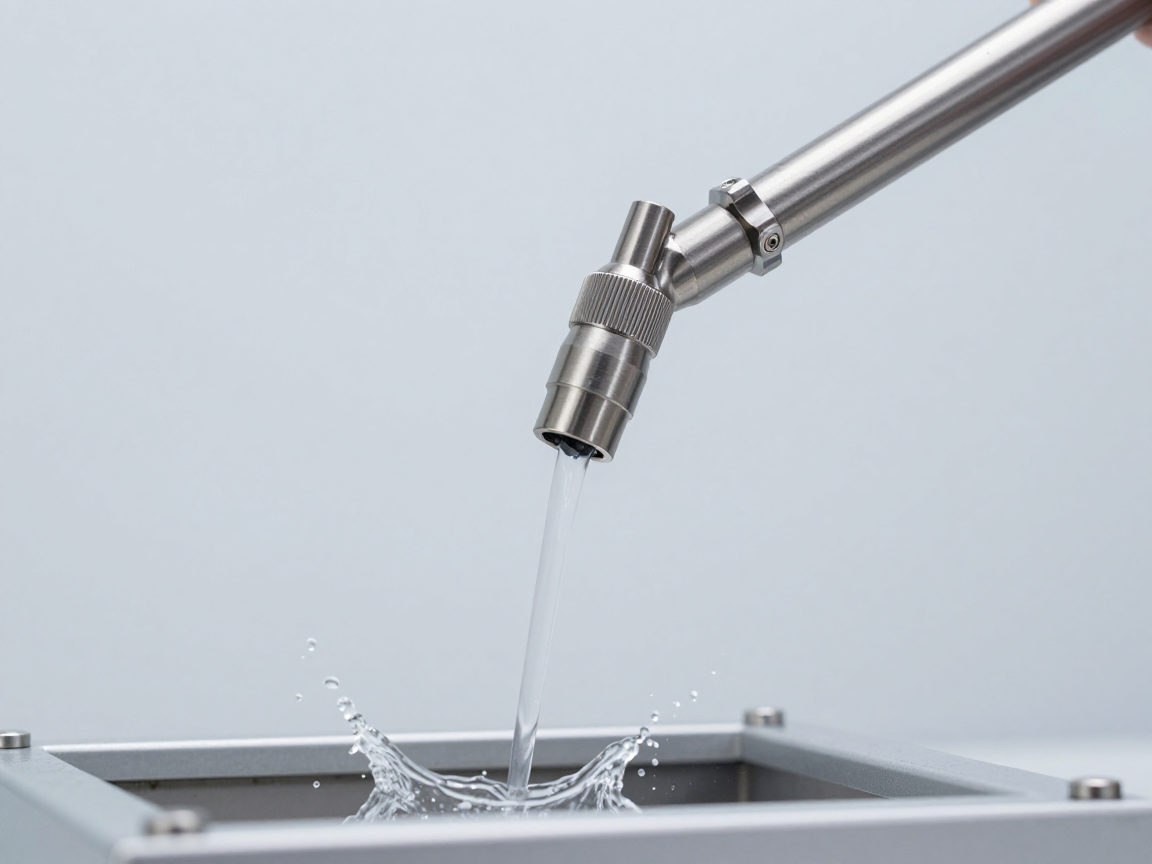
One technical detail often skipped: the standard requires a nozzle with a uniform circular outlet, not a fan-spray head. If a laboratory uses a modified garden nozzle, the jet disperses and the test is milder than specified — the report still says IPX5 while the test is really equivalent to IPX4.
3. IPX6: a large stream, and what it costs
IPX6 raises the nozzle to 12.5 mm and the flow to 100 l/min — eight times IPX5. This is not “turning it up” but a large stream of water, heavy enough to press on surfaces and drive water into gaps in a way a small jet cannot.
The practical consequences appear in three product groups:
- Devices with speaker or sensor membranes: the membrane survives a small jet but is deformed by the large stream, and the bond lifts.
- Enclosures with many flaps and doors: the large stream loads the whole face of the flap, not just the edge of the gasket.
- Devices with vents: a pressure-equalising vent is usually small enough to stop a jet, but a large stream can push water through the vent membrane if the membrane is not rated for it.
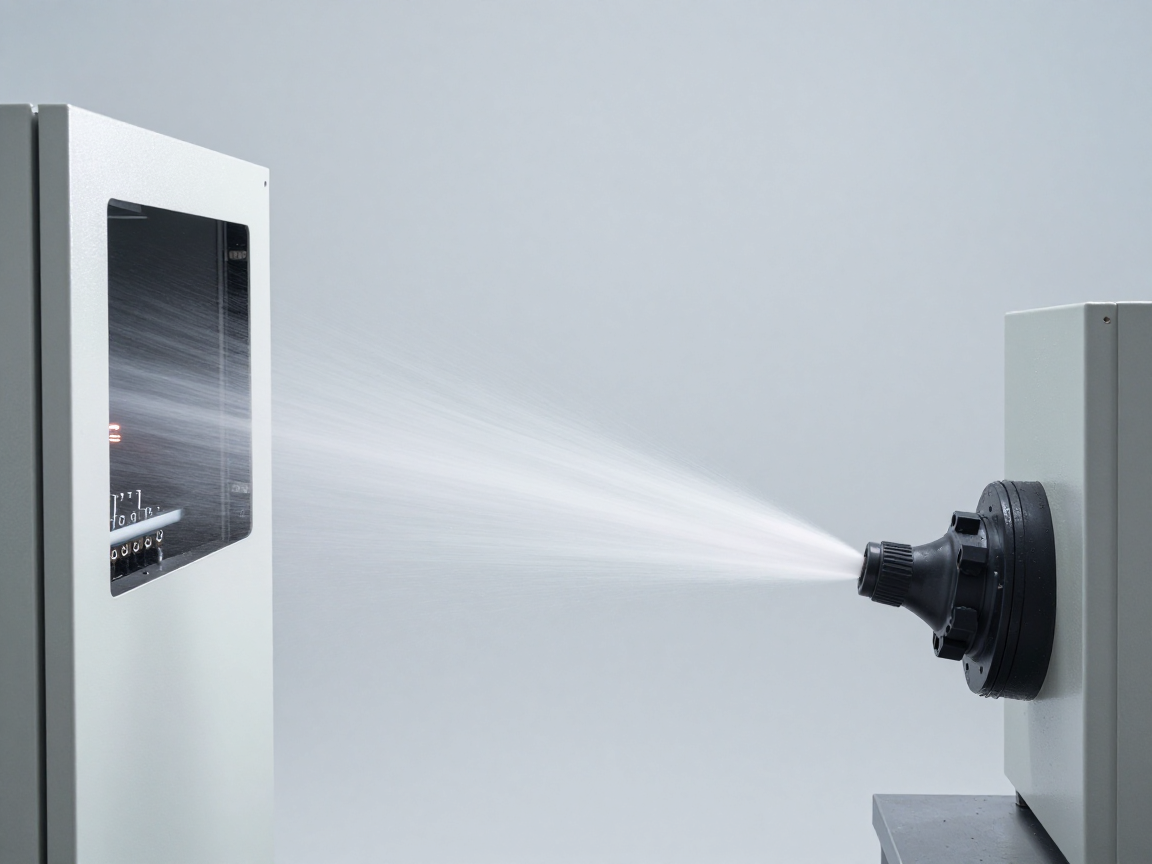
The point to remember: IPX6 is not harder than IPX5 in every respect. With some designs, the small high-velocity jet of IPX5 penetrates a narrow gap better than the large low-pressure stream of IPX6. That is why a sample can pass IPX6 and fail IPX5 — and the reverse. The two tests complement each other; they are not a ranking.
4. Why the 2.5–3 m distance matters
Both levels place the nozzle 2.5–3 m from the sample. That number is not arbitrary: it sets the kinetic energy left in the jet when it reaches the sample. Closer, the jet strikes before it disperses and the pressure at the contact point is higher than designed; farther, the jet breaks into mist and the test becomes milder.
Three things to check before running the test:
- Measure the flow with a graduated container and a timer, do not trust the nominal pump figure.
- Measure from the nozzle mouth to the nearest surface of the sample in the test orientation, not to the centre of the sample.
- Record the pump pressure — the standard specifies flow and diameter, pressure is only a consequence; a pump short on flow gives a weak jet even with a healthy pressure gauge.
This is the most often rushed part, because measuring flow takes time and sprays water over the floor. But an IPX6 report that does not record the measured flow proves nothing.
5. Sample preparation and assessment
| Step | Requirement | Common mistake |
|---|---|---|
| Configuration | As shipped: flaps, seals, blanking plugs, labels, supplied accessories | Testing a bare housing and concluding for the finished product |
| Orientation | As installed: hanging, floor-standing, tilted | Laying it flat because that is easier |
| Power | Unpowered by default; if powered, state it explicitly | Not recording the state in the report |
| Duration | From the surface area, minimum 3 minutes | Running exactly 3 minutes for every sample size |
| Assessment | Open the enclosure after the test, photograph each compartment | Wiping the outside and declaring “pass” |
On the acceptance criterion: no water ingress in a harmful quantity. “Harmful” must be defined before the test, covering at least three points — water in the electronics compartment, water in the battery compartment, and post-test function (charging, display, sensors, buttons). For products with a designed drain chamber, state that water in the drain is acceptable.
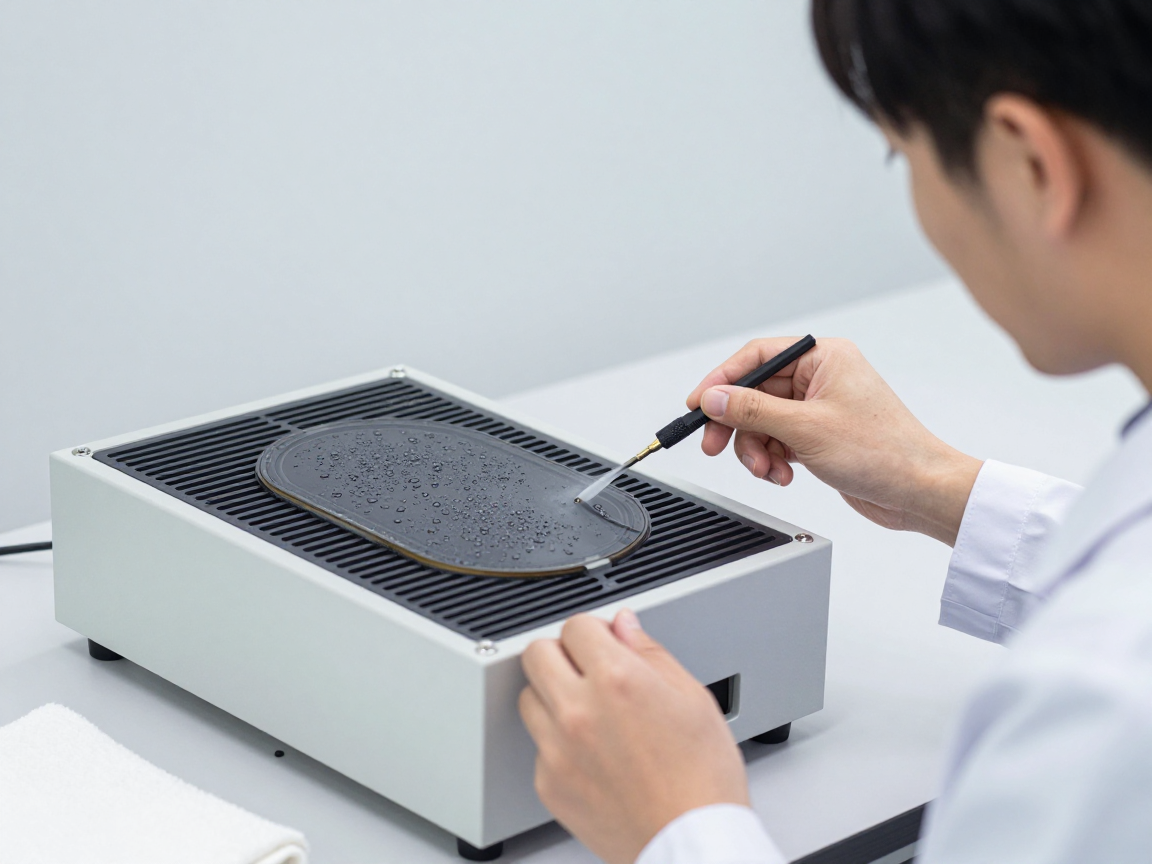
6. IPX5/IPX6 do not replace IPX7 and IPX8
This is the most expensive misunderstanding in this cluster. A jet and an immersion are two different ingress mechanisms:
| Factor | Water jet (IPX5, IPX6) | Immersion (IPX7, IPX8) |
|---|---|---|
| Source of pressure | Kinetic energy of the jet, local effect | Hydrostatic pressure, whole surface |
| Duration | Short, measured in minutes | Continuous 30 minutes, or as agreed |
| Weak point exploited | Gaps facing the nozzle, thin gaskets, membranes | Every submerged joint, cable entries, connectors |
| How it is judged | Water entering during spraying | Water entering during the whole immersion |
An enclosure that passes IPX6 can perfectly well fail IPX7 if the flap only seals when external pressure presses it shut, while under immersion water seeps along the thread. The reverse is equally true. If the product may fall into water, add the immersion test — see IPX7 explained and Is IP68 really waterproof for the limits of digit 8.
7. IPX6K, IPX9K and the limits of level 6
In automotive files you will meet codes with a K. The K is a variant in ISO 20653 for road vehicles, not a level in IEC 60529:
- IPX6K: still a small nozzle but at higher flow and pressure than IPX6, for positions exposed to strong spray such as engine bays and wheel arches.
- IPX9K: high-pressure, high-temperature jets sprayed from several angles, for equipment that must be machine-washed in food, pharmaceutical and automotive plants.
Make this clear: IPX6 is not the highest water level and cannot be used to prove resistance to high-pressure machine washing — a domestic pressure washer already produces far more pressure than the IPX6 test. If a customer asks “can it be cleaned with a pressure washer”, IPX6 alone is not a sufficient answer; you need IPX9K testing or a specific agreement.
If the product is a Tier 1 component, use exactly the code on the drawing: an IPX6 report submitted against an IPX6K requirement will be rejected, even though the two tests sound similar.
8. Choosing a level for outdoor products
| Real situation | Minimum level | Reason |
|---|---|---|
| Outdoors but sheltered, slanted rain only | IPX4 | Splash from all directions but no jet |
| Outdoors unsheltered, near the ground, hose-washed | IPX5 | Small jet, but with kinetic energy |
| Equipment on ships, trucks, beside flooded roads | IPX6 | Large stream hitting directly, sustained |
| Must be washed by machine or steam | IPX9K (to ISO 20653) | Beyond the scope of IEC 60529 |
| Risk of flooding or dropping into water | IPX7 or IPX8 | Different ingress mechanism — separate test |
The rule for choosing: choose by the mechanism of water attack, not by the biggest number a supplier can deliver. A higher level is not only more expensive to test; it drags design changes with it — thicker gaskets, more screws, a different speaker membrane — which usually make the product harder to assemble and more expensive per unit.
The structure of the IP code is covered in What is IEC 60529; the four milder levels in IPX1 to IPX4; dust in IP5X and IP6X: the talc dust test.
9. Six common errors
| Error | Consequence | Prevention |
|---|---|---|
| Not measuring flow, judging by eye | The test is weaker than specified but the report still says IPX5/IPX6 | Measure with a graduated container for one minute before each run |
| Nozzle closer than 2.5 m | The jet strikes before dispersing; pressure higher than intended | Measure and record the distance in the report |
| Sample not rotating on the turntable | One face takes the water; the rest are untested | Check the turntable and its speed before spraying |
| Timing by feel | Large samples are tested for too short a time | Use 1 minute per m², minimum 3 minutes, and record it |
| Testing a bare housing without flaps and seals | The result cannot be used for the product as sold | Test the correct configuration and photograph it |
| Opening the unit while the surface is still wet | Outside water runs in and the conclusion is wrong | Wipe the surface, open at an angle, record the sequence |
10. Contracts and labels
Model clause for IPX5:
“The enclosure shall meet IPX5 to IEC 60529: tested with a 6.3 mm nozzle, flow 12.5 l/min measured at the nozzle, distance 2.5–3 m, sample rotating on a turntable, duration 1 minute per m² (minimum 3 minutes), sample in production configuration and installation orientation, unpowered; no water shall enter the electronics and battery compartments, verified by disassembly.”
For IPX6, replace “6.3 mm nozzle, 12.5 l/min” with “12.5 mm nozzle, 100 l/min”. For IPX6K, state “to ISO 20653” — do not merge it with IEC 60529, because the two standards use different parameter sets.
On the label, state both digits (for example IP65 or IP66 where dust protection also applies). Claiming “jet resistant” without a code cannot be verified, and when a customer complains there is nothing to check it against.
Frequently asked questions
Does IPX6 survive a high-pressure washer?
No. IPX6 specifies a high flow but at much lower pressure than a pressure washer. To claim machine-wash resistance you need IPX9K testing or the specific conditions the customer states.
If it passes IPX6, can we declare IPX5?
In principle that cannot be inferred, because the two tests differ in nozzle diameter and flow. The safe route is to test the level you intend to claim, or state in the report that a higher level was tested with its specific parameters.
After passing IPX6, is IPX7 still needed?
Yes, if the product may be flooded. Jets and immersion exploit different weak points; passing a jet level does not guarantee passing an immersion level.
Why does a sample pass IPX6 but fail IPX5?
Because a 6.3 mm jet has higher velocity at the nozzle mouth and can pass through a narrow gap, while the 12.5 mm stream only loads the surface. That is why the two levels are not ranked substitutes.
How long do IPX5/IPX6 tests take?
Each test itself is at least 3 minutes, but with preparation, flow measurement, disassembly and drying, one set of samples for both levels usually takes half a day to a day.
Conclusion
IPX5 and IPX6 differ by two easy-to-remember numbers: 6.3 mm – 12.5 l/min and 12.5 mm – 100 l/min. But the technical consequences are far larger than the numbers suggest: on one side a small jet with high kinetic energy, on the other a large stream loading the whole surface.
Three things to do now with existing files: check whether the report records the measured flow and the nozzle distance; whether the sample was in production configuration; whether the declared level matches the level actually tested.
If the product is both outdoors and at risk of flooding, do not pick one level instead of the other — test and declare both, for example IP66 and IP67. The extra test usually costs far less than a shipment returned.
References
- IEC 60529, Degrees of protection provided by enclosures (IP Code) — second digit, levels 5 and 6: nozzle, flow, distance, duration.
- ISO 20653 — IP code for road vehicles and the K variants.
- IEC 60068-2-18 — water test (test R), supplementary guidance on methods.
Related articles
- What is IEC 60529? The IP code explained
- IPX1 to IPX4: parameters, equipment and errors
- IPX7 explained: immersion at 1 m for 30 minutes
Talk to us
Disclaimer
This article is our own interpretation; it is not legal advice. Readers should check the official text of the standard before applying it to a specific product.
See also: Copyright Policy & Disclaimer of ticforall.com.