Home Blog

CISPR 15: interference limits for lighting equipment

0
Cover image of the article «CISPR 15: interference limits for lighting equipment»

CISPR 15 is the prescribed standard Limits and methods for measuring electromagnetic interference for lighting and similar equipment. The point that makes CISPR 15 unique is: The measuring frequency range starts from 9 kHz — lower than most other EMC standards — along with specific tests such as insertion loss, because the luminaire is a system with long wires, ballasts and drivers distributed throughout the entire luminaire block.

1. Scope of application

  • Bulbs and self-ballasted lamps: Fluorescent lamps, compact lamps, LED lamps, high-intensity discharge (HID) lamps, metal halide lamps, sodium lamps.
  • Luminaire and accompanying control devices: electromagnetic ballast, electronic ballast, LED driver, power adapter for lights.
  • Specialized lighting equipment: Street lights, headlights, decorative lights, construction lights, stage lights and some types of advertising lights as prescribed by standards.
  • Devices use mains power and some devices use battery power or DC power, depending on configuration.
  • Exclusions: display screens and multimedia equipment (CISPR 32), household appliances (CISPR 14-1), industrial – scientific – medical equipment (CISPR 11).

2. Why the measurement range starts at 9 kHz

Electronic ballast and LED driver switch at frequencies of tens of kHz (usually 20 – 100 kHz). The noise generated around the switching frequency and its harmonics falls exactly in the range below 150 kHz, where the radio-marine bands and some control systems on the grid are operating. Therefore, CISPR 15 must “cover” from 9 kHz instead of starting at 150 kHz like other standards.

3. The main tests

3.1. Terminal voltage disturbance at the mains port — 9 kHz to 30 MHz

  • Use a network to stabilize the source impedance and evaluate quasi-peak and average.
  • Limit has many sub-ranges, for example with power connector: approx 110 dBµV in the range 9 – 50 kHz, gradually decreasing 90 → 80 dBµV in the range 50 – 150 kHz, 66 → 56 dBµV in 150 – 500 kHz, 56 dBµV in 500 kHz – 5 MHz and 60 dBµV in 5 – 30 MHz.
  • Because the limit below 150 kHz is quite “open” but the driver’s noise is large right there, most CISPR 15 errors of LEDs fall in the range of 9 – 150 kHz.

3.2. Radiated disturbance

  • Range 30 MHz – 300 MHz, extended to 1 GHz according to some regulations; typical limit 30 dBµV/m (30 – 230 MHz) and 37 dBµV/m (230 – 300 MHz) when measured at 10 m.
  • Large luminaires, street lamps, and lamps with long wires often cause stronger radiated disturbance than small lamps because the wire structure and lamp frame act as antennas.
  • For the range below 30 MHz, the standard stipulates the measurement of radiated magnetic fields using frame antennas according to specific configurations.

3.3. Insertion loss — 9 kHz to 30 MHz

  • Is a typical test of CISPR 15, applicable to some types of luminaires with separate ballasts.
  • The test determines the amount of attenuation the luminaire provides to the interfering signal — that is, evaluates its ability to “block” the interference from spreading from the lamp to the grid.
  • The required attenuation value depends on the frequency range and lamp type, so you must look up the table in the standard.
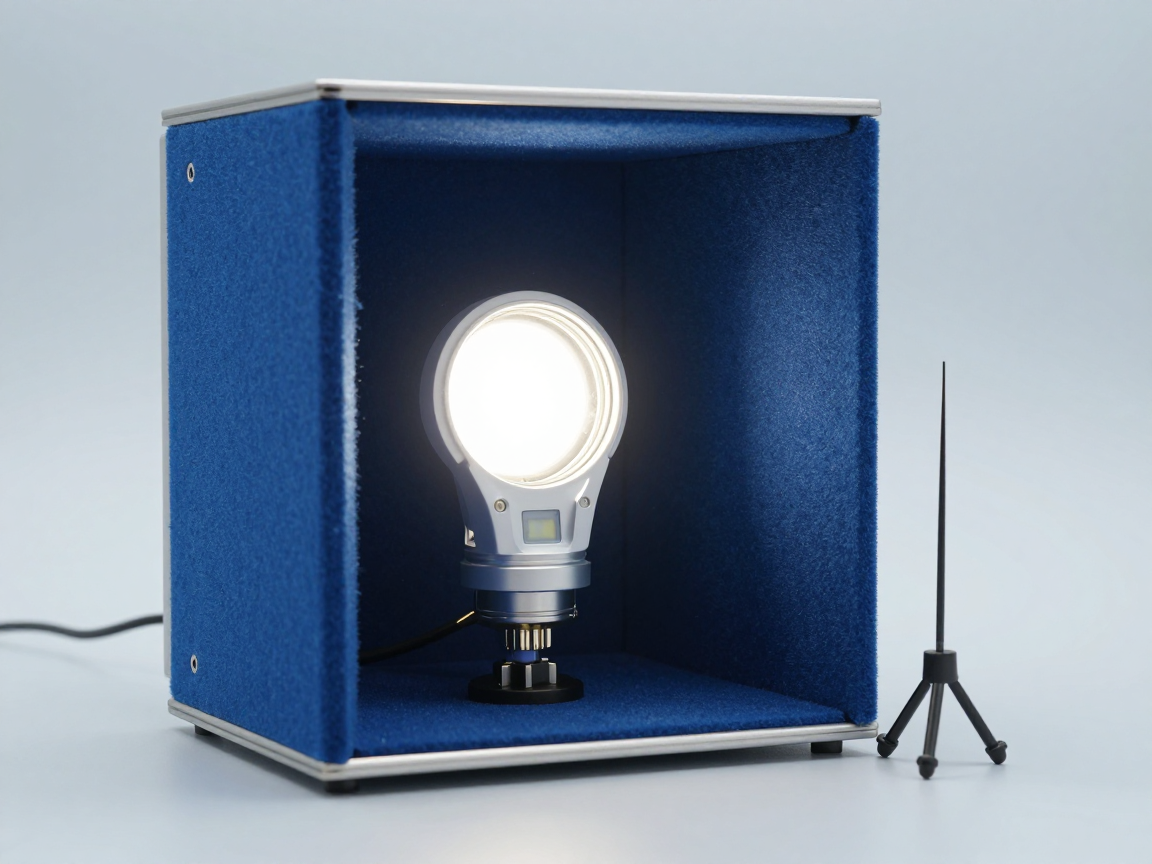
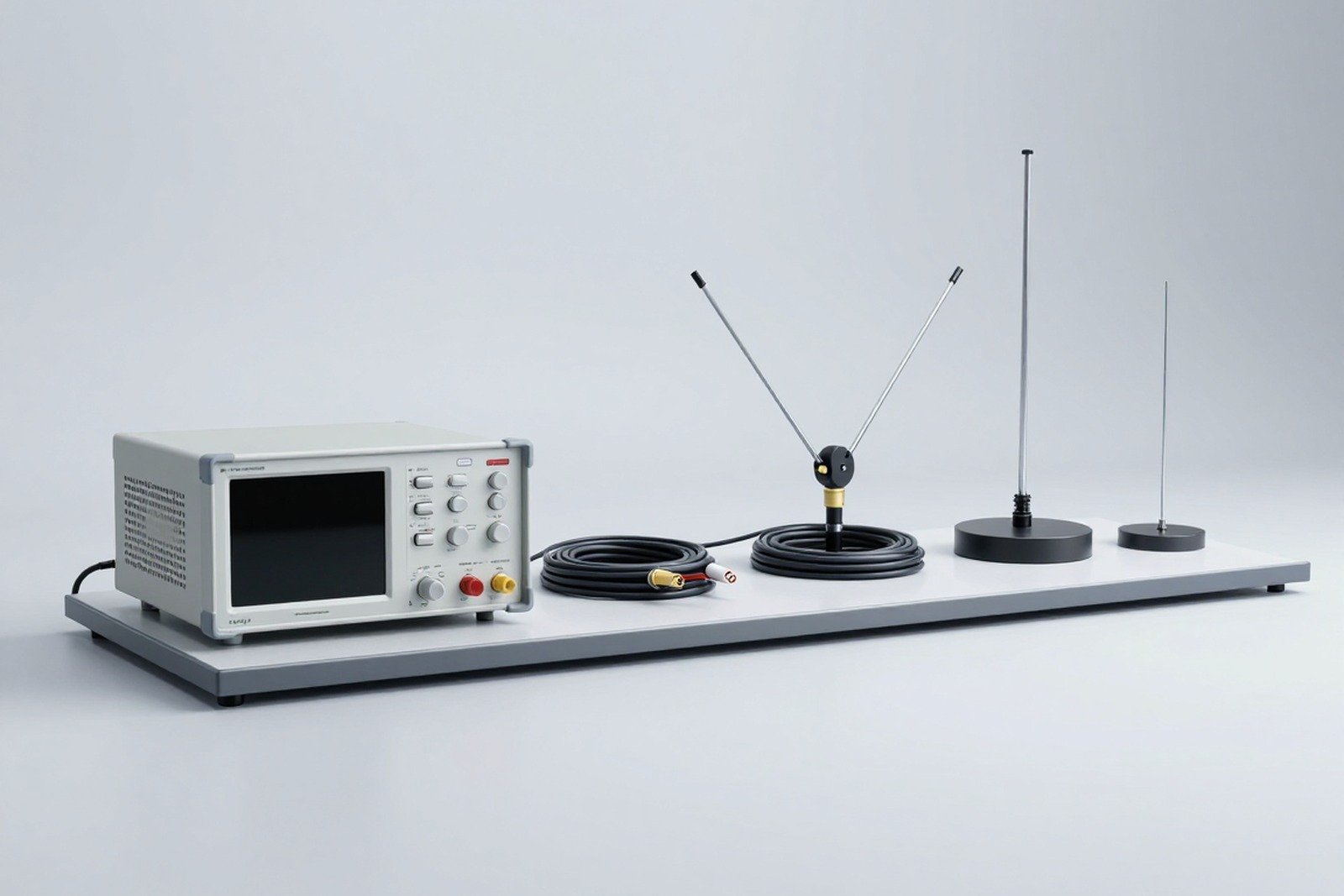
Surface-mounted LED glows in a semi-radiator chamber with blue absorbing material behind it and a small antenna on a tripod
LEDs must be measured in a steady state of light — driver noise varies with load and temperature.

4. Lamps must meet both CISPR 15 and 61000-3-2 Class C

This is a point many businesses miss. Lighting equipment is inside two Different request groups:

  • CISPR 15 — high-frequency disturbance (9 kHz – 30 MHz and radiation above 30 MHz).
  • IEC 61000-3-2 Class C — current harmonics at low frequencies (3rd order = 30·λ % of basic current, next steps 10 %, 7 %, 5 %, 3 %…), same exemption conditions for some devices with power ≤ 25 W according to the provisions of the standard.
  • With some types of lamps, additional considerations must be taken IEC 61000-3-3 if the capacity and load characteristics fall within the applicable range.

Common reality: LED lights use cheap drivers with only bridge rectifiers and filter capacitors — achieving CISPR 15 is quite easy but Class C sliding because the 3rd harmonic is too large, and vice versa, drivers with active PFC achieve better Class C but generate higher frequency noise if the EMI filter is not designed properly.
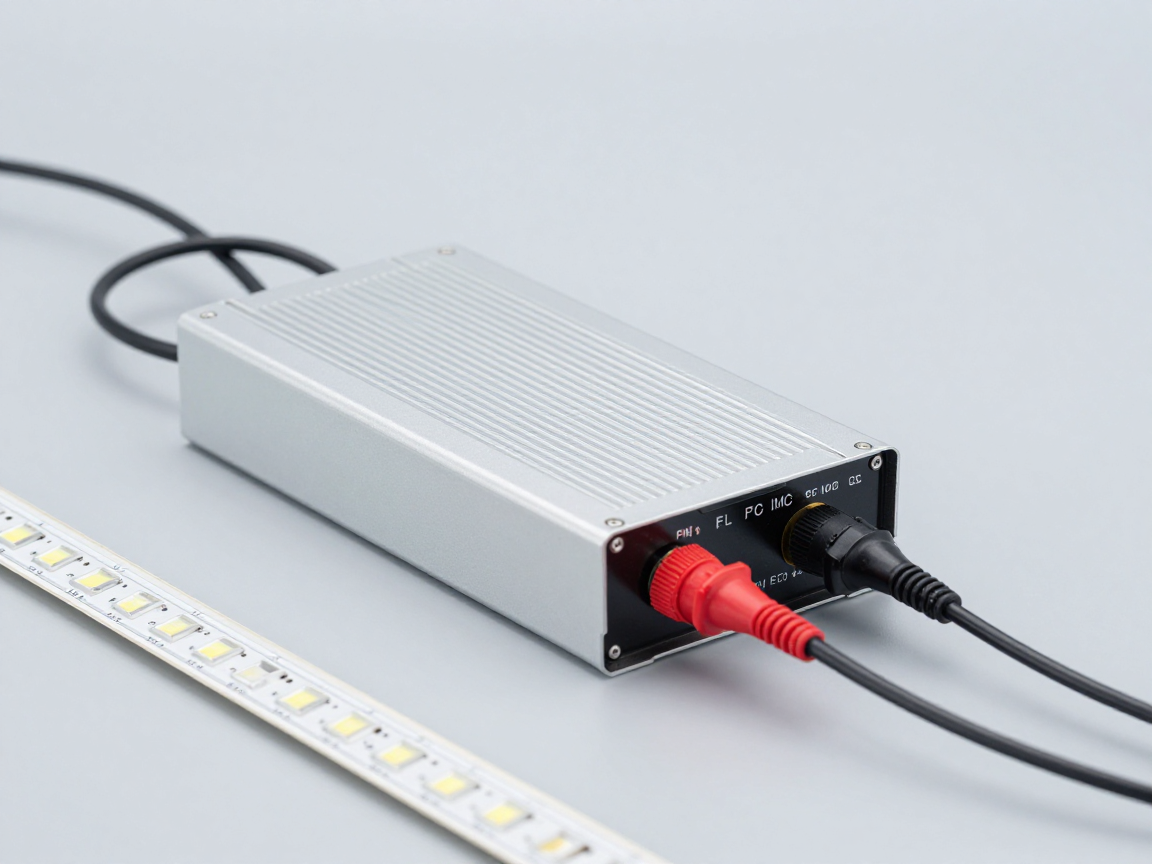
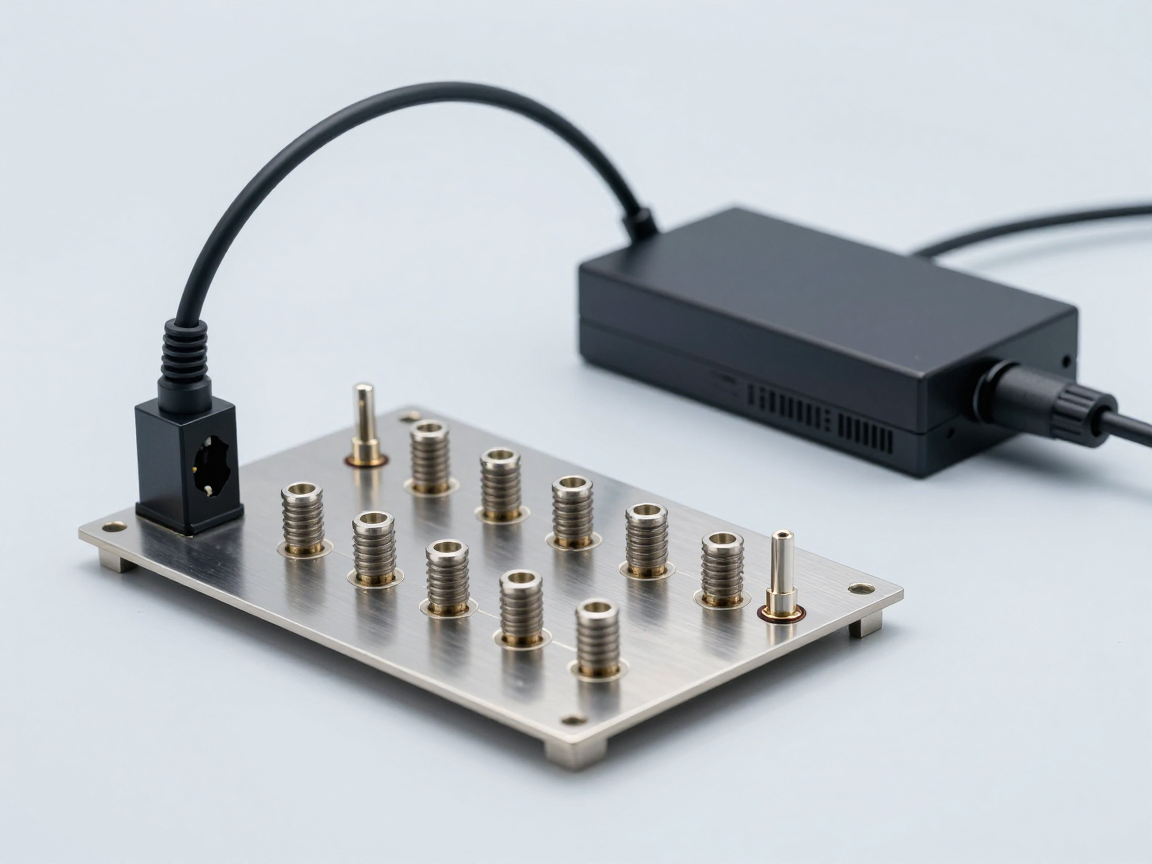
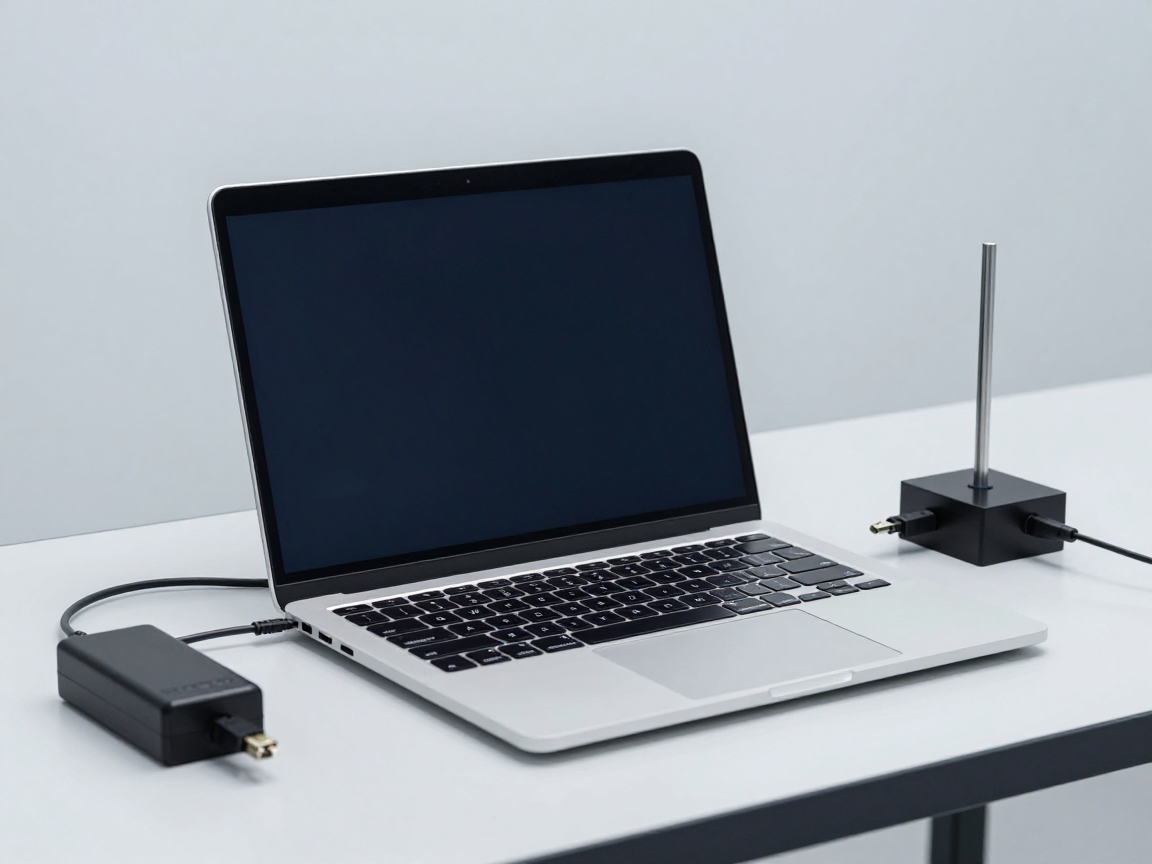
Small LED driver box connected to short power cord and LED strip on the table, with voltage probe and coaxial cable
The LED driver is the “heart” of both measurements: both determining current harmonics according to 61000-3-2, and determining high frequency noise according to CISPR 15.

5. Test conditions and easy mistakes

  • The lamp must be optically stable: Measure after the lamp stabilizes (usually 15 – 30 minutes), at the specified test room temperature. LED and CFL noise changes with temperature.
  • Devices with brightness adjustment: Must measure at many dim levels because the switching frequency changes with the dim level, and the maximum interference level is not 100%.
  • Included light and bulb set: When selling light sets with bulbs, you must try the correct combination sold on the market.
  • Lamp wire and frame: Luminaire length, arrangement and size strongly influence radiated interference — do not change configuration between tests.
  • Power source and measuring cable: All power wires must pass through LISN, including the dim or controller wires.

6. Edition and application in Vietnam

  • CISPR 15 is updated multiple times to keep up with LED technology; When preparing documents, you need to look up the current version on the IEC Webstore and the version cited by market regulations.
  • In Vietnam, CISPR 15 is translated into TCVN 7186 and is in the group of referenced standards of QCVN 9:2012/BKHCN with Amendment 1:2018 for household electrical and electronic equipment.
  • For imported lights, documents usually include: electrical safety (IEC 60598/TCVN respectively), EMC (CISPR 15), energy efficiency (according to energy labeling regulations) and current harmonics (61000-3-2).

7. Frequently asked questions

Do LED lamps have to be tested to CISPR 15?

Have. LED lighting fixtures and LED drivers fall within the scope of CISPR 15. Only LED products with display/information functions will move to CISPR 32.

Are lamps below 25 W exempt?

The standard has provisions for exemptions for some low power cases, but exemption conditions depend on the type of device and version of the standard; must check the original text before drawing conclusions. In many cases, measuring is still cheaper than arguing about exemption conditions.

Why measure from 9 kHz when the equipment switches at only 50 kHz?

Because the harmonics of the switching frequency and transient phenomena at start-up create a spectrum that spreads below the fundamental frequency, directly affecting the frequency range used for information on the grid.

8. Conclusion

CISPR 15 is a “narrow but deep” standard: the scope is just lighting equipment, but the requirements range from 9 kHz to 1 GHz with specific tests such as insertion loss. With LEDs, success depends almost entirely on driver quality — and the driver has to satisfy high frequency noise (CISPR 15) confused current harmonics (61000-3-2 Class C), the two problems pull in two different directions.

Related articles


Talk to us


    Disclaimer

    The article was compiled by us for interpretation; not legal advice. The above limits are illustrative for common ranges; The original table in the CISPR 15 version cited for the specific product must be consulted. Copyright Policy & Disclaimer.
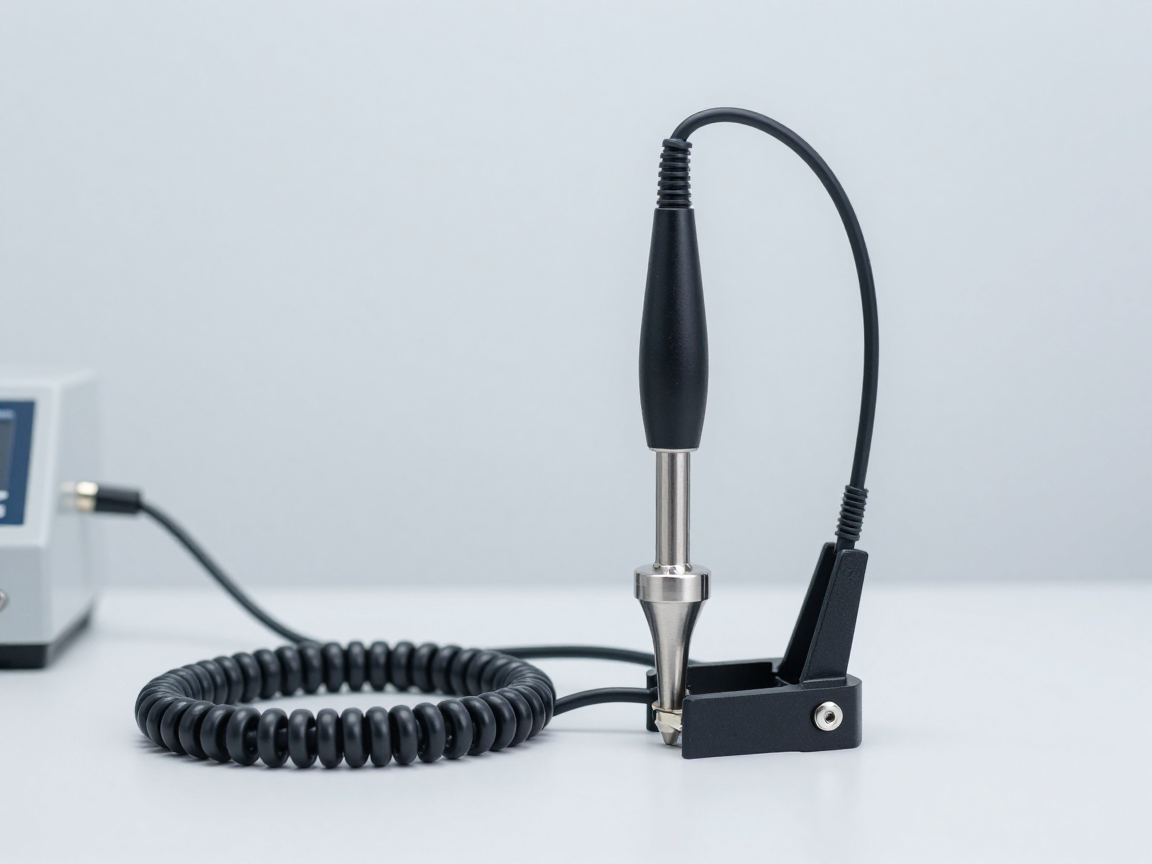
    CISPR 14-1: emissions for household appliances and power tools

    0
    Cover image of the article «CISPR 14-1: emissions for household appliances and power tools»

    CISPR 14-1 regulations Limits and methods for measuring electromagnetic emissions for household appliances, electric tools and similar equipment — product groups with motors, heating elements or electronic control circuits, using mains or battery power. This is the “gateway” standard for nearly all exported household products: rice cookers, vacuum cleaners, fans, drills, mixers, microwave ovens, heating equipment.

    1. Scope of application

    • Household appliances: rice cooker, kettle, microwave, refrigerator, washing machine, vacuum cleaner, fan, mixer, iron, heating equipment.
    • Electric tools: drills, grinders, saws, screwdrivers, garden tools — even cordless handhelds.
    • Similar devices: vending machines, electrical equipment used in the home but not in the information technology or lighting group.
    • Equipment Runs on batteries or accumulators is also within the scope when it has the same function as a mesh device.
    • Exclusions: lighting equipment (CISPR 15), multimedia equipment (CISPR 32), industrial – scientific – medical equipment (CISPR 11).

    2. The four test groups of CISPR 14-1

    2.1. Terminal voltage disturbance at the mains port — 150 kHz to 30 MHz

    • Measured by source impedance stabilization network, evaluate both quasi-peak and average.
    • Typical limits for residential environments: 66 → 56 dBµV gradually decreasing in the range of 150 – 500 kHz, 56 dBµV in 500 kHz – 5 MHz and 60 dBµV in 5 – 30 MHz; average level is 10 dB lower.
    • For hand-held power tools, the limits may be relaxed according to specific regulations for this group.

    2.2. Disturbance power — 30 MHz to 300 MHz

    • This is the test characteristic of CISPR 14-1 and is also the biggest difference compared to CISPR 32.
    • Use absorbing clamp clamp around the power cord with real load, measure the disturbance power transmitted along the cable and record it in dBpW.
    • Advantage: this test replaces part of the radiated measurement with a small device with a power cord — faster and more stable in a standard test room.
    • The limit depends on the device type and frequency band, so you must look up the table in the standard according to the correct product group.

    2.3. Radiated disturbance

    • Applicable to some product groups, usually in the range of 30 MHz – 1 GHz, measured in a semi-sterilization chamber or test field.
    • Devices with radio transmitters (remote control, Wi-Fi, Bluetooth) must also consider specific radio requirements according to specialized standards.

    2.4. Discontinuous disturbance — the “click” test

    • Many household appliances emit interference short pulse when switching (relays, switches, starter motors, thermostats) rather than generating continuous noise. The standard evaluates this type of interference separately.
    • How to evaluate: count the rate at which pulses appear (number of “clicks” per minute) and apply the corresponding limit — the more pulses, the lower the level must be, until it is considered continuous noise and applies the limit continuously.
    • This is an easy part to miss when preparing the sample yourself: the test device in quiet mode “passes”, but when running enough switching cycles, it actually exceeds click.
    Small hand blender with power cord coiled on table, absorbent clamp opening jaws around cable bundle
    Absorbing clamp measures power disturbances traveling along the power cord — typical test of CISPR 14-1.

    3. Operating conditions — the most error-prone point

    • Run in full mode: start, acceleration/deceleration, reversing, heating, electronic control, power saving mode, load and unload mode.
    • Measurement in worst mode: with vacuum cleaners, when the engine is heavily loaded; With microwave ovens, the magnetron operates stably; With inverter devices, the switching frequency causes resonance.
    • Stabilization time: Some appliances (iron, fryer) need to run hot enough for proper evaluation; The electronic device needs to completely boot up.
    • Cables and accessories: Use the correct type of power cord and accessories when sold on the market, do not use replacement cords.
    The body of the cordless vacuum cleaner with the battery and charging base is on the test table, and the near-field magnetic field probe is placed close to the motor housing
    Battery-operated equipment is still covered by CISPR 14-1 and often experiences failures in the high frequency range due to high-speed switching circuits.

    4. CISPR 14-1 and CISPR 14-2 — the pair that goes together

    • CISPR 14-1: emission.
    • CISPR 14-2: immunity — ESD, EFT, surge, radiated RF, conducted RF, voltage drop, power interruption, magnetic fields, and phenomena specific to motor equipment.
    • Full EMC profiles for household appliances typically include: CISPR 14-1 + CISPR 14-2, included IEC 61000-3-2 and IEC 61000-3-3 If the device is connected to the public low-voltage supply system with a current ≤ 16 A.
    • Electrical safety is a parallel document, not a replacement: IEC 60335 (in Vietnam, TCVN 5699 and QCVN 4).

    5. Edition and application in Vietnam

    • The commonly used version of CISPR 14-1, issued in 2020, has had additional amendments; When preparing documents, you need to look up the current version on the IEC Webstore and the version cited by market regulations.
    • In Vietnam, QCVN 9:2012/BKHCN and Revision 1:2018 regulate electromagnetic compatibility requirements for household electrical and electronic equipment; The referenced standards are CISPR 14-1, CISPR 15 and CISPR 11, translated as TCVN 7492-1, TCVN 7186 and TCVN 6988.
    • For exported power tools, additional electrical safety requirements need to be checked — passing EMC records does not mean passing safety records.
    • The list of potentially unsafe goods and the method of assessing conformity are specified in Appendix I/II of Circular 36/2026/TT-BKHCN — should be compared before planning a test.

    6. Frequently asked questions

    Do battery-powered appliances have to be tested to CISPR 14-1?

    Yes, if the function is similar to the mesh device. When measuring, the device is powered as it is in use (battery/battery or charging source), and the charging status must be considered if sold with a charger.

    Why use an absorbing clamp instead of a radiated measurement?

    For small devices with short power cords, interference spreads mainly along the power cord; Measurement with absorbent clamps gives better reproducible results and is consistent with the standard’s orientation for this product group.

    Is the click test mandatory?

    Applicable when the device has an intermittent noise source (switching, thermostat, motor start). Many home appliances must evaluate for clicks, not just intermittent noise.

    7. Conclusion

    CISPR 14-1 is a “normal” standard but not simple: three tests (mains terminal voltage disturbance, disturbance power, radiated disturbance) plus a click test, with the same requirement to run in full operating modes. Practical experience shows Most CISPR 14-1 errors come from not testing enough modes, not from the limit.

    Related articles


    Talk to us


      Disclaimer

      The article was compiled by us for interpretation; not legal advice. The above limits and tests are for illustration purposes only; You must look up the full text of CISPR 14-1 and the regulations applicable to the specific product. Copyright Policy & Disclaimer.

      What is CISPR 32? Emission for multimedia devices

      0
      Cover image of the article «What is CISPR 32? Emission for multimedia devices»

      CISPR 32 is standard about electromagnetic emissions for multimedia equipment (MME). Launched in 2015 by merging CISPR 22 (information technology equipment) and CISPR 13 (radio and television receivers), CISPR 32 is currently the most cited standard for computers, network equipment, monitors, televisions, audio equipment and nearly all connected consumer electronics products.

      1. Why CISPR 32 was created

      Previously, a smart TV could belong to both CISPR 13 (thanks to the television reception function) and CISPR 22 (thanks to Ethernet and USB ports). The blurred line between information technology equipment and audiovisual equipment causes controversy when it comes to certification. CISPR 32 addresses it by:

      • Combine the two standards into a single frame for multimedia device groups.
      • Given table determining applicable levels by function and port of the device.
      • Additional measurement requirements above 1 GHz for devices with high clock sources — something the old CISPR 22 did not cover.

      2. Scope of application

      • The device’s main function is: information technology, communications, audio and video broadcasting/recording, display: computers, servers, monitors, printers, scanners, routers, modems, switches, IP cameras, IP phones, TVs, set-top boxes, content players, amplifiers, connected speakers, projectors, video conferencing equipment.
      • The whole device Use mains power, use adapter and run on battery.
      • Exclusions Equipment has its own standards: lighting equipment (CISPR 15), industrial – scientific – medical equipment (CISPR 11), household equipment (CISPR 14-1), automotive equipment (CISPR 25), radio equipment are regulated separately according to radio function.
      • Mistaken points: same “LED lamp” but the lighting falls under CISPR 15, while LED display screens fall under CISPR 32 — decision function.

      3. Class A and Class B

      • Class B — equipment used in civil environment (houses, residential areas, places that may cause interference with radio and television waves). Tighter limits.
      • Class A — equipment used in commercial and industrial environments, where there is no reason to protect the population. Limits are looser.
      • Equipment sold to both households and businesses is often evaluated according to Class B so that one set of documents can be used for many sales channels.

      4. Emission tests in CISPR 32

      4.1. Conducted disturbance at the AC mains port — 150 kHz to 30 MHz

      • Measure on source impedance stabilization network (LISN/V-AMN), evaluate also quasi-peak (QP) and average (AVG).
      • Limited example Class B: 66–56 dBµV (QP) in the range 150 – 500 kHz decreasing with frequency; 56 dBµV in 500 kHz – 5 MHz; 60 dBµV in 5 – 30 MHz. AVG level is 10 dB lower.
      • Limited example Class A: 79 dBµV (QP) in 150 – 500 kHz and 73 dBµV in 500 kHz – 30 MHz.

      4.2. Radiated disturbance — 30 MHz to 1 GHz

      • Measured by antenna in a semi-empty chamber or outdoor test site, standard distance 10 m (some cases allow 3 m with compensation factor).
      • Limit Class B typical: 30 dBµV/m in 30 – 230 MHz and 37 dBµV/m in 230 MHz – 1 GHz.
      • Limit Class A at 10 m: 40 dBµV/m and 47 dBµV/m for the two ranges respectively.
      • EUT placed on turntable, horizontal and vertical polarized antenna; Rotate the EUT and raise and lower the antenna to find the maximum level.

      4.3. Disturbance at telecommunication and signal ports

      • Measure 150 kHz – 30 MHz on communication ports using ISN, AAN, voltage probe or current probe.
      • This is a unique requirement in CISPR 32 compared to the old standard, reflecting the fact that network equipment has long cables.

      4.4. Emission above 1 GHz — 1 GHz to 6 GHz

      • Applies depending on the largest clock source inside the device (specified frequency thresholds) or depending on configuration.
      • Level measurement peak. peak and average, the antenna is located closer to the EUT — this fact is very important for Wi-Fi devices, phones, and devices with high-speed processors.
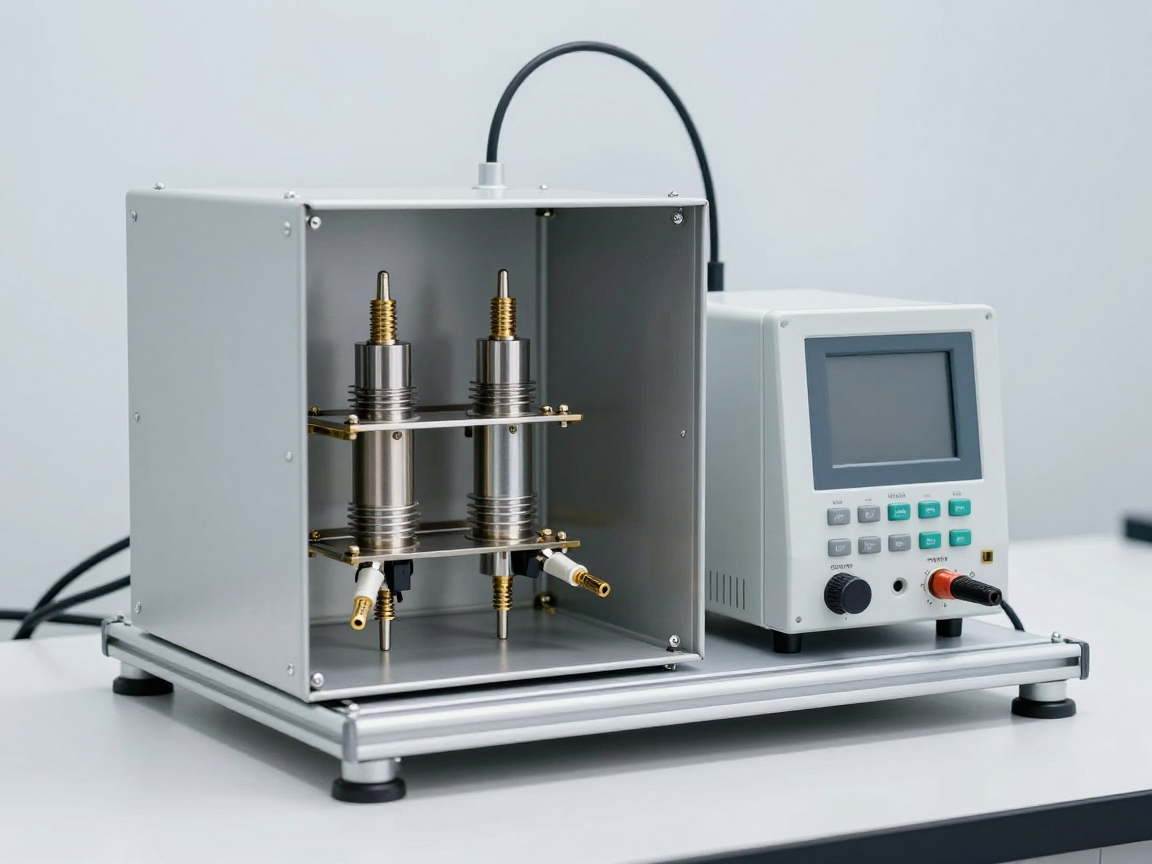
      Power impedance conditioning box with ground plane power outlet, coaxial test cable and power cord from small multimedia equipment
      Conducted disturbance on the power port is the first and most common fail test for devices with cheap pulsed power supplies.

      5. Test configuration — the part that decides the result

      • Representative configuration: The EUT must be run in a fully functional configuration, connecting to any port (screen, network, USB, Wi-Fi, speaker), because the worst configuration determines the result.
      • Working mode: For example, the computer must simultaneously read disks, transmit data over the network, and display moving images; The TV must display complex images, not a blank screen.
      • Wiring: Length, height above ground plane, cable bundling, and adapter location are all specified and must be recorded — one wrong detail can change the results by several dB.
      • Power and auxiliary cables: All power cables must pass through LISN, do not use free long wires in the measurement chamber.
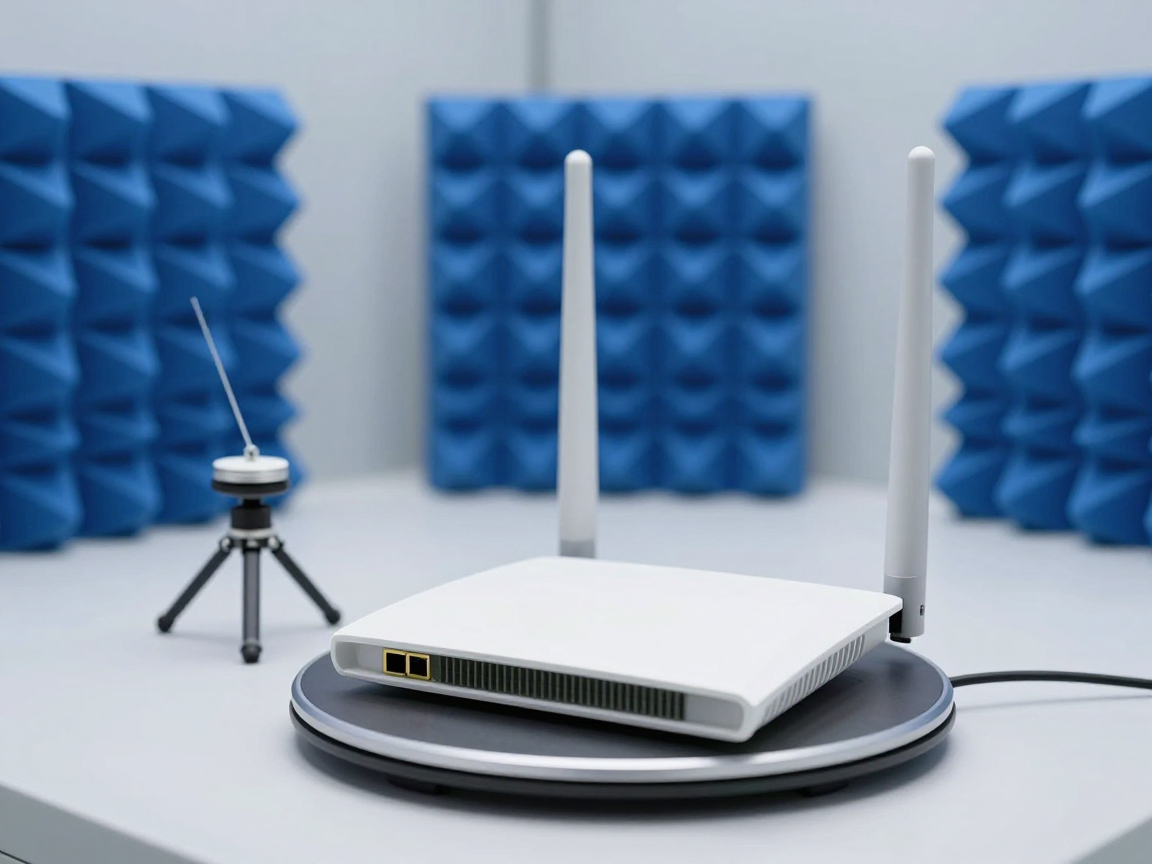
      The wireless router has two antennas placed on a turntable in a semi-radiator chamber with blue absorbing material
      Devices with radio ports must simultaneously run the data transmission function when measuring emissions — the standby state often gives artificially low results.

      6. CISPR 32 and CISPR 35 — the pair to remember

      • CISPR 32 has emission only. Not to be confused with the full EMC version.
      • CISPR 35 is the standard immunity corresponding for multimedia devices (replacing previous CISPR 24): ESD, EFT, surge, radiated RF, conducted RF, magnetic fields, voltage drop and power interruption.
      • In many markets, EMC profiles for multimedia devices = CISPR 32 + CISPR 35, with 61000-3-2 and 61000-3-3 when the equipment is connected to the public low-voltage supply system.
      • Measuring methods and instruments are specified in the kit CISPR 16 (CISPR 16-1-x for instruments, CISPR 16-2-x for methods).

      7. Application in Vietnam and other markets

      • For ICT equipment and radio equipment imported and exported into Vietnam, EMC requirements are in the specialized standards system of the Ministry of Information and Communications; Need to look up the list of goods and current conformity assessment method (refer to Appendix I/II of Circular 36/2026/TT-BKHCN and the list of the Ministry of Information and Communications).
      • In the EU, multimedia equipment applies EN 55032 and EN 55035; In the US, FCC Part 15B uses Class A/B classification in the same spirit as CISPR 32; In Japan, there is VCCI CISPR 32.
      • Practical note: many markets still accept CISPR 32 reporting but require it correct version cited in domestic regulations — always check before scheduling a test.

      8. Frequently asked questions

      Can one product fall under both CISPR 32 and CISPR 15?

      Not for the same function. For example, LED lighting falls under CISPR 15; If the product is an LED advertising screen connected to the network and displaying digital content, it is usually considered according to CISPR 32.

      Is measurement above 1 GHz mandatory?

      Depends on the configuration and maximum clock frequency of the device as specified in the standard; Products with Wi-Fi, LTE or high-speed processors are often subject to measurement.

      Does CISPR 32 include immunity requirements?

      No. CISPR 32 only regulates emissions; immunity is at CISPR 35.

      9. Conclusion

      CISPR 32 is the EMC “gateway” for nearly all consumer electronics and networking equipment today. Good preparation means: determining the correct Class, running the correct worst configuration, arranging cables correctly, and remember that the file is only complete when adding CISPR 35 and current harmonic/flicker requirements if the device is grid-connected.

      Related articles


      Talk to us


        Disclaimer

        The article was compiled by us for interpretation; not legal advice. The above limit is an illustrative example of a common range; The original table in the CISPR 32 version cited for the specific product must be consulted. Copyright Policy & Disclaimer.
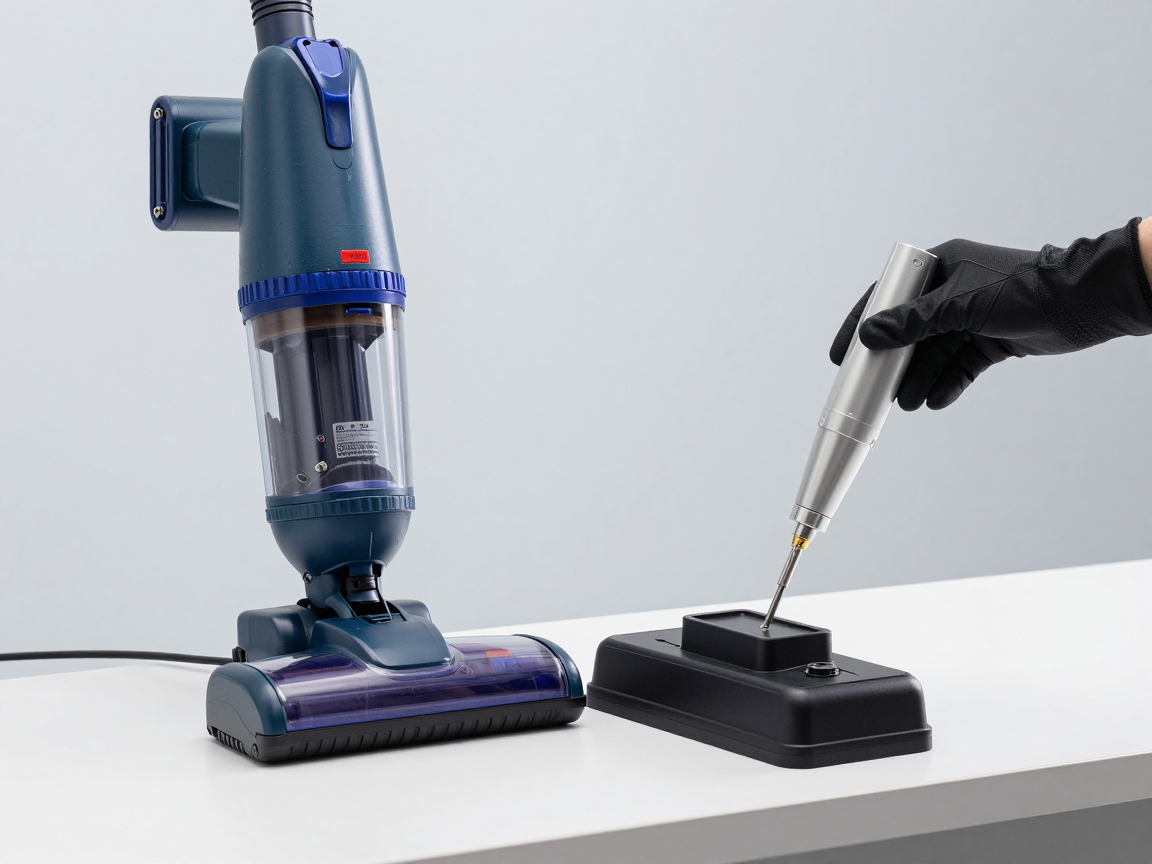
        IEC 61000-4-2 (2025 edition): ESD testing — test levels, arrangements and calibration

        0
        Cover image of the article «IEC 61000-4-2 (2025 edition): ESD testing — test levels, arrangements and calibration»

        IEC 61000-4-2 Specifies an immunity test electrostatic discharge (ESD) — phenomenon that occurs when a person or electrically charged object touches the device. This is the most commonly performed immunity test, but also the one on which the results depend the most experimental arrangement: the same product, the same test level, two different ways of placing wires and coupling planes can give two opposite results.

        1. How ESD builds up and how it causes damage

        • Electricity source: People walking on carpets, plastic chairs, rubbing clothes, plastic bags, conveyor belts — can all accumulate electricity up to several kV, especially up to 15–35 kV when humidity is low.
        • Launch path: through gaps, buttons, joints, metal casings, connection port contacts, key heads, screws.
        • Consequences: Dead components (open oxide joints, punctured gates), but more common are temporary errors — crashes, resets, incorrect data, flashing screens, lost connections — errors that are difficult to find because they are difficult to reproduce.

        2. How an ESD event is simulated

        The ESD simulator consists of a simulation circuit 150 pF series 330 Ω (standard RC network) charged to the test voltage and then discharged through the contact or air-discharge electrode. The discharge current profile at 8 kV contact level must be within the specified window:

        • Up time: about 0.7 – 1 ns.
        • Top of first line: about 30 A (tolerance ± 30 %) at 8 kV.
        • Value at 30 ns: about 16 A (± 30 %).
        • Value at 60 ns: about 8 A (± 30 %).

        This waveform is the reason “anti-ESD” cannot be just a protective device: 30 A peak per nanosecond requires a current drain extremely short and extremely direct about the ground plane.

        3. Test levels

        • Contact discharge: 2 kV — 4 kV — 6 kV — 8 kV; This is the preferred method because it repeats well.
        • Air discharge: 2 kV — 4 kV — 8 kV — 15 kV; Used when the surface is not conductive and contact cannot be applied.
        • X level Let product standards choose their own level, for example, medical, military, and telecommunications equipment have a higher level.

        Principles of practice: Contact on all metal surfaces that is accessible to the user; spray air at the insulating surface (slots, plastic, stickers) and at joints.

        ESD simulation gun with pointed contact tip and round air-discharge electrode placed next to a ring-shaped metal calibration target
        Contact tip and air-discharge electrode for different waveforms; Calibration target is used to confirm the correct flow type before testing.

        4. Test set-up according to 61000-4-2

        • Reference ground plane (GRP) made of metal, connected to protective ground, placed under the test table.
        • Insulated table 0.8 m high, place the EUT with cables and auxiliary equipment on top.
        • Horizontal graft plane (HCP) size 1.6 m × 0.8 m placed on the table, with a thin insulation layer between the HCP and EUT.
        • Vertical graft plane (VCP) 0.5 m × 0.5 m located away from the EUT 0.1 m, the lower edge is 0.1 m away from the HCP.
        • Discharge resistor 470 kΩ at both ends of the wire connecting HCP and VCP to GRP, to avoid electric charge and still retain coupling properties.
        • Cables and connectors must be placed according to regulations regarding length and distance — incorrect placement is the number one cause of different results between two laboratories.

        Indirect launch is performed on the HCP and VCP (applied at the edge and mid-plane) to simulate launching into a metal object near the device.

        Small device placed on a flat metal surface with all cables positioned on an insulated stand and a ground wire bolted to the flat surface
        Cable positioning and distance from the coupling plane determine the ESD current escape path — the easiest part to get wrong and also the easiest to fix.

        5. Number of discharges and how to run

        • Launch exposure: a minimum of 10 pulses per polarity at each selected test point.
        • Air launch: minimum of 20 pulses (10 pulses per polarity) at each test point; In sensitive locations, it may be necessary to run additional consecutive pulses to find accumulated errors.
        • Pulse interval: at least 1 second for the EUT to recover and for the insulation layer to not become electrically charged.
        • Order of execution: run from low to high and record the exact error level — this is the most valuable information for design correction.

        6. Calibration and uncertainty

        • The ESD launcher must be calibrated as a flat line low impedance calibration target with a wide enough bandwidth, in accordance with the standards.
        • In the new version, calibration requirements are added for both air-discharge electrode — the previous point was overlooked because the air spray waveform is highly dependent on distance and humidity.
        • Test results must be accompanied by evaluation measurement uncertainty follow the general instructions of group 61000-4, and recheck the waveform before/after running to rule out instrument failure.

        7. What is new in IEC 61000-4-2:2025?

        • Additional requirements Calibrate the air-discharge electrode next to contact tip calibration.
        • Added instructional appendix Select test point and number of pulses when launched into direct contact.
        • Add appendix for wearable device and for some specific groups of equipment, there are separate test arrangements.
        • Improved calibration requirements, uncertainty assessment, and clarification of post-installation testing steps.

        8. Common mistakes in practice

        • Set the VCP at the wrong distance (further than 0.1 m) reduces the coupling level, causing the device to “reach” artificially.
        • No monitoring software — the device reset without anyone knowing, the report still recorded criterion A.
        • Ignore indirect launch to HCP/VCP, while this is a common cause of errors for devices with long cables.
        • Test at too high humidity cause insufficient air discharge to form — environmental conditions must be recorded in the report.
        • Do not run the most sensitive operating mode (for example, USB + Wi-Fi + charging at the same time) so no error is detected.

        9. Conclusion

        IEC 61000-4-2 is more than just “8 kV shot”. The real value of the test lies in the correct layout, choosing enough test points, running the right number of pulses, closely monitoring the function and accurately recording the error level. By doing those five things, ESD results will no longer be “luck” but data that can be used to improve the design.

        Related articles


        Talk to us


          Disclaimer

          The article was compiled by us for interpretation; not legal advice. The above waveform and layout parameters are for illustration purposes only; You must refer to IEC 61000-4-2:2025 verbatim when planning the test. Copyright Policy & Disclaimer.
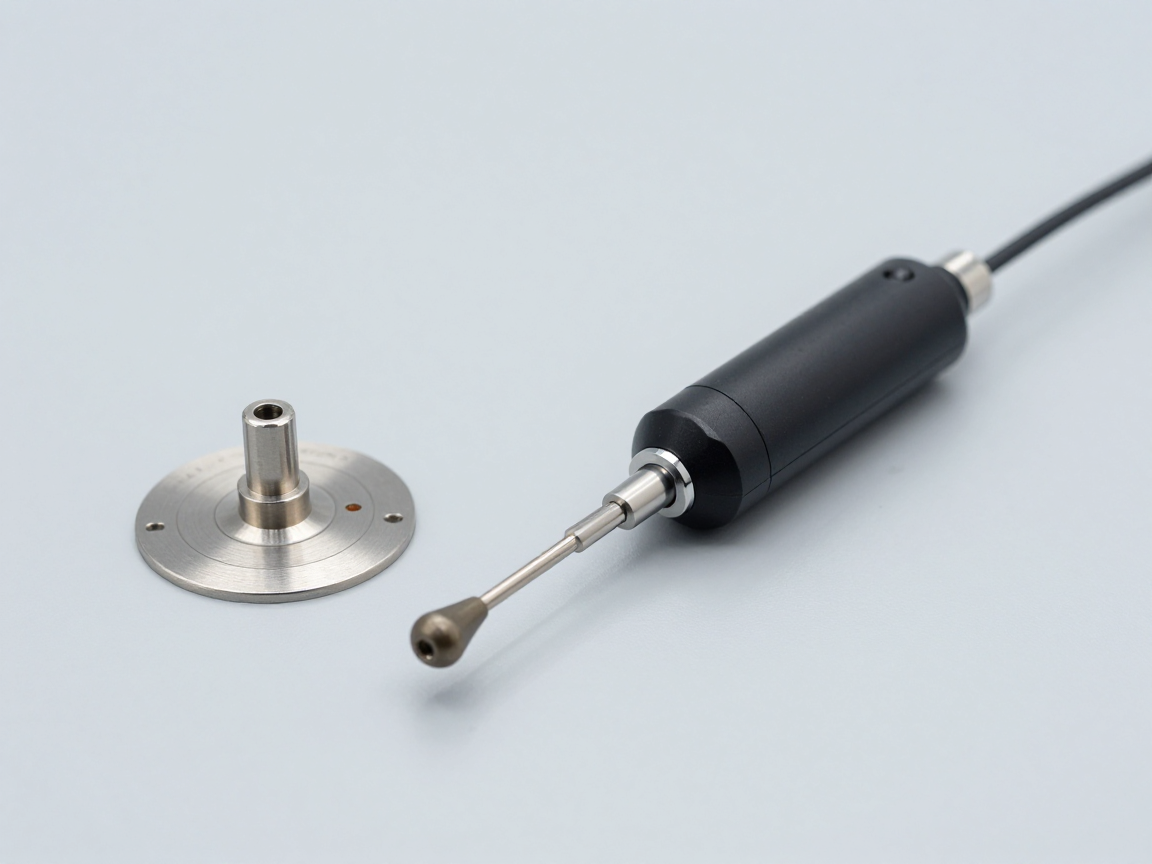
          IEC 61000-3-2: current harmonic limits for equipment ≤ 16 A

          0
          Cover image of the article «IEC 61000-3-2: current harmonic limits for equipment ≤ 16 A»

          IEC 61000-3-2 is the standard that sets the limit current harmonics which the device feeds back into the public power grid. This is one of the two most mandatory low-frequency standards in the EMC file (along with IEC 61000-3-3 on flicker), and is also the standard that causes many products with pulsed power supplies to be redesigned because they are not “green” enough in terms of current harmonics.

          1. Why harmonic currents are limited

          Power electronic devices consume non-sinusoidal current: the input current is cut into short pulses, distorted compared to the sinusoidal form of the voltage. That type of distorted current contains many harmonic components (usually odd orders: 3, 5, 7, 9…). Consequences:

          • Neutral wire overload — the third and triple harmonics of the phases add together on the neutral instead of canceling.
          • Device loss and heat — transformers, condensers, and motors get hotter due to harmonic currents.
          • Voltage distortion spreads to other machines — on the same low-voltage grid, one device damages the power quality for the other device.

          2. Scope of application

          • Applicable to electrical and electronic equipment Nominal input current ≤ 16 A per phase, enter public low voltage grid.
          • Applicable to both single-phase and three-phase equipment (with three-phase, the applicable conditions relate to the balanced nature of the load).
          • Exclusions equipment with current > 16 A per phase (switch to 61000-3-12) and professional arc welding equipment (switch to 61000-3-12).
          • Here it is type test according to the design, without having to check each product on the line.

          3. Equipment classification: the four classes

          The limit depends on the Class, so the first step is always to determine the Class. Classification in order of priority from D to A:

          • Class D — equipment with current entering the bearing “special waveform” (wide pulse peak, short time flow) and power ≤ 600 W. Typical examples: personal computers, monitors, televisions, some ICT devices.
          • Class C — lighting equipment: light sets, self-ballasted lights, LED bulbs, drivers, high-pressure lights, street lights.
          • Class B — hand held electric tools (drills, grinders, hand-held cutters…).
          • Class A — all remaining non-B/C/D equipment, including: balanced three-phase equipment, non-D household appliances, non-hand tools, incandescent lamp dimmers, audio equipment.
          Note: a desktop computer is usually Class D, but the same power supply attached to an industrial machine may be considered Class A — the function determines the Class, not the components.

          4. Limits for each class

          4.1. Class A — absolute limits in amperes

          • Odd harmonic: 3rd order = 2.30 A; 5th order = 1.14 A; 7th order = 0.77 A; 9th order = 0.40 A; 11th order = 0.33 A; 13th order = 0.21 A; 15th order = 0.15 A.
          • From level 17 to 39 descending limit: 0.132 — 0.118 — 0.10 — 0.09 — 0.084 — 0.077 — 0.072 — 0.067 — 0.063 — 0.059 — 0.056 — 0.053 A.
          • Even harmonic also limited: 2nd order = 1.08 A; 4th order = 0.43 A; step 6 = 0.30 A, and the next even steps decrease in descending order in table 1 of the standard.

          4.2. Class B — 150 % of Class A limits

          Hand-held power tools are loosened by 1.5 times the Class A limit for each harmonic step, because they operate intermittently and have highly variable loads.

          4.3. Class C — limits as a percentage of the fundamental current

          • Level 3 = 30·λ % fundamental current, where λ is the power factor of the circuit (usually the power factor of the PFC unit).
          • Level 5 = 10 %, level 7 = 7 %, level 9 = 5 %, level 11 = 3 %, level 13 = 3 %, and odd steps from 15 to 39 = 3 %.
          • Additional conditions: for lighting devices with current phase angles of certain steps, additional phase angle conditions apply; Lighting equipment with a capacity of ≤ 25 W is exempt from the provisions of the standard.

          4.4. Class D — limits in mA per watt

          • Capacity limits: 3rd order = 3.4 mA/W, 5th order = 1.9 mA/W, 7th order = 1.0 mA/W, 9th order = 0.5 mA/W, 11th order = 0.35 mA/W, the higher orders continue to decrease (0.296 — 0.257 — 0.226 — 0.199 mA/W for orders 13–19…).
          • In parallel, the stream of absolute harmonic Class A limits must not be exceeded corresponding — meaning that even if the mA/W calculation is satisfactory, the Class A ceiling must still be checked.
          • The power used to calculate the limit is the active power measured under test conditions.
          Rear panel of AC power cabinet with short test leads connecting to the power analyzer input and pulse power supply on the table
          Measure current harmonics according to 61000-4-7: stable ac source, power analysis, and short leads to avoid impedance errors.

          5. Measurement conditions — the most overlooked part

          • Measurement method follow IEC 61000-4-7: Use a measurement window of 10 cycles (50 Hz grid) or 12 cycles (60 Hz grid), evaluated according to the average value in the observation range.
          • Test voltage and frequency: device identification; With 230 V grid, usually test at 230 V/50 Hz, measured in stable working mode.
          • Operating mode: Run the device in the mode for maximum harmonics (usually the largest load, but with some inverter devices it is the average load) — this is the point where a test plan is needed.
          • The device has many modes (e.g. inverter refrigerator) must be measured in all modes where excess harmonics may occur, not just the nominal mode.
          • Measurement source must have low impedance and small voltage distortion, so that the measured harmonic current is that of the device and not the power grid.
          The LED driver board is opened on the anti-static mat next to the PFC choke, capacitor and screwdriver
          LED drivers often use large filter capacitors and bridge rectifiers – the source of odd-order harmonics; Adding active PFC is a common way to achieve Class C.

          6. A four-step process for a 61000-3-2 file

          1. Determine Class in the order D → C → B → A based on the function and current waveform characteristics.
          2. Select test mode for the worst harmonic and clearly state in the test plan (capacity, load, sampling time).
          3. Measure harmonics according to 61000-4-7 at nominal voltage/frequency, thermally stabilize before measurement.
          4. Compared to the limit corresponding (absolute, percentage or mA/W) and create a comparison table for each level in the report.

          7. Current edition and points to note

          • Widely applied version: IEC 61000-3-2:2018 + A1:2020 + A2:2024 (version 5.2, still valid according to IEC Webstore search on September 29, 2026).
          • Version 5 expands the scope and clarifies application conditions compared to version 4; Recent revisions add clarity to lighting fixtures and short-cycle handling.
          • Current harmonics are only half of the low frequency requirement: equipment remains to be considered IEC 61000-3-3 (voltage fluctuations and flicker) or 61000-3-11/3-12 depending on current and load type.

          8. Frequently asked questions

          Is equipment with active PFC exempt from harmonic measurement?

          Not exempted. Active PFC helps with very small harmonics, but limits must still be measured and compared; In fact, many records use measurement reports to prove success instead of theoretical analysis.

          Do products below 25 W have to be tested?

          For lighting equipment, the standard has provisions for exemptions for some low-power cases — but the exemption conditions depend on the type of equipment and version of the standard, so you must check the verbatim before drawing conclusions.

          How does three-phase measurement differ from single-phase?

          With three-phase loads, all three phases must be considered simultaneously; Some balanced three-phase equipment is considered Class A but must still measure harmonics on each phase.

          9. Conclusion

          IEC 61000-3-2 may seem like just a “limit table”, but the tricky part is define Class and Select test mode. Those two things determine most of the pass/fail results and are also two points that the lab needs to agree on with the customer right from the test plan, before opening the meter.

          Related articles


          Talk to us


            Disclaimer

            The article was compiled by us for interpretation; not legal advice. The above limits ​​are a common table of values ​​used for illustration; must look up the original table in the standard when filing, as IEC may modify values between versions. Version checked on IEC Webstore on September 29, 2026. Copyright Policy & Disclaimer.
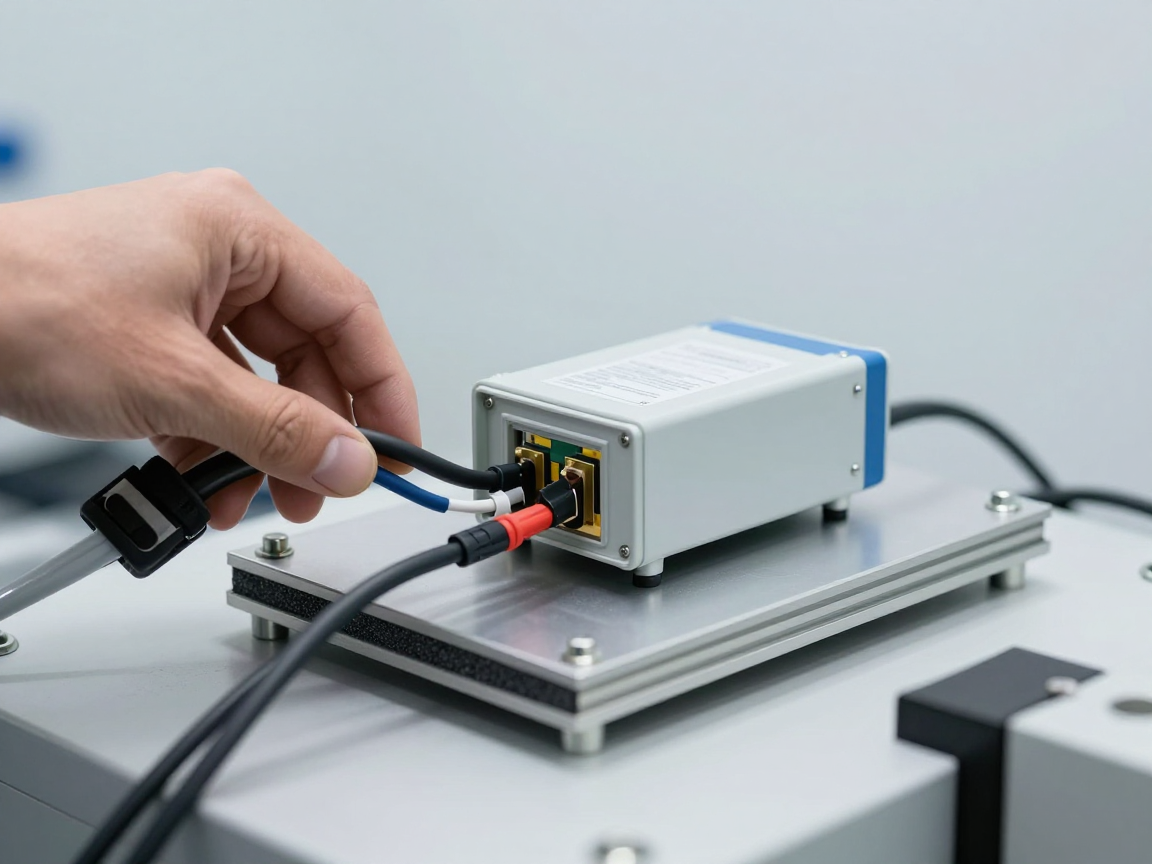
            What is IEC 61000-4? Overview of immunity tests and measurement methods

            0
            Cover image of the article «What is IEC 61000-4? Overview of immunity tests and measurement methods»

            IEC 61000-4 is the “method” part of the IEC 61000 series: it defines interference phenomena, test levels, experimental setup, instruments and evaluation methods for immunity tests and EMC measurements. This is the part that laboratories use every day, and it is also the part that businesses need to understand to know what measurements they are paying for.

            1. The role of the 61000-4 group

            • Yes basic EMC publication: provides a range of test levels (usually including “X” levels for optional product standards) and standardization methods.
            • Do not decide on your own level of application — test levels, pass/fail criteria and operating conditions specified by the product standard or general standard (61000-6-x).
            • Guaranteed Results are reproducible between laboratories: same level, same wave, same arrangement must give equivalent results within the allowable uncertainty.

            If you want to visualize the whole picture, start from here IEC TR 61000-4-1 — the instruction document is considered a “map” to guide the entire 61000-4 group.

            2. Main tests by phenomenon

            2.1. Impulsive and transient phenomena

            • IEC 61000-4-2 — ESD (electrostatic discharge): simulate electrical discharge from a person or charged object; contact level 2/4/6/8 kV, air discharge up to 15 kV.
            • IEC 61000-4-4 — EFT/Burst (fast pulse beam): Fast, low amplitude, high repetition pulses on the power port and signal port; attached to relay contact arc.
            • IEC 61000-4-5 — Surge: high energy impulses (lightning, grid switching), form 1.2/50 µs voltage and 8/20 µs current, normal level 1/2/4 kV and “X”.
            • IEC 61000-4-12 — Ring waves: Ring-shaped damped oscillating wave, used for indoor low-pressure equipment.
            • IEC 61000-4-18 — Damped oscillatory wave: High frequency damped oscillation, used for equipment installed in the station.

            2.2. Electromagnetic fields

            • IEC 61000-4-3 — Radiated RF fields: most used immunity test, range 80 MHz – 1 GHz and extended to 6 GHz in the current version; Typical levels are 3 V/m or 10 V/m.
            • IEC 61000-4-6 — Conducted RF: Pump RF noise through cable using CDN/EM-clamp, 150 kHz – 80 MHz, typical level 3 V or 10 V.
            • IEC 61000-4-39 — Near field: Simulates RF sources located very close to devices (phones, nearby radio devices), wide band up to 6 GHz.
            • IEC 61000-4-8/4-9/4-10 — Magnetic fields: 50/60 Hz industrial frequency magnetic field, pulsed magnetic field, damped oscillating magnetic field.
            • IEC 61000-4-20/4-21/4-22/4-23: TEM chamber, GTEM chamber, reverberation chamber and testing method in small chamber.

            2.3. Supply voltage and power quality

            • IEC 61000-4-11 (≤ 16 A) and IEC 61000-4-34 (> 16 A): voltage drop, short interruption and voltage variation on AC source.
            • IEC 61000-4-29: voltage drop and short cut on DC power port (devices using adapters, telecommunications devices, battery-powered devices).
            • IEC 61000-4-27 (phase imbalance), IEC 61000-4-28 (source frequency variation): specific low frequency immunity tests.
            • IEC 61000-4-14 (voltage fluctuation), IEC 61000-4-13 (low-frequency harmonics and mesoharmonics) — the immune side of the low-frequency group.

            2.4. Low-frequency measurement and power quality

            • IEC 61000-4-7 — Harmonic and mesoharmonic measurements (use with limit 61000-3-2).
            • IEC 61000-4-15 — Flickermeter: flicker measurement (Pst, Plt) according to 61000-3-3 and 61000-3-11.
            • IEC 61000-4-30 — Methods for measuring power quality Class A and Class S; The 2025 version has 2026 corrections.
            • IEC 61000-4-31, 61000-4-41: measurement on large current grids and additional measurement methods.

            2.5. Special groups

            • IEC 61000-4-16, 4-17, 4-19: low-frequency conducted disturbance, DC power ripple and on-grid signals.
            • IEC 61000-4-24, 4-25, 4-32, 4-33, 4-35, 4-36: High electromagnetic pulse phenomenon group to HEMP/HPEM — used for stations, military, and critical infrastructure.
            ESD test setup: horizontal coupling plane on wooden table, two resistive ground wires and ESD gun touching the edge
            ESD according to 61000-4-2: the arrangement of the coupling plane and the ground path determine the results, not the test level alone.

            3. What does an immunity test involve?

            1. Test plan — lists test port, test level, pass criteria, EUT operating mode, monitoring mode.
            2. Select level and waveform according to product standards; Record all parameters (amplitude, rise time, width, repetition frequency).
            3. EUT configuration — conductors are placed at the correct length and height as specified, the EUT is connected to auxiliary equipment, and the monitoring software runs continuously.
            4. Calibrate/check instruments — ESD gun, burst/surge generator, RF pump system, CDN must all have a valid calibration certificate.
            5. Test run and record — observe both functional criteria and abnormal phenomena; A/B/C conclusion for each port.
            The power coupling and decoupling box allows for surge testing with multiple terminals and cables connecting to the test equipment
            Surge according to 61000-4-5 always comes with a power coupling/decoupling network — the part that determines the level of pulse energy entering the device.

            4. Performance criteria A/B/C

            Each test must include criteria chosen by the product standard. Three familiar levels:

            • A: operates as designed during and after interference.
            • B: Temporary deterioration, self-recovery after interference stops, no intervention required.
            • C: Temporary deterioration, requiring operator reset, but no loss of data and no loss of safety functions.

            In fact, many EMC errors are not at the test level but at the test level tracking criteria: If the “worst case” operating mode is not set and there is no monitoring software, the device may have lost functionality and the report will still be successful.

            The EFT pulse generator capacitance coupling clamp clamps around the signal cable bundle on the insulating bracket above the ground plane
            EFT/Burst according to 61000-4-4 typically uses a capacitive coupling clamp for the signal port — clamp position directly affects the result.

            5. Edition updates to know (checked 29 September 2026)

            • IEC 61000-4-2:2025 (version 3) replaces 2008 version — adds air-discharge electrode calibration, test point selection appendix and wearable device.
            • IEC 61000-4-30:2025 with correction 2026 — updates to Class A/Class S power quality measurement methods.
            • IEC 61000-4-29:2026 (version 2) — replace version 2000 for voltage drop/DC power interruption test.
            • Recent modifications: 61000-4-23 A1:2025, 61000-4-27 A2:2025, 61000-4-34 A2:2025.
            • Commonly used version: 61000-4-3:2020, 61000-4-6:2023 (version 5).

            6. Conclusion

            IEC 61000-4 is a tool to turn EMC requirements into repeatable measurements: each disturbance phenomenon has a corresponding part of the standard that defines the waveform, level and layout. Understanding group 61000-4 helps you ask the right questions to the lab: What phenomenon should be tested, at what level, according to what version, and evaluated by what criteria? — and those are the three questions that determine the quality of the entire EMC profile.

            Related articles


            Talk to us


              Disclaimer

              The article was compiled by us for interpretation; not legal advice. The standard number and version can be found on the IEC Webstore on September 29, 2026 and may be updated by IEC. Copyright Policy & Disclaimer.
              Which EMC standards apply to your product? Diagram selected by product family

              0
              Cover image of the article «Which EMC standards apply to your product? Diagram selected by product family»

              The question “what EMC standards must my product test against?” there is only one answer: Applicable standards are product standards or product family standards cited by market regulations; Only when there is no standard do they use the general standard IEC 61000-6-x. Standard grade errors are the most common cause of returned documents.

              1. Priority order among types of EMC standards

              • Product standards: specific to a product type, for example transformers (IEC 61558), electric meters (IEC 62052), medical equipment (IEC 60601-1-2), electric drives (IEC 61800-3). Highest priority.
              • Product family standards: for a functional product group — CISPR 14-1/14-2, CISPR 15, CISPR 11, CISPR 32/35. Second priority.
              • Generic standards: IEC 61000-6-1, 6-2, 6-3, 6-4, 6-5, 6-7, 6-8 — only for use where there is no appropriate product/product family standard.
              • Basic standards: IEC 61000-3-x and 61000-4-x — provide limits, levels and methods; It is cited by superiors and does not stand on its own.

              Principles of practice: Do not stack two standard levels with the same scope. If CISPR 14-1 has already been applied to washing machines, there is no need to apply 61000-6-3 for the same emission requirement.

              2. Step 1 — Classify the product by family

              • Household appliances, hand-held electric tools, electric toys, cooking equipment: CISPR 14-1 (emission) and CISPR 14-2 (immunity).
              • Lighting equipment: light bulbs, light sets, drivers, ballasts, street lights — CISPR 15.
              • Multimedia devices: computers, monitors, network equipment, routers, TVs, audio equipment, IP cameras, printers — CISPR 32 (emission) and CISPR 35 (immunity).
              • Industrial – scientific – medical equipment (ISM), industrial power supplies, welding machines: CISPR 11 (emission); immunity according to product standard or 61000-6-2.
              • Medical equipment: IEC 60601-1-2 (including detailed EMC immunity for medical devices and medical systems).
              • Electric drive – inverter: IEC 61800-3.
              • Measurement and control equipment: IEC 61326-1 (and parts 61326-2-x for specialized measuring equipment).
              • Electric cars and motorbikes: CISPR 25 (vehicle emissions), ISO 11452-x (vehicle immunity), ISO 7637-x (power cable impulses), UNECE R10.
              • Wireless radio devices: corresponding radio standard (e.g. EN 300 328) and the accompanying EMC standard by functional group, usually EN 301 489-x.
              Laptop open on test bench with power adapter, network cable, and near-field probe
              Laptops belong to the multimedia device group — the profile is usually CISPR 32 (emission) plus CISPR 35 (immunity).

              3. Step 2 — Determine the environment of use

              The environment decides Class (A or B) of emission limits and immunity levels when using common standards:

              • Residential, commercial, light industrial environments: tighter limits (Class B according to CISPR 32; 61000-6-3 emission, 61000-6-1 immunity).
              • Industrial environment: The limits are looser (Class A; 61000-6-4 emission, 61000-6-2 immunity) but the immunity level is higher.
              • Transformer stations, power plants: 61000-6-5 — places with unusually high electromagnetic intensity.
              • Safety function: 61000-6-7 — relating to functional safety and safety-related systems.
              • Professional equipment for use in unknown environments: 61000-6-8.

              Practical note: when selling the same product to both households and factories, manufacturers often choose a stricter level so that one set of records can be used for many distribution channels.

              4. Step 3 — Always check the 61000-3 group if connected to the public supply

              Regardless of product family, if equipment is connected to the public low-voltage supply system, the following two low frequency requirements are often cited in the family standard:

              • IEC 61000-3-2: current harmonic limit — applicable for equipment with input current ≤ 16 A per phase.
              • IEC 61000-3-3: Limits voltage fluctuations and flicker — applies to equipment ≤ 16 A per phase, not affected by 61000-3-11.

              This is why CISPR 14-1 or CISPR 15 in the filing still entails the 61000-3-2/3-3 requirement: the 61000-3 group adds a “low frequency” section that CISPR does not cover.

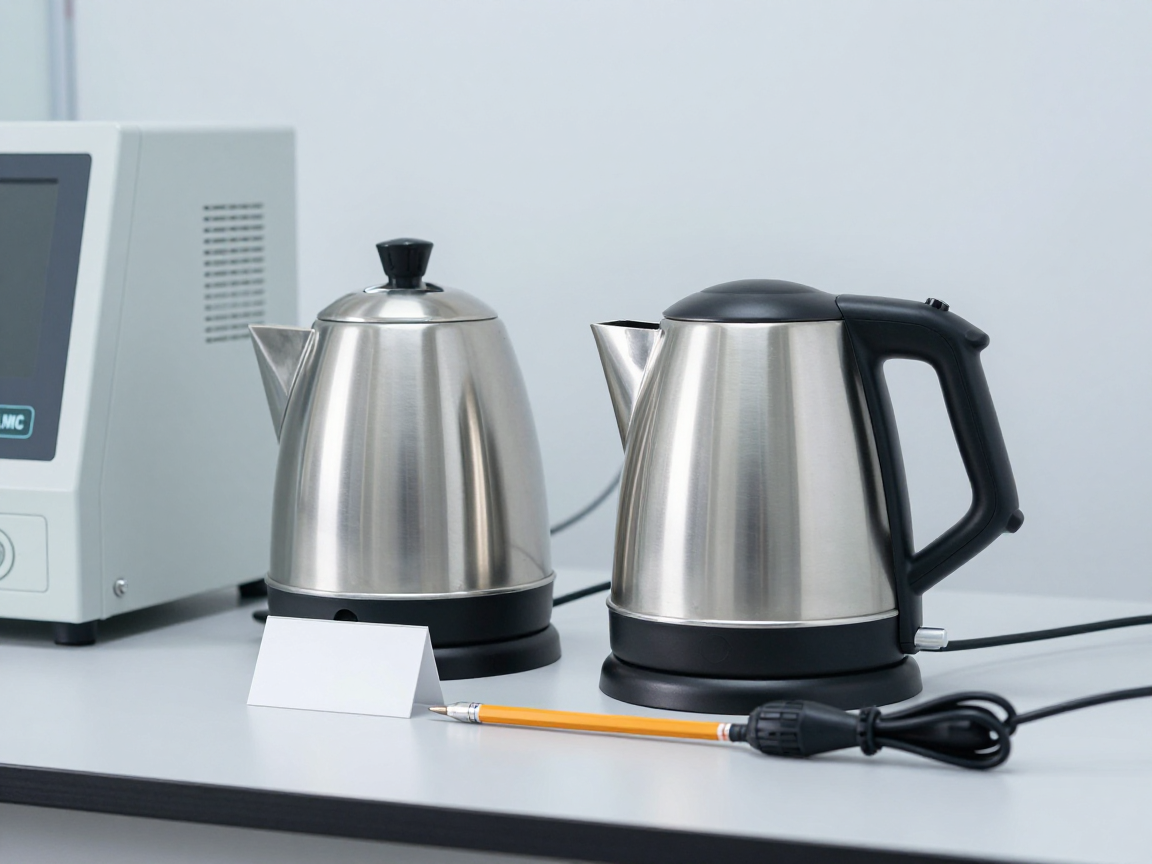
              A small electric kettle and an electric screwdriver are placed side by side on the test table, each product has its own power cord
              Kettles and electrical appliances: are the same household appliances, but immunity test levels and emission limits may be different according to appendix of CISPR 14-1.

              5. Standard selection flow — four questions in a row

              1. Does the product have its own product standards? If there is one (medical, meter, transformer, transmission), use that standard first.
              2. If not, then which family does the product belong to? Household appliances (CISPR 14-1/14-2), lighting (CISPR 15), multimedia (CISPR 32/35), ISM (CISPR 11).
              3. Don’t belong to any family? Use general standard 61000-6-x according to the usage environment.
              4. Does the product plug into the public low-voltage grid? If applicable, add 61000-3-2 and 61000-3-3 when referenced in the standard.

              6. Where it is easy to go wrong

              • CISPR 22 and CISPR 13 have been merged into CISPR 32. New filings should not cite CISPR 22; Corresponding immunity switched to CISPR 35 (formerly CISPR 24).
              • CISPR 32 has emission only. If the regulation requires immunity, CISPR 35 or the corresponding general standard must be added.
              • LED lighting falls under CISPR 15, not CISPR 32 — unless the device is a display or multimedia device.
              • The separate power supply (adapter, driver) may belong to a different family than the finished product — it is necessary to determine which products are “responsible devices” according to market regulations.
              • Class A and Class B are not “immunity test levels” — they are environmental emission classifications, not interference resistance assessments.

              7. Application in Vietnam

              • Electrical equipment, household electronics and power tools: QCVN 9:2012/BKHCN (Amended 1:2018) cites CISPR 14-1, CISPR 15 and CISPR 11; Translated into TCVN 7492-1, TCVN 7186, TCVN 6988.
              • ICT and wireless equipment: according to specialized standards of the Ministry of Information and Communications, with a list of potentially unsafe goods in Appendix I/II of Circular 36/2026/TT-BKHCN.
              • Electrical safety (not EMC but comes with documentation): QCVN 4:2009/BKHCN and Amendment 1:2016, IEC 60335 series standards.

              8. Conclusion

              Choosing the right EMC standard is a hierarchical problem, not a “choose a test” problem. Let’s start from product standards – product families – general standards in the correct order of priority, determine the environment used to finalize Class A/B, and always check whether the profile entails the current harmonic and flicker requirements of group 61000-3.

              Related articles


              Talk to us


                Disclaimer

                The article was compiled by us for interpretation; not legal advice. The list of standards is a typical example and does not replace the search for applicable standards and regulations. Copyright Policy & Disclaimer.
                What is emission and immunity? EMC platform for standards makers

                0
                Cover image of the article «What is emission and immunity? EMC platform for standards makers»

                Electromagnetic compatibility (EMC) has two symmetrical halves: emission — devices that cause interference to the surrounding environment, and immunity — the device is resistant to environmental interference. Every EMC test falls into one of these two halves; Correct distinction will help to read the standard correctly, prepare the correct sample and not buy unnecessary measurements.

                1. How EMC is defined

                According to the common definition in the IEC 61000 series and the electrical engineering dictionary (IEC 60050), EMC is the ability of a device to operate satisfactorily in its electromagnetic environment without causing unacceptable electromagnetic interference to any object in that environment..

                This definition contains three important ideas:

                • “Satisfactory performance” — EMC does not require that the device be perfect, only that it does not degrade its function excessively when exposed to interference.
                • “Environment” — Each type of environment (house, factory, hospital, transformer station) has a different background disturbance level, so the required level is also different.
                • “Do not cause unacceptable interference” — there are minor disturbances that are considered acceptable; The limit is that boundary line.

                2. Emission — when the equipment is the source of disturbance

                Emission is electromagnetic energy that the device generates and releases into the environment. Typical sources: pulse power supplies, inverters, brushed motors, LED lights and drivers, high-clock processors, switching power circuits. Emissions are divided according to propagation path and frequency range:

                • Conducted emission: Noise spreads along the power cord, signal wire, and ground wire. Popular measurement range 150 kHz – 30 MHz with LISN (source impedance stabilization network).
                • Radiated emission: interference propagated through space, measured with an antenna in a semi-anechoic chamber or outdoor test site. Common measurement range is 30 MHz – 1 GHz, some standards extend to 6 GHz.
                • Low frequency emission: current harmonics and voltage/flicker fluctuations dumped into the grid — fall under group IEC 61000-3.
                The LISN source impedance stabilization box connects the coaxial cable to the meter and the small pulse source serves as the device under test
                Standard conducted emission measurement: noise on the power cord is transmitted through the LISN to the measurement receiver.

                Emission results are typically read as peak levels in measurement mode quasi-peak (QP), and check further average (AVG) when exceeding the QP limit. With devices with short duty cycles, one must run the “worst” working mode to see all the interference.

                3. Immunity — when the equipment is the “victim”

                Immunity is ability to tolerate interference while still maintaining functionality. The opposite of immunity is susceptibility. A product is considered immune when, under the influence of a specified level of disturbance, it remains within evaluation criteria selected:

                • Criterion A: Operates normally during and after interference.
                • Criterion B: The function is temporarily impaired but recovers automatically after the disturbance stops, without operator intervention.
                • Criterion C: temporarily degrades and requires operator restart or reconfiguration, but retains data and functional safety.

                These three criteria are chosen by the product standard, not determined by the 61000-4-x. For the same 4 kV ESD test, a medical device may qualify for criterion A while a household appliance is approved for criterion B — and that makes sense, since the resulting loss of functionality is different.

                4. The four combinations and how they are named

                Combining the two divisions (conduction/radiation) with the two halves (emission/immunity), we get four common combinations in test reports:

                • Conducted emission — for example measuring source-port disturbance according to CISPR 11, CISPR 14-1, CISPR 15, CISPR 32.
                • Radiated emission — e.g. field measurement at 10 m in a semi-anechoic chamber according to CISPR 14-1, CISPR 32.
                • Conducted immunity — for example RF according to IEC 61000-4-6, DC power ripple according to 61000-4-17.
                • Immunity to radiated fields — e.g. radiated RF fields according to IEC 61000-4-3, industrial frequency magnetic fields according to 61000-4-8.
                Small electric heater on test bench with power cable threaded through current clamp
                Many household products draw large currents and switch continuously — both as a source of emission and subject to immunity tests.

                5. Map of frequency ranges and phenomena

                • 0 – 2 kHz: current harmonics, voltage fluctuations and flicker, phase unbalance, supply frequency variation (limited to IEC 61000-3-2, 61000-3-3, 61000-3-11, 61000-3-12; methods in 61000-4-7, 61000-4-15, 61000-4-13, 61000-4-14, 61000-4-27, 61000-4-28).
                • 2 – 150 kHz: low-frequency conducted disturbance, signal on grid, ripple on DC power (IEC 61000-4-16, 61000-4-17, 61000-4-19).
                • 150 kHz – 30 MHz: High-frequency conducted disturbances — half emission specified by CISPR, half immunity specified by IEC 61000-4-6.
                • 30 MHz – 1 GHz: Radiated interference and RF field immunity (IEC 61000-4-3; emissions according to CISPR).
                • Above 1 GHz: high-frequency emission, immunity to 6 GHz according to 61000-4-3; Devices with nearby RF sources should also consider 61000-4-39.
                • Pulse phenomenon: ESD (61000-4-2), EFT/Burst fast pulse burst (61000-4-4), lightning pulse/surge switching (61000-4-5), damped oscillation wave (61000-4-18) — not ranked by frequency band because the energy is very wide.
                • Voltage: voltage drop, short interrupt, voltage variation on AC source (61000-4-11, 61000-4-34) and on DC port (61000-4-29).

                6. Which quantity is measured?

                • Conducted interference: voltage, unit dBµV (level relative to 1 µV).
                • Radiation interference: electric field strength, unit dBµV/m or V/m.
                • Magnetic field immunity: Magnetic field strength, unit A/m.
                • Current harmonics: amperes (A) in harmonic order, or % of base current for lighting equipment.
                • Flashing: index Pst (short term), Plt (long term) and voltage change amplitude d, dmax.

                7. Which standard covers what?

                • Low frequency emission: IEC 61000-3-2, 61000-3-3, 61000-3-11, 61000-3-12.
                • High frequency emission: CISPR 11, CISPR 14-1, CISPR 15, CISPR 32 (and industry standard limits).
                • Immunity: IEC 61000-4-2 to 61000-4-39 depending on the phenomenon; for multimedia equipment is CISPR 35, for household appliances is CISPR 14-2.
                • General standards for “calling” the above parts: IEC 61000-6-1, 6-2, 6-3, 6-4, 6-5, 6-7, 6-8.
                The ESD simulation gun is placed next to the metal coupling plane and the coiled ground wire
                ESD is the most familiar immunity test — but it’s immunity, not emission.

                8. Three common misunderstandings

                1. “Emission measurement is complete and EMC is complete”. Incorrect — emission and immunity are two independent sets of requirements; Many markets require both.
                2. “ESD, surge, EFT are emissions due to strong impact on the device.” On the contrary, these are tests immunity: device that plays the role of endurance.
                3. “Achieving CISPR is achieving IEC 61000-3”. CISPR regulates high frequency conducted/radiated disturbances; Harmonics and flicker are still regulated by 61000-3-2 and 61000-3-3, even though they are in the same file.

                9. Conclusion

                Firmly grasping the two emission-immunity halves and the four conduction/radiation combinations helps to read standards correctly, create correct test lists and correctly understand reported results. The next step is to go into each specific group: IEC 61000-3 for harmonic and flicker limits, IEC 61000-4 for the immunity test method, and CISPR 11/14/15/32 for high frequency emission.

                Related articles


                Talk to us


                  Disclaimer

                  The article was compiled by us for interpretation; not legal advice. Terminology and grouping are based on the IEC 61000 series and IEC Guide 107. Businesses should compare the original standards applicable to specific products. Copyright Policy & Disclaimer.
                  What is IEC 61000? Overview of electromagnetic compatibility (EMC) standards

                  0
                  Cover image of the article «What is IEC 61000? Overview of electromagnetic compatibility (EMC) standards»

                  IEC 61000 is a set of electromagnetic compatibility (EMC) standards developed by the IEC: it does not stipulate which products must be labeled, but rather defines disturbance phenomena, test levels, measurement methods and limits so that all industry standards are shared. Correct understanding of this set of standards helps businesses choose the right test, the right version and not pay for unnecessary measurements.

                  1. Why an EMC basic standards series is needed

                  Almost all electrical and electronic equipment emit noise medium affected by noise from the environment. If each industry defines its own phenomena, test levels, and measurement methods, then test results in one lab cannot be compared with another, and a product that passes in one country fails in another.

                  IEC 61000 was born to solve exactly that problem: standardize phenomena and methods (belonging to group 61000-4), standardized low frequency emission limits (heading 61000-3), standardize the way the environment is described (heading 61000-2) and General standards for product groups (group 61000-6).

                  2. The six groups of the IEC 61000 series

                  • 61000-1 — General: concepts, terminology, evaluation models, functional safety and measurement uncertainty. For example, IEC 61000-1-2:2016 on methods to achieve functional safety, IEC 61000-1-9:2024 on uncertainty assessment.
                  • 61000-2 — Environment: Describe and classify the electromagnetic environment, compatibility level, and expected interference level. For example 61000-2-2 (low-band compatibility level in public low voltage grids), 61000-2-4:2024 (compatibility level in industrial installations).
                  • 61000-3 — Limits: emission limit low frequency injected into the public supply system — mostly current harmonics and voltage fluctuation/flicker (61000-3-2, 61000-3-3, 61000-3-11, 61000-3-12).
                  • 61000-4 — Testing and measurement techniques: Phenomena definitions, test levels, and testing methods — from ESD, EFT, surge, RF fields to voltage drops, magnetic fields, harmonics, and power quality. This is the group most used by laboratories.
                  • 61000-5 — Installation and mitigation guidelines: Instructions for installation, grounding, lightning protection and noise reduction at the system and construction level.
                  • 61000-6 — Generic standards: common standards follow usage environment when there are no industry standards: residential/commercial (61000-6-1, 61000-6-3), industrial (61000-6-2, 61000-6-4), power plant (61000-6-5), functional safety (61000-6-7), professional environment (61000-6-8).
                  Semi-thoracic chamber with pyramidal absorber, turntable and internal measurement antenna
                  From a disturbance phenomenon defined in 61000-4-x the test, test level and test room conditions are derived.

                  3. “Basic EMC publication” and the role of IEC Guide 107

                  Most 61000-3 and 61000-4 standards carry status basic EMC publication follow IEC Guide 107. Meaning:

                  • They are not self-imposed on the product. The product standard or general standard (61000-6-x) is the “calling” document for use.
                  • They give test level range and standard method; Choosing which level and which criteria to meet is the responsibility of the industry technical committee.
                  • Therefore, when reading a test report, it is necessary to clearly distinguish: test level (from 61000-4-x) and applicable requirements (from product standards).

                  4. How to read the designation and edition

                  • 61000-4-2:2025 — part 4-2, official version 2025. The number after the colon is the year of issuance, not the version number.
                  • 61000-3-2:2018/AMD2:2024 — original 2018 with revision 2 issued in 2024.
                  • CSV (Consolidated version) is a consolidated version that has incorporated modifications; RLV (Redline version) is a comparison of changes; SER is the total package of parts of a group.
                  • When recording in documents, contracts or scope ISO/IEC 17025 should be recorded enough version strings, for example IEC 61000-3-2:2018+A1:2020+A2:2024, to avoid controversy over the application.
                  Two thick standard folders sit on the desk next to glasses and pens
                  Recording the correct version string in the records is more important than stating “according to IEC 61000” in general.

                  5. How do Part 3 and Part 4 differ?

                  This is the most commonly confused point:

                  • 61000-3 is the limit — says how many current harmonics and how many voltage fluctuations the device is allowed to emit. This is a “threshold”, there is no detailed test method.
                  • 61000-4 is the method — say how to generate disturbance, how much, how to arrange it, and according to what criteria to evaluate pass/fail. Here’s the “how to”.

                  For example with a vacuum cleaner: the current harmonic limit is 61000-3-2, but the measurement is done according to the method of 61000-4-7; The flicker limit is 61000-3-3, and the standard measuring tool is the flickermeter 61000-4-15.

                  6. The relationship with CISPR — where most people get it wrong

                  IEC 61000-3 only covers low frequency emissions (harmonics and flicker). Emission high frequency — conducted and radiated disturbances in the range 150 kHz and above — due CISPR regulations: CISPR 11 (industrial, scientific, medical equipment), CISPR 14-1/CISPR 14-2 (household appliances and electric tools), CISPR 15 (lighting equipment), CISPR 32/CISPR 35 (multimedia equipment), CISPR 16-1-x and CISPR 16-2 (measuring instruments and methods).

                  So a product may have to simultaneously: CISPR 14-1 for conducted/radiated interference, IEC 61000-3-2 for current harmonics and IEC 61000-3-3 for flicker — all are emission requirements but in three different standards.

                  The spectrum analyzer and source impedance conditioning box are connected to the device under test using a coaxial cable
                  Same device, but conducted noise measured by LISN, current harmonics measured by power analyzer and flicker measured by flickermeter.

                  7. Which editions are in force (checked 29 September 2026)

                  Look on the IEC Webstore, the IEC 61000 series is available About 170 publications are still valid. Some recently issued versions that businesses and labs need to update:

                  • IEC 61000-4-2:2025 (version 3) — replaces 2008 version, adds air-discharge electrode calibration requirements and wearable device appendices.
                  • IEC 61000-4-30:2025 (version 4, with revision 07/2026) — Class A/Class S power quality measurement method.
                  • IEC 61000-4-29:2026 (version 2) — voltage dips and short interruptions on the DC power port.
                  • IEC 61000-6-3:2026 (version 4) — general emission standards for residential environments.
                  • Notable mergers: 61000-3-2:2018+A1:2020+A2:2024, 61000-3-3:2013+A1:2017+A2:2021, 61000-4-6:2023 (version 5).

                  8. IEC 61000 in Vietnam

                  • Electrical safety: QCVN 4:2009/BKHCN and Amendment 1:2016, the standard is IEC 60335 (translated into TCVN 5699).
                  • Electromagnetic compatibility: QCVN 9:2012/BKHCN and Amendment 1:2018, the standards are CISPR 11, CISPR 14-1 and CISPR 15, translated into TCVN 6988, TCVN 7492-1 and TCVN 7186.
                  • For ICT and radio equipment, EMC requirements are within the specialized standards of the Ministry of Information and Communications; List and method of assessing conformity are found in Appendix I/II of Circular 36/2026/TT-BKHCN.
                  • Note: Vietnamese codes are currently based primarily on CISPR, but CISPR 14-1 and CISPR 15 cite 61000-3-2 and 61000-3-3 for harmonics and flicker — so group 61000-3 is still required.

                  9. Four steps to use the series in a technical file

                  1. Determine the usage environment (residential, industrial, professional, power plant) and product type to find applicable industry standards.
                  2. Check version of the IEC 61000-3 and 61000-4 sections cited by the industry standard — the version in the industry standard is the version that is valid for certification purposes.
                  3. Finalize the list of tests, test levels and passing criteria before testing; clearly stated in the report.
                  4. Compare national standards (QCVN) of the import market to supplement mandatory requirements such as labels, documents, and certification methods.

                  10. Frequently asked questions

                  Is IEC 61000 a mandatory standard for conformity marking?

                  No. IEC 61000 is a technical foundation standard. Mandatory documents are market standards/regulations (for example in Vietnam, QCVN 4 and QCVN 9), which cite the corresponding background standards.

                  Does a product need both Part 3 and Part 4 testing?

                  Depending on applicable standards: part 3 (limits) usually applies to all public low-voltage grid-connected equipment with current ≤ 16 A; Part 4 (immunity) only applies if required by product standards/regulations. Many markets require both.

                  11. Conclusion

                  IEC 61000 is the technical “skeleton” of EMC: group 1 talks about concepts, group 2 about environment, Group 3 on low frequency emission limits, Group 4 on test and measurement methods, group 5 is about installation, group 6 connects everything to the product according to the usage environment. Understanding the roles of each group, knowing which standards “call” which standards, and always checking the current version — these are the three things that help EMC documents go quickly and right the first time.

                  Related articles


                  Talk to us


                    Disclaimer

                    The article was compiled by us for interpretation; not legal advice. Standard version data looked up on IEC Webstore on September 29, 2026. Enterprises should compare the verbatim standards and regulations applicable to specific products. Copyright Policy & Disclaimer.
                    Conformity assessment procedure 2026: household electrical appliances and ICT equipment

                    0
                    Cover image of the article «Conformity assessment procedure 2026: household electrical appliances and ICT equipment»

                    From 2026, conformity assessment procedures for household electrical appliances and information and telecommunications technology (ICT) equipment will be determined by the product risk level: medium-risk goods only require a declaration of conformity, while high-risk goods must obtain a certificate of conformity and be registered for state quality inspection before customs clearance.

                    1. Four documents governing the procedure from 2026

                    • Decree 22/2026/ND-CP (January 16, 2026): details of the Law on Standards and Technical Regulations — Chapter IV on declaration of conformity, conformity mark, recognition of assessment results; Chapter V on conditions for business services and conformity assessment.
                    • Decree 37/2026/ND-CP (January 23, 2026): details of the Law on Product and Goods Quality — ensuring quality in production (Article 66), with imported goods (Article 68); designation of conformity assessment organizations (Articles 71–72); State inspection of quality imported goods (Articles 82–87); Chapter III about goods label.
                    • Circular 14/2026/TT-BKHCN (April 9, 2026): announced conformity, 08 methods of certifying conformity (Article 5) and conformity mark.
                    • Circular 36/2026/TT-BKHCN (effective July 1, 2026): List of medium-risk goods (Appendix II) and high-risk (Appendix I) under the responsibility of the Ministry of Science and Technology, with quality management requirements for each product line; Repeals Circular 29/2025/TT-BKHCN and the earlier list circulars.

                    The legal background is Law No. 70/2025/QH15 and Law No. 78/2025/QH15, shifting from the group 1/group 2 approach to one based on the level of risk.

                    2. Step 1 — Determine the level of risk and applicable standards

                    Look up the product name and HS code in Appendix I or II of Circular 36/2026/TT-BKHCN; identify the quality management requirements for that product line, including grounds for declaration of conformity and methods for assessing conformity.

                    • Household electrical appliances, high-risk (Appendix I): rice cooker (8516.60.10), kettle (8516.79.10), electric fan, hair dryer (8516.31.00) — QCVN 4:2009/BKHCN and Amendment 1:2016; declared on the basis of certification by a designated body; methods 5 and 7; Imports must be inspected by the state for quality.
                    • Household electrical appliances, medium-risk (Appendix II): microwave oven, electric iron, refrigerator, washing machine, air conditioner — QCVN 9:2012/BKHCN and Amendment 1:2018; declared on the basis of certification by a recognised body or of self-assessment results; methods 1, 5 and 7.
                    • ICT, medium-risk (Appendix II): laptops (8471.30.20), tablets (8471.30.90), lithium batteries (8507.60.90), mobile and 5G information terminals (8517.13.00, 8517.14.00), DVB-T2 television receivers (8528.72.92) — QCVN 118:2018, 101:2020, 132:2022, 134:2024, 86:2025, 63:2020/BTTTT; methods 3 and 7.
                    • ICT, high-risk (Appendix I): 2.4 GHz broadband data transmission equipment (EIRP 60–200 mW; QCVN 54:2020, QCVN 112:2017/BTTTT), 5 GHz radio access equipment (EIRP 60 mW or more; QCVN 65:2021/BTTTT) — declared on the basis of certification by a designated body; methods 3 and 7; Imports must be inspected by the state for quality.
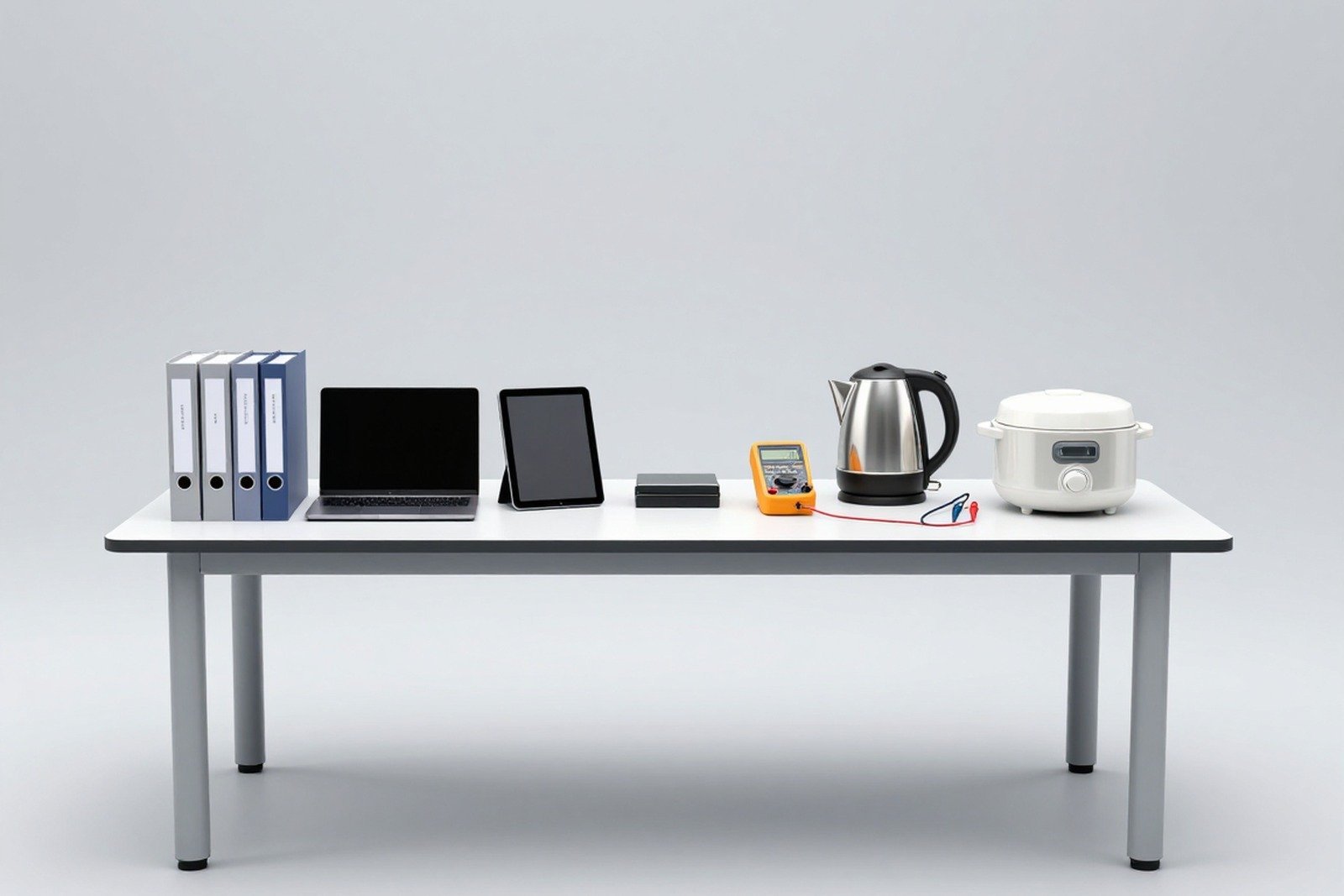
                    Small household electrical appliances and information technology and telecommunications equipment placed next to each other
                    Two groups of products are listed in the same list but may fall into two different Appendices.

                    Two branches of procedure: for medium-risk goods there is no quality inspection on import — the business simply declares conformity before releasing the goods into circulation (Clause 1, Article 82), with no registration step. High-risk goods must be registered for state inspection before customs clearance; Testing and certification take place after the goods arrive at the storage location but before customs clearance is completed (Article 83).

                    3. Step 2 — Register for state inspection of high-risk imported goods

                    Correct order: the business registers for state inspection before customs clearance (for high-risk goods, registration comes first, before testing and certification); The inspection agency will only send a Notice to carry out customs clearance procedures when the dossier is complete and valid (Clause 1, Article 83) and customs clearance is granted only after a Notice confirming compliance with the quality requirements is issued (Clause 5, Article 83). If there is no Certificate of conformity, then carry out customs procedures to bring the goods to the storage location (Clause 2, Article 83) and then test and certify (Clause 6, Article 83) — before completing customs clearance, not after.

                    1. Register with the product and goods quality inspection agency through the National Single Window or the National Public Service Portal (Clause 4, Article 83).
                    2. Already have a Certificate of Conformity: The dossier includes Inspection Registration according to Form No. 1, Appendix VII; Certificate of conformity issued by a designated organization (if issued for a batch of goods, it must match batch information: product name, type, origin, manufacturer, quantity); photo or description of the goods with main label content; secondary label sample if the main label does not have enough content.
                    3. No Certificate of Conformity: register with Form No. 1 with photo or description of goods and labels; Return the goods to the storage location according to customs laws and contact the designated organization for evaluation; When the results are available, it will be handled as if a certificate had been issued.
                    4. Incomplete profile: The inspection agency confirms the missing content; the business must supplement it within 7 working days; if overdue, it must provide a written explanation of the reason and the expected completion date.

                    About labels: This labeling content is according to Chapter III of Decree 37/2026 (Decree 43/2017 and 111/2021 expire from July 1, 2026).

                    4. Step 3 — Testing at a designated testing body

                    • Goods High risk must be tested at a designated testing organization; This result is the basis for assessing compliance with corresponding standards (Clause 6, Article 83 of Decree 37/2026). With goods medium-risk, self-assessment testing must still be carried out by a recognised or designated body.
                    • Specified conditions (Article 72 Decree 37/2026): registered for testing activities; recognized in the right scope; at least 6 testers, each with a minimum of 2 years of experience.
                    • Results abroad: mutual recognition (Article 40) and unilateral recognition (Article 41) of Decree 22/2026/ND-CP with organizations recognized by ILAC, IAF, APAC members.

                    5. Step 4 — Certificate of conformity

                    • According to Clause 2, Article 66 of Decree 37/2026: goods medium-risk declared on the basis of certification by a recognised certification body or self-assessment results of businesses; goods high-risk declared on the basis of certification by a designated certification body and are not self-assessed.
                    • Designated certification body: The industry management ministry appoints and publishes the list; Conditions (Article 72): registering for certification activities, being recognized in the right scope, at least 6 review experts and a minimum of 20 working days of experience.
                    • Common methods (Article 5 of Circular 14/2026/TT-BKHCN): 1 — testing of representative samples of the type and type; 3 — add assessment of the production process, sample monitoring at the production site; 5 — add assessment of the production process or management system; 7 — batch testing and evaluation.
                    • Methods 1 and 6 Does not apply to high-risk goods (Clause 3, Article 6, Circular 14/2026/TT-BKHCN); The method must be stated on the certificate. Methods 3 and 5 are associated with periodic monitoring.
                    Take equipment samples at the production line for testing
                    Medium risk goods are self-assessed but must still be based on testing results from an accredited or designated organization.

                    6. Step 5 — Declaration of conformity and customs clearance

                    High-risk imported goods, in addition to registration for inspection, must also comply with quality management requirements before being put into circulation (Article 68), including declaration of conformity on the basis of the Certificate of conformity of the designated organization (Clause 2, Article 66).

                    • Medium-risk and high-risk goods must both declare their conformity before being put into circulation: domestically produced goods according to Clause 2, Article 66, medium-risk imported goods according to Clause 1, Article 82.
                    • According to Article 37 of Decree 22/2026/ND-CP, the declaration above is registered in the National database on measurement, standards and quality and a confirmation code is received; When the system has a problem, submit it directly or by post.
                    • Enterprises are solely responsible for the published content and storage of technical records, test results, and certificates to present when requested.
                    • Results: Complete and valid records — in 01 working day The inspection agency issues a Notice of inspection results that meet quality requirements (Form No. 3, Appendix VII) for customs clearance. If the label does not comply, the business must remedy it within no more than 5 working days.
                    • After customs clearance: High-risk goods are still subject to market inspection according to Article 88; Goods that have been licensed for circulation or have implemented corresponding quality control measures according to specialized laws will not be re-inspected according to Article 82 (Clause 3, Article 82).
                    Application for state inspection of quality of imported goods and warehouse shipments
                    Complete and valid records: notification of meeting quality requirements will be issued within 01 working day.

                    7. Exemption from inspection, no re-announcement and reduced inspection

                    • Exemption from inspection upon import (Clause 1, Article 86, Decree 37/2026) for high-risk goods: luggage, personal effects, gifts, and border resident goods within tax-free norms; diplomatic goods; sample goods, test samples for inspection and certification; raw materials for processing or producing exported goods; duty-free goods; emergency goods, specialized security goods.
                    • There is no need to re-declare conformity (Clause 5, Article 86): medium-risk imported goods that have been announced for the previous batch do not have to be re-declared when the next batch has same name, use, brand, type, technical characteristics, production facility and origin; Enterprises prepare internal documents to record for post-audit.
                    • Reduce testing: high-risk goods of the same import enterprise, with the same name, type, production facility and origin, then after three consecutive imports that meet the requirements, inspection is reduced for 2 years; Enterprises self-save documents; Stop the regime when there is a violation (Article 84).

                    8. Quick checklist before importing or selling to the market

                    1. Look up the product name and HS code in Appendix I/II of Circular 36/2026/TT-BKHCN to know the risk level and management requirements.
                    2. List all applicable standards (safety, lithium battery, electromagnetic compatibility, radio frequency…) with the correct version; Choose the method according to the risk level.
                    3. High-risk goods: conformity certification before submitting the inspection dossier for customs clearance; Medium risk goods: declared conformity before being put into circulation.

                    9. Transition regulations you need to know

                    • Decree 37/2026 (Article 97): group 1 and group 2 goods according to previous regulations continue to apply until the end of June 30, 2026. Decree 22/2026 (Article 70): registered conformity assessment organizations continue to operate until the certificate expires.
                    • Circular 36/2026: Certificates of conformity and Notices of receipt of declarations already issued remain valid until their expiry date.
                    • ICT businesses note: the old catalog circulars of the Ministry of Information and Communications have been abolished; Check according to Appendix I/II Circular 36/2026.

                    10. Frequently asked questions

                    Registration for state inspection before or after customs clearance?

                    Before. Registration for inspection is the first step: the inspection agency only sends a Notice to the enterprise to carry out customs clearance procedures when the dossier is complete and valid (Clause 1, Article 83) and high-risk goods are only cleared after the Notice meets quality requirements (Clause 5, Article 83).

                    Are imported medium-risk goods subject to state quality inspection?

                    No. According to Clause 1, Article 82 of Decree 37/2026, medium-risk goods are not subject to quality inspection when imported but must be declared compliant before being placed on the market.

                    Are laptops and phones subject to state inspection when imported?

                    Not required, because laptops and phones fall under Appendix II (medium-risk), but a declaration of conformity is still needed.

                    11. Conclusion

                    The conformity assessment procedure for household electrical appliances and ICT equipment from 2026 revolves around one question: whether the product belongs to medium-risk or high-risk. Medium risk goods follow the route of declaration of conformity, without inspection at the border gate; High-risk goods must be certified as conforming to regulations at a designated organization and register for state quality inspection upon import. Determining the right level of risk, the right standards and the right method will help shorten customs clearance time.

                    Related articles