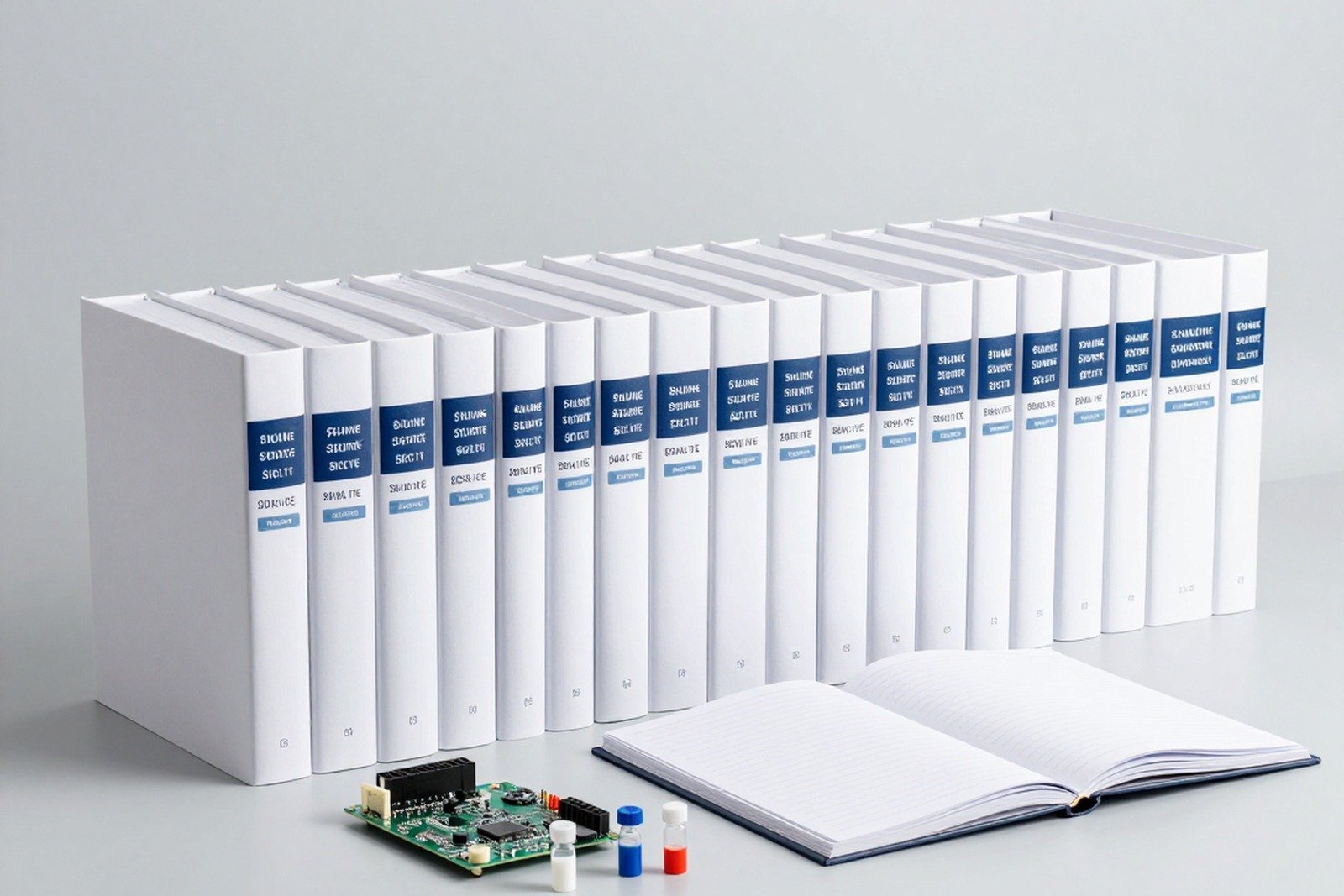
Every RoHS test report cites at least part of the IEC 62321. But very few people who read the report understand how this set of standards is organized, which parts are used for which substances, and why some parts almost never appear in the report.
This article is a map of the standards — so when you pick up a test report, you know what it’s about.
1. What is IEC 62321?
This is a set of international standards Determination of certain substances in electrical and electronic products (electrotechnical products), developed by IEC, includes many parts released in stages. This set of standards does not prescribe limit — the limit is in Directive 2011/65/EU. IEC 62321 only specifies way of determination content of those substances.
This distinction is important in practice:
| Text | Regulate what? |
|---|---|
| Directive 2011/65/EU (and 2015/863) | Which substances are restricted, what are the limits, and what are the obligations of the business? |
| IEC 62321 (parts) | How to sample, dissect, screen and analyze to determine content |
| EN IEC 63000 | How to prepare technical documents to evaluate products against substance restriction requirements |
2. What parts does the standard include?
The set of standards is divided according to function (sampling, extraction, screening, analysis) and follow substance group. These are the most important parts:
| Part | Content | When to use? |
|---|---|---|
| Part 1 | Overview and general guidance for the entire set of standards | Do not use directly in testing; used to understand the structure of the standards set |
| Part 2 (2021 version) | Sampling strategy and mechanical sample preparation | The step of disassembling every product — is the foundation of every result behind |
| Part 3-1 | X-ray fluorescence (XRF) screening | Rapid screening of heavy metals in plastics and metals |
| Part 3-2 (2020 version) | Screening of total fluorine, chlorine and bromine in polymers and electronic materials by sample combustion – ion chromatography (C-IC) | Quick halogen group test when flame retardants or PVC are suspected |
| Part 4 | Determination of mercury in polymers, metals and electronic materials | Mercury (Hg) — usually according to CV-AAS, CV-AFS, ICP-OES, ICP-MS techniques |
| Part 5 (2013 version) | Cadmium, lead and chromium in polymers and electronic materials; cadmium and lead in metals — by AAS, AFS, ICP-OES and ICP-MS | The three major metals (Pb, Cd, total Cr) — the most cited section |
| Part 6 | PBB and PBDE in polymers by GC-MS | Brominated flame retardants group; especially with recycled plastic |
| Part 7-1 | Cr(VI) in anti-corrosion coating on metals by colorimetric method | Galvanized parts have a chromium passivation layer |
| Part 7-2 | Cr(VI) in polymers and electronic materials by colorimetric method | Cr(VI) in plastics, electronic materials — different subjects from 7-1 |
| Part 8 (2017 version) | Phthalates in polymers by GC-MS and by Py/TD-GC-MS | DEHP, BBP, DBP, DIBP — four “new” RoHS substances |
Important note: This set of standards is updated in parts, not at one time. You may encounter part 2 of the 2021 version but part 5 of the 2013 version, part 8 of the 2017 version — that’s normal. Before making references to a contract, check the current version of each section on the IEC site.
3. Read a test report: what part to look for?
| On the report it says | Meaning what did the testing room do? |
|---|---|
| IEC 62321-3-1 | Only screening by XRF — not a chemical conclusion |
| IEC 62321-5 | Analyzed metals (Pb, Cd, total Cr) by quantitative method |
| IEC 62321-4 | Mercury determined |
| IEC 62321-6 | Tested for PBB and PBDE by GC-MS |
| IEC 62321-7-1 or 7-2 | Identified Cr(VI) — not total chromium |
| IEC 62321-8 | Four phthalates tested |
| IEC 62321-2 | Disassembled according to standards (usually recorded, does not replace analysis results) |
How to quickly check whether a set of documents is complete: compare the list of restricted substances with the sections that appear on the report. If the report only has 3-1 (XRF) and 5 (metal), then PBB/PBDE, Cr(VI) and four phthalates were not tested — even though the report cover may say “RoHS”.
4. Three technical groups in the standard set
Screening group
Includes XRF (part 3-1) and sample combustion – ion chromatography for halogens (part 3-2). The goal is to quickly reduce the number of samples that must be analyzed. Screening results always have an “inconclusive” zone and are not in themselves conclusive.
Elemental analysis group
Includes mercury (part 4) and total Cd, Pb, Cr groups (part 5). Techniques listed in the standard include AAS, AFS, ICP-OES and ICP-MS. The choice of technique depends on the limit needed, the type of sample matrix and the capabilities of the testing laboratory — for example, ICP-MS gives the highest sensitivity, ICP-OES is suitable when the concentration is higher.
Organic compound analysis group
Including PBB/PBDE (part 6) and phthalate (part 8), using GC-MS. This is a group that requires careful sample extraction, because the results strongly depend on the quality of the extraction. Part 8 also shows how to use additional pyrolysis/thermal adsorption accessories (Py/TD-GC-MS) for some cases.
5. Why is the standard set so divided?
Three practical reasons:
- Because different materials need different treatments. Metals and polymers cannot decompose by the same process. Cr(VI) in thin coatings must be evaluated by area (µg/cm²), while heavy metals in plastics must be evaluated by mass percentage.
- Because different groups of substances require different equipment. Metals use atomic spectroscopy; organic compounds using gas chromatography mass spectrometry.
- Because the set of standards is updated partially. When the EU added four phthalates, it only needed to add section 8 instead of amending the entire set of standards.
6. China uses its own set of standards: GB/T 39560
Points businesses exporting to China must remember: mandatory standards GB 26572-2025 (effective August 1, 2027) uniquely designates the string GB/T 39560 do the test method. This series is built according to the structure corresponding to IEC 62321, but test reports for the Chinese market need to cite the correct set of Chinese standards specified.
Practical consequence: a report stating only IEC 62321 may not be directly acceptable for the purpose of demonstrating compliance with GB 26572-2025. Please check with the testing laboratory before sending samples. Details in the article GB 26572-2025: China’s first mandatory RoHS standard.
7. Frequently asked questions
The test report only states IEC 62321 without any part — is there any problem?
Yes. “IEC 62321” is the name of the whole set of standards, not enough to know what was tested. A proper report must clearly state the section (eg 62321-5, 62321-8). If not clearly stated, ask the testing laboratory to supplement or correct it.
Why don’t I see part 3-1 in the report but see part 5?
Because part 3-1 is screening. When the screening results are in the clear pass zone, many dossiers are only kept in internal minutes and not included in the main report. It is imperative that the report contains sufficient results for every restricted substance.
Is there any part of IEC 62321 devoted to material declaration?
No. Material declaration falls within the scope of other standards (e.g. IEC 62474 for material declaration in the electrical and electronics industry, or IPC-1752A). IEC 62321 is a set of testing standards.
Is it okay if the test lab uses the internal method instead of IEC 62321?
Technically acceptable if the method is validated and has equivalent reliability. But in commerce and in regulatory compliance documents, citing internationally recognized standards makes documents much easier to accept. For the Chinese market, designated standards are mandatory.
Which is the latest version of IEC 62321?
Depends on each part. The standards are updated individually, so the parts have different issuance years (for example, part 2 version 2021, part 5 version 2013, part 8 version 2017). Before making references to a contract, check the current version of each section on the IEC site.
8. Conclusion
IEC 62321 is a set of standards Specifies how to test, no limit specified. This set is divided by function (part 2 sampling and extraction, parts 3-1 and 3-2 screening) and by substance group (part 4 mercury, part 5 Cd/Pb/Cr, part 6 PBB/PBDE, part 7-1 and 7-2 Cr(VI), part 8 phthalate).
Practical use: when receiving a report, compare the restricted substances list with the sections cited. A report missing sections 6, 7 or 8 means PBB/PBDE, Cr(VI) or four phthalates were not tested — even if the report cover says “RoHS”.
References
- IEC 62321-2:2021 — mechanical sampling and sample preparation
- IEC 62321-3-1 — XRF screening; IEC 62321-3-2:2020 — screening of total fluorine, chlorine and bromine by sample combustion – ion chromatography
- IEC 62321-5:2013 — cadmium, lead and chromium in polymers, electronic materials; cadmium and lead in metals, by AAS, AFS, ICP-OES and ICP-MS
- IEC 62321-8:2017 — Phthalates in polymers by GC-MS and Py/TD-GC-MS
- Directive 2011/65/EU and Directive (EU) 2015/863
- GB 26572-2025 — China mandatory standard, GB/T 39560 series designation
Related articles
- What is halogen-free? Not covered by RoHS but customers still request it — why?
- When is XRF only needed, when is wet testing required? Batch RoHS control strategy
- Material declaration according to IEC 62474 and IPC-1752A: what must the supply chain send and receive?
- How long does a RoHS test kit take and what does it cost?
- What does a RoHS test report need to be valid? 9 items cannot be missing
- What is GB/T 39560? Why does China uniquely specify this set of test methods?
- What capabilities does a RoHS test room need? ISO/IEC 17025, VILAS and scope of accreditation
- PBB/PBDE testing by GC-MS: why recycled plastics are organic bromine hot spots
- Lead, cadmium, mercury testing: ICP-OES, ICP-MS or AAS — which method to choose?
- Cr(VI) test: how are colorimetric and ion chromatography (IC) different?
- Testing 4 phthalates (DEHP, BBP, DBP, DIBP): GC-MS principles and 6 common traps
- Dissection of the sample according to IEC 62321-2: if this step is done incorrectly, all subsequent results will be meaningless
- How many samples are enough for a RoHS test kit? Principles for selecting samples, stored samples and control samples
- RoHS test procedure from A to Z: from sample receipt, extraction, screening to reporting
- XRF RoHS screening: how to read the results, how much to trust, 5 limitations you must know
Discuss further
Disclaimer
This article is an interpretive content compiled by us; not legal advice. The IEC 62321 standard is updated in parts, so the number of years of publication may vary between parts.
Before citing in contracts or regulatory compliance documents, businesses need to compare the current version of each section on the IEC site.
See more: Copyright Policy & Disclaimer by ticforall.com.