Quick summary
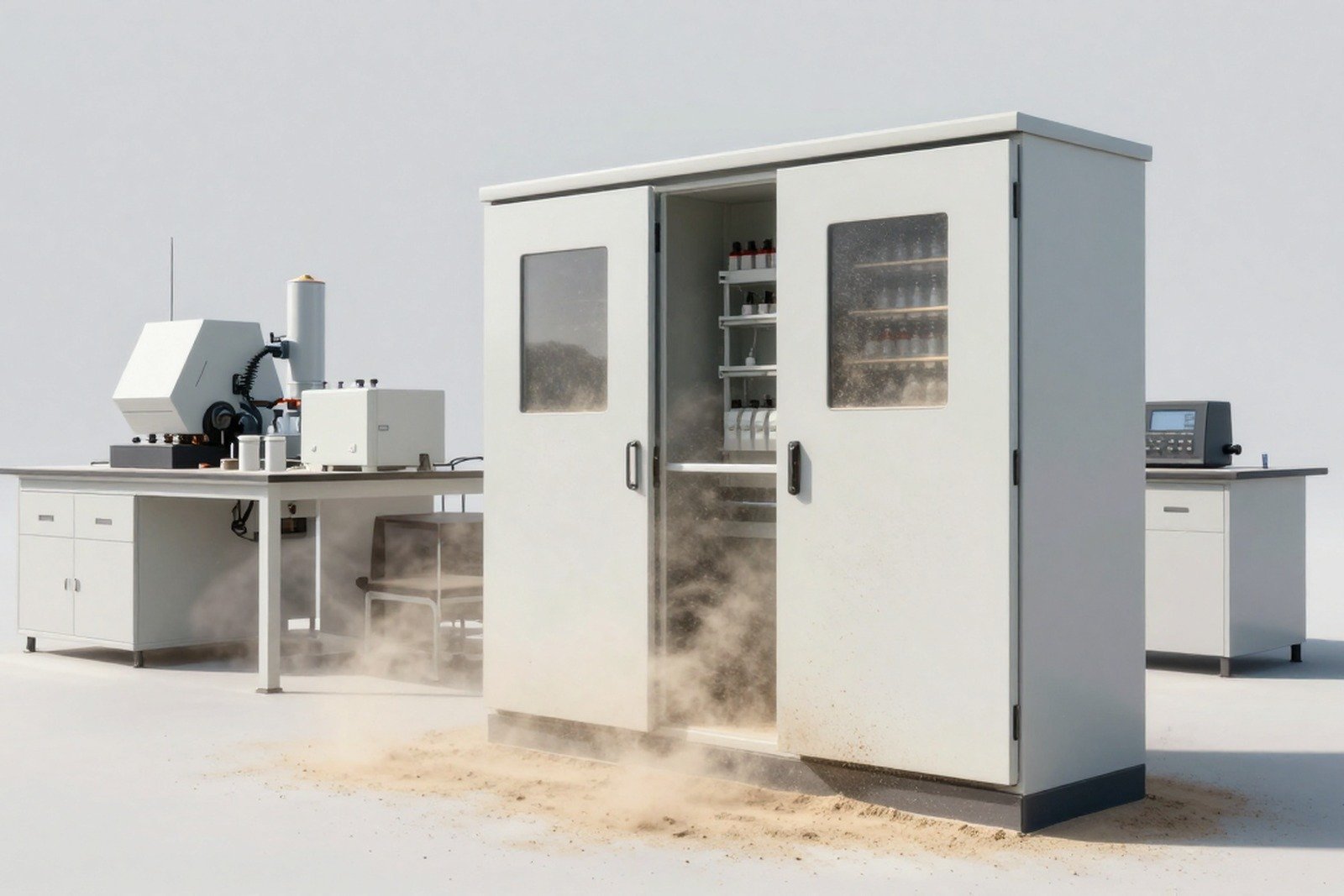
- Level 6X means “dust-tight” as the standard defines it: no ingress of dust in an 8-hour talc test with an internal depression.
- But the “dust” in that test is talc with a defined particle size, mostly below 75 µm — it does not represent real site dust, which also carries sub-micron particles, fibres, salt and abrasive grit.
- Sub-micron particles do not “squeeze through gaps” the way coarse grains do — they travel like a gas, riding the air that moves in and out as the enclosure breathes.
- So IP6X is a necessary condition, not a sufficient one in fine-dust environments: optical sensors, MEMS, contacts and bearings still fail behind an IP6X label.
Of all the IP levels, 6X carries the most misleading name: “dust-tight”. “Tight” sounds absolute, while the test is very specific about the particle type, the duration and the conditions.
1. What “dust-tight” means in the standard
The two dust levels have different criteria, and the difference is often skipped when reading a report:
| Level | Criterion in the standard | How it is judged |
|---|---|---|
| 5X | Dust does not enter in a quantity sufficient to interfere with operation | Dust permitted, as long as function is unaffected |
| 6X | No ingress of dust | No dust found inside the sample |
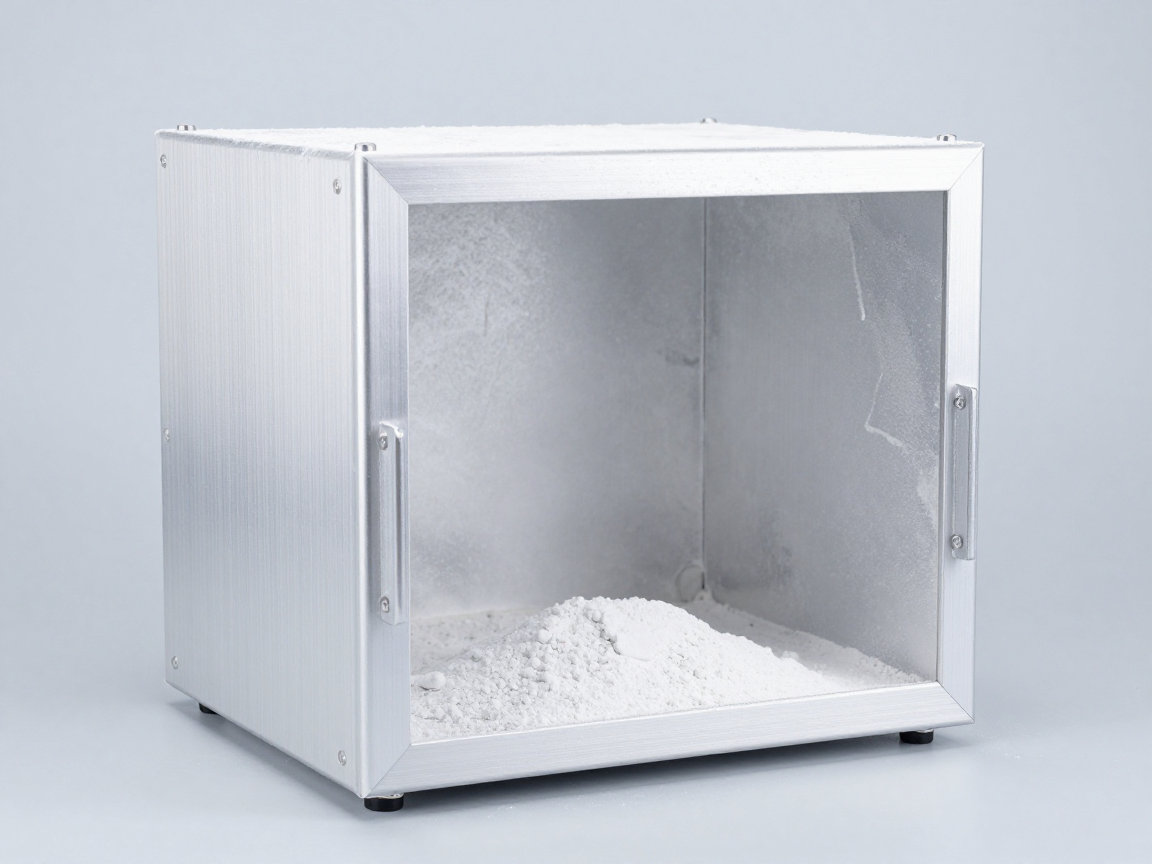
For 6X the test uses talc powder, 8 hours, with a depression inside the enclosure to model the pressure difference — exactly the mechanism that pushes dust through gaps in service. “No ingress of dust” is judged by observation inside the sample after the test.
The point to hold on to: the criterion is written for one specific dust, over one specific duration. It is not a statement about every particle type under every condition.
2. How large are the test dust particles
To see why “dust-tight” is not “everything-tight”, place talc on the same scale as other particles:
| Particle type | Typical size | Behaviour |
|---|---|---|
| Gravel, coarse sand | > 500 µm | Blocked by most gaps and meshes |
| Fine sand | 100–500 µm | Enters larger gaps, strongly abrasive |
| Talc test dust (6X) | mostly < 75 µm | Enters small gaps, settles |
| Cement dust, chalk | 1–50 µm | Settles, cakes when damp |
| PM10 | < 10 µm | Stays airborne for long periods |
| PM2.5 | < 2.5 µm | Follows air flows, enters any air path |
| Soot, smoke, nanoparticles | < 0.1 µm | Behaves almost like gas molecules |
The critical threshold is around 1 µm. Above it, particles are stopped mechanically: a gap narrower than the particle blocks it. Below it, particles are governed by Brownian motion and follow air flow — they pass through a gap the way air does, however narrow, as long as air can pass at all.
3. How real dust differs from test dust
| Property | Talc (test) | Field dust |
|---|---|---|
| Size distribution | Narrow, defined | Very wide, from gravel to nanoparticles |
| Shape | Soft, platy | Includes angular, abrasive grains |
| Moisture | Dry, conditioned | Varies; damp dust cakes into crusts |
| Composition | Homogeneous | Contains salt, metals, carbon, organics |
| Charge | Low | Friction-charged dust clings to surfaces |
| Exposure time | 8 hours | Years, with cycles |
Three differences matter directly: real dust contains finer particles than talc, it contains salt and metals so it can conduct or corrode, and it goes through wet cycles so it cakes into hard deposits inside gaps.
4. Four paths fine dust still uses
- Riding the air (the main one): a sealed enclosure still breathes as temperature changes — air out when hot, in when cold. Every intake carries sub-micron particles. This is why an enclosure that passed 8 hours of IP6X still accumulates dust after two years.
- Diffusion of ultrafine particles: below 1 µm, a particle needs only an air path — even the gap around a speaker membrane, a vent, or a moulded lid seam.
- Through membranes and vents: ePTFE vents block water well, but their particle filtration ratings differ. Choosing a vent for water without checking its particle rating is a common error.
- Electrostatic attraction: charged dust clings to the outside, then air flow or vibration carries it into gaps; charged plastics attract dust right onto the seal line and degrade it.
5. Why fine dust is more dangerous than coarse dust
In many applications, smaller particles are harder to deal with:
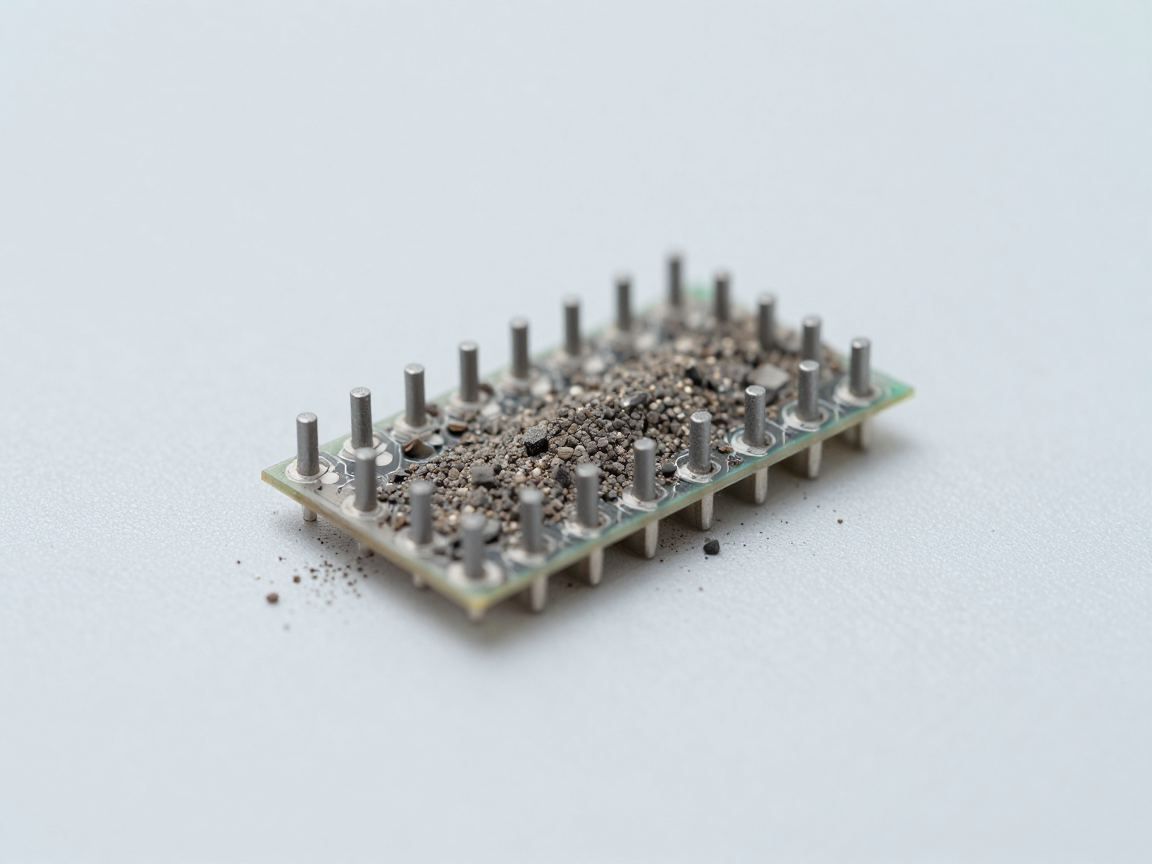
- Optical sensors: a film of fine dust on the window degrades the signal gradually, with no sudden failure to trigger maintenance; coarse dust usually gets noticed earlier.
- MEMS and small mechanisms: moving gaps are a few micrometres — particles of that size jam them, while coarse grains cannot get in.
- Electrical contacts: metal or carbon dust forms conductive bridges and shorts; salt dust absorbs moisture and creates a conductive, corrosive film.
- Bearings and gears: angular abrasive dust acts like sandpaper, wearing parts far faster than soft dust.
- Heat dissipation: dust coating the fins reduces cooling, temperature rises, the enclosure breathes harder — a self-reinforcing loop.

6. Reading the report: ten points to check
| Point | Question | Warning sign |
|---|---|---|
| 1 | Which level was tested — 5X or 6X? | Report says 6X but the description uses 5X criteria |
| 2 | Test duration | Shorter than 8 hours |
| 3 | Was a depression applied? | No depression — skips the most important ingress mechanism |
| 4 | Dust type and quantity | Type or mass not stated |
| 5 | Sample configuration | Empty housing, no cable glands, no flap |
| 6 | Sample position in the chamber | Vague description, orientation unstated |
| 7 | Acceptance criteria | Says only “pass”, without saying what was checked or where |
| 8 | Photos before and after opening | No photos — nothing to substantiate the result |
| 9 | Combined with a water level? | Only 6X tested while claiming “IP66” or “IP68” |
| 10 | New or aged sample? | New sample, while the product serves for years |
Among these ten, points 3 and 5 are the most commonly omitted — and both make the result look better than reality.
7. Three traps in “IP6X” claims
- Trap 1 — “IP6X” instead of “IP6X plus a water level”. Dust and water levels are independent. A device tested for dust only has no basis for claiming “IP66” or “IP67”.
- Trap 2 — a 5X result relabelled as 6X. 5X permits dust, 6X does not; moving from 5X to 6X requires a different design, not a different label.
- Trap 3 — ignoring real conditions. A device mounted where wind carries dust, near grinding operations, or in a cement plant carries a far heavier dust load than 8 hours in a quiet chamber.
8. When additional testing is needed
| Additional test | What it models | When it is needed |
|---|---|---|
| Standard test dust A2/A4 (ISO 12103-1) | Dust with a wider size distribution than talc | Equipment for heavy industrial environments |
| Salt dust / salt spray | Coastal dust combined with corrosion | Outdoor equipment near the sea, chemical plants |
| Wet–dry dust cycling | Dust caking into crusts inside gaps | Environments with condensation, rain or washing |
| Dust test after thermal cycling | Dust ingress via the breathing mechanism | Equipment with internal heat, outdoors |
| Combined dust + water (e.g. IP66) | Dust degrading the seal, then water entering | Always, when the product must survive both |
Selection principle: if the real environment has particles finer than talc, or has moisture, a dry talc test alone does not describe it. At minimum, add a test that combines dust with moisture or with thermal cycling.
9. Six common misunderstandings
| Misunderstanding | Reality |
|---|---|
| “IP6X means completely sealed, nothing gets in” | True only for talc over 8 hours with a depression; ultrafine particles still ride the air |
| “IP6X includes water protection” | No. Dust and water levels are independent; each needs its own test |
| “Passing 5X is nearly the same as 6X” | Different criteria: 5X permits dust, 6X does not |
| “A gasket is enough to keep dust out” | A gasket blocks coarse grains; fine particles follow air through any air path |
| “Dust only affects mechanical equipment” | Electronics are more sensitive: optical sensors, contacts, MEMS |
| “Test once and forget it” | Retest when material, supplier or process changes |
10. What to write in the contract
To avoid disputes, state five points:
- The exact level: “IP6X per IEC 60529” — not a vague “dust protected”.
- Test conditions: 8 hours, talc, depression per the standard; record the measured depression value.
- Sample configuration: complete unit in shipping configuration, with cable glands fitted.
- Acceptance criteria: “no visible dust in the functional compartment, inspected within 5 minutes of opening, with photographs”.
- Combined tests if needed: state explicitly whether water testing is included, and at which level.
Model wording: “Dust protection per IEC 60529: IP6X, tested for 8 hours with talc and the standard depression, complete unit in shipping configuration; pass when no visible dust is present in the functional compartment, inspected within 5 minutes of opening, with before and after photographs.”
Frequently asked questions
Is IP6X absolutely dust-tight?
No. It means “no ingress of dust” in an 8-hour talc test with a depression. Particles below 1 µm can still enter with the air exchanged as the enclosure heats and cools.
Why is there dust inside a device that passed IP6X?
Because the test is 8 hours on a new sample, while service is years with thousands of thermal cycles. Each cycle moves a small volume of air — and ultrafine dust — inside.
Does IP6X include water protection?
No. The two levels are independent. To claim IP66 or IP67 you must test the corresponding water level on the same configuration.
Can ultrafine dust be blocked at all?
Yes, but it takes specific measures: vents with a defined particle filtration rating (not just water resistance), eliminating unnecessary gaps, and reducing the pressure swing inside the enclosure. No gasket blocks particles that travel with air if air still passes.
Should outdoor products take 5X or 6X?
Usually 6X, because outdoor dust is fine and humid. But more important is testing with a water level and testing after thermal cycling — those two conditions decide real service life.
Conclusion
“Dust-tight” is a conditional claim: talc, 8 hours, with a depression, on a new sample. It is a good and necessary test — but not an absolute guarantee for fine-dust environments.
What to do: re-read your reports against the ten points in section 6, add tests that combine dust with moisture or thermal cycling, and always state the corresponding water level when making a claim. Those three steps turn a number on a label into a real technical assurance.
References
- IEC 60529 — degrees of protection, talc dust test conditions and the 5X/6X criteria.
- ISO 12103-1 — test dust (A2 fine, A4 coarse).
- IEC 60068-2-14 — change of temperature; IEC 60068-2-52 — salt mist, cyclic.
Related articles
- IP5X and IP6X: the talc dust test step by step
- Why IP67 devices still fail in the field
- What is IEC 60529? The IP code explained
- IPX5 and IPX6: the 6.3 mm versus 12.5 mm jet
Talk to us
Disclaimer
This article is our own interpretation; it is not legal advice. Readers should check the official text of the standard before applying it to a specific product.
See also: Copyright Policy & Disclaimer of ticforall.com.