Home Blog Page 12

What is ISTA 7D? Temperature testing procedures for shipping packaging

0
Cover image of the article «What is ISTA 7D? Temperature testing procedures for shipping packaging»

ISTA® 7D is a group test Development Test — packaging development article group. Full name: Temperature Test for Transport Packaging, 2007 edition (editorial revision July 2022).

What needs to be said now, before anything else: This article only evaluates one factor — temperature. It no impact measurement, no vibration measurement, no compression measurement. So 7D never stands alone: ​​it must always be paired with a Series 1, 2 or 3 lesson to form the full review set. This is the most common point of confusion — many records say “ISTA 7D tested” and are interpreted as “packaging tested”.

The second important point, and the main thing the ISTA document must make clear: ISTA strongly recommends the use of ISTA 7E instead of 7D. 7E was developed following a comprehensive survey of the temperature range in parcel delivery systems, and is considered the best and most up-to-date simulation of the thermal environment. This article presents 7D as documented, and clearly states when to choose 7E.

1. What is ISTA 7D?

Document definition: Procedure 7D is an article development test to evaluate effects of exposure to outside temperatures up each packaged-product individually. Specifically, the document states four purposes of use:

  • Used to Develop temperature-controlled shipping packaging, made of any material.
  • Used to Analyze individual or comparative performance between standard shipping packaging and insulated packaging, compared to commonly encountered conditions.
  • Designed to measures the relative ability of packaging to protect the product when exposed to temperature cycles.
  • Products and packaging are considered together, not separate.

And a very important limiting sentence: this article It is not intended to evaluate the packaged-product’s ability to protect against shock, vibration and/or compression.

2. Warning before use: 7D profile is not “worst case”

The document places a notable warning (CAUTION): the cycle profile in 7D is General simulation, not intended to represent the worst temperature exposure. Furthermore, the document states: “The profiles listed in this procedure are not based on current research data” — while there are many variables that influence thermal and distribution performance, as well as the thermal extremes of the actual distribution environment of each distribution situation.

From there, the document outlines a series of instructions that should be read carefully before committing to customers:

  • If you try to comply with government, industry, laboratory, validation or regulatory standards or guidelines This procedure can be supplemented or replaced It is the user’s responsibility to know and understand such requirements and use the appropriate procedures accordingly.
  • ISTA strongly recommends using ISTA 7E instead of 7D. 7E was developed following a comprehensive survey of the thermal range in the parcel system, is considered the best and most up-to-date simulation of the thermal environment, and can be purchased separately from ISTA.
  • After the packaging has achieved acceptable thermal performance through a series of 7D screening/probing, should run an additional series of general simulation distributions — to simulate the extremes expected to be encountered in the shipping environment.
  • With packaged-product can be sent via system small parcel, consider General Simulation 3A.
  • With insulated shipping container In parcel system, you should consider ISTA 7E.

In short: 7D is a tool develop and compare good, but not “covers all heat conditions” proof. For pharmaceutical products, cold chain, frozen foods — need to read more articles What is ISTA standard? to place 7D in the correct position in the deck.

3. Responsibilities of the shipper

The document requires the shipper to determine before trying two things:

  1. Limit the exact temperature of the product — upper and/or lower limits.
  2. Limit the time allowed above or below those temperature limits (excursion).

This is the basis for a pass/fail conclusion. If we just say “the product can withstand 2–8 °C” without saying anything How long are you allowed to overtake?, the test has no criteria for judgment. In essence, this is the same principle as the card Four pass/fail criteria when testing packaging: businesses must determine themselves in advance.

4. Test sample: strict requirements on “thermal equivalence”

Because this is a thermal lesson, 7D’s model requirements are much more stringent than mechanical lessons. Regulatory documents:

  • Samples should be real packaging and products, not tested. If either (or both) are absent, the sample must be substituted as real as possible.
  • Replacement products must be as close as possible composition, texture, thermal mass, consistency — e.g. liquid, powder or paste and other physical properties, and must packaged in the product’s correct primary packaging.
  • Recommendation: packaged-product simulation should be as close as possible specific heat compared to the real product, so that the temperature of both materials changes at the same rate.
  • If used Refrigerant or heat stabilizer, must be right type that the shipper will use in practice.
  • Model Number: a template for the articles in this process.
  • Repeat recommendation: ISTA requires running the procedure once, but Recommended to run three or more times with a new sample for each test.

The document also notes: packaging has undergone transportation should not be considered representative of standard conditions. To ensure testing is in perfect condition, the product and packaging must be sent to an accredited laboratory over-package when sending, or Repackage with new packaging at the lab.

5. The test sequence consists of 4 steps

# Category Test Test level Status
1 Temperature Preconditioning Store the product and each packaging component at the required temperature, Minimum 24 hours Options (according to documentation: “Optional”)
2 Ambient temperature Cycle 1 of the selected profile According to profile Required
3 Ambient temperature Cycle 2 According to profile Required
4 Ambient temperature Remaining cycles of profile According to profile Required

Technically, this sequence is much simpler than the 3 Series exercises — but “simple” here only refers to the number of steps, not the rigor of the operation. Three important operational requirements:

  • Every cycle: set packaged-product on pallets or open platforms Let the heat circulate completely around all sides; guaranteed Minimum clearance 6 in (150 mm) between any side of the bale and the floor, interior wall or other bale.
  • Yes Confirm that the chamber/room has reached the correct cycle temperature before testing — don’t “put it in and wait”.
  • At the end of each cycle, remove the bales and transfer the temperature to the next cycle manually or with a pre-programmed controller.

Return Primary conditioning, the document has two branches: if used thermocouple probe To measure product temperature, it is a must Insert the probe into the product First, condition for at least 24 hours, then install the product in the box without delay, check the probe is working properly, make sure the probe wire comes out does not create air leaks at the lid, then add wrapping paper/dunnage and seal; then Start temperature recording at a predetermined recording interval (e.g. 15 or 30 minutes). If you do not use a probe, skip those steps but still have to condition for a full 24 hours.

Two practical notes are rarely mentioned, but if done incorrectly, the results will be meaningless:

  1. If used frozen gel/ice packs, possible thermal stabilization time longer than 24 hours, especially if they are frozen in the shipping container itself and not individually.
  2. Must confirm correctly that the material has been properly conditioned by product testing and that the coolant has been individually monitored prior to testing.
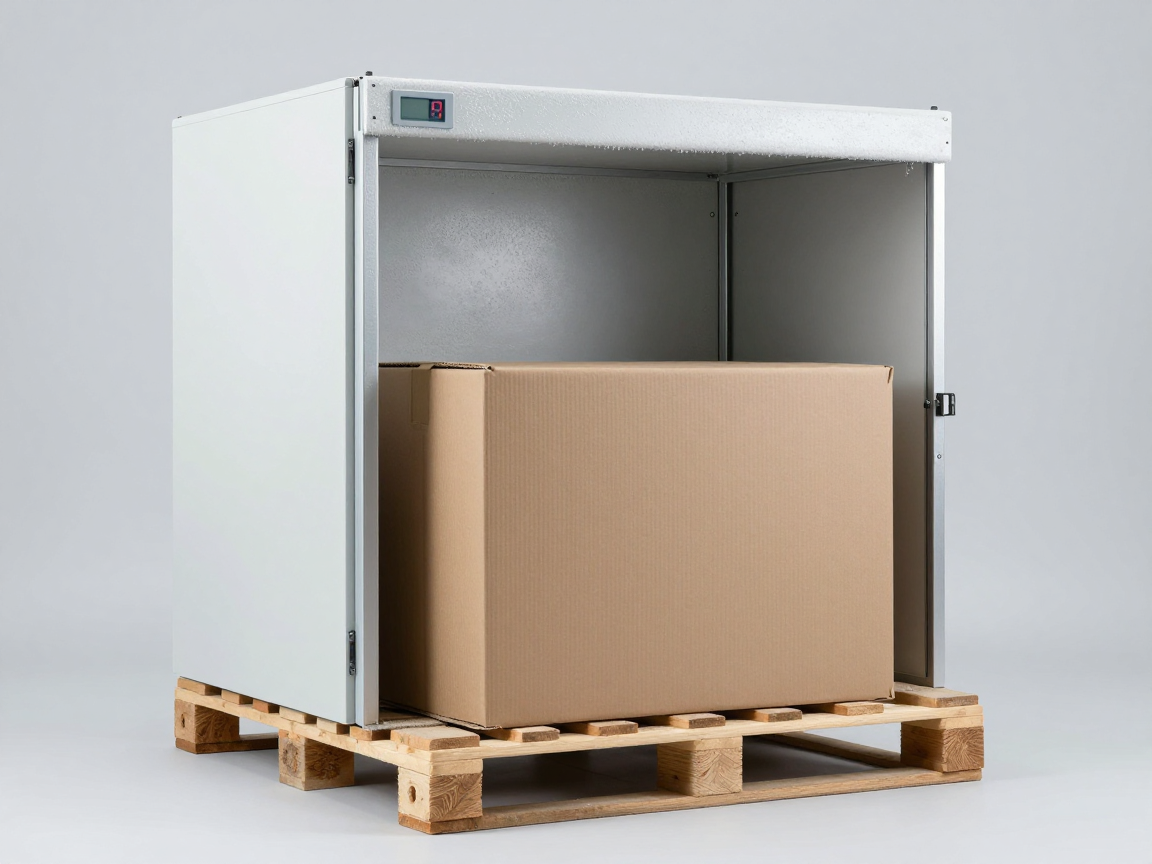
Unlabeled brown carton on wooden pallet inside large temperature test chamber with frost on wall and small temperature display
The entire 7D test is just temperature: place the bale in a draft-free chamber/room, ensuring at least 6 in (150 mm) of clearance to allow heat to circulate around all sides.

6. Thermal cycle profiles (cycle profiles)

This is the “data” part of the 7D. The documentation provides two profile families: cycle/soak (keep at temperature for a number of hours) and ramp (transfer temperature along the ramp).

Cycle/soak family — domestic United States

24-hour domestic small parcel shipping (air), winter/summer:

# Winter Profile (cold sent & cold received) Now Total Summer Profile (hot to send & hot to receive) Now Total
1 18 °C (65 °F) 4 4 22 °C (72 °F) 4 4
2 −10 °C (14 °F) 2 6 35 °C (95 °F) 2 6
3 10 °C (50 °F) 12 18 30 °C (86 °F) 12 18
4 −10 °C (14 °F) 6 24 35 °C (95 °F) 6 24

Domestic cargo transportation within 48 hours (airway): The four-cycle structure is similar to the 24-hour level, but cycle 3 is longer 36 hours (42 hours total) instead of 12 hours, bringing the total time to 48 hours.

72-hour international express air shipping (from USA): also four cycles, but cycle 3 lasts longer 56 hours (66 hours total), bringing the total time to 72 hours.

Profile Cycle 1 Cycle 2 Cycle 3 Cycle 4 Total
Winter 24 hours 18 °C / 4 h −10 °C / 2 h 10 °C / 12 h −10 °C / 6 h 24 h
Summer 24 hours 22 °C / 4 h 35 °C / 2 h 30 °C / 12 h 35 °C / 6 h 24 h
East 48 hours 18 °C / 4 h −10 °C / 2 h 10 °C / 36 h −10 °C / 6 h 48 h
Summer 48 hours 22 °C / 4 h 35 °C / 2 h 30 °C / 36 h 35 °C / 6 h 48 h
East 72 hours 18 °C / 4 h −10 °C / 6 h 10 °C / 56 h −10 °C / 6 h 72 h
Summer 72 hours 22 °C / 4 h 35 °C / 6 h 30 °C / 56 h 35 °C / 6 h 72 h

Cycle/soak family — when the sender and receiver are in different seasons

For international shipments within 72 hours from the United States, the conditions of the sender and receiver are specified not the same season, documents for two year-cycle profiles:

# Profile COLD → HOT (send cold, receive hot) Total Profile HOT → COLD (send hot, receive cold) Total
1 18 °C (65 °F) / 4 h 4 h 22 °C (72 °F) / 4 h 4 h
2 −10 °C (14 °F) / 6 h 10 h 35 °C (95 °F) / 6 h 10 h
3 10 °C (50 °F) / 32 h 42 h 0 °C (32 °F) / 32 h 42 h
4 22 °C (72 °F) / 24 h 66 h 10 °C (50 °F) / 24 h 66 h
5 35 °C (95 °F) / 6 h 72 h −10 °C (14 °F) / 6 h 72 h

The law extends when there is a delay

The document states a very practical rule: because Delays are possible, if experience indicates concern, the total hours of the profile can be extended as follows:

  • Profile 24 hours → increase by 8 hours.
  • Profile 48 hours → an additional 16 hours.
  • Profile 72 hours → increase by 24 hours.

With winter 24/48/72 and summer 72 profiles, plus last cycle. As for the 72-hour profile, which has different sending and receiving conditions, it is added 8 hours into cycle 2 and 16 hours into the last cycle.

Ram family — when to use it?

The document clearly states: ramp profile is more suitable than cycle/soak in two cases — (1) Very small insulated tank, with little thermal mass, and (2) situations that do not involve transporting goods, for example shipped in car trunk. The temperature levels are then transferred in 2-hour ramps, with interspersed “2-hour at temperature” segments: for example, a 24-hour freezing profile goes from 18 °C (0–6 hours) → 2-hour ramp → −20 °C (−4 °F) for 2 hours → ramp 2 hours → 10 °C (12–18 hours) → ramp 2 hours → −20 °C for 2 hours → ramp; summer profile used 45 °C (113 °F) for hot spots instead of 35 °C.

Worth noting: they use ramp −20 °C and +45 °C — much harsher than the cycle/soak family (−10 °C and +35 °C). This is a technical detail that is easily overlooked when choosing a profile.
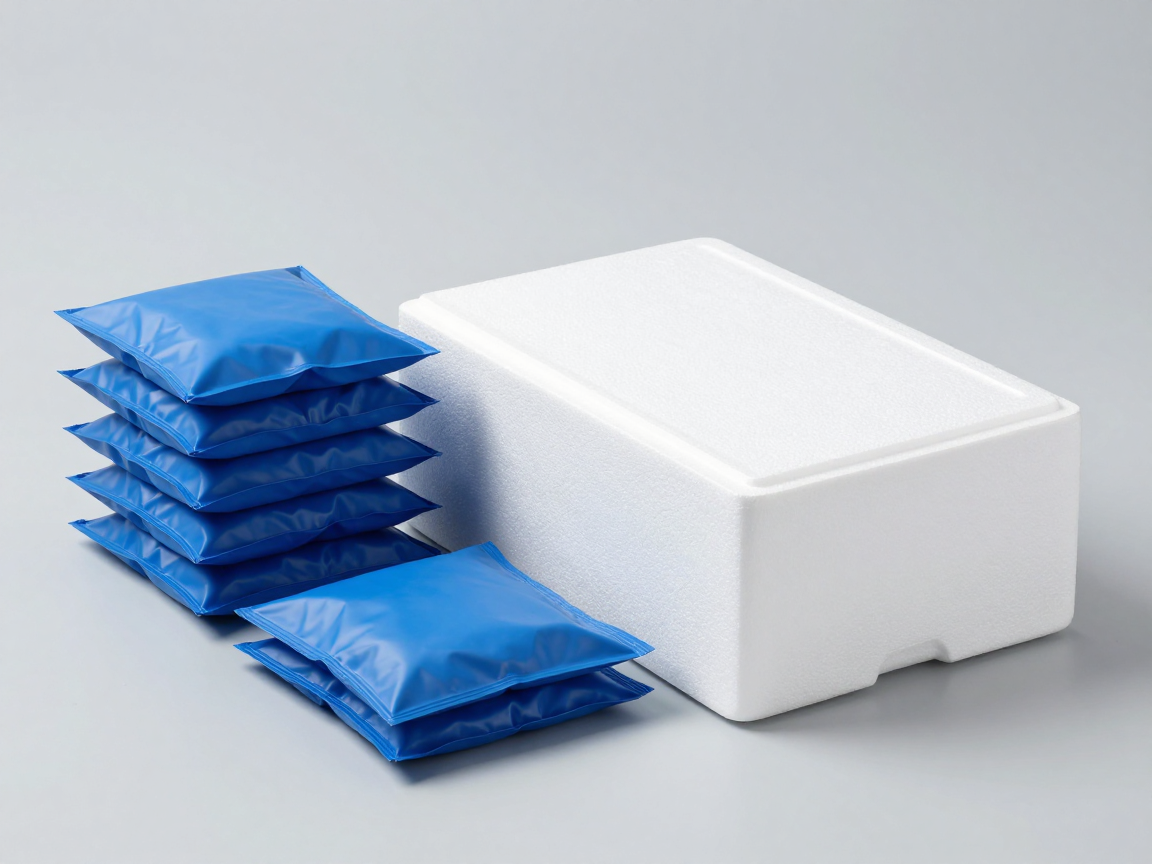
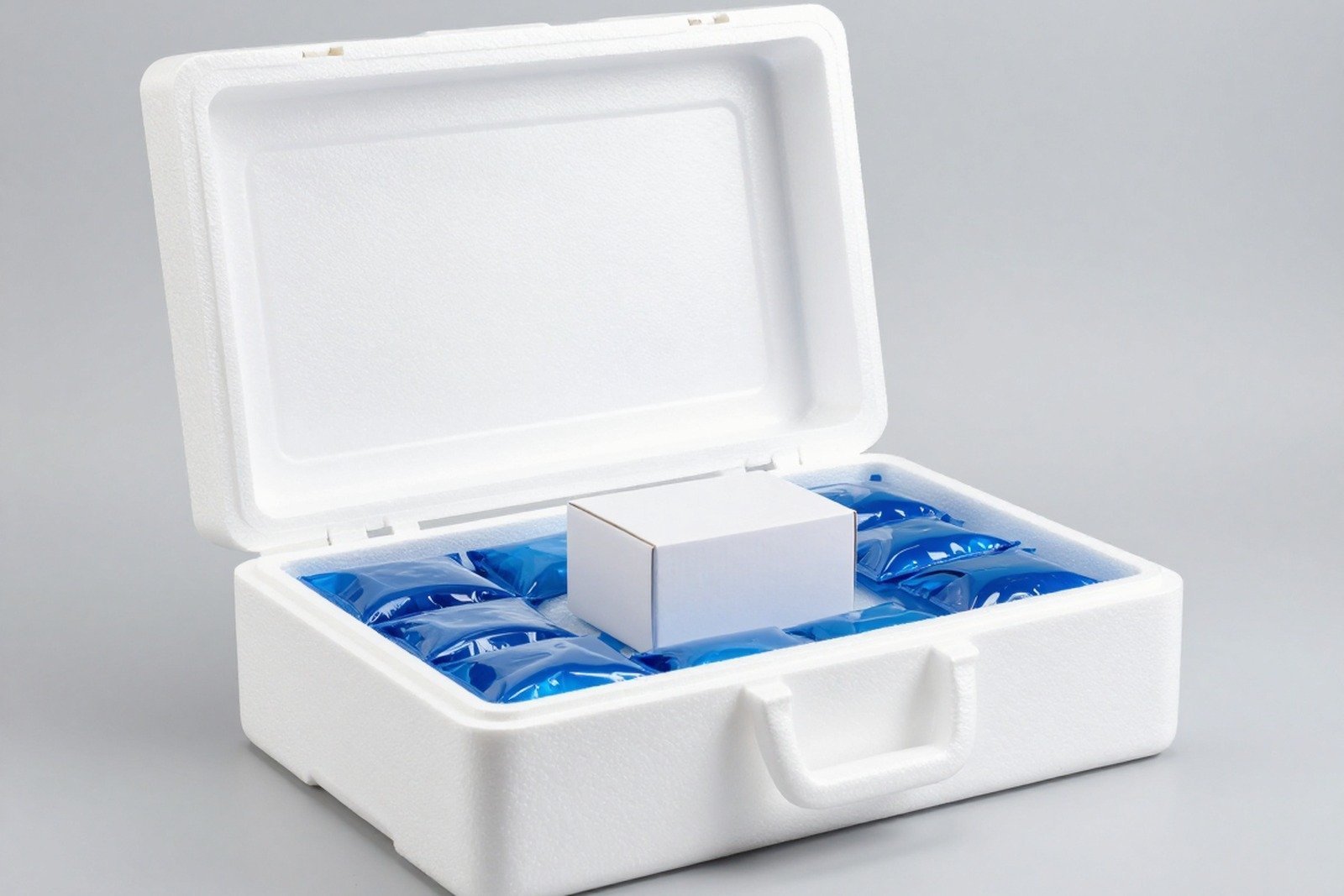
Several bags of blue cold gel and an unlabeled Styrofoam insulated container were displayed on the laboratory table
The refrigerant must be the same as the actual shipper uses, and frozen gel/ice packs may require a thermal stabilization period longer than 24 hours.

7. Identify faces, edges, corners and safety warnings

The document still requires a standard angled face identification procedure (placed according to the intended shipping position; if the position can be changed, placed so that the main shipping label is on the top side; special rules for cartons include manufacturer’s joint — manufacturer joints — and rules for non-6-sided bales). With thermophoresis, this mainly serves to record probe position and results.

But part safe of 7D is the most readable part of the entire document, because it is directly related to life:

  • Solid CO₂ (dry ice) has surface temperature −78 °C (−108 °F); Use dry ice in heat-controlled packaging with extreme caution. Always working at well ventilated area because CO₂ gas is a sublimation product of dry ice; over a long time it push oxygen out of enclosed spaces, maybe cause suffocation to testing staff. Must use Goggles and cold-resistant gloves when holding. Packaging containing dry ice must be designed to The sublimated CO₂ escapes.
  • Liquid nitrogen (for specialized tank systems, e.g. dry nitrogen vapor shippers, liquid nitrogen tanks) are subject to the same warnings: the oxygen-repelling properties of the gas phase and extreme cold temperatures −195 °C (−319 °F).
  • Any frozen refrigerant such as gel pack or foam ice pack Even in sub-freezing temperatures, you must handle it carefully.

8. Equipment required

Category Request Standard
Air conditioning Room or chamber draft-free + control device ASTM D3103 (equipment section)
Temperature indicator Thermocouple probe, temperature recorder, datalogger (optional) ASTM D3103 (equipment section)
Baling platform Pallet or open platform, ensuring clearance ≥ 6 in (150 mm) on all sides —
Small data logger temperature probe with coiled cable next to an unlabeled insulated container on a lab table
The thermocouple probe goes through the tank lid: the wire leading out must not create air leaks, and must start recording immediately at the beginning of the specified recording interval (e.g. 15 or 30 minutes).

The documentation also mentions one thing before starting: Check and confirm calibration of temperature monitoring equipment and environmental chambers. And it is necessary to know in advance the total weight and external dimensions L × W × H of the packaged-product in inches (mm or m).

9. Common mistakes when performing 7D

  1. Consider the 7D a full packaging test. The 7D only measures temperature — not shock, vibration, or compression. It must always be paired with a Series 1/2/3 article.
  2. Thermal limits and excursion duration are not specified in advance. Without these two numbers, it is impossible to conclude pass/fail.
  3. Choose the wrong season or the wrong time period. Winter and summer profiles are different; 24/48/72 hours different; and the off-season send–receive profile is a separate set of five cycles.
  4. Use cycle/soak for small containers or transport in the trunk of a car. In these two situations, it must be used ramp profile (and note ramp uses −20 °C / +45 °C, which is harsher).
  5. 6 in (150 mm) clearance is not guaranteed. If the bale is placed close to the floor, wall or close to another bale, the heat will not circulate and the results will be wrong.
  6. Place the bales in and then wait for the chamber to reach temperature. Must confirm that the chamber is at the correct cycle temperature before place a case.
  7. Use alternative products that are not thermally equivalent. Must be closest in composition, texture, thermal mass, consistency and specific heat capacity; must be packaged in the correct primary packaging of the product.
  8. Use a different refrigerant than what the shipper actually uses. Documents required are of the correct type.
  9. Let the probe wire create an air leak. The thermocouple wire going out must not create gaps/leakage in the cover.
  10. Leave the gel/ice pack for 24 hours and it’s done. Gel packs frozen in shipping containers may be required longer 24 hours thermal stability.
  11. No temperature recording range recorded. Must set a predetermined recording interval (e.g. 15 or 30 minutes) and run recording immediately at the start.
  12. Do not handle dry ice/liquid nitrogen safely. Ventilation areas, goggles, cold-resistant gloves, and packaging must have ventilation for CO₂.
  13. Skip the calibration check. Calibration of the thermal monitor and environmental chamber must be confirmed prior to testing.

10. 7D or 7E — which song to choose?

Situation Suitable article Reason
Insulated shipping box in parcel system ISTA 7E 7E is built from a comprehensive survey of the thermal range in the parcel system; The 7D documentation strongly recommends using 7E
Heat testing according to specialized regulatory requirements (pharmacy, cold chain) According to that industry standard The document clearly states that it is the user’s responsibility to know the supplement/substitution policy
Screen/explore and quickly compare two insulated packaging designs 7D Right for the purpose of “development testing”
Very small barrel, little thermal mass; or transport in the trunk of a car 7D — ramp profile Ramp is more suitable than cycle/soak in these two situations
It is necessary to evaluate the overall packaging (drop, vibration, compression) with heat 7D/7E graft an article Series 1/2/3 7D does not measure shock, vibration, or compression
Small parcels in general Consider 3A Document 7D shows 3A for small parcel systems

11. What does cost and time depend on?

Three main variables: profile selected (24/48/72 hours, and five-cycle profiles when sending–receiving off-season — plus grace period if there is a risk of delay); conditioning time (minimum 24 hours for all materials, may be longer with frozen gel packs); and thermal sample preparation — replacement product with equivalent heat, correct refrigerant, insert probe, ensure no air leaks. Since there is only one sample required (three recommended), sample costs are often much lower than for mechanical lessons — Test chamber time costs is the dominant factor. See more articles What does the cost and time of ISTA packaging testing depend on?

12. Frequently asked questions

Does ISTA 7D test for drops and vibrations?

No. 7D only evaluates the influence of outside temperature. The documentation clearly states it no to evaluate protection against shock, vibration and/or compression. To fully evaluate, you must pair 7D with a Series 1, 2 or 3 lesson.

Why does ISTA recommend using 7E instead of 7D?

Because 7E was developed following a comprehensive survey of temperature ranges in parcel delivery systems (in collaboration with the Pharmaceutical Cold Chain Interest Group) and is considered the best, most up-to-date simulation of thermal environments. The 7D document also clearly states its profiles Not based on current research data and does not represent the worst case.

Which profile should I choose for my product?

Answer three questions: goods go domestic or international; Estimated journey 24, 48 or 72 hours; and whether the sender – receiver conditions are in the same season or not. If the package is very small or transported outside the cargo route (for example, the trunk of a car), use a ramp profile.

How many samples are needed?

A sample is required. ISTA recommends running three or more times with new samples each time to get sufficiently reliable conclusions.

Is 24-hour pre-conditioning required?

According to the document’s Test Sequence table, the preconditioning step is listed as “Optional”; But when done, it needs to be conditioned enough for all materials to reach the required temperature, at least 24 hours – and longer with freezing gel packs. In practice, this is a step that should not be skipped.

Is it allowed to extend the test when the goods are delayed?

Yes. Documents allow extending the total time: 24 hours + 8 hours, 48 ​​hours + 16 hours, 72 hours + 24 hours (added to the last cycle; for the 72-hour send-receive profile in different seasons, add 8 hours to cycle 2 and 16 hours to the last cycle).

13. Conclusion

ISTA 7D is a packaging development test that evaluates the influence of external temperature on packaged-products — for temperature-controlled shipping packaging, insulated packaging, cold chain, and comparative thermal performance analysis. Three things to remember: only measures temperature — does not measure shock, vibration, or compression, so it must always be paired with a Series 1/2/3 test; The 7D profile is a general simulation and ISTA strongly recommends using 7E instead, especially for insulated boxes in parcel systems.; and test series has only 4 steps — minimum 24-hour preconditioning followed by thermal cycles, with strict requirements for heat equivalent sample and 6 in (150 mm) clearance for heat circulation.

Before testing, it is necessary to determine: upper/lower temperature limits of the product; Excursion time allowed; domestic or international travel and 24/48/72 hours; conditions of sender and recipient; and type of refrigerant if any.

Reference standard version: article content is based on ISTA 7D document (2007 version, revised July 2022) — Temperature Test for Transport Packaging. The test levels are a summary for reference; When implementing, the official standard, the current version of ISTA, must be used.


References

  • ISTA 7D, 2007 version (editorial change July 2022) — Temperature Test for Transport Packaging, International Safe Transit Association
  • ISTA 7E — Testing Standard for Thermal Transport Packaging Used in Parcel Delivery System Shipment (recommended post to replace 7D)
  • ISTA — Test Procedures & Projects (current catalog, accessed September 28, 2026)
  • ASTM D3103 — Referenced method for conditioned rooms/chambers and temperature indicators

Related articles


Discuss further


    Disclaimer and acknowledgment of intellectual property rights

    This article is an explanatory content compiled by us for the purpose of introducing and disseminating knowledge. Article is not a translation, copy, abridgement or replacement of the parent standard, and is not evaluated, approved or sponsored by ISTA (International Safe Transit Association)..

    The entire content of ISTA standards is copyrighted by the International Safe Transit Association, Inc. (East Lansing, Michigan, USA) — All rights reserved. ISTA® and the ISTA logo are registered trademarks of the International Safe Transit Association, Inc.; Mentioned in this article are for guidance purposes only and do not imply any affiliation, partnership or sponsorship.

    Article content For reference only; Before applying for any purpose — testing, evaluation, certification or commercial decision-making — the reader should refer directly to the original ISTA document (including ISTA 7E where appropriate), and consult an accredited testing facility when necessary.

    Safety note: the use of dry ice (solid CO₂) and liquid nitrogen in temperature controlled packaging testing poses a risk of asphyxiation and frostbite. All operations must comply with current labor safety regulations and the equipment manufacturer’s instructions.

    When performing testing, it is mandatory to use the official, current version of the standard, obtained directly from ISTA. We do not redistribute ISTA materials in any form. Information in this article may be out of date with the current version of the standard.

    See more: Copyright Policy & Disclaimer by ticforall.com.
    What is ISTA 6-SAMSCLUB? Packaging test procedure for Sam’s Club distribution system

    0
    Cover image of the article «What is ISTA 6-SAMSCLUB? Packaging test procedure for Sam's Club distribution system»

    ISTA® 6-SAMSCLUB is a group test procedure Member Performance — developed by ISTA in collaboration with Sam’s Club, used exclusively for goods sold into Sam’s Club’s distribution system in the United States. The standard version being referenced: Packaged-Products for Sam’s Club® Distribution System Shipment, 6-SAMSCLUB, 2010 edition.

    The special thing about this process compared to all other ISTA exercises is that it divided into four types of packaging (Type A–D) with four completely different test sequences — and this is the first “hurdle”: choosing the wrong Type means the entire test plan, number of samples, and cost are all wrong. The classification is based on two questions: row palletized or floor-loaded, and goods fresh or not.

    This is also the coverage process 12 TEST BLOCKS with rare articles like rotational flat drop, rotational edge drop, clamping simulation, flat push with lifting blade, bridged impact and concentrated edge impact — that is, types of damage that occur in real warehouse infrastructure (forklifts, clamp trucks, unloading pallets, hauling bales) and not just drops and vibrations. The article goes through the definition, classification, four test series, four “specialty” TEST BLOCKs along with equipment table, compression force formula and common errors.

    1. What is ISTA 6-SAMSCLUB?

    Document description: Project 6-SAMSCLUB is an article general simulation for packaged-product sent via Sam’s Club distribution to a destination in the United States. The process is built from a program Large-scale field survey, observation and measurement on the Sam’s Club system itself: visit Distribution Centers (DCs), foreign suppliers, seaports and club stores in the US; attach accelerometers to ocean containers, trucks and forklifts; then convert all that data into lab test levels.

    So this is not a “logical inference” article, but an article derived from real measured data — the reason why the test series here is more detailed and “strange” than the regular 3 Series articles.

    One point to emphasize about infrastructure: in the Sam’s Club system, goods often come from the manufacturer Go through one or more Distribution Centers and then go to the club store. At DC there are many types of handling: manual, forklift, clamp truck (clamp)… and Initial shipment configuration may be changed at DC to suit the needs of the system and the requirements of each club. The final trip to the store is usually on pallets.

    Document notes: users need to know other packaging requirements of the Sam’s Club system — configuration, material, mass and height limitations… This test procedure is only a part of packaging performance and does not replace operational requirements.

    2. Four types of packaging Type A–D — the classification step decides everything

    The document defines four types of packaged-products, based on two axes: original sending method (palletized or floor-loaded) and Are the goods damaged by temperature/humidity? (Perishable or Non-Perishable).

    Definition first

    • Perishable — food, drinks, fresh flowers… can be spoiled if not kept at the correct temperature and humidity.
    • Non-Perishable — aviation is affected by extreme heat/humidity.
    • Floor-Loaded — original item sent No palletization, no unitization, loaded directly into a truck or container, and “club quantity” is a case/unit.
    • Club (Store) Quantity — packaged-product numbers are usually sent in one go to replenish a club/store. A group of goods may leave the factory as a unitized load, but then be damaged remove into small groups or individual products to send to clubs according to additional needs.
    • Unitized Load — many bales are tied together with straps, shrink/stretch films… to be loaded, unloaded and transported as one block.
    • Slip Sheet — flat plate with edges on one or more edges, used as a base to collect/hold/unload goods into a unit load (replace pallet).
    • Standard vs Custom Pallets — standard pallets are popular designs, with published parameters; Custom pallet designed for a narrow product, performance specifications are not common/published.
    • Elongated (long bale) — longest side ≥ 36 in (910 mm) and The remaining two edges are each ≤ 20% of the longest edge.
    • Flat (flat bale) — shortest side ≤ 8 in (200 mm) and The next side is 4 times or more longer than the shortest side and volume ≥ 800 in³ (13,000 cm³).

    The document emphasizes: if a bale fits Elongated medium Flat then must try like Elongated lawsuit.

    Large or Small? (only applies to floor-loaded goods)

    A floor-loaded event is considered Large if satisfied at least one under three conditions:

    • Volume ≥ 50 lb (23 kg); or
    • Longest side ≥ 24 in (610 mm) and second longest side ≥ 20 in (510 mm) and shortest side ≥ 20 in (510 mm); or
    • Any any length/width/height ≥ 30 in (760 mm).

    If the above conditions are not met, then Small. This is the criterion that distinguishes Type B (Large) and Type C (Small).

    Table of four types

    Type Nature How to send initially Notes
    A Non-Perishable (dry goods) Palletize on standard or custom pallets Two sub-branches: club quantity it is batch of intact pallets, or no (including long and flat bales)
    B Non-Perishable Floor-loaded, sued Large Including long and flat bales
    C Non-Perishable Floor-loaded, sued Small Club quantity is case or unit
    D Perishable (fresh goods) Palletization Shortened test string — no vibration

    Two “Type conversion exceptions” are important to remember, because they decide which posts to run:

    1. Floor-loaded goods unitized on slip sheet but in the end placed on pallets To send in bulk to the club → must be placed on a standard pallet before trying and considered Type A.
    2. Floor-loaded goods unitized but without slip sheet, finally placed on the pallet → run part of the private chain and then switch to Type A. Specifically: Type B runs Sequence 1, 2 and 7; Type C runs Sequence 1, 2 and 6; then fasten it onto a standard pallet and run Sequence 3–7 of Type A.
    Shipments on wooden pallets with unlabeled brown cartons were tilted onto the concrete floor of the testing room for a rotational drop test
    Type A: the entire batch of pallets is tested as a unit — including horizontal impacts, face/side drops, compression, vibration, and lifting blades if using custom pallets.

    3. Four test series Type A–D

    Type A — Non-Perishable, sent initially on pallet (most complete post)

    # Category Test Test level (US / international) Request
    1 Climate Pre-conditioning Ambient lab room, 12 o’clock Required
    2 Climate Controlled air conditioning Select by chart Options
    3 Impact Inclined or Horizontal Impact Impact velocity 42 in/s (3.5 ft/s) (1.1 m/s) All 4 vertical sides of the pallet lot
    4 Shock Rotational FLAT Drop 6 in (150 mm) / 8 in (200 mm) Whole lot of pallets
    5 Vertical compression Top-to-Bottom According to the formula, keep the force 1 hour Whole lot of pallets
    6 Vertical vibration Random Grms total 0.46, 3 hours Whole lot of pallets
    7 Shock Rotational EDGE Drop 4 in (100 mm) / 6 in (150 mm) Whole lot of pallets
    8 Push horizontally Flat Push with lifting blade Push 40 in (1 m) for 2–3 seconds Only with custom pallets

    Read the transition step carefully: if club quantity is the whole batch of pallets, then stop here. If club quantity no Whole lot, choose three samples from the batch (ideally one in the upper layer, one middle, one lower layer) and run three steps 9–13:

    • 9. Clamping Simulation (horizontal compression) — calculated according to the formula, clamped in many positions; only required in certain distribution situations.
    • 10. Free-Fall Drop — Bottom Orientations: 15 in (380 mm) (domestic) / 18 in (460 mm) (international), 3 drops per sample.
    • 11. Vertical vibration, stacking — all three models stack on top of each other: Grms total 0.55, 1 hour.
    • 12. Concentrated Edge Impact — with bales only flat: hazard box falls 12 in (300 mm) / 15 in (380 mm).
    • 13. Bridged Impact — with bales only long: hazard box falls at the same level as above.

    Type B — Non-Perishable, floor-loaded, Large case

    # Category Test Test level (US / international)
    1–2 Climate Preconditioning 12 hours / controlled (optional) —
    3 Impact Inclined/Horizontal Impact 42 in/s, 4 or 6 sides according to instructions
    4 Shock Rotational FLAT Drop 7 in (180 mm) / 9 in (230 mm)
    5 Vertical compression According to the recipe, keep 1 hour Top pallet if top ≥ 45 × 37 in
    6 Vertical vibration Random has top load 0.0035 lb/in³ (96 kg/m³) Grms 0.46, 3 hours
    7 Horizontal compression Clamping Simulation Just some situations
    8 Shock Rotational EDGE Drop 5 in (130 mm) / 7 in (180 mm)
    9 Shock Concentrated Edge Impact Flat bale thread — 12 in / 15 in
    10 Shock Bridged Impact Long bales only — 12 in / 15 in

    Type C — Non-Perishable, floor-loaded, Small case

    # Category Test Test level (US / international)
    1–2 Climate Preconditioning 12 hours / controlled (optional) —
    3 Shock Free-Fall Drop, chain 1 — 6 falls Max 14 in (360 mm) / 18 in (460 mm)
    4 Vertical compression According to the recipe, keep 1 hour —
    5 Vertical vibration Incidentally, there is a top load of 0.0035 lb/in³ Grms 0.46, 3 hours
    6 Horizontal compression Clamping Simulation Just some situations
    7 Shock Free-Fall Drop, chain 2 — 6 falls Max 26 in (660 mm) / 32 in (810 mm)
    8–9 Shock Edge Impact / Bridged Impact Flat bale / long bale only — 12 in / 15 in

    Details of Type C’s two falling chains (this is the only free-fall card with two chains in 6-SAMSCLUB):

    Times Sequence 1 — posture Sequence 2 — pose
    1 Face 1 Edge 2-3
    2 Face 2 Corner 3-4-6
    3 Face 6 Edge 4-5
    4 Corner 2-3-5 Corner 1-4-6
    5 Edge 3-4 Edge 1-6
    6 Face 3 (highest level) Face 3 (highest level)

    Chain 1: 10 in (250 mm) for the first 5 times and 14 in (360 mm) for the 6th time (domestic); 12 in/18 in for international. Chain 2: 14 in for the first 5 times and 26 in (660 mm) for the 6th time (domestic); 18 in/32 in for international.

    Type D — Perishable, sent on pallet (short chain)

    # Category Test Test level
    1 Climate Controlled air conditioning — required: Cool, Cold or Frozen Choose according to distribution conditions
    2 Shock Rotational EDGE Drop 4 in (100 mm) / 6 in (150 mm) — a whole lot of pallets
    3 Vertical compression Top-to-Bottom Hold force 30 seconds then release (other than Type A: 1 hour)
    4 Shock Free-Fall Drop — Bottom Orientations 15 in (380 mm) / 18 in (460 mm), 3 drops per sample

    Two important notes about Type D: (1) strings are intentionally shortened to complete in the shortest possible time, to ensure that the properties of cool/cold/frozen samples do not change significantly throughout the series if testing cannot be done immediately in a conditioned environment; (2) Type D does not require vibration testing. With Type D, three models are selected from inside batches (if possible), one in the upper layer, one in the middle, one in the lower layer.

    4. Four “specialty” TEST BLOCKs need to be understood properly

    Rotational FLAT Drop

    This article imitates the situation The entire shipment tilted and fell with a thud: place the bale on a hard surface (steel or concrete), Raise one edge to the correct height and let it fall freely. Test level: Type A is 6 in/8 in, Type B is 7 in/9 in. With packages that allow multiple sending positions, the document has ramifications: if can lift edge up to the correct height without the bale overturning then proceed, otherwise skip that position – this detail must be read carefully in TEST BLOCK 3.

    Rotational EDGE Drop

    Different from flat drop: One edge is placed on a support pillow 3.5–4.0 in (90–100 mm) high of wood or equivalent, the opposite edge lifted and then dropped freely against the floor. For example with Type A: place side 3 down, place sides 3-5 on the pillow, lift and release sides 3-6; Then remove the pillow, place edges 3-4, lift and release edges 2-3. Level: 4 in/6 in with Type A and Type D; 5 in/7 in with Type B.

    Clamping Simulation (horizontal compression — clamping vehicle simulation)

    A laboratory horizontal clamping machine with two large clamps is pressing the two sides of an unlabeled brown carton
    Clamping Simulation simulates the clamping force of a clamp truck — this is a typical type of damage to warehouse infrastructure, not to transportation lines.

    This article simulates clamp truck at DC. Operating rules:

    • The vise is placed 3 in (76 mm) each way from bale corners (3 in. back and 3 in. deep), pressing against two opposite sides (e.g., sides 2 and 4).
    • Pressing speed: 0.02–0.1 in/s (0.5–2.5 mm/s).
    • Hold force 30 seconds then release; Repeat for a total of 5 compressions up with a pair of faces.
    • The clamping force is calculated according to the formula and then clamped for approx 400 lbf (1800 N) to 2000 lbf (8900 N) (If calculating below 400, use 400; above 2000, use 2000).
    • No perform clamping with Pails/Cylinders (drum/pillar).

    Flat Push with lifting tongue (custom pallets only)

    With the above shipment Custom pallets, add push post: use forklift blade to push the shipment 40 in (1 m) in 2–3 seconds. This is a “slide push” test on the floor — simulating pushing a pallet with the lifting blade without engaging the pallet. Note: if club quantity it is If the batch is intact, this step is required in the Type A chain.

    5. When to use Type B or Type C?

    A large laboratory compressor with two steel tables presses down a shipment on a pallet of unlabeled brown cartons
    Top-to-Bottom vertical compression: force is calculated according to the formula (depending on height, lot mass and compensation factor) and then held for 1 hour — Type D only holds for 30 seconds.

    Type B and Type C are different just in size/mass (Large or Small), but the test sequence is different in nature: Type B tries equal horizontal impact + rotational fall (because large packages can no longer be picked up by hand), but Type C is equal two chains fall freely (because small bales are still hand-picked and dropped from many different heights). This is the easiest point to make mistakes when planning.

    With Type B, a detail about vertical compression: if the top of the bale is in the test position ≥ 45 × 37 in (1140 × 940 mm) then the pallet must be placed on top; If smaller then No need for upper pallets.

    6. Vertical compression force formula (easiest to make mistakes when making records)

    Documentation for two groups of formulas. With Type B and Type C (floor-loaded):

    Compression force (lbf) = [(108 − V) / V] × WG ×M
    In which: V = height of package according to actual shipping position (in); WG = mass of entire unitized batch (lb); M = compensation factor — 2.5 for domestic, 3.0 for international. If the result is > 7500 lbf, use it 7500 lbf.

    With Type A and Type D (palletized): must run trial calculation before:

    Trial (lbf) = {[(108 − H) / H] × WG × M} + {(L − 1) × WC ×NL}
    In which: H = height of entire pallet batch; L = number of layers in batch; WC = volume of one case/unit; NL = number of cases/units per class. If pallet batch no have individual cases/units in regular layers (e.g. a large product on a custom pallet), use L = 1, WC =WG, NL = 1.

    Then, depending on the trial results and batch weight, choose one of the formulas 4a–4f: for example, Type A ≤ 750 lb (340 kg) but trial ≥ 1500 lbf, use the formula [(108−H)/H]×WG×M; If trial < 1500 lbf, use 1500 − [(L−1)×WC×NL]; and the threshold is similar to the 2500 lbf mark for lots > 750 lb. The result is always blocked on at 7500 lbf (33,400 N). This is the part that needs to be calculated carefully using a spreadsheet because a wrong threshold will result in a completely different compression force.

    7. Random vibration spectrum — two PSD panels

    6-SAMSCLUB used two different vibration spectrum; Here are the most important technical details when setting up a vibrating table:

    Spectrum 1 — for pallet lots (Type A) and odd floor-loaded cases (Type B, C). Gross grms 0.464, duration 3 hours, theoretical peak-to-peak stroke 1.556 in (39.5 mm):

    Frequency (Hz) PSD (G²/Hz) Frequency (Hz) PSD (G²/Hz)
    1.6 0.00090 15 0.00450
    3,4 0.04750 20 0.00450
    4,3 0.04750 30 0.00063
    7 0.00175 80 0.00063
    13 0.00175 200 0.00006

    Spectrum 2 — for three stacked bales (TEST BLOCK 12 of Type A). Gross grms 0.552, duration 1 hour, stroke 1.649 in (41.9 mm):

    Frequency (Hz) PSD (G²/Hz) Frequency (Hz) PSD (G²/Hz)
    1.6 0.00050 13 0.00405
    3,4 0.06500 20 0.00405
    4,3 0.06500 30 0.00115
    6 0.00260 68 0.00115
    11 0.00260 80 0.00090
    200 0.00030

    Return top load for vibration: if the total theoretical load of one shaft < 25 lb (11 kg) then do not use load on that axis; If ≥ 25 lb, round up to a multiple of 5 lb (2 kg). The document divides the load into one, two or four parts depending on the size of the top (18 in). For small and light cargo, the theoretical load is reduced, and for packages ≤ 30 lb (14 kg) or ≤ 2 ft³ then split in half formula results.

    8. Equipment and supplies

    Category Request Standard
    Climate conditioning Record temperature and humidity; controlled air conditioning chamber ISO 2233 or ASTM D4332
    Free fall The machine falls freely ISO 2248 or ASTM D5276
    Rotational drop (face) Hard surface — steel or concrete ISO 2876 or ASTM D6179
    Rotational drop (edge) Hard surface + support pillow 3.5–4.0 in (90–100 mm) high and correspondingly wide, at least 8 in (200 mm) longer than the longest side of the bale ISO 2876 or ASTM D6179
    Horizontal impact Machine inclined or horizontal impact ASTM D880 / D4003 / ISO 2244
    Hazard box — Concentrated Edge Wooden box 12 × 12 × 12 in (305 mm), total volume 9 lb (4.1 kg); The impact edge is covered with corner steel (angle iron) ASTM D5276 / ISO 2248 (machine)
    Bridged Impact Machine falls + hazard box on + two support pillows Place the two ends of the longest side parallel to each other and the shortest side parallel ASTM D5265 (except impactor)
    Vertical compression Fixed table compressor, or load + load spreader ASTM D642
    Top pallet Standard block pallets 48 × 40 in (1200 × 1000 mm), “picture-frame” style, base wraps around entire perimeter; If the goods go on a custom pallet, use the same custom pallet —
    Clamping Clamping machine; The vise is larger than the sides of the bale —
    Vibrate randomly Vertical vibration system + holding device (no vertical movement restriction) ISO 13355 or ASTM D4728

    Three material details that are easy to get wrong:

    1. The concentrated edge hazard box must include Corner armored edges, 9 lb (4.1 kg) total and 12 in. each way. Ballast mass (if required) must be Concentrated loose material in bags, held in place by void fill — not rock or solid block.
    2. Right support block ≥ 8 in (200 mm) longer than the longest side of the bale and 3.5–4.0 in (90–100 mm) high/wide.
    3. The top pallet of the compression post must be the pallet full-perimeter-base picture-frame — because this type of base distributes compression force along the circumference, unlike regular pallets.

    9. Number of samples and sample selection method

    Documentation: a sample is a requirement for this procedure; If the sample is a pallet/unitized then it may be necessary withdraw individual cases/units from that lot for the next tests. When many identical samples are tested, All samples must pass all tests. ISTA requires running the procedure once with a specified number of samples, but recommended run the entire process five times or more with new samples each time.

    How to get Type dependent sampling:

    Case Number of samples for the next articles How to choose
    Type A, club quantity no intact batch 3 One in the upper layer, one in the middle, one in the lower layer (if possible); reuse for Test Block 10 (clamping)
    Type B or Type C (clamping) 1 —
    Type D 3 Choose from inside lot (if possible), one top, one middle, one bottom

    Two practical notes: (1) if the sample is sent to an ISTA Certified lab for testing, yes full over-package or Repackage with new packaging at the lab to ensure samples are in perfect condition; (2) pallet/skid used in the test must be of type and status typical of field reality.

    10. Pass/fail criteria and documentation

    Like all ISTA processes, 6-SAMSCLUB does not set itself “pass” criteria: Shipper, manufacturer, Sam’s Club buyer and/or related parties must confirm before testing four things:

    1. What is product damage?
    2. Allowable damage tolerance level (if any).
    3. Correct method to determine product condition at the end of the test.
    4. Acceptable packaging condition at the end of the test.

    The parties must also provide information Input to determine the correct test parameter: club (store) quantity, pallet type, initial shipment configuration, approved container loading diagram, shipment details and distribution system configurations, typical climatic conditions… The documentation clearly states: many TEST BLOCKS need this information to perform properly — examples if available approved container loading diagram then only try the positions in the chart; If not, you must try all three positions.

    Regarding documentation: documents require description configuration, materials and structure of the product and test packaging (seemingly small differences can cause large performance differences) and Imaging is strongly recommended with detailed description. With corrugated cartons, documentation recommends identifying and recording basisweight of paper/board — because quantification is a better indicator of texture and barrel equivalence than the ECT/Burst index (see also article Four pass/fail criteria when testing packaging).

    11. Common errors when implementing 6-SAMSCLUB

    1. Misclassification Type. This is the most expensive error: Type A/B/C/D have completely different test sequences, model numbers and devices. Need to determine correctly original sending method and club quantity is an intact batch of pallets or not.
    2. Missed the “continued run” part of Type A. If the club quantity is not an intact lot, you must select 3 samples and continue testing Block 10, 5, 12 (and 13/14 if flat/long) — do not stop at step 8.
    3. Do not use the top pallet for compaction. Must be a full-perimeter-base picture-frame 48 × 40 in block pallet; For Large top cases < 45 × 37 in, the top pallet is not required.
    4. Wrong calculation of compression force. Wrong compensation factor M (2.5 domestic vs 3.0 international), wrong V/H height, or wrong trial calculation branch all lead to wrong compression force — need to make a calculation and check again.
    5. Confusion of two vibration spectra. The pallet/floor-loaded spectrum is Grms 0.464 for 3 hours; three-bale stacking spectrum is Grms 0.552 in 1 hour. Using the wrong PSD table means trying another lesson.
    6. Forget top load when vibrating Types B, C. Top load 0.0035 lb/in³ (96 kg/m³), divided into 1/2/4 parts according to top size (18 in mark), and omitted if total theoretical load < 25 lb (11 kg).
    7. The support pillow is too short or the height is wrong. Pillows should be 3.5–4.0 in (90–100 mm) high/wide and ≥ 8 in (200 mm) longer than the longest side of the bale.
    8. Hazard box “fabricated” incorrectly. Concentrated Edge Hazard Box must be 12 × 12 × 12 in, total 9 lb (4.1 kg) and has angled steel-coated edges; Ballast must be loose material in a bag, held by void fill.
    9. Placing the clamp in the wrong position. The vise must be retracted 3 in. (76 mm) both horizontally and in depth from the corner of the bale, and must be pressed 5 times × 30 seconds.
    10. Try Type D vibration. Type D no Vibration test request; instead the air conditioner is cold required and the string is intentionally shortened for quick testing.
    11. Forget Slipsheets. Floor-loaded goods unitized on slipsheet but sent as a whole to the club must be placed on a standard pallet and tested as Type A.
    12. Do not try all three positions without a loading diagram. If there is no approved container loading diagram, Type B/C must try all three compression and vibration positions; Only diagrams can narrow the pose.

    12. What does cost and time depend on?

    Four governing variables: Type (Full Type A is the longest sequence — 13 steps, including tongue lift; Type D is the shortest sequence); model number (3 samples for Type A when the club quantity is not a whole lot, and all 3 samples must pass); time chain — 12 hours of pre-conditioning plus controlled conditioning, drop/impact exercises, Keep compress for 1 hour, vibrate 3 hours (Type A/B/C), and Type A additionally vibration stacking 1 hour; and manufacturing supplies — picture-frame top pallet, bearings, corner armored hazard box, top load for vibration, holding device. Article What does the cost and time of ISTA packaging testing depend on? Analyze further how to compare quotes between processes.

    13. Frequently asked questions

    How are 6-SAMSCLUB and 6-AMAZON.COM different?

    Both are Member Performance — built by an ISTA member for its own infrastructure. 6-SAMSCLUB serves the Sam’s Club system (mainly pallet/floor-loaded to club stores), while 6-AMAZON.COM serves parcel goods to Amazon customers (SIOC and Over Boxing). Articles in the 6 Series are not interchangeable.

    How do I know if my goods are Type A, B, C or D?

    Answer two questions: are goods goods? fresh (Perishable) no → if yes, Type D. If no: original sent goods on pallets (whether standard or customized, including the case of unitizing on a slipsheet and then placing it on a pallet) is Type A; send floor-loaded then rely on Large/Small to separate B and C.

    How is Type D different from the other Types?

    Three points: air conditioning is cold required (not optional), Don’t try vibrating, and vertical compression just holds 30 seconds instead of 1 hour. The series was shortened to limit changes in frozen/cold sample characteristics.

    Why does 6-SAMSCLUB have “push with lifting tongue” and “horizontal clamp” exercises?

    Because Sam’s Club infrastructure uses many forklifts and clamp truck at the Distribution Center, and the shipment configuration may be changed at the DC. These two exercises simulate exactly those effects — no drops or vibrations on the road.

    How to test if the bale is both flat and long?

    Must try like Elongated — which means running Bridged Impact, not Concentrated Edge Impact. The document clearly states this priority rule.

    Is it mandatory to run 5 times?

    Not required: ISTA requires the procedure to run once with the specified number of samples, but recommended Run the entire procedure five or more times using the new sample to get a sufficiently confident conclusion about representative performance.

    What is club quantity and why is it important?

    It is a packaged-product number that is usually sent in one go to replenish a club/store. It’s important because in the Type A string: if club quantity it is If the batch of pallets is intact, stop after step 8 (no need for further testing); if no Then you have to choose 3 samples and continue running the horizontal compression, falling, and stacked vibration exercises.

    14. Conclusion

    ISTA 6-SAMSCLUB is a Member Performance process for goods entering the Sam’s Club system in the United States, built from a large-scale field measurement program. Three things to remember: The Type A/B/C/D classification step determines the entire test plan; Test series covers typical warehouse injuries — horizontal impact, face/side drop, 1 hour vertical compression, 3 hours vibration, horizontal clamping simulating a clamp truck and pushing with lifting blades; and Vertical compression must be calculated according to the formula with compensation factor 2.5 (domestic) / 3.0 (international), while vibration uses two separate PSD spectra (Grms 0.464 for pallet/floor-loaded, 0.552 for three stacked packages).

    Before placing a trial order, businesses need to prepare: initial shipping method (pallet or floor-loaded) and type of pallet; club quantity is the whole lot; Three-dimensional size and volume to classify Large/Small; whether the product is fresh or not; origin point in or outside the United States (to choose domestic or international level); and approved container loading diagram if available.

    Reference standard version: article content is based on document ISTA 6-SAMSCLUB (2010 version) — Packaged-Products for Sam’s Club® Distribution System Shipment. The test levels are a summary for reference; When doing so, you must use the official standard, the current version of ISTA and comply with the current requirements of Sam’s Club.


    References

    • ISTA 6-SAMSCLUB, 2010 version — Packaged-Products for Sam’s Club® Distribution System Shipment, International Safe Transit Association
    • ISTA — Test Procedures & Projects (current catalog, accessed September 28, 2026)
    • ISO — ISO 2233, ISO 2248, ISO 2876, ISO 2244, ISO 13355 (referenced methods)
    • ASTM — D4332, D5276, D6179, D880, D4003, D642, D5265, D4728 (equivalent methods cited)

    Related articles


    Discuss further


      Disclaimer and acknowledgment of intellectual property rights

      This article is an explanatory content compiled by us for the purpose of introducing and disseminating knowledge. Article is not a translation, copy, abridgement or replacement of the parent standard, and is not evaluated, approved or sponsored by ISTA (International Safe Transit Association)..

      The entire content of ISTA standards is copyrighted by the International Safe Transit Association, Inc. (East Lansing, Michigan, USA) — All rights reserved. ISTA® and the ISTA logo are registered trademarks of the International Safe Transit Association, Inc.; Mentioned in this article are for guidance purposes only and do not imply any affiliation, partnership or sponsorship.

      Sam’s Club® are trademarks of their respective owners; are mentioned to indicate technical standards and do not imply affiliation or sponsorship.

      Article content For reference only; Before applying for any purpose — testing, evaluation, certification or commercial decision-making — the reader should consult the original ISTA document and applicable Sam’s Club requirements directly, and consult an accredited testing facility as needed.

      When performing testing, it is mandatory to use the official, current version of the standard, obtained directly from ISTA. We do not redistribute ISTA materials in any form. Information in this article may be out of date with the current version of the standard.

      See more: Copyright Policy & Disclaimer by ticforall.com.
      What is ISTA 6-AMAZON.COM Over Boxing? Procedure for testing outer box packaging for goods sent to Amazon

      0
      Cover image of the article «What is ISTA 6-AMAZON.COM Over Boxing? Procedure for testing outer box packaging for goods sent to Amazon»

      ISTA® 6-AMAZON.COM – Over Boxing is a group test procedure Member Performance — built by Amazon.com with ISTA and only used for goods sold into the Amazon system. Full name: e-Commerce Fulfillment for Parcel Delivery Shipment — 6-AMAZON.COM Over Boxing, 2018 edition.

      The bottom line: this process applies when the product cannot be shipped in its own retail box, which must be placed into one over box accompanied by inserting material (dunnage — air pillow or Kraft paper), then sent to consumers via delivery system. This is the “other side” of the 6-AMAZON.COM process pair: if the goods can be sent using the product box, use SIOC; If you have to box outside, use Over Boxing.

      This is also the same process Pass/fail criteria are predetermined by Amazon rather than leaving it up to the manufacturer to define — an important difference from conventional ISTA processes. The article goes over: definition, 32 kg range, proper packaging (including a set of “hazard products” that simulate other products in a multi-item order), a 6-stage sequence with 17 drops and 2 hours of vibration, passing criteria, model number, equipment and common errors.

      1. ISTA 6-AMAZON.COM – What is Over Boxing?

      According to the original document, Project 6-Amazon.com-Over Boxing is the article General simulation for e-commerce order fulfillment. Goods are placed Over Box — can be a single product with dunnage, or multiple retail products with dunnage — to send from Amazon.com to the consumer via parcel system (which can include air, rail, or ground).

      The document defines very specifically the terms that packaging workers need to understand:

      • Dunnage — loose material used to support and protect the product in the box, for example air pillow or Kraft paper.
      • Air pillow — airbag inserts, usually made from LDPE #4 or HDPE #2 plastic; Document specifying dimensions 8 × 4 in (203 × 102 mm) and maximum thickness 1.0 mil.
      • Fragile products — Fragile goods when dropped without protective packaging: glass, ceramic, porcelain, terracotta, electronics…
      • Hazard products — reusable “mimics” that act as other products in a multi-item order.
      • Liquids — liquids, semi-liquids or solids that can liquefy at temperatures above 70 °F, may leak from the primary packaging.
      • Tertiary carton — shipping box made from corrugated cardboard (Over Box).

      The General Considerations section of the document has four caveats to tell customers: test levels are based on general data and may not be representative of a particular distribution system; Product and packaging are considered together; certain conditions such as humidity, pressure or unusual handling may not be covered; and for dangerous goods, pass this test no This means it meets international/national dangerous goods requirements — it does not replace UN standards, it can only be used in conjunction with them.

      2. Range: up to 70 lb (32 kg)

      Document 3 states: Over Boxing covers testing of individual packaged-products weigh 70 lb (32 kg) or less, is prepared for completing e-commerce orders by over-boxing and sending via parcel delivery company. Goods weighing more than 32 kg are outside the scope of Over Boxing — this is the first threshold to check when considering whether this process can be used.

      Regarding the conditions for using Over Boxing, definition document e-Commerce Fulfillment shipments is any configuration that:

      • Individual retail products no designed to be sent in its own box; and
      • One or more retail products are placed in a shipping carton (“over-box”) with dunnage to be sent to the end customer from an online retailer or distribution center.

      Applies to both Single Item Shipment (Single Item Shipment) and Multi-item orders (Multiple Product Shipment — multiple products ordered online are combined into one shipping box). These two configurations are available Packaging process and model number vary, and this is the easiest point to make mistakes when quoting prices.

      The unlabeled brown carton was slightly open, with a plastic air bag inside cushioning a small unlabeled retail box
      Over Boxing: products that cannot be sent in the original box will be placed in an outer box with dunnage — air pillow or Kraft paper.

      3. Pack before testing: Over Box, dunnage and hazard products

      Unlike many procedures that only describe the test, Over Boxing describes it standard “pack out” way — because in the Amazon channel, the outer packaging is created by the seller/Amazon, not the product, so it must be standardized for the test results to be meaningful.

      Over Box

      • Over Box is made from corrugated cardboard C-Flute, sealed with wide poly tape 2 in (50.8 mm) — one strip on the top and one on the bottom.
      • With heavy bale ≥ 15.0 lb (6.80 kg): Over Box must have all three sizes 2.0 in (50.8 mm) larger than Test Specimen’s largest dimension. For example in the document: if the product is 30.0 × 22.0 × 12.0 in, the Over Box is 32.0 × 24.0 × 14.0 in.
      • For lighter packages, Over Box is selected according to the available table (starting with the smallest box, increasing to the next size until it fits).
      • Documents note: Avoid over stuffing — the box must be able to be closed without having to press hard to hold the lid down when gluing.

      Dunnage

      Air pillow is Only insertion method allowed in Over Box according to the documentation; 8 × 4 in (203 × 102 mm), 1.0 mil maximum thickness. Dunnage is filled with space so that Test Specimen is possible blocked and braced (block and hold) properly.

      Hazard products (multi-item orders only)

      For multi-item orders, documents require creation hazard product acting as other bales in the box:

      • Crafting by giving steel shot, sand or dense loose flow material into a plastic bag to the desired volume, seal the bag, place in the RSC/RET bin, and Insert paper so the heavy block doesn’t slide and does not create concentrated loads.
      • Minimum board: 32 ECT C-Flute.
      • If reusing hazard product, make sure the box is not severely worn (rounded edges, tired cardboard) — it should be replaced periodically for consistent results.
      • Documents not allowed Replace hazard product by adding more Test Specimen.

      The document has a standard table of 10 hazard products (A–J) with nominal dimensions and weight, tolerance ±3%:

      Name Dimensions L×W×H (mm) Dimensions (in) Mass (kg) Mass (lb)
      A 102×102×25 4.0 × 4.0 × 1.0 0.23 0.5
      B 76×76×76 3.0 × 3.0 × 3.0 0.45 1.0
      C 76×76×76 3.0 × 3.0 × 3.0 0.68 1.5
      D 102×76×76 4.0 × 3.0 × 3.0 1.0 2.0
      E 152×102×102 6.0 × 4.0 × 4.0 1.13 2.5
      F 102×102×102 4.0 × 4.0 × 4.0 1.36 3.0
      G 102×76×51 4.0 × 3.0 × 2.0 1.59 3.5
      H 152×152×21 6.0 × 6.0 × 2.0 1.81 4.0
      I Custom Custom 2.04 4.5
      J Custom Custom 2.49 5.5

      The document also includes a composite table Test Specimen volume → hazard product → Over Box (inner size, style and ECT). Example: Test Specimen 0–0.5 lb using hazard A, B, D with Over Box RSC/29 size 10.0 × 7.0 × 3.0 in; Specimens 15.0–70 lb do not use hazard (single item) and Over Box = product size + 2.0 in each dimension, RSC/32. This table needs to be looked up directly in the standard version when making a pack out application.

      Place Test Specimen in the bin

      • Mark the sides/edges/corners of the Over Box according to the procedure rules, determining the product orientation according to the way it lies on the vibrating table.
      • Put Test Specimen in, accumulate corner 3-4-6, and oriented so that The most vulnerable area is towards the 3-4-6 corner.
      • An important example that the document gives: with liquid products, the most vulnerable area is cap/spray valve/pump — the lid must be placed so that contact Face 4 and Face 6.
      • Do not reuse Test Specimen of a single-item order sequence for a multi-item order sequence.

      4. Over Boxing’s 6-stage series

      # Group Test type Test level Request
      1 Climate Pre-conditioning Ambient Required
      2 Climate Controlled air conditioning Temperature/humidity select according to the chart Options
      3 Shock Falling (string 1) 9 falls Required
      4 Vibration Random vibration — spectrum Over-the-Road Grms total 0.53 Required
      5 Shock Falling (sequence 2) 8 drops Required
      6 Integrity Leak Test 8 o’clock Only with liquid goods

      The sequence has an important practical detail: after finishing conditioning, the ambient temperature and humidity must be recorded. as soon as I started testing, and run the remaining string as quickly as possible — because the purpose is to evaluate the packaging in its newly released state.

      5. Details of test stages

      1st falling chain — 9 times (standard for bales < 32 kg)

      Times Altitude Posture
      1 460 mm (18 in) Edge 3-4
      2 460 mm (18 in) Edge 3-6
      3 460 mm (18 in) Edge 4-6
      4 460 mm (18 in) Corner 3-4-6
      5 460 mm (18 in) Corner 2-3-5
      6 460 mm (18 in) Edge 2-3
      7 460 mm (18 in) Edge 1-2
      8 910 mm (36 in) Face 3
      9 460 mm (18 in) Face 3

      Point of interest: the edge/corner drops are all 18 in., but the drop plane number 8 is 36 in (910 mm) — double. This is the “heaviest” drop of the chain and is often the decisive one for canned goods with empty spaces inside.

      Free fall tester in the lab with an unlabeled brown carton in a position ready to fall onto a small wooden bar
      Over Boxing’s fall sequence includes 9 falls (including one 36 in) and then 8 falls after shaking, of which the last fall hits a hazard block.

      Random vibration — Over-The-Road spectrum, three positions

      The vibrating table runs according to a random vibration spectrum Over-the-Road (Grms total 0.53) with three positions and three time periods:

      • Face 3 on the vibrating table — 60 minutes.
      • Face 4 on the vibrating table — 30 minutes.
      • Face 6 on the vibrating table — 30 minutes.

      A total of 2 hours of vibration, and the packaging must hold its position No restrictions on vertical movement — meaning you can hold the bale horizontally but do not pin it down on the table.

      Random vibration table in the lab with an unlabeled brown carton placed in the middle of the table
      Vibration of Over Boxing: Over-the-Road Grms spectrum 0.53, running in three positions for 60 – 30 – 30 minutes respectively.

      Second chain of drops — 8 times, including drops on hazard blocks

      Times Altitude Posture
      10 460 mm (18 in) Edge 3-4
      11 460 mm (18 in) Edge 3-6
      12 460 mm (18 in) Edge 1-5
      13 460 mm (18 in) Corner 3-4-6
      14 460 mm (18 in) Corner 1-2-6
      15 460 mm (18 in) Corner 1-4-5
      16 910 mm (36 in) Face 6 or Face 4 — the most dangerous flat position
      17 460 mm (18 in) Face 3 falls on hazard

      Drop 17 has its own geometric rule: the bale must hit midpoint of hazard, vertically long edge of face and parallel to the short side of the beaten face; hazard set parallel to the short side of Face 3 or Face 2. Notable: Falling distance to the impact surface, not including the top of the hazard — if this point is measured incorrectly, the test level will be incorrect.

      8 hour leak test (liquid goods)

      Open the Over Box, take out the Test Specimen (liquid primary packaging) and Place it on its side so that the liquid touches the entire lid — to test the lid’s ability to stay sealed. No Place the load on top. After 8 o’clock, leak check; if leakage occurs before At 8 hours, the test can be stopped immediately and recorded as a failure.

      6. Pass/fail criteria — set by Amazon, not self-defined

      This is the biggest difference from conventional ISTA processes. With Over Boxing, the documentation is stated Acceptance Criteria and state clearly: Failure to meet the criteria below will result in a Fail result (Test Specimen only considered):

      • Products fully operational according to expected function.
      • No leaks.
      • Every application Tamper evident is not affected — sealed intact.
      • Secondary packaging is considered part of the product No major damage/dents/scratches.

      And a very important sentence: hazard products, dunnage and tertiary packaging (outer cartons) are NOT part of the pass/fail criteria. This means that a dented outer box or a broken air pillow does not result in a failed test — only the product and primary/secondary packaging are evaluated. This is commercially reasonable (the outer box is a waste cost) but needs to be clearly stated to customers to avoid the misunderstanding that “pass = good packaging”.

      The document also states: shipper and Amazon.com Four things must be determined together before testing — what constitutes product damage, the allowable damage tolerance, the method for determining product condition at the end of the test, and the acceptable packaging condition at the end of the test.

      7. Model number — the most important table when creating a budget

      The model number of Over Boxing depends volume and product type (Non-Fragile / Fragile), according to the table:

      Send configuration < 15 lb (6.80 kg) — Non-Fragile < 15 lb — Fragile ≥ 15 lb (6.80 kg) — Non-Fragile ≥ 15 lb — Fragile
      Single Item 1 2 1 5
      Multiple Items 1 3 0 0
      Total number of samples needed 2 5 1 5

      Fragile goods include glass, ceramics, porcelain, terracotta, electronics… and even liquid goods. Here is a table explaining why fragile items < 15 lb are needed 5 samples and fragile items ≥ 15 lb also 5 samples — a number that often surprises customers when quoting prices. The document also requires samples to be of packaging and products Haven’t tried it yet; If sent to the lab, it must be fully over-packaged or repackaged with new packaging at the lab.

      8. Equipment and supplies

      Category Request Standard
      Climate conditioning Record temperature and humidity; air conditioning chamber (optional) ISO 2233 or ASTM D4332
      Free fall The machine falls freely ISO 2248 or ASTM D5276
      Hazard block Made from hardwood or metal; high 20–25 mm (0.75–1.0 in), wide 150 mm (6.0 in); longer second shortest size of bales at least 200 mm (8.0 in); The two long upper edges are rounded to a radius equal to the block height ± 2.0 mm —
      Vibrate randomly Vertical random vibration system, Over-the-Road spectrum ISO 13355 or ASTM D4728
      Over Box Carton C-Flute; Packages ≥ 6.80 kg are 2.0 in. larger than the speciment in each direction —
      Duct tape Wide poly tape 2 in (50.8 mm), one upper band and one lower band —
      Dunnage Air pillow only: 8 × 4 in (203 × 102 mm), 1.0 mil maximum thickness —
      Hazard products Concentrated material flows loose in bags, RSC/RET tanks, boards with a minimum of 32 ECT C-Flute —

      Hazard block details are easy to get wrong, and if done wrong, the 17th drop result is no longer valid: height 20–25 mm (no higher), width 150 mm, and Round the top edge with a radius equal to the block height. This is not “just any wooden stick”.

      9. When to Over Boxing — and when not to?

      Situation Process Why?
      The product cannot be sent in the original box, it must be packed in an outer box with dunnage, and sent to Amazon customers 6-AMAZON.COM Over Boxing Correct scope and Amazon requirements
      Products can be sent in the original box (SIOC), to Amazon customers 6-AMAZON.COM SIOC The “other side” process of the 6-AMAZON.COM pair
      Goods sold in the Sam’s Club system 6-SAMSCLUB Sam’s Club’s own process
      Parcel goods in general do not require Amazon certification 3A The parcel process is more general and simpler
      Goods weigh more than 32 kg Outside of 6-AMAZON.COM Over Boxing Documents limited to 70 lb (32 kg)
      Goods going through e-commerce channels are different from packages with specific shapes 3L Covering long/flat bales, TV/Monitor, LTL

      Principle: Over Boxing or SIOC is a packaging decision, not a product decision. The same product can achieve both if there are two packaging options. When consulting, it is necessary to determine: whether the product can be sent automatically (SIOC) or must be over-boxed; and if over-box, is it a single item or multiple item order — because the packaging process and model number are different.

      10. Common mistakes when performing Over Boxing

      1. Choose the wrong configuration. It seems like you order one item, but in reality the product is sold by order of many items (or vice versa) — the packaging process, product hazards, and model numbers are all different.
      2. Close Over Box of wrong size. For packages ≥ 6.80 kg, the speciment must be 2.0 in. larger in each direction; Closing too tight or too loose will cause the test to fail.
      3. Use dunnage other than air pillow. The document clearly states that air pillow is Only insertion method allowed, measures 8 × 4 in, maximum thickness 1.0 mil.
      4. Overstuffed with dunnage. The document clearly states to avoid over-packing dunnage: the box must be able to be closed without having to hold down the lid.
      5. Making hazard block incorrectly. Height 20–25 mm, width 150 mm, 200 mm longer than the second shortest side, rounded edges equal to the height.
      6. Measurement of falling distance 17 times was wrong. Must count to face va, does not take into account the hazard peak; The hazard must be parallel to the short side of Face 3 or Face 2, the bale hits the middle of the hazard.
      7. Wrong orientation of speciment. The most vulnerable area must be towards the 3-4-6 corner; With liquid goods, the cap must contact Face 4 and Face 6.
      8. Place a test load on the sample when testing for leakage. The document clearly states: no Set top-load to Test Specimen when testing for leaks.
      9. Misunderstanding of passing criteria. Outer boxes, dunnage and hazard products no counts as pass/fail — but the product, tightness, tamper-proof sealing, and secondary packaging do.
      10. Reuse Test Specimen between two strings. The document prohibits reusing the Test Specimen of a single-item sequence for a multi-item sequence.
      11. Do not record board quantity. With cartons, the documentation recommends recording the basis weight — if the nominal weight changes, even if the board is at the same performance level, try again.
      12. Using worn out hazard products. If reused, check that the box is not heavily worn (rounded edges, tired cardboard); If you don’t change it periodically, the results will be inconsistent.

      11. What does the cost and trial time depend on?

      Four key variables: model number (fragile goods need 5 samples, all must meet — maximum control); Configure single item or multiple items (multi-item orders need to create a separate hazard product set and pack out table); time chain — preconditioning, plus control conditioning if selected, 17 drops, 2 hours of vibration in three positions, and with extra loose rows 8 o’clock leak test; and sample manufacturing — Over Box with correct size/ECT, air pillow with correct specifications, hazard product with correct weight and structure. Article What does the cost and time of ISTA packaging testing depend on? Analyze further how to compare quotes.

      12. Frequently asked questions

      How are Over Boxing and SIOC different?

      SIOC (Ships In Own Container) are goods that can be sent in the product box itself. Over Boxing means goods must be placed in an outer box with dunnage. These are two separate procedures in the 6-AMAZON.COM pair, with different test sequences and number of sampless.

      How much weight does Over Boxing apply to?

      Up to 70 lb (32 kg) — documentation limits the range to this.

      If I don’t have an air pillow, can I use another packing material?

      No. The document states air pillow is the only insertion method allowed in the Over Box, with dimensions of 8 × 4 in and a maximum thickness of 1.0 mil. Using different materials means trying a different lesson from the standard.

      If the outer box is dented, will the test be marked “fail”?

      No. Hazard products, dunnage and tertiary packaging are not included in the pass/fail criteria. Only the product (working, leak-free, intact seal) and its secondary packaging will be evaluated.

      Who decides the pass/fail criteria?

      With Over Boxing, the criteria are already available in the Amazon/ISTA document — different from the typical ISTA process where the business defines it themselves. However, the shipper and Amazon.com still have to agree in advance on the product damage tolerance and acceptable packaging conditions.

      How to test liquid products?

      According to the standard sequence, then add an 8-hour leak test step: place the primary packaging on its side so that the liquid touches the entire lid, do not place a load on top, and check for leaks after 8 hours (if leaks occur earlier, stop and record failure).

      Is it necessary to record the paper weight of the carton?

      The document strongly recommends recording the basis weight of the paper/board used to make the box; If the nominal rating changes, even if the board is at the same performance level, try again.

      13. Conclusion

      ISTA 6-AMAZON.COM – Over Boxing is a process for goods sold into the Amazon system Cannot be sent with original box, must be packed in an outer box with air pillow. Three things to remember: Range up to 32 kg, divided into single and multi-dish orders; test series of 17 drops (two 36 in., one on a hazard block) and 2 hours of vibration Over-the-Road Grms 0.53; and The passing criteria are specified by Amazon, only considering the product – not considering the outer box, dunnage or hazard product.

      Before placing a test, businesses need to prepare: specimen mass (to determine whether it is within 32 kg); whether the goods are fragile or not (to calculate the number of samples); Configure single item or multiple items; and the three-dimensional size of the product (to choose the correct Over Box).

      Reference standard version: article content based on ISTA document 6-Amazon.com – Over Boxing (2018 version) — e-Commerce Fulfillment for Parcel Delivery Shipment. The test levels are a summary for reference; When doing so, you must use the official standard, the current version of ISTA and comply with Amazon’s current requirements.


      References

      • ISTA 6-Amazon.com – Over Boxing, 2018 edition — e-Commerce Fulfillment for Parcel Delivery Shipment, International Safe Transit Association
      • ISTA — Test Procedures & Projects (current catalog, accessed September 27, 2026)
      • ISO — ISO 2233, ISO 2248, ISO 13355 (referenced methods)
      • ASTM — D4332, D5276, D4728 (equivalent methods cited)

      Related articles


      Discuss further


        Disclaimer and acknowledgment of intellectual property rights

        This article is an explanatory content compiled by us for the purpose of introducing and disseminating knowledge. Article is not a translation, copy, abridgement or replacement of the parent standard, and is not evaluated, approved or sponsored by ISTA (International Safe Transit Association)..

        The entire content of ISTA standards is copyrighted by the International Safe Transit Association, Inc. (East Lansing, Michigan, USA) — All rights reserved. ISTA® and the ISTA logo are registered trademarks of the International Safe Transit Association, Inc.; Mentioned in this article are for guidance purposes only and do not imply any affiliation, partnership or sponsorship.

        Terms such as Amazon, Amazon.com are trademarks of their respective owners; are mentioned to indicate technical standards and do not imply affiliation or sponsorship.

        Article content For reference only; Before applying for any purpose—testing, evaluation, certification, or commercial decision-making—the reader should consult the original ISTA document and applicable Amazon requirements directly, and consult an accredited testing facility as needed.

        When performing testing, it is mandatory to use the official, current version of the standard, obtained directly from ISTA. We do not redistribute ISTA materials in any form. Information in this article may be out of date with the current version of the standard.

        See more: Copyright Policy & Disclaimer by ticforall.com.
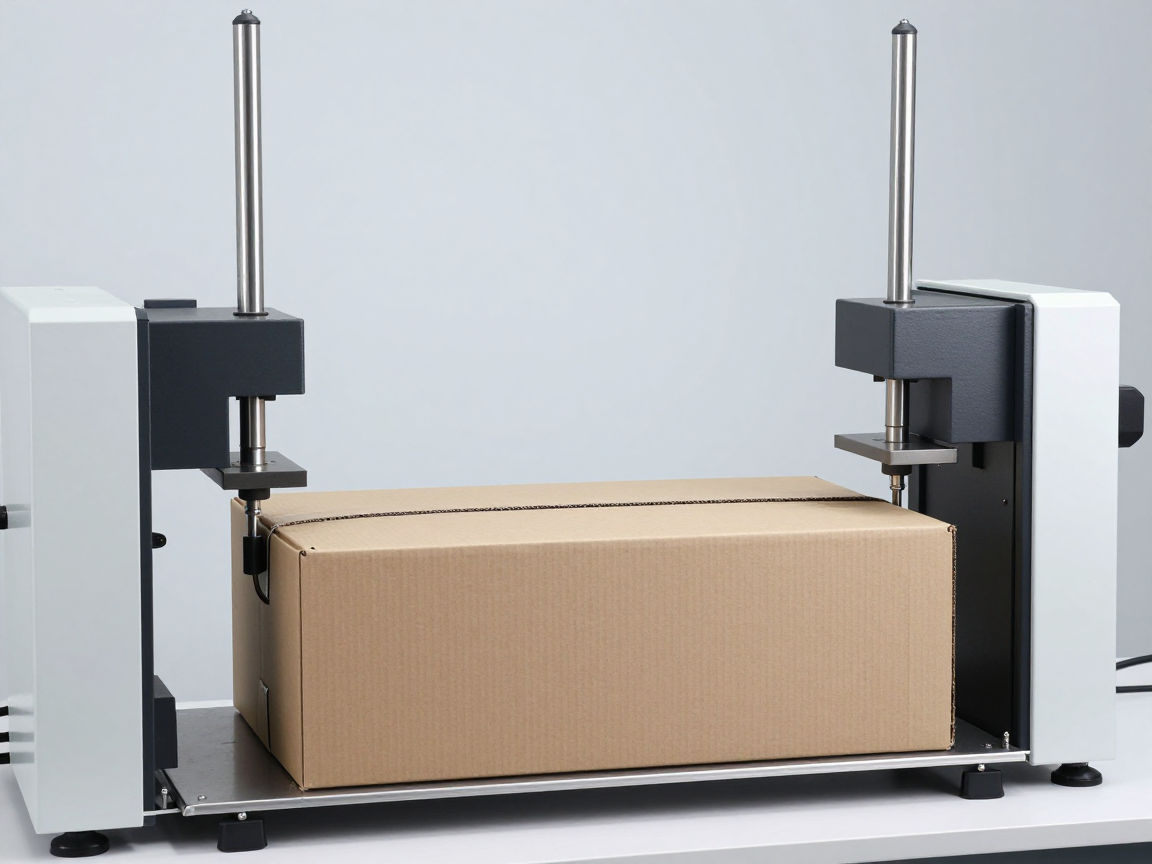
        What is ISTA 3L? E-commerce fulfillment process

        0
        Cover image of the article «What is ISTA 3L? E-commerce fulfillment process»

        ISTA® 3L is General simulation project for e-commerce channels — full name is Generalized E-commerce Retailer Fulfillment Test. This is the ISTA process newest and greatest in the 3 Series group: the 2023 version is up to 51 pages long, with eight packaged-product types (Small, A, B, C, D, E, F, G, H) ranges from 4.5 kg parcels to LTL pallets and both models are dedicated to TV/Monitor.

        First point to understand: 3L is not “new version 3A”. 3A simulation parcel delivery system with a fixed test sequence. 3L simulation The order fulfillment process of a typical online retailer — goods go through fulfillment warehouses, packaging, then to consumers by parcel or LTL, with special situations such as drop in a bag, edge/corner drop, bridge impact, and even concentrated edge impact for flat bales.

        This article goes through: why ISTA built 3L; eight packaged-product types; two handling methods; two shape concepts determine the whole test sequence (elongated and flat); sequence table for each group; special test stages; number of samples rule; device; and when to choose 3L instead of 3A, 3B, 3E or 6-AMAZON.COM.

        1. What is ISTA 3L?

        3L is the project for Generalized E-commerce Retailer Fulfillment — simulates an online retailer fulfilling orders and sending individual packaged-products to consumers. The 3L document clearly defines three shipping systems:

        • Parcel Delivery — sent via delivery system (UPS, FedEx…) when weight < 150 lb (68 kg), longest side ≤ 108 in (2.74 m) and total length + girth not exceed 165 in (4.19 m). Including elongated and flat bales.
        • LTL Standard — sent via LTL system (joint shipment), no build pallets or shelves.
        • LTL Palletized — sent via LTL system but yes Separate pallets/shelves for each package.

        The document also defines standard pallets (universal design, published parameters, correct use) and custom pallets (specifically designed for a narrow product/range of products, uncommon parameters) — because the standard applies the same test level but different interpretations of “pallet” will affect the interpretation results.

        One note ISTA emphasizes in the Samples section: product and packaging must As close to actual production as possible. Pre-production samples — hand-made samples, one-piece CAD samples or short batches — often insufficiently represented for the results to make sense. Maybe try early in the product development cycle, but The final official test must use actual production goods. This is where many businesses make mistakes when they rush to get certification for their prototypes.

        2. Why does ISTA have its own 3L?

        The e-commerce channel creates dangers that 3A (traditional parcel) does not adequately simulate:

        • Sue extreme shapes — flat furniture, picture frames, elongated bars, large flat panels — packages that 3A does not handle separately.
        • Throw/drop in bag — many online retailers bag or sack items before shipping; equipment drop in a bag, which means the object rotates/impacts differently than when falling freely from the ground.
        • The product is fragile and leaks easily — glass, ceramic, liquid — with separate sampling rules (section 8).
        • TV/Monitor — a product group with its own fragile characteristics and unique handling, ISTA separates into two styles G and H.
        • Calculated horizontal and vertical compression — simulate clamping forces on conveyors and stacking forces in LTL warehouses.

        In other words: 3L is “3A that spans the entire spectrum of shapes and forms encountered by a physical online retailer”.

        3. Eight types of ISTA 3L packaged-products

        Type Sending system Volume Size
        Small Parcel ≤ 10 lb (4.5 kg) Long side ≤ 14 in (350 mm) and volume ≤ 800 in³ (13,000 cm³)
        A Parcel < 50 lb (23 kg) Length+girth ≤ 165 in (4.19 m); long side > 14 in (350 mm) and ≤ 108 in (2.74 m)
        B Parcel 50 lb – < 100 lb (23–45 kg) Length+girth ≤ 165 in; long side ≤ 108 in
        C Parcel 100–150 lb (45–68 kg) Length+girth ≤ 165 in; long side ≤ 108 in
        D LTL < 100 lb (45 kg) Length+girth > 165 in (4.19 m) or Long side > 108 in (2.74 m)
        E LTL ≥ 100 lb (45 kg) Length+girth > 165 in or Long side > 108 in or ≥ 150 lb (68 kg)
        F LTL, handled by pallets Palletized LTL bales — test level according to pallet handling method
        G Parcel — TV/Monitor < 150 lb (68 kg) Length+girth ≤ 165 in; long side ≤ 108 in
        H LTL — TV/Monitor ≥ 150 lb (68 kg) or length+girth > 165 in, or long side > 108 in

        The two G/H types don’t just differ in mass — ISTA separates them product category specifically because of “specific product characteristics and vulnerable areas, plus different handling methods”. If your product is a TV or monitor, do not use an A–F style table to derive the test sequence.

        4. Two processing methods at fulfillment warehouse

        3L differentiates how goods arrive at the retailer’s Fulfillment Center (FC):

        Method Definition
        Standard Handling (floor loaded) Sue to FC no pallets, or multiple packages on the same pallet, and sent to the consumer no Includes pallets.
        Pallet Handling Sue to FC on separate pallets and sent to the consumer on pallets.

        This is the easiest place to make a mistake when reading 3L: the same product can fall into different test series depending on how the retailer handles the case — not the product. Need to directly ask the customer/consignee about the handling method at FC before choosing the style.

        Group of unlabeled brown cartons of many sizes stacked on a clean warehouse floor
        ISTA 3L covers eight packaged-product types — from 4.5 kg parcels to LTL pallets and even TV/Monitor.

        5. Two concepts determine the whole test sequence: “elongated” and “flat”

        Three specific 3L test blocks — edge swing drop, full flat swing drop, bridge impact and concentrated edge impact — Only required for elongated or flat bales. This is why bale shape must be determined before anything else.

        • Rotational Edge Drop (block 21), 9 in (230 mm): required for lawsuits elongated and flat.
        • Full Rotational Flat Drop (block 22): test level packaged-product size depends; Required for elongated and flat bales.
        • Bridge Impact (block 23): hazard box Drop 16 in (400 mm); only required for lawsuits elongated.
        • Concentrated Edge Impact (block 24): 16 in (400 mm) fall hazard box; only required for lawsuits flat.

        Bridge impact simulates the classic situation on a conveyor/shipping yard: a long bale lies across two edges, the middle part is unsupported, and then gets hit by another object — a typical damage pattern of long lines. Concentrated edge impact simulates a small heavy block (edge hazard box) hitting it edge of flat bales. Equipment details of hazard box: see section 9.

        6. Test sequence: table according to main group

        3L is divided into two “families” of sequences: family parcel (Small, A, B, C) and last name LTL / pallet (D, E, F) same TV/Monitor family (G, H). The table below is the parcel group sequence (Small/A) according to the documentation:

        # Group Test type Test level Request
        1 Climate Pre-conditioning Ambient lab room, 12 o’clock Required
        2 Climate Controlled air conditioning Temperature/humidity select according to the chart Options
        3 Shock Free fall (no in bag) 9 falls — altitude changes with mass Required
        4 Vibration Vibrate randomly yes and no download above Grms total 0.53 and 0.46 Required
        5 Shock Free fall (in the bag / on the dangerous side) 8 drops (some types: 7 times) — including falling on a hazard Required
        6 Shock Rotational Edge Drop 9 in (230 mm) Required for elongated & flat bales
        7 Shock Full Rotational Flat Drop According to packaged-product size Required for elongated & flat bales
        8 Shock Bridge Impact 16 in (400 mm) fall hazard box Only elongated lawsuits
        9 Shock Concentrated Edge Impact 16 in (400 mm) fall hazard box Only flat cases
        10 Integrity Leak Test (leak test) 8 o’clock Only with liquid goods

        With the group Type Small and Type A, the document clearly separates stage 3 fell into the bag (9 times) and stage 5 is fell in the bag (7 times for Type A) — meaning small goods and goods up to 23 kg can be packed in bags at one stage, creating a different appearance. With the group LTL (D, E, F), the test string adds:

        • Tip / Tipover (block 3): inclined 22° — required for bales ≥ 48 in (1.2 m) high and with a bottom edge < ½ height; or ≥ 30 in (760 mm) high with center of gravity > ½ bale height.
        • Drop flat swivel & edge swivel at 9 in (230 mm): blocks 5 and 6, mandatory.
        • Inclined or horizontal impact (block 8): va velocity 48 in/s (1.2 m/s).
        • Horizontal compression (Clamping, block 9): Value calculated by formula, clamped in many positions — required with each axle width ≥ 24 in (610 mm) and < 75 in (1,905 mm).
        • Vertical compression (block 10): value calculated according to the formula, holding force 1 hour, try in the intended transport position or the most stable position.
        • Random vibration with/without load on: still Grms 0.53 and 0.46.
        • With Type F (LTL palletized): release and rotate flat using level 9 in (230 mm) and do it on the 3 side down.

        With Type G/H (TV/Monitor), the document has a separate drop height table with two columns < 70 lb (32 kg) and 70–150 lb (32–68 kg), including the step "fall from 36 in (910 mm) / 24 in (610 mm) to the most dangerous flat position"; If you don't know the most dangerous position of Type G, use it Face 6.

        7. Details of some notable test stages

        Vibration with and without top load

        Both levels Grms 0.53 and 0.46 are required — you don’t have to choose one. Some runs no top load (bale lying bare on vibrating table), some running yes top load to simulate a bale being crushed by other bales. This is an important difference from procedures that only run a single spectrum: 3L tests both load states because resonant damage appears in one state but not in the other.

        Fall by mass and fall on hazard

        Falling height varies with volume packaged-product, not fixed. For example, for the LTL group, the height table has two columns < 70 lb (32 kg) and 70–150 lb (32–68 kg): side/corner drops of 18 in (460 mm) with light bales reduce to 12 in (300 mm) with heavier bales, and dangerous flat falls of 36 in (910 mm) / 24 in (610 mm). There is a prescribed drop on hazard (hazard side): the bale must hit the middle of the hazard, vertically on the long side and parallel to the short side of the hit side; Falling range calculated to the collision, not taking into account the hazard.

        The free fall tester in the lab holds an unlabeled brown carton in a falling angle position
        ISTA 3L divides falls into several groups: falls without bags, falls in bags, falls on dangerous surfaces and falls at height depending on mass.

        Release edge rotation and release flat rotation

        With LTL types (C, E, F, H), flat rotation is performed by placing the bale on a hard surface (steel or concrete), raising one edge to the specified height and then quick release let the case fall freely. Documents note: if the bale has turned over before raising the edge to the required height, rotate it cannot be performed — This case must be clearly recorded in the minutes, not silently ignored.

        Leak Test 8 hours

        Only required for liquid goods. The case is kept 8 o’clock in the prescribed position to detect leaks — this is the step most missed when testing liquid cargo using other procedures.

        8. Model number rule — the difference of 3L

        3L states a notable rule: For fragile goods, five samples are needed. The document defines fragile goods as goods that break easily or can leak during distribution, including:

        • Glass/ceramic/porcelain/terracotta.
        • Liquid/semi-liquid/or solid that can liquefy at high temperature (above 70 °F).
        • According to the literature, in general products are composed of 25% or more (the ingredients mentioned above) also belong to this group.

        If your goods are fragile, do the math five samples and all must pass right from the budgeting stage. For non-fragile goods, number of sampless follow the general regulations of the procedure. And as stated in part 1: the sample must be actual manufactured goods, not a hand-made prototype or a CAD model of one — otherwise, the test results are not representative.

        Before testing, the document requires gathering information about Initial shipping configuration, approved loading diagram, details on shipping and configuration in the distribution system, typical climatic conditions… to determine the correct test parameters. This is the document that businesses need to prepare in advance, not the lab that has to guess on its own.

        9. Equipment and method standards

        Category Equipment Method standards
        Climate conditioning Record temperature and humidity; controlled air conditioning chamber ASTM D4332 or ISO 2233
        Free fall The machine falls freely ASTM D5276 or ISO 2248
        Tip / Tipover Sample tilting device ASTM D6179 or ISO 2876
        Drop flat rotation / edge & corner rotation Tester + support block 3.5–4.0 in (90–100 mm) high, proportionately wide, at least 8 in (200 mm) longer than the longest side of the bale ASTM D6179 or ISO 2876
        Inclined/horizontal impact Inclined or horizontal impactor ASTM D880, ASTM D4003 or ISO 2244
        Concentrated Edge Impact Free fall machine + edge hazard box: wooden box 12 × 12 × 12 in (305 × 305 × 305 mm), total volume 9 lb (4.1 kg); Ballast is a loose material contained in a bag, held by void fill; The edge of the box is covered with angle iron ASTM D5276 or ISO 2248
        Vibrate randomly Vertical vibration system, with top load/no top load ISO 13355 or ASTM D4728
        Clamping Horizontal clamping machine — value calculated according to the 3L formula —
        Vertical compression Compressor, or weight + load distribution plate; Hold force for 1 hour —

        The concentrated edge impact hazard box is an easy part to get wrong: the correct size is 12 in, the correct weight is 9 lb, the ballast is loose material in the bag, and the impact edge must be covered with angle iron. Using a “similar” box will change the results.

        A large unlabeled flat cardboard box the size of a television stands on the warehouse floor next to a hand cart
        ISTA 3L has two separate models (G and H) for TV/Monitor, with separate drop height and hazard position tables.

        10. When to use ISTA 3L — and when not to?

        Real situation Recommended procedure Why?
        Goods sold online, sent from the retailer’s fulfillment warehouse to the consumer (parcel or LTL) 3L Exact scope of “e-commerce retailer fulfillment”
        Long/flat packages (furniture, frames, large panels) 3L There are dedicated bridge impact / concentrated edge impact blocks
        TV, monitor 3L Type G/H There are separate falling sequences and poses for the TV/Monitor group
        Sold on the Amazon system, goods sent with the product box or need to be overboxed 6-AMAZON.COM (SIOC / Over Boxing) The process is built by Amazon, reflecting Amazon’s operating infrastructure
        Sold at Sam’s Club system 6-SAMSCLUB Process built by Sam’s Club
        Traditional parcel goods, not following the fulfillment model of online retailers 3A 3A is simpler, correct basic parcel chain
        Multiple LTL shipments, no pallets 3B (or 3L Type D/E) 3B targets a pure LTL model; 3L is used when there is a specific fulfillment/product type factor
        Whole pallets come with the whole vehicle 3E 3L does not simulate FTL homogeneous pallets

        General principles: Choose according to the actual itinerary of the package, not the product name. If the same product runs multiple channels (for example, sold on Amazon and sold in stores), it may be necessary to try multiple processes in parallel.

        11. Common mistakes when implementing ISTA 3L

        1. Choose the wrong style. Use Type A–F panels for TV/Monitor (correctly should be G/H), or skip the next two groups shape elongated / flat — results in removing 4 required blocks.
        2. Only run one vibration spectrum. 3L required both Grms 0.53 and 0.46, both with and without top load.
        3. Leave it “in your pocket”. The in a bag style creates a completely different look; to skip is to try an exercise that is different from the standard.
        4. Making the hazard box incorrectly. Exactly 12 × 12 × 12 in, exactly 9 lb, loose ballast in bag, edge covered with angle iron.
        5. Use the prototype. One-piece hand-made/CAD samples are often unrepresentative; Official tests must use actual manufactured goods.
        6. Forget the five-piece rule for fragile goods. Glass, ceramic, liquid… need five samples and all must pass.
        7. Do not prepare distribution documents. 3L requires information on dispatch configurations, loading plans, typical climatic conditions, etc. to determine test parameters.
        8. Forgot to do the 8 hour leak test with liquid goods — only block 25 is available, and no other process can replace it.
        9. Confusing horizontal compression with vertical compression. Two different blocks: clamping (horizontal, clamping in many positions, only with shaft width ≥ 24 in and < 75 in) and vertical compression holding force for 1 hour.
        10. Do not record a failed test. If the bale overturns on its own before being raised to a sufficient height (rotation release), it must be clearly recorded in the record.

        12. What does the cost and time of ISTA 3L testing depend on?

        Four key variables: packaged-product type (Type A has a lot less stops than Type E/F — LTL group has additional tip/tipover, impact 1.2 m/s, horizontal compression and vertical compression 1 hour); model number (fragile goods require five samples, all must pass); optional/mandatory blocks by shape (drop rotated edge/flat, bridge impact, concentrated edge impact — required if bales are long or flat); and cumulative time — 12 hours of pre-conditioning, plus controlled conditioning if selected, vibration stages, 1-hour holding force vertical compression, and for liquid cargo an additional 8 hours of leak testing. Article What does the cost and time of ISTA packaging testing depend on? Analyze how quotes compare between labs.

        13. Frequently asked questions

        How is ISTA 3L different from ISTA 3A?

        3A simulates a fixed sequence of parcels for a single parcel. 3L simulates an online retailer’s order fulfillment process, featuring eight packaging-product types, two handling methods, and specific steps such as drop in bag, edge/corner rotation drop, bridge impact, concentrated edge impact, horizontal compression, and calculated vertical compression. If your goods follow the e-commerce model with complex shaped packages, 3L is more suitable.

        How many pieces are considered “elongated” and “flat”?

        Document 3L defines these two groups based on the ratio between the long side and the other two sides (long is called elongated, flat/thin is called flat). Because this is the condition that determines the three required blocks (bridge impact and concentrated edge impact), you must look up the definition in the applicable standard instead of guessing based on your feelings.

        Why does 3L need to run both Grms vibration levels?

        Because the condition of the bale with/without the above load creates different resonance damage; Running only one state will miss the type of failure that only occurs in the other state.

        How many samples are needed for fragile goods?

        Five samples, and all must pass. Fragile goods include glass/ceramic/porcelain/terracotta, liquid or semi-liquid, and in general the product is composed of 25% or more of such components.

        Can I use a hand-made sample to test for certification before production?

        Shouldn’t. It can be tested early in the development cycle for reference, but the final official test must use actual production goods — prototypes are often not representative enough.

        Can 3L replace 6-AMAZON.COM?

        No. If a customer requests certification under the Amazon system, the exact two 6-AMAZON.COM processes (SIOC or Over Boxing) must be used — the 6 Series process is built by that member to reflect their own operating infrastructure.

        Does 3L include compression?

        Yes, for the LTL group: horizontal compression (clamping, calculated according to the formula, multi-position clamping, only for shafts with width ≥ 24 in and < 75 in) and vertical compression (holding force for 1 hour in the intended transport position or most stable position).

        14. Conclusion

        ISTA 3L is the largest and most detailed project in the 3 Series — ISTA’s “e-commerce test”. Three things to remember: Eight packaged-product styles range from 4.5 kg parcel to LTL pallet and TV/Monitor; The shape (elongated / flat) determines the four required blocks; and There are specific stages that cannot be replaced by any process — drop in bag, bridge impact, concentrated edge impact, horizontal/vertical compression and 8 hour leak test for liquid cargo.

        Before placing a trial order, businesses need to prepare: weight and three bale sizes (to check the type); elongated/flat shape; sending system (parcel or LTL, with pallet or not); how to handle the retailer’s FC; and if it is a TV/Monitor, immediately determine the model G or H. Don’t forget the model year rule with fragile goods and the requirement to use actual manufactured goods.

        Reference standard version: article content is based on ISTA Project 3L document (2023 version) — Generalized E-commerce Retailer Fulfillment Test. The test levels are a summary for reference; When implementing, the official standard, the current version of ISTA, must be used.


        References

        • ISTA Project 3L — Generalized E-commerce Retailer Fulfillment Test, 2023 edition, International Safe Transit Association
        • ISTA — Test Procedures & Projects (current catalog, accessed September 27, 2026)
        • ISO — ISO 2233, ISO 2248, ISO 2876, ISO 2244, ISO 13355 (referenced methods)
        • ASTM — D4332, D5276, D6179, D880, D4003, D4728 (equivalent methods cited)

        Related articles


        Discuss further


          Disclaimer and acknowledgment of intellectual property rights

          This article is an explanatory content compiled by us for the purpose of introducing and disseminating knowledge. Article is not a translation, copy, abridgement or replacement of the parent standard, and is not evaluated, approved or sponsored by ISTA (International Safe Transit Association)..

          The entire content of ISTA standards is copyrighted by the International Safe Transit Association, Inc. (East Lansing, Michigan, USA) — All rights reserved. ISTA® and the ISTA logo are registered trademarks of the International Safe Transit Association, Inc.; Mentioned in this article are for guidance purposes only and do not imply any affiliation, partnership or sponsorship.

          Article content For reference only; Before applying for any purpose — testing, evaluation, certification or commercial decision-making — the reader should refer directly to the original ISTA document (the most complete and up-to-date version) and consult an accredited testing facility when necessary.

          When performing testing, it is mandatory to use the official, current version of the standard, obtained directly from ISTA. We do not redistribute ISTA materials in any form. Information in this article may be out of date with the current version of the standard.

          See more: Copyright Policy & Disclaimer by ticforall.com.
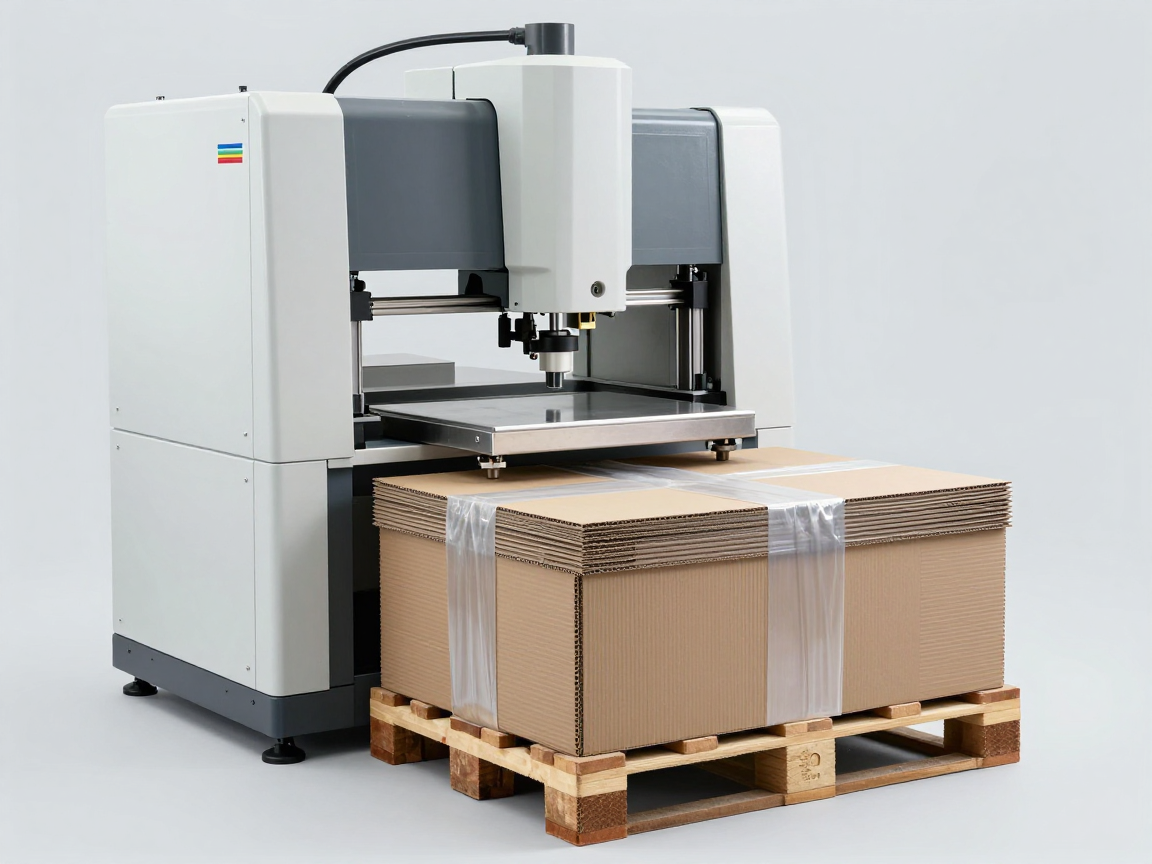
          What is ISTA 3K? Fast-moving consumer goods packaging test procedure in European retail chains

          0
          Cover image of the article «What is ISTA 3K? Fast-moving consumer goods packaging test procedure in European retail chains»

          ISTA® 3K is one project. project (project) belongs to the general simulation group, for Fast-moving consumer goods (FMCG) circulate through multi-point retail chains in Europe — Fast Moving Consumer Goods in the European Retail Supply Chain. This is one of ISTA’s most “region-specific” processes: it simulates the supply chain part controlled by the retailer — from picking goods at the retailer’s distribution center, building mixed pallets/roll cages, delivering them to supermarkets, and then processing them in the store until they hit the shelves.

          What makes 3K different from every other process in the Series 3: The test unit is a “package” — a multiple batch of retail units (collation of primary packs), for example, shrink-wrap tray of 6 cans, carton of 12 milk cartons, bag of 10 kg of pet seeds; and the test not only evaluates the fact itself but also evaluates it in a mixed pallet/roll cage setting. This is why 3K requires a larger number of samples than nearly any other process: enough to build an entire composite block.

          This article presents the scope of application of 3K, four packaging types that 3K distinguishes, a series of 14 test blocks, three types of samples (test package / dummy package / roll cage fill), required equipment and points to prepare before testing. If your goods do not go to a European retail chain, section 9 will help determine the more appropriate process.

          1. What is ISTA 3K?

          According to the original document, Project 3K is a general simulation for submitted fast-moving consumer products multiple-retail supply chain environment in Europe — where the retailer’s operations include Send mixed goods separately to each store in roll cages or on mixed pallets.

          ISTA’s geographical scope is (not limited to): Sweden, Norway, Denmark, England, France, Belgium, Netherlands, Germany, Austria, Switzerland, Spain and Italy. The document also clarifies the scope of application for other similarly developed European countries if they have multi-point retail infrastructure; and because the hybrid delivery model is spreading, 3K could apply in other countries as well. Many European grocery packaging is in form shelf-ready (shelf-ready) — 3K applies equally to both shelf-ready and non-shelf-ready packaging.

          The most important scope boundaries: 3K is only simulated portion controlled by the retailer. The ISTA document clearly states: “This test method relates only to the retailer controlled parts of this supply chain. Separate testing should be undertaken at the unit load level”. unit load from the manufacturer to the retailer’s distribution center no belongs to 3K, but must be tested separately at the unit load level (eg group 3E). ISTA also notes: research shows hazards in the section controlled by retailers often more harsh (due to complex product mix), but reached 3K no Eliminates the need to evaluate at the unit load level.

          The four ISTA limitations mentioned in the General section should be discussed with customers before using the results:

          • Test levels are based on observations of the distribution systems of many brand owners and retailers, corrected for field damage — but the test may not be representative of a particular distribution system.
          • Products and packaging are evaluated together.
          • Some conditions may not be covered: humidity, pressure, careless or unusual handling.
          • With dangerous goods packaging: reached 3K no This means meeting international/national requirements for transporting dangerous goods; 3K does not replace UN standards but can only be used in conjunction with them.

          2. Most common misconception about ISTA 3K

          Biggest misunderstanding: consider 3K a “pallet test”. Not. The unit of evaluation is multi-lot retail package (shrink film trays, cartons, bags) — these packages are subject to pass/fail review. Mixed pallet or roll cage is just that context create load. If you need to evaluate the entire pallet as a unit (the entire pallet comes with the vehicle), that is a different problem (3E).

          Second misunderstanding: I think 3K is used for delivery goods. Are not. 3K simulates a retail chain (retailer → supermarket → shelf) with rows mixed in roll cage. Goods sent individually according to the delivery system used 3A or group 3L.

          Third misunderstanding: Prepare too few samples. This is the point that makes many businesses “shocked” when receiving sample requests: 3K does not need “a few packages” but needs enough packages to Build a block of goods minimum size 0.8 m × 0.8 m × 1.6 m, then double that number (details in section 7).

          3. Four packaging styles that ISTA 3K distinguishes

          3K classifies packages according to how one lifts and carries it — because this is exactly the kind of impact that DC picking causes. Four styles:

          Type How to lift/carry Identification conditions
          Type 1 Lift/carry one hand — both ends closed Weight ≤ 4.5 kg; and one main dimension ≤ 120 mm; and packaging without holes ≥ 60 × 40 mm with enough softness/space behind to insert 3 fingers (i.e. closed containers, or shrink-wrap trays that cannot be lifted by inserting your hand into the top of the packaging)
          Type 2 Lift/carry two hands — both ends closed All main dimensions ≥ 120 mm; and/or mass > 4.5 kg; and There aren’t enough holes to put your hands through like above
          Type 3 Lift/carry one hand — open-top style Weight ≤ 7 kg; and has a hole in one (or more) ends ≥ 60 × 40 mm with enough softness/space to insert 3 fingers (usually a shrink-wrap tray)
          Type 4 Lift/carry two hands — open style at both ends Weight > 7 kg; and has holes at opposite ends ≥ 60 × 40 mm large enough to pass a hand through (usually a shrink-wrap tray with open ends)

          Why is this classification important? Because it determines how the “carry” in test block 4 is performed — whether the carry is supported by the bottom or carried by hand holes in the shrink film. The two cases cause completely different loads on the joints and on the packaging. Before submitting a sample, you need to clearly define your style; If the packaging can be lifted in more than one way, it is necessary to agree with the tester which method is popular in your channel.

          A cardboard tray of unlabeled beverage cans sits on an empty retail store shelf
          The subject of ISTA 3K: a “package” is a multiple batch of retail units (e.g., 6–12 can shrink-wrap trays) — which may or may not be shelf-ready.

          4. What does ISTA 3K test? — Series of 14 test blocks

          3K runs in a fixed order test block sequence, divided into two parts: sue (package) and mixed block level (mixed load). The table below is the order according to the document:

          # Granted Test type Test level Required
          1 Sue Preliminary atmospheric conditioning Ambient, frozen or cool — choose according to distribution and sales channels Required
          2 Sue Pyramid pick (overhang stack) 5 minutes Required
          3 Sue Drag (drag) 900 mm at 1.0 m/s Required
          4 Sue Carry (to carry) 10 seconds of static + 5 cycles of oscillation when worn Required
          5 Sue Placement drop (drop when placed down) 5 hits, multiple positions, 150 mm high Required
          6 Sue Drop-on (drop over the lower bale) The bottom of the upper bale hits the top of the lower bale, 150 mm Required
          7 Sue Impact 8 hits at 1.35 m/s Options
          8 Mixed block Impact 4 hits at 0.91 m/s Required
          9 Mixed block Vibrate randomly Gross grms 0.28 in 40 minutes, then 0.517 in 60 seconds Required
          10 Mixed block Fall flat 1 drop from 60 mm Required
          11 Sue Placement drops 4 impacts, multiple positions, 150 mm Required
          12 Sue Falling (try expanding) 4 collisions, many positions, 300mm Recommended (optional)
          13 Sue Drop-on (try expanding) The bottom of the upper bale beats the top of the lower bale, 300mm Recommended (optional)
          14 Reviews Test and evaluate Don’t try — evaluate the test package and roll cage fill package Required

          The ISTA document has a separate note for blocks 12–13: the 300 mm level represents the “worst within normal limits” handling — not every bale will fall from 300 mm, but a few will, so it’s worth testing for performance. If no To perform these two blocks, the test report must clearly state.

          5. Package delivery item group: simulates picking up goods at DC

          This is 3K’s “specialty” — an exact simulation of what happens when warehouse staff remove goods from raw pallets to build mixed goods:

          • Pyramid pick / overhang stack (block 2): simulates a situation where a package is only partially supported on the pallet at the picking side, because other packages have been removed — the package is “protruding” and subject to bending.
          • Drag (block 3): simulates dragging a bale off a pallet — 900 mm at a speed of 1.0 m/s. This impact mainly destroys the bottom surface and the adhesive/adhesive joints.
          • Carry (block 4): simulates lifting and carrying the bale a short distance from the picking face to the mixed load — 10 seconds of static plus 5 cycles of oscillation while carrying. The way to carry it (supporting the bottom or putting your hand through the shrink film hole) depends on the packaging type in part 3.
          • Placement drop & drop-on (block 5, 6, 11, 12, 13): simulate impact when put sue down and when drop one bale onto the bale below while building the load block. This is why the 3K comes in two heights: 150 mm (normal) and 300 mm (extended).
          • Horizontal impact (block 7, optional): Simulate impacts occurring on automatic conveyor systems at DCs with bale-level automation. ISTA clearly states: if known or capable Packages pass through a DC with a conveyor system/package automation system, should be done this block.

          6. Group of mixed block level items: roll cage and mixed pallet

          The 3K document states a notable technical decision: in Europe, both are used mixed pallets and mixed roll cage; observation shows roll cage is at greater risk because the bales can lean against the mesh wall of the cage (mixed pallets do not have walls). Since both forms are popular, ISTA chooses worse case — roll cage — Do a test configuration.

          Three mixed block level categories:

          • Horizontal impact (block 8): 4 impacts at 0.91 m/s — simulates cage-to-cage (or mixed pallet to mixed pallet) collisions, or load-to-fixture collisions when loading, driving, and handling at the supermarket.
          • Random vibration (block 9): Grms 0.28 for 40 minutes, then Grms 0.517 for 60 seconds. The additional 60 seconds of vibration at a higher level simulates more severe vibration when the load is moved over ramp chequer-plate or rough floors in the receiving area — usually at a supermarket.
          • Flat fall (block 10): 1 drop from 60 mm — simulates higher level vertical impulses commonly encountered when loads are damaged accumulate/arrange or cross the threshold.
          Four-wheeled metal roll cage containing shrink-wrap trays for unlabeled cans and bottles located in the shipping area
          The test configuration of ISTA 3K is mixed roll cage — ISTA chooses the higher risk model between roll cage and mixed pallet.

          7. Number of samples and three sample types (TP/DP/RCF)

          3K required Many samples are identical, quantity depends on package size. Instructions on how to estimate: build the number of bales needed to create a block at least 0.8 m × 0.8 m × 1.6 m There are no significant gaps, then double. Example given in the document: bale 0.4 × 0.4 × 0.2 m needed 16 bales for that block → total needed 32 bales to try.

          Patterns are divided into three categories with different roles — points that are easily misunderstood:

          Type Symbol Role Rated pass/fail?
          Test package City Runs from the beginning to the end of the chain; when testing many similar bales, all Must pass all tests Yes
          Dummy packages DP Used in blocks 1, 2, 3, 6 and 13 to create the correct real load conditions (so that the hazard is correctly applied to the test package); If it loses shape/support, replace it with another model No
          Roll cage fill package RCF Only used in blocks 8, 9, 10 to build mixed cargo blocks around the test package; After block 10 is set aside and review later Yes (assessment at block 14)

          ISTA notes three conditions for converting between sample types. If done incorrectly, it will ruin the test value: dummy package of blocks 1–6 no used as roll cage fill for blocks 8–10; roll cage fill after block 10 no used as dummy for blocks 11–13 (because they were marked for pass/fail). Samples should be labeled TP/DP/RCF right from the start to trace.

          Four other principles of preparation:

          • Samples must be packaging and products not yet tested; Sent to the lab must be over-packaged or repackaged in new packaging at the lab.
          • Yes Document carefully about configuration, materials, structure of products and packaging; ISTA strongly recommends using photos to supplement descriptions.
          • With carton, ISTA recommends identifying and recording basisweight (paper/board rating) — if the nominal rating changes, even if the board remains at the same performance level, should try again.
          • Select the right air conditioning mode (ambient/frozen/cool). suitable for distribution and sales channels product — do not use default.

          8. Accompanying equipment and method standards

          Category Equipment Method standards
          Climate conditioning Temperature and humidity recording device; air conditioning chamber ISO 2233 or ASTM D4332
          Free fall (preferred) fork-type free-fall drop tester ISO 2248 or ASTM D5276
          Free fall (alternative 1) Manual drop with standard ruler — for drops of 150 mm —
          Free fall (alternate 2) Belt + quick release — for 60 mm drop of mixed block ISO 2248 or ASTM D5276
          Impact Inclined impact machine or horizontal impact system ISO 2244, ASTM D880 or ASTM D4003
          Vibrate randomly Vertical random vibration system; There must be measures to keep the sample from leaving the table no Limit vertical movement ISO 13355 or ASTM D4728
          Mixed batch of goods 4-wheel metal roll cage, approximately 800 mm × 700 mm (horizontal) and 1800 mm height (from bottom of wheel to top of cage); an additional middle floor may be needed —
          The crutch-style free-fall machine in the packaging testing room holds a shrink-wrap tray that holds the can just before release
          The fork-type free-fall drop tester is the preferred device for the ISTA 3K — but must be able to drop down to 150 mm and 60 mm.

          Noteworthy detail: the 3K document clearly states that the machine falls as a crutch preferred choice for all 3K drop tests, including 60 mm drops of composite blocks; but because some machines cannot lower down to 150 mm or 60 mm, the new document lists the two alternatives mentioned above. If the lab does not have a properly calibrated machine, the results may not be comparable between tests.

          9. When should you not use ISTA 3K?

          Real situation Recommended procedure Why?
          Goods go to European retail chains, mixed delivery by store by mixed roll cage/pallet 3K True range simulation part retailer controls
          Raw pallets from the manufacturer to the retailer’s DC 3E (try separately at unit load level) 3K only covers the retailer-controlled portion
          Goods sent individually via parcel delivery system 3A The treatment and hazard models are completely different
          E-commerce goods delivered directly to consumers Group 3L / 6-series by channel 3K does not simulate delivery to consumers
          Goods go to North America or Asia market Process according to the right channel The 3K test level is based on observations of the European retail system
          Packaging for dangerous goods UN standards and corresponding regulations 3K does not supersede these requirements

          10. Common mistakes when performing ISTA 3K

          1. Mix three types of samples. Using dummy package (DP) instead of roll cage fill (RCF), or using RCF that has passed block 10 as dummy for blocks 11–13 — distorts both the load structure and the evaluation scope.
          2. Just prepare a few packages. Without enough samples to build a 0.8 × 0.8 × 1.6 m block (duplicated), it is not possible to run a full series of blocks 8–10.
          3. Choose the wrong air conditioning mode. Using ambient for frozen/cool products is to ignore the most important practical conditions of that channel.
          4. Remove block 7 because it’s “optional”. If goods possible going through the package level automation DC, the ISTA document clearly states this block should be implemented.
          5. The removal of blocks 12–13 is not recorded. Two 300 mm blocks are recommended; If omitted, the minutes must state — otherwise, the report is considered incomplete.
          6. Do not record board weight (basis weight). When changing paper suppliers, even if the board is at the same performance level, the old results are no longer valid — without the original data, it cannot prove anything.
          7. I thought reaching 3K was enough for the whole chain. 3K only covers the part the retailer controls; The unit load part must be tested separately.

          11. What does the cost and time of the ISTA 3K test depend on?

          Four dominant factors: The number of samples is very large (according to bale size, it can be up to several dozen bales, divided into three types) — usually the most expensive factor; 14 block chain running time includes 5 minutes pyramid pick, 900 mm drag, 5 carrying cycles, multiple 150/300 mm drops, plus 40 minutes + 60 seconds vibration, plus conditioning; must build a mixed roll cage according to the prescribed size, with a middle floor if necessary; and specialized equipment — Crutch-type fall machine can be lowered to 60 mm, impact system, vibrating table enough to load the entire cage. Article What does the cost and time of ISTA packaging testing depend on? Analyze further how to compare quotes.

          12. Frequently asked questions

          What types of products is ISTA 3K used for?

          Fast-moving consumer goods packaged in mixed batches (shrink trays, cartons, bags) sold through multi-point retail chains in Europe — food, beverages, groceries, personal care, pet food… As long as the goods follow a mixed delivery model to each store.

          Is 3K a European process?

          Yes. 3K’s test level and roll cage configuration are based on European retail observations; The document lists the main applicable countries and similar developed countries. For other markets, it is necessary to choose the appropriate channel process.

          How many samples are needed for a 3K test?

          There is no fixed number: estimate by the number of bales enough to build a block ≥ 0.8 × 0.8 × 1.6 m, then double. The smaller the bale, the larger the number of samples — for example, a 0.4 × 0.4 × 0.2 m bale requires about 32 bales.

          Why use roll cages and not mixed pallets?

          Because ISTA considers roll cage to be a worse case scenario (bales can lean against the net wall, creating greater lateral load), and both forms are popular in European practice. Choosing the worse case helps the result cover both.

          Does a dummy package count as a pass/fail sample?

          No. Dummy package is only to create correct loading conditions for test package; it is not tested or rated pass/fail, and if it loses its ability to support, replace it with another model.

          In what way is the 3L group different from the 3K group?

          3L is a project for e-commerce/delivery channel (online retailer’s parcel), with SMALL/A/B models and separate test series including vibration with/without top load, drop, rotating drop, bridge impact… 3K for retail chains store in Europe with mixed roll cages.

          Does reaching 3K mean that the goods are not damaged at the supermarket?

          No. 3K is a general simulation based on observations of many distribution systems, not a specific system; The results say the packaging exceeds the specified test levels according to your predetermined criteria — see four pass/fail criteria.

          13. Conclusion

          ISTA 3K is a project dedicated to fast-moving consumer goods passing through multi-point retail chains in Europe, simulating the part of the supply chain controlled by the retailer. Three points to remember: The unit of evaluation is the batch package, not the pallet; Test configuration is mixed roll cage — worse case than mixed pallet; and Large number of samples, divided into three types TP/DP/RCF with strict conversion rules.

          Before placing a trial order, businesses should prepare: packaging type (Type 1–4) and package size; channel-appropriate air conditioning mode (ambient/frozen/cool); Quantity of board if it is a carton; and confirm whether the goods go through a DC with an automated conveyor system for bale feeding (to decide block 7).

          Reference standard version: article content based on ISTA Project 3K document (2011 version, revised 2022) — Fast Moving Consumer Goods in the European Retail Supply Chain. The test levels are a summary for reference; When implementing, the official standard, the current version of ISTA, must be used.


          References

          • ISTA Project 3K — Fast Moving Consumer Goods in the European Retail Supply Chain, 2011 edition (edited 2022), International Safe Transit Association
          • ISTA — Test Procedures & Projects (current catalog, accessed September 27, 2026)
          • ISO — ISO 2233, ISO 2248, ISO 2244, ISO 13355 (referenced methods)
          • ASTM — D4332, D5276, D880, D4003, D4728 (equivalent methods cited)

          Related articles


          Discuss further


            Disclaimer and acknowledgment of intellectual property rights

            This article is an explanatory content compiled by us for the purpose of introducing and disseminating knowledge. Article is not a translation, copy, abridgement or replacement of the parent standard, and is not evaluated, approved or sponsored by ISTA (International Safe Transit Association)..

            The entire content of ISTA standards is copyrighted by the International Safe Transit Association, Inc. (East Lansing, Michigan, USA) — All rights reserved. ISTA® and the ISTA logo are registered trademarks of the International Safe Transit Association, Inc.; Mentioned in this article are for guidance purposes only and do not imply any affiliation, partnership or sponsorship.

            Article content For reference only; Before applying for any purpose — testing, evaluation, certification or commercial decision-making — the reader should refer directly to the original ISTA document (the most complete and up-to-date version) and consult an accredited testing facility when necessary.

            When performing testing, it is mandatory to use the official, current version of the standard, obtained directly from ISTA. We do not redistribute ISTA materials in any form. Information in this article may be out of date with the current version of the standard.

            See more: Copyright Policy & Disclaimer by ticforall.com.
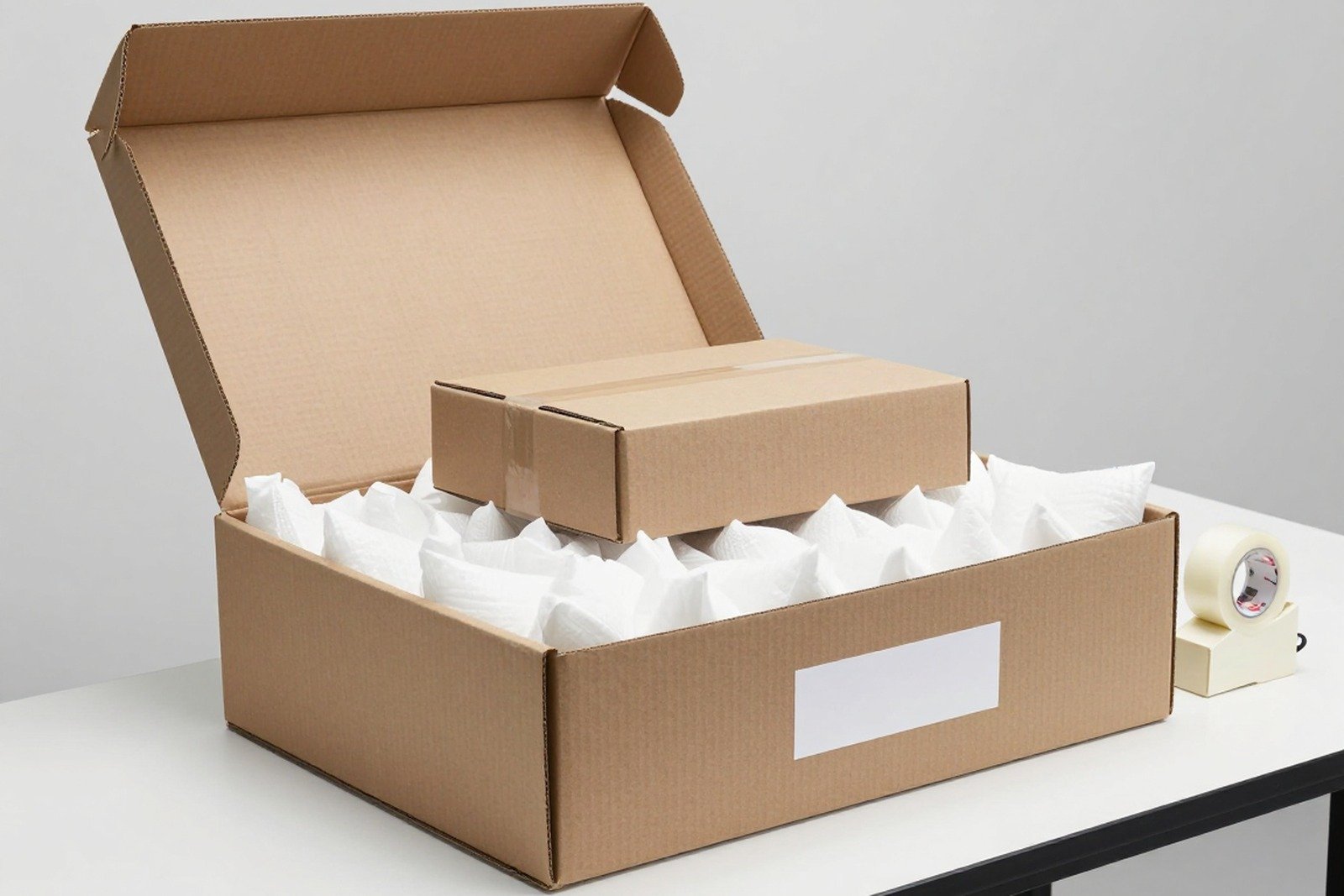
            What is ISTA 3H? Bulk Transport Containers test procedure

            0
            Cover image of the article «What is ISTA 3H? Bulk Transport Containers test procedure»

            ISTA® 3H is a belonging process Series 3 — General Simulation (general simulation) for Bulk goods in shipping containers are loaded and unloaded using mechanical equipment — Products or Packaged-Products in Mechanically Handled Bulk Transport Containers. This is the procedure for goods units cannot be loaded or unloaded by human power: because of their size or mass, they must be handled by forklifts, trailers or cranes.

            Typical example that the ISTA document itself states: Auto parts stored in reusable racks. The test unit is one shipping container (or a system of containers) containing the same product. ISTA states 3H also possible considered for mixed goods, and can be used for evaluation internal dunnage material (interior dunnage).

            This article presents the application scope of 3H, 9-stage sequence, three vibration spectra according to transport mode (steel spring road / air-ride road / rail), vibration time calculation formula, railway shock categories and points to prepare before bringing the container to the test room. Note about version: post based on ISTA 3H version 2025 — This version replaces 3H’s old approach and has many technical changes, so if your internal documents still refer to the old version, you need to compare them.

            1. What is ISTA 3H?

            According to the original document, ISTA 3H is the lesson general simulation test for mechanically handled bulk loads — general simulation for mechanically handled bulk cargo. Scope: “bulk made loads up of one transport container or system consisting of the same product that because of their size and/or weight must be handled by mechanical means”.

            It is necessary to clearly distinguish three easily confused concepts:

            • Bulk load here is not “bulk cargo” (dumped goods, grain goods) in the sense of maritime logistics. In ISTA 3H, “bulk” means a large block of goods — usually a container/rack/shelf containing many similar products.
            • The test unit is the whole container, not each small package inside. This is the core difference compared to 3A and 3F (test unit is single bale).
            • 3H emphasizes the entire mechanical loading and unloading chain, not just shipping. That’s why the procedure has categories rotational drop (drop edge rotation) and impact (horizontal impact) repeat twice — before and after the vibration stage.

            The four ISTA limitations mentioned in the overview should be informed to customers before using the results:

            • Test level based on General data, may not be representative of a particular distribution system.
            • Products and packaging are evaluated together.
            • Some conditions are not covered: humidity, pressure, unusual handling.
            • There are non-equivalent alternatives (non-equivalent alternatives). ISTA clearly warns: in many cases these options no give the same results, and the chosen option must be clearly stated in the test report.

            2. Most common misunderstanding about ISTA 3H

            Biggest misunderstanding: Consider 3H as the “goods on pallet” test.. Incorrect. Goods on regular pallets (including mixed pallets) belong to 3E or 3F. 3H is for goods units so large that it cannot be handled by hand — industrial racks, reusable metal shelves, specialized containers for spare parts. If you can lift a package with two people, chances are you don’t need 3H.

            Second misunderstanding: think that any alternative chosen is the same. Document 3H clearly states the alternatives are non-equivalent — for example, a short shock stage can be done with an inclined impactor (conbur) or a horizontal impactor, but the two recording methods are different (impact velocity vs. velocity change with a nominal 10 ms half-sine pulse) and can give different results. The document also has a separate warning: inclined plan may not be suitable with specimens prone to rotation/out of position — a recumbent position may result false negative results (false negative).

            Third misunderstanding: ignore route data. The vibration stage of 3H depends directly on the mode of transport and expected distance — the same package traveling 200 km and 1,200 km will have different vibration times. This is different from 3F (fixed vibration for 30 minutes).

            3. What does ISTA 3H test? — 9-stage sequence

            The procedure runs sequentially on the same sample set in the order below. The three shock/fall stages are repeated twice — one before and one after the vibrating leg — simulates the container being mechanically unloaded at both ends of the journey.

            # Category Test type Test level Required
            1 Preliminary atmospheric conditioning Temperature and humidity Laboratory conditions, 12 hours Required
            2 Controlled atmospheric conditioning Temperature and humidity Choose from conditions table (72 hours) Options
            3 Shock — brief impact Inclined impact (conbur) or horizontal impact 35 in/s (0.89 m/s), hitting all 4 vertical surfaces Required
            4 Shock — drop rotation Rotational drop, flat and edge forms 4 in (100 mm) Required
            5 Vibration Vibrate randomly Spectrum by mode of transport — Grms 0.54 / 0.28 / 0.13 Required
            6 Shock — brief impact (repeat) Inclined impact or horizontal impact 35 in/s (0.89 m/s) Required
            7 Shock — drop rotation (repeat) Rotational drop, flat and edge forms 4 in (100 mm) — all 4 bottom sides Required
            8 Compression Compressor or counterweight + load distribution plate According to the calculation formula (see section 6) Options
            9 Shock — prolonged horizontal impact Horizontal impact slide 6 mph (2.7 m/s), 300 ms, trapezoidal pulse Only required for goods traveling by rail
            Inclined impact testing machine (conbur) with large steel frame container fixed on a sled in the testing room
            Stages 3 and 6 of ISTA 3H: the block container is pushed against the retaining wall at a minimum speed of 35 in/s (0.89 m/s), repeated so that all 4 facades are struck.

            4. Shock stage: two impacts and two rotation drops

            Short impact (impact). The container is placed in the middle of the sled so that one vertical surface is flat against the retaining wall (backstop/sail) and parallel to the front edge of the vehicle. Minimum impact speed 35 in/s (0.89 m/s). The impact is repeated 3 more times let it all All 4 facades were damaged. This stage is performed twice — before and after the vibration stage.

            Technical notes when choosing equipment: use an impact machine inclined it must be noted impact velocity; Use an impact machine horizontal then note it velocity change and the shock event must be a half-sine pulse of nominal length 10 ms. The two methods for data sets are different in nature.

            Rotational drop. This stage simulates a container being lowered incorrectly and one bottom edge hitting the concrete/steel floor — a very real situation when loading and unloading with a forklift. There are two forms:

            • Flat swivel release: Place the container on a hard surface (steel or concrete), lift one edge up 4 in (100 mm), then let it fall freely.
            • Drop edge rotation: Place the container on a hard surface, using a wooden bar/cushion 3.5–4.0 in (90–100 mm) high and wide. opposite edge, lift the other side 4 in (100 mm), then let it fall freely.

            On the first rotation release, the operation is repeated with an adjacent bottom edge. On the second rotation release (after the vibrating stage), the operation is performed with the edge opposite the first one, and ISTA requests Make sure all 4 bottom edges are lifted and released through two chains. This is an easy point to miss when checking the minutes: enough times is not necessarily enough all four sides.

            5. Vibration stage: three spectrums according to mode of transport

            Before vibrating, it must be determined that the container will travel flat railway, steel spring truck or air-ride truck. If there is only one method, use the spectrum of that method. If there are multiple methods, ISTA requires them to be used spectrum has the highest Grms in potential methods.

            Mode of transport Grms total Theoretical journey
            Steel Spring Truck 0.54 45.13 mm (1.777 in) peak-to-peak
            Air-ride Truck (Air-Ride Truck) 0.28 54 mm (2.14 in) peak-to-peak
            Railway (Railcar) 0.13 21.26 mm (0.837 in) peak-to-peak

            Each spectrum has its own breakpoint table that needs to be loaded into the vibration controller. Prussia Steel Spring Truck of 3H overlaps with the spectrum used in other Series 3 road processes (3A, 3B, 3E, 3F); The two spectrums, air-ride and railway, have completely different shapes, characterized by lower energy levels but distributed in different frequency ranges.

            How to calculate vibration time — typical points of 3H, calculated according to actual distance:

            • Test time (minutes) = distance (miles) ÷ 5, max 240 minutes.
            • Or: test time (minutes) = distance (km) ÷ 8, max 240 minutes.

            Documented example: distance 750 miles → 150 minutes; distance 1,000 km → 125 minutes. Number 240 minutes is the ceiling — meaning that no matter how far the line goes, the vibration time will not increase.

            Large steel frame container containing many similar metal parts placed on a vibrating table, held by straps
            Stage 5: block container placed on vibrating table with face 3 pressed against the background. The fixture must prevent the sample from leaving the table but must not restrict vertical movement.

            Regarding specimen fixation, ISTA has an important technical warning: fixation devices Vertical movements must not be restricted of sample. With large containers, tightening the belt too tightly to “make sure” is a common mistake and distorts the results.

            6. Compression stage (optional): formula for calculating compression force

            Unlike 3F (forced compression), in 3H the compression category is option. Compression force is calculated using the same formula as other Series 3 processes, applicable to both warehouse and vehicle loading situations:

            • Wt — total volume of cargo (container + product).
            • S — the total number of blocks that can be placed in a column (warehouse or vehicle), including the bottom block.
            • F — compensation factor, default F = 3 (If other values are used, there must be an explanation in the minutes).
            Device/method Formula (Inch-Pound system) Formula (metric system)
            Compressor — apply and release Wt × (S − 1) × F × 1.4 — lbf Wt × (S − 1) × F × 9.8 × 1.4 — N
            Compressor — apply and hold Wt × (S − 1) × F Wt × (S − 1) × F × 9.8
            Counterweight + load distribution plate Wt × (S − 1) × F — lb Wt × (S − 1) × F — kg

            If never capable of stacking on this block, S = 1 and the calculated value is 0 — no need to try compression. The running method is similar to 3F: two compression plates are pressed at speed 0.5 in/min (13 mm/min); Apply and hold method holds force 1 hour; Counterweight method holds the load for 1 hour on a rigid load distribution plate larger than the top surface of the sample.

            7. Stage 9 — rail shock: prolonged horizontal impact

            This is the category Compulsory only for goods traveling by rail, and is the most complex part of 3H. This item must be completed by degree horizontal impact sled (do not use tilt machine), with pulse trapezoidal 300 ms at a variable speed of 6 mph (2.7 m/s).

            Before testing, it must be determined queuing direction (loading orientation) — this depends on the container size, vehicle/wagon size and whether the shipper guarantees to use only one loading orientation or not:

            • Folding only long face (sides 2 and 4) parallel to the front wall of the car/coach → hitting the long side.
            • Folding only short face (sides 5 and 6) parallel to the head wall → hitting the short side.
            • Can be folded both directions → hit the long side and then the short side respectively.

            The test level table consists of four lines, different in gap. gap — distance between sample and bulkhead sail before impact:

            Pulse Time (ms) Velocity (mph / m/s) Long face Short face Gap (in/mm)
            Trapezoidal 300 6 (2.7) 2 5 0
            Trapezoidal 300 6 (2.7) 2 5 4 (100)
            Trapezoidal 300 6 (2.7) 4 6 0
            Trapezoidal 300 6 (2.7) 4 6 4 (100)

            What is Gap and why does it exist? In rail transport, goods are usually not close to the front wall of the carriage but have space. When the train brakes or blocks cars and cargo Accelerate through that gap then hits the wall — the collision kinetic energy level is much greater than if it was close. The gapped pulse accurately simulates this situation. The order of blows can be flexible, as long as enough corresponding blows are performed.

            8. Accompanying equipment and method standards

            Category Equipment Method standards
            Climate conditioning Temperature and humidity recording device; air-conditioned chamber if choosing the optional route ASTM D4332
            Short impact — inclined Inclined Impact Tester — Conbur ASTM D880
            Short impact — horizontal Horizontal impact system (velocity change recording, 10 ms half-sine pulse) ASTM D4003
            Prolonged horizontal impact (railway) Horizontal impact sled (trapezoidal pulse 300 ms) ASTM D4003
            Rotational drop Rotating drop test system ASTM D6179
            Vibrate randomly Random vibration system with spectrum control ASTM D4728
            Compression (optional) Compressor (fixed table or floating table) or counterweight + load distribution plate ASTM D642

            9. Number of samples and sample preparation

            ISTA 3H requires 1 sample per run — at least in currently available Series 3 processes, and is the cost sweet spot for bulk batches (as the sample is a large container). ISTA Recommended to do 5 times or more with a new sample each time to get representative conclusions. With batches, the cost of building 5 samples can be very large, so in reality many businesses only run it once — in which case the limits of the results need to be clearly understood and clearly stated in the minutes.

            Two important preparation points:

            • Samples must be untested. If sent to the lab by regular shipping, it must be over-packaged or repackaged in new packaging at the lab.
            • The total mass and external dimensions (D × W × H) must be measured and recorded. — all three of these information are used in the steps of determining test position, alignment direction, and compression formula.

            10. When should ISTA 3H not be used?

            Three processes that are easily mistakenly chosen interchangeably are 3E, 3F and 3H. How to distinguish:

            Real situation Correct procedure Why?
            Goods are palletized uniformly, loaded and unloaded by forklift, but pallets are the standard transport unit 3E Units are unitized blocks on pallets, simulating FTL
            Retail packages are on mixed pallets of many types, delivered to retail locations 3F Unit is individual package; The pallet is just a backdrop
            Large containers/racks contain the same type of products, requiring loading and unloading by forklift/crane; can take the railway 3H The unit is a whole cubic container, with a rail shock category
            Bulk goods are bagged and poured into containers Not in 3H 3H’s “bulk” is a large block of goods, not loose goods
            Goods going by sea/international containers, need to simulate high stacking Consider 3E with conditioning, or a channel process 3H does not cover humidity/pressure
            Forklifts transport large steel frame containers between two rows of identical steel frames in the warehouse
            ISTA 3H target scenario: bulk containers being loaded, unloaded and loaded using mechanical equipment — the exact type of simulated impact and drop stage scenario.

            11. Common errors when performing ISTA 3H

            1. Only do one impact/drop rotation. The whole shock chain must repeat twice (stages 3–4 before vibration, stages 6–7 after vibration) and must ensure that all 4 vertical surfaces are hit and all 4 bottom edges are lifted and released.
            2. Choosing the wrong vibration spectrum. If the cargo can travel by both road and rail, the spectrum with the highest Grms (usually steel spring truck 0.54) must be used, not the spectrum of the “main” route.
            3. Calculate vibration time according to feeling. Vibration time must be inferred from the expected distance; If route data is not available, the assumption should be clearly stated in the minutes. The 240 minute ceiling is a limit, not a default.
            4. Fixing the sample too tightly on the vibrating table. Improper vertical movement of the container — “passing” results can be artificial.
            5. Missed the rail shock category. If the goods go by rail but skip stage 9, the test is no longer within the 3H range – this is a mandatory category specifically for rail.
            6. Use a tilting machine to make it easier for the sample to rotate. The literature warns that tilted positions can cause false negatives; For samples that are easy to rotate/deflect, choose the horizontal impact option.
            7. Do not record the selected alternative. Because the alternatives are not equivalent, the records must clearly state which method was used — otherwise, the results cannot be compared between tests or between laboratories.

            12. What does the cost and time of the ISTA 3H test depend on?

            Four main controlling factors: sample size (an entire container/rack, with product inside — the cost of prototyping is often greater than the cost of testing itself); specialized equipment (tilted impactor or horizontal sled, rotating drop system for large blocks, vibrating table with enough load capacity — not every lab has it); Rail shock category If the goods go by rail, because horizontal impact sled is needed; and Vibration time calculated by distance — up to 240 minutes occupying the vibration table, plus 12 hours of preconditioning (and 72 hours for each controlled conditioning sequence if selected). Article What does the cost and time of ISTA packaging testing depend on? Detailed analysis and how to compare quotes.

            13. Frequently asked questions

            Is ISTA 3H a test for pallet goods?

            No. 3H is for block rows forced to load and unload using mechanical equipment — usually a reusable container or rack containing the same product. Goods on normal pallets fall into 3E (homogeneous pallets) or 3F (mixed pallets).

            How many samples does 3H need?

            One sample per run. ISTA recommends 5 or more repetitions with a new sample, as one run only indicates whether the sample passes the test levels or not.

            Why do we need to run compression if this is a heavy load?

            The compression category in 3H is option and only makes sense when the loads can actually be stacked (in a warehouse or in a vehicle). If stacking is never done, S = 1 and there is no need to run.

            For goods traveling by both road and rail, which spectrum should you choose?

            Choose the spectrum with the highest Grms among the potential modes — usually 0.54 steel spring truck — and still have to run the extended rail shock category because the cargo is rail capable.

            Can a rotating drop be replaced with a flat drop?

            No. Flat and edge rotating drops are two separate stages that simulate a situation where the container is lowered sideways, with one edge hitting the floor – essentially different from dropping the entire bottom flat.

            Is it mandatory to run 5 times?

            Optional — ISTA request done once and recommended 5 times or more. But if it is run only once, this limitation should be clearly stated when interpreting the results.

            Does 3H cover humidity and pressure conditions?

            No. The ISTA document states that certain shipping conditions such as humidity, pressure or unusual handling may not be covered. If the goods are affected by these factors, it is necessary to choose a controlled conditioning stage or other suitable process.

            14. Conclusion

            ISTA 3H is a general simulation procedure for mechanically handled bulk cargo, with three features to remember: 1 sample is the minimum, The impact-rotation shock sequence is repeated twice surrounding the vibration stage, and Vibration spectrum and vibration time depend on mode of transport and distance. The category of prolonged rail shock is only required when goods travel by rail — but when required, it cannot be ignored.

            Before scheduling a test, businesses should prepare four pieces of information: total volume and outer dimensions of the container; Actual mode of transport (steel spring road, air-ride, rail) and expected distance; stackability in warehouse/vehicle; and the loading direction in the vehicle if the goods can go by rail.

            Reference standard version: article content is based on the January 2025 ISTA 3H document — Products or Packaged-Products in Mechanically Handled Bulk Transport Containers. This is a version with technical changes compared to previous 3H versions; When implementing, the official standard, the current version of ISTA, must be used.


            References

            • ISTA 3H — Products or Packaged-Products in Mechanically Handled Bulk Transport Containers, version 2025 (technical change January 2025), International Safe Transit Association
            • ISTA — Test Procedures (current process list, accessed September 27, 2026)
            • ASTM — cited method standards: D4332, D880, D4003, D6179, D4728, D642
            • ISTA 3E and 3F — used to compare scope of application

            Related articles


            Discuss further


              Disclaimer and acknowledgment of intellectual property rights

              This article is an explanatory content compiled by us for the purpose of introducing and disseminating knowledge. Article is not a translation, copy, abridgement or replacement of the original standard, and is not evaluated, approved or sponsored by ISTA (International Safe Transit Association)..

              The entire content of ISTA standards is copyrighted by the International Safe Transit Association, Inc. (East Lansing, Michigan, USA) — All rights reserved. ISTA® and the ISTA logo are registered trademarks of the International Safe Transit Association, Inc.; Mentioned in this article are for guidance purposes only and do not imply any affiliation, partnership or sponsorship.

              Article content For reference only; Before applying for any purpose — testing, evaluation, certification or commercial decision-making — the reader should refer directly to the original ISTA document (the most complete and up-to-date version) and consult an accredited testing facility when necessary.

              When performing testing, it is mandatory to use the official, current version of the standard, obtained directly from ISTA. We do not redistribute ISTA materials in any form. Information in this article may be out of date with the current version of the standard.

              See more: Copyright Policy & Disclaimer by ticforall.com.

              What is ISTA 3F? Packaging test procedure for individual packages on mixed pallets at retail intersections

              0
              Cover image of the article «What is ISTA 3F? Packaging test procedure for individual packages on mixed pallets at retail intersections»

              ISTA® 3F is a belonging process Series 3 — General Simulation (general simulation), for Each individual package weighs 100 lb (45 kg) or less sent as part of mixed pallets (mixed pallet load), following a regional route — typically from a distribution center (DC) to a retail store.

              What makes 3F different from most other processes in the same set: The test unit is still a single bale, but the test context is a mixed pallet. Your package does not travel alone, but is stacked with goods from many other suppliers on the same pallet, subjected to stacking loads from the packages above, subjected to vibrations of the whole block, and handled as a pallet, not individual packages. Therefore, 3F has both a compression category (like the logistics test) and a falling category (like the single bale test).

              This article presents the scope of application of 3F, the sequence of 6 test stages, how to calculate compression force, random vibration spectrum, how to arrange 6 samples, required equipment and points to prepare before sending samples to the testing laboratory. If you are considering 3F vs 3A or 3E, part 9 of the article directly compares these three processes.

              1. What is ISTA 3F?

              According to the original document, ISTA 3F is post general simulation test for “packaged-products that are shipped as an individual package from a distribution center to a retail outlet in a mixed pallet configuration” — that is, individual packages are sent from the distribution center to the retail outlet in a mixed pallet configuration.

              Four limitations ISTA clearly states in the overview, which should be discussed with customers before using the results:

              • Test levels are based on general data and maybe not representative for a specific retail distribution system.
              • Products and packaging are evaluated together, not separate.
              • Some shipping conditions are not covered: humidity, pressure, or abnormal handling.
              • Series 3 does not automatically comply with carrier packaging regulations (carrier packaging regulations). If the buyer requires compliance with carrier regulations, it needs to be checked separately.

              The volume range is 100 lb (45 kg) or less for an individual package. This is the threshold that needs to be determined first: packages weighing more than 45 kg usually no longer follow the retail mixed pallet model, but move to other process groups such as 3B (LTL) or 3E (unitized load).

              2. Most common misunderstanding about ISTA 3F

              Most common misunderstanding: Consider 3F the “pallet test”. Not. The unit subject to evaluation is still single case — ISTA requires 6 separate packages and tracks the status of each package. Pallets are just that context creates loads (stacking, vibration, loading and unloading) that the package must endure. If your goal is to value the entire pallet as a shipping unit, the correct procedure is 3E, not 3F.

              Second misunderstanding: think 3F only has vibrato and compression. Actually 3F does two falling stages — one leg before vibration (12 in and 30 in) and one leg after vibration (18 in and 24 in, with the latter also falling on corners and edges, not just faces). This “drop – shake – fall” structure simulates the real life cycle of a package on a mixed pallet: loading onto the pallet, long-distance transportation, then unloading at the store.

              Third misunderstanding: I thought I had to make real pallets according to the customer’s configuration. No need. What you need to know is the bale mass, external dimensions, and the number of layers that can be placed on it — serving the formula for calculating compression force. Setting up the sample stacking column on the vibrating table is pre-determined in the procedure.

              3. What does ISTA 3F test? — 6-stage sequence

              The procedure runs sequentially on the same set of samples, in the fixed order below. Accumulated damage from the previous pass is part of the result — do not replace the sample or rest it in between.

              # Category Test type Test level Required
              1 Preliminary atmospheric conditioning Temperature and humidity Ambient laboratory conditions, 12 hours Required
              2 Controlled atmospheric conditioning Temperature and humidity Choose from conditions table (72 hours) Options
              3 Compression Compressor or counterweight + load distribution plate According to the calculation formula (see section 4) Required
              4 Shock — fall face drop 12 in (310 mm) and 30 in (760 mm), side 3 Required
              5 Vibration Vibrate randomly Spectrum “Steel Spring Truck”, Grms total 0.54, 30 min Required
              6 Shock — fall Falling face, falling corner, falling edge 18 in (460 mm) and 24 in (610 mm) Required
              Three test stations in the packaging laboratory: compressor, vibration table and free fall tester — corresponding to the three mandatory stages of ISTA 3F
              The three mandatory stages of ISTA 3F: compression (stage 3), drop (stages 4 and 6), and random vibration (stage 5) — illustrate the three corresponding instrument stations.

              Stage 1 — pre-conditioning (mandatory). Samples were stored at internal laboratory temperature and humidity 12 o’clock before trying. This is a state preparation step, not a simulation of extreme conditions.

              Stage 2 — controlled air conditioning (optional, 72 hours). Use only when it is known that extreme climatic conditions are harmful to the product. ISTA requires use highest limit of the product and recommended use both the highest and lowest limits. Commonly used levels: extreme cold −29°C; cold and humid 5°C/85% RH; Control conditions 23°C/50% RH; hot and humid 38°C/85% RH; hot, humid, then extremely hot (38°C/85% then 60°C/30%); high temperature 50°C; extreme dry heat 60°C/15% RH; extreme cold −18°C. Each selected conditioning chain must run a separate full test, with a new sample. After exiting the air conditioning chamber, the remaining stages must be performed as soon as possible.

              4. Stage 3 — compression: how to calculate compression force

              This is the technical part that makes many businesses passive when receiving quotes, because of compression not a fixed number which is calculated from the weight of the package and the number of layers that can be placed on it.

              Symbols in the formula:

              • Wt — total weight of the package (lb or kg), including packaging.
              • S — the total number of bales that can be in a column in the warehouse, including the bottom bale.
              • F — compensating factor, used by default F = 3; Using other values ​​must have an explanation in the test report.
              • 1.4 — factor that takes into account compression time, only used for “apply and release” method.

              When the actual number of bale layers is unknown, ISTA gives an estimate formula based on the stack height: S = 196 in ÷ H (metric system: S = 5 m ÷ H), rounded up to an integer. Where 196 in (5 m) represents one tall warehouse stacking column; The best way is still to determine S from the actual warehouse.

              Device/method Formula (Inch-Pound system) Formula (metric system)
              Compressor — apply and release Wt × (S − 1) × F × 1.4 — units lbf Wt × (S − 1) × F × 9.8 × 1.4 — units N
              Compressor — apply and hold Wt × (S − 1) × F Wt × (S − 1) × F × 9.8
              Counterweight + load distribution plate (apply and hold) Wt × (S − 1) × F — unit lb Wt × (S − 1) × F — unit kg

              Important note: if never there’s a possibility of having something stacked up in the warehouse, then S = 1, the calculated value is 0, and no need to try compression. This is a point that can help reduce costs, but it must be determined honestly: goods traveling on mixed pallets almost always have an upper layer.

              Regarding running method: the sample is placed with the underside in the correct storage position; If the actual folding position is unclear, place it in the most stable position (3rd side down). The two compression plates press against each other at speed 0.5 in/min (13 mm/min). With the apply and hold method, the force is held 1 hour then discharge. With the counterweight method, the load is held for 1 hour on a rigid load distribution plate, larger than the top surface of the sample.

              5. Stage 5 — random vibration: “Steel Spring Truck” spectrum

              Vibration stage of 3F used vibrate randomly with spectrum ISTA Steel Spring Truck (steel spring truck) and level Gross grms 0.54. This is the vibration spectrum shared by many Series 3 road processes — that is why tests 3A, 3B, 3E and 3F have similar vibrations, differing in sample arrangement and order of stages.

              Breakpoints need to be loaded into the vibration controller to create a spectrum:

              Frequency (Hz) PSD level (g²/Hz)
              1.0 0.00072
              3.0 0.018
              4.0 0.018
              6.0 0.00072
              12.0 0.00072
              16.0 0.0036
              25.0 0.0036
              30.0 0.00072
              40.0 0.0036
              80.0 0.0036
              100.0 0.00036
              200.0 0.000018

              The theoretical journey needed for this spectrum is 45.13 mm (1.777 in) peak-peak. Vibration time: 30 minutes.

              How to arrange 6 samples on a vibrating table — the easiest part to get wrong:

              • The first three samples (1, 2, 3) are arranged in columns in the middle of the vibrating table, use a column stack fixing device, all of them side 3 facing down. Order: sample 1 on the bottom, sample 2 in the middle, sample 3 on top.
              • If the column height exceeds 108 in (2,743 mm), remove the top sample from the column (and check again; if it’s still too high, remove the middle sample). The discarded sample is placed separately on the vibrating table with side 3 facing down.
              • The remaining three samples (4, 5, 6) are not ranked, each model has one position: 4-sided model 3 down, 5-sided model 4-down, 6-sided model 6 down – placed spread on the remaining vibrating table.
              • Fixed equipment Vertical movements must not be restricted of sample. This is an important technical condition: improper fixation will render meaningless results because the sample is not subjected to the correct level of vibration.
              The column of three stacked cartons is fixed by a column frame on a vibrating table in the packaging testing room
              Sample stacking of ISTA 3F: column of three bales (pattern 1–2–3) fixed on the vibrating table, and three individual bales in three different positions — simulating bales between the column and the top bales of a mixed pallet simultaneously.

              6. Stages 4 and 6 — two drops surrounding the shaking stage

              Stage 4 (before shaking): each sample is released face fall at two heights — 12 in (310 mm) and 30 in (760 mm), all fall in face 3. The different falling heights reflect two different loading and unloading situations in the regional retail chain.

              Stage 6 (after shaking): each sample is released 18 in (460 mm) on side 3, then release 24 in (610 mm) According to the specific pose of each model:

              Sample 1 2 3 4 5 6
              Drop position 24 in (610 mm) face 3 corner 3-4-5 edges 3-6 corner 2-3-5 edges 2-3 edges 2-5

              The numbering of faces/edges/angles follows the general ISTA convention: an edge is named by the two faces that make it up (for example, edge 3-6), an angle is named by the three faces that meet there (for example, angle 2-3-5). Before testing, the sample is placed in the actual transport position; If the shipping position can be changed, place it so that the main shipping label position is on the top side. With carton included manufacturer’s joints (manufacturer joint), the procedure has separate instructions for determining side 1 and side 2 — this step should be done properly before starting, because all subsequent fall positions depend on it.

              7. Accompanying equipment and method standards

              Category Equipment Method standards
              Climate conditioning Temperature and humidity recording device; air-conditioned chamber if choosing the optional route ASTM D4332
              Compression Compressor (fixed table or floating table both work) or counterweight + load distribution plate ASTM D642
              Free fall Free fall drop test system ASTM D5276
              Vibrate randomly Random vibration system with universal control + column fixing device ASTM D4728

              8. Number of samples and sample preparation

              ISTA 3F requires 6 samples for a full run — a figure that is higher than many other processes, and is why 3F typically costs more than 3A. These six samples are not for “try again if it fails”, but for distributed according to stage 5 structure: three samples stacked in columns (bearing stacked load) and three samples lying oddly in three different positions. Therefore, if a sample fails midway, it cannot be “replaced” with another sample without disrupting the structure of the test.

              ISTA also states: requires the procedure to be performed one time, but recommends performing the procedure five or more times using new samples with each test. That is, one run is the minimum; To obtain conclusions representative of the actual performance of the packaging, it is necessary to repeat 5 or more times with a new sample each time. This is a point that needs to be agreed upon with the customer right from the time of obtaining a quote, because the number of iterations directly affects the cost.

              Samples must be packaging and products not yet tested. If the goods are sent to the laboratory by ordinary transport, the packaging must be over-packaged for that stage of transport, or Reclose with new packaging at the laboratory — otherwise, the results are no longer representative of reference conditions.

              9. How is ISTA 3F different from 3A and 3E?

              These three processes are often used interchangeably. The simplest distinction is by Queue context:

              Process Object Transport context
              3A Single packages ≤ 70 kg go to the parcel delivery system Packages come separately, go through automatic classification, and process each package
              3B Single package going LTL (combined shipment) The package is in a truck with multiple shippers, loaded and unloaded many times, not unitized
              3E Unitized cargo block (pallets of the same type) The entire pallet travels with the vehicle, evaluating the block as a unit
              3F Single package ≤ 45 kg The bale is on top mixed pallets travel from DC to retail locations on regional routes

              ISTA also suggests it directly in the 3F document: if necessary try it unitized cargo block sent to distribution center, using 3E; if it is single case In floor loading conditions with common compound rows, use 3A.

              Retail store receiving area with mixed pallet of cartons and hand pallet truck next to it
              ISTA 3F target context: mixed pallets are unloaded in the receiving area of a retail store — the package is subjected to the stacking and vibration loads of the entire block, then unloaded as one pallet.

              10. Common mistakes when implementing ISTA 3F

              1. Counting sample errors. Many units send 5 samples because they remember the “five samples” of SIOC procedures or mistakenly remember the recommendation to repeat 5 times. 3F needs 6 samples per run.
              2. Wrong column placement in vibrating stage. Mixing samples 1–2–3 with 4–5–6, or forgetting to properly position 4-side down / 6-side down for two odd samples, will lose the representativeness of the results.
              3. Fix the sample too tightly. The fixture must not block the vertical movement of the sample. If the sample is “pinned” rigidly, the vibration transmitted to the product will be distorted — the results may be artificial.
              4. Ignore determining the storage position before compression. The compression surface must be the lower surface in the actual storage position; If you don’t know, use the most stable position (face 3 down) and clearly state it in the record.
              5. Select S machinery. Using the formula S = 196 in ÷ H is an estimate when there is no data; If actual goods are always arranged in 4 layers, using S = 4 with clear explanation will be accurate and may be cheaper.
              6. Samples were not packaged properly. Samples that travel by road to the lab without being over-packaged or repackaged at the lab are already “tested” before testing — the results are no longer valid for comparison.

              11. What does the cost and time of ISTA 3F testing depend on?

              The three main controlling factors are: number of samples (6 for each run) and number of replicates; equipment occupancy time — the vibration phase alone is 30 minutes, plus the load hold compression phase of 1 hour if using the apply and hold method, plus 12 hours of preconditioning, and 72 hours for each controlled conditioning sequence if selected; and Column stack fixing for the vibration stage, which requires specialized equipment that not every lab has. Article What does the cost and time of ISTA packaging testing depend on? Carefully analyze the five factors that affect price and how to compare quotes between units.

              12. Frequently asked questions

              How heavy is ISTA 3F used for packages?

              100 lb (45 kg) or less, calculated based on the total weight of the package including packaging. Heavier bales need to be transferred to another process — usually 3B or 3E depending on the packaging type.

              In what way is 3F different from 3A?

              3A is for packages traveling in a parcel delivery system (each package is handled separately) and has four package groups (Standard, Small, Flat, Elongated) with different drop test levels. 3F is for bales on mixed pallets, yes compression category which 3A doesn’t have, but no grouped by shape and only has a weight threshold of 45 kg.

              In what way is 3F different from 3E?

              3E reviews unitized cargo block (pallets of the same type, fixed into one unit). 3F reviews each case in a mixed pallet context. If your product is individually palletized and shipped in its own vehicle, 3E is correct.

              Why do we need 6 samples?

              Because the vibrating stage requires a column of three samples at the same time (simulating bales under stacked load) and three odd samples in three positions (simulating different positions on the pallet). Without a sample, it is not possible to build enough test structures.

              Is it mandatory to run a controlled air conditioning stage?

              No — this is an optional leg. Should only be chosen when extreme climatic conditions are known to be harmful to the product. If selected, each series lasts 72 hours and each series must run a full test with the new sample.

              My goods are never stacked, should I try compression?

              If there is really no possibility of anything loading on the package, S = 1 and the calculated compression force is 0 — no compression test is needed. But with mixed pallet shipments, there is almost always a layer of bales on top, so in practice this category almost always has to run.

              Does achieving 3F mean that the goods are not damaged during transportation?

              No. 3F is a general simulation based on general data, not a specific distribution system; ISTA documentation states that test levels may not be representative of your particular retail system. A successful result means the packaging exceeds the specified test levels according to the criteria you have predetermined — see four pass/fail criteria.

              13. Conclusion

              ISTA 3F is a general simulation process for retail packages up to 45 kg traveling on mixed pallets from distribution centers to retail points. Three points to remember: 6 samples per run, Compression items are calculated according to a formula and are not fixed, and The vibrating stage must be built with the correct structure of columns + odd bales. Mistaking 3F for 3A or 3E is the most costly mistake, because these three processes simulate three completely different queuing scenarios.

              If you need to determine the right process, prepare four pieces of information: the total weight of the bales, the outer dimensions (L × W × H), the number of layers of bales that can be stacked in the warehouse, and the shipping method (mixed pallets, single bales, or uniform pallets). Those four pieces of information determine almost the entire choice of process and compression force calculation.

              Reference standard version: article content based on ISTA 3F document (2017 version, revised July 2022). The test levels, formulas and lookup tables in the article are a summary for reference – when doing so, the official standard, the current version of ISTA, must be used.


              References

              • ISTA 3F — Packaged Products in Mixed Pallet Loads for Regional Shipment 100 lb (45 kg) or Less, 2017 edition (edited July 2022), International Safe Transit Association
              • ISTA — Test Procedures (current process list, accessed September 27, 2026)
              • ASTM — cited method standards: D4332, D642, D5276, D4728
              • ISTA 3A, 3B and 3E — used to compare scope of application

              Related articles


              Discuss further


                Disclaimer and acknowledgment of intellectual property rights

                This article is an explanatory content compiled by us for the purpose of introducing and disseminating knowledge. Article is not a translation, copy, abridgement or replacement of the original standard, and is not evaluated, approved or sponsored by ISTA (International Safe Transit Association)..

                The entire content of ISTA standards is copyrighted by the International Safe Transit Association, Inc. (East Lansing, Michigan, USA) — All rights reserved. ISTA® and the ISTA logo are registered trademarks of the International Safe Transit Association, Inc.; Mentioned in this article are for guidance purposes only and do not imply any affiliation, partnership or sponsorship.

                Article content For reference only; Before applying for any purpose — testing, evaluation, certification or commercial decision-making — the reader should refer directly to the original ISTA document (the most complete and up-to-date version) and consult an accredited testing facility when necessary.

                When performing testing, it is mandatory to use the official, current version of the standard, obtained directly from ISTA. We do not redistribute ISTA materials in any form. Information in this article may be out of date with the current version of the standard.

                See more: Copyright Policy & Disclaimer by ticforall.com.
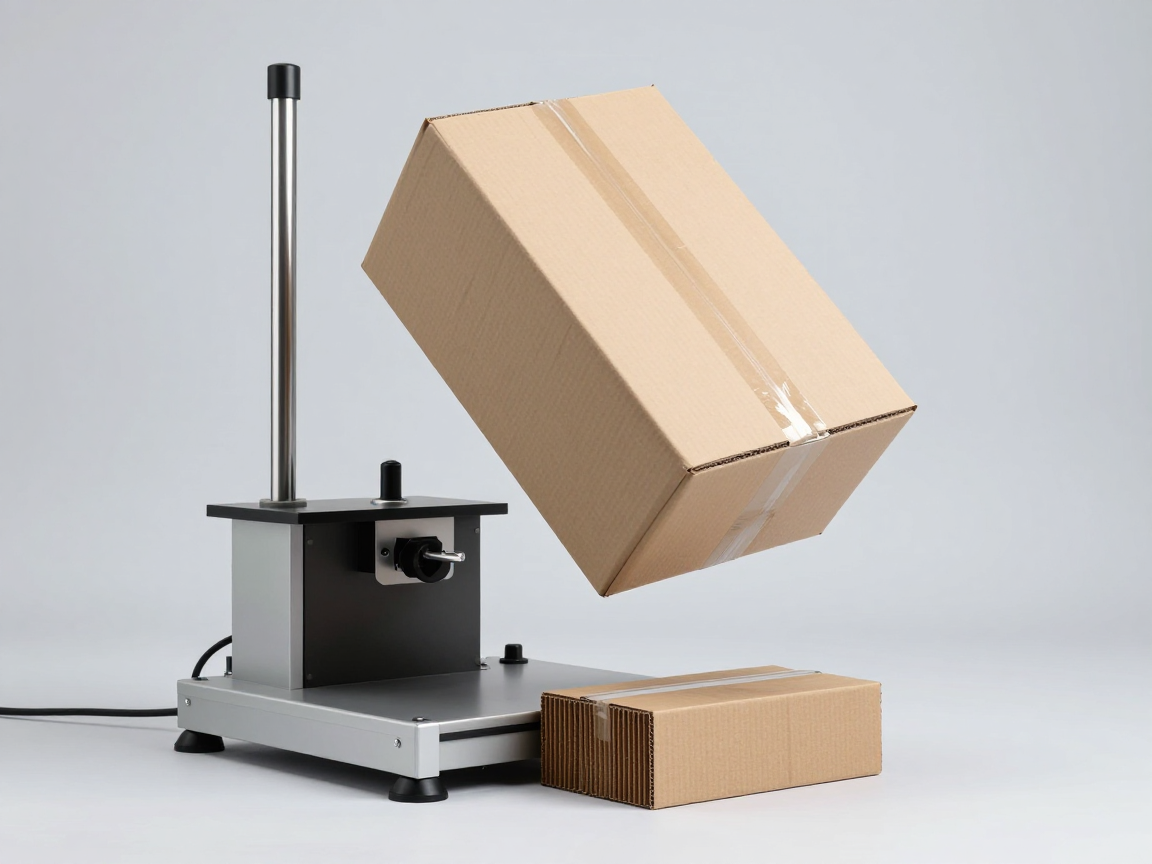
                What is ISTA 3E? Procedure for testing unitized load traveling by full truck (FTL)

                0
                Cover image of the article «What is ISTA 3E? Procedure for testing unitized load traveling by full truck (FTL)»

                ISTA® 3E is a belonging process Series 3 — General Simulation Performance Test (general simulation), for unitized load is prepared to go through the system full truck — Full Truckload (FTL), which means the whole trip only carries unitized load, usually retail products of the same type, towards a single destination — typically from factory to distribution center.

                If 3A simulates individual packages in the parcel network and 3B simulates multiple shipments, then 3E correctly simulates the problem of unitized load traveling in whole trucks: stacking throughout the journey, impacts along the vehicle body when braking and cornering, and the stability of the entire load when loading and unloading. The article presents the definition of unitized cargo, seven steps of the procedure, three ways to perform the compression step and points to prepare before testing.

                1. What is ISTA 3E?

                A unitized load consisting of wooden pallets carrying shrink-wrapped cartons and plastic straps — test subject of ISTA 3E
                The test object of ISTA 3E is the cargo block unitization: goods are stacked on pallets, wrapped with shrink film and fixed belts into a unified block.

                First, you need to understand the definition used in the document: 1 unitized cargo block is one or more products or packages, usually placed on skids or pallets, but always secured or bound for circulation as a single unit. Example in the literature: a shrink-wrapped pallet containing many individual boxes; a machine that does not pack boxes tightly onto pallets; or a pallet with tray, tube and carton cover.

                This procedure is used to:

                • Reviews protection performance of goods and packaging against vibration, impact and other stresses commonly encountered during loading, unloading and transportation.
                • Reviews stability of the entire block of goods — something that procedures for individual packages do not check for.

                The document also clearly states the limits: 3E test levels is based on general data and may not be representative of a particular distribution; packaging and products are evaluated together, not separate; and some shipping conditions such as Abnormal humidity, pressure or handling may not be covered.

                Reference documents: ISTA 3E 2016 — Unitized Loads of Same Product (latest technical change April 2017).

                2. Most common misunderstanding about ISTA 3E

                • “Once palletized, 3E can be used for all cases.” No. 3E is only correct when the whole trip bring unitized load a destination. Pallets for multiple shipments belong to the palletized/skidded group of 3B.
                • “REACHing 3E is a product that is not damaged no matter which channel it goes to.” 3E stops on the journey to the distribution center. If the goods are still separated from the center to the point of sale, that part not in 3E — the documentation clearly indicates that 3F should be used in this case.
                • “3E only checks the packaging.” No. 3E reviews packaging and product together, and evaluate stability of the cargo — so it also checks stacking configurations, wraps, belts and pallets.
                • “3E’s test level is representative of our distribution channel.” The documentation is straightforward: test levels are based on general data, which may not be representative of any particular distribution.

                3. What does ISTA 3E test? — 7-step sequence

                Compression testing machine applies top-down force to shrink-wrapped unitized cargo in the testing room — compression test according to ISTA 3E
                Compression test: force is applied to the top of the unitized cargo to simulate stacking loads during transportation and storage.

                The items are performed in the following order, on the same sample block. Note the two impact stages at either end of the procedure, surrounding the compression and vibration sections:

                # Category Test level/requirement
                1 Pre-conditioning Ambient temperature and humidity — required
                2 Controlled air conditioning According to the table of standards — option
                3 Impact Choose one of two: inclined impact (conbur) 48 in/s (1.2 m/s), or horizontal impact 48 in/s (1.2 m/s) — required
                4 Falling rotating edge Height depends on cargo volume — required
                5 Compression Choose one of three: loading and unloading machine — calculated force × 1.4; loading and holding machine — computational force; or use weights and spreader plates — calculated load — required
                6 Vibrate randomly Level Grms 0.54 — required
                7 Falling rotating edge Repeat, height depends on cargo volume — required

                Two points worth noting about the structure: first, Falling rotated edges appear twice — before and after compression and vibration; Second, the compression step is the simulation step realistic stacking load that the cargo block must bear, so it cannot be ignored when the cargo travels intact.

                4. Accompanying equipment and method standards

                Unitized cargo placed on large metal vibration table in packaging testing room — random vibration test according to ISTA 3E
                Vibration test (random vibration): the unitized cargo is fixed on a vibration table and subjected to a vibration spectrum simulating the transportation of the whole vehicle.
                Category Equipment Method standards
                Climate conditioning Air conditioning chamber with temperature and humidity recording device ASTM D 4332
                Inclined impact Inclined impact testing machine (conbur) ASTM D 880
                Horizontal impact Horizontal impact test system ASTM D 4003
                Compression — load and then release Compression testing machine (both fixed or floating tables can be used) ASTM D 642
                Compression — loading and holding Load with load spreader plate The documentation does not cite a method standard for this approach
                Vibrate randomly Random vibrating table system ASTM D 4728

                Two equipment requirements are notable in the compression step:

                • With how Load then release, required documents Use the exact same type of pallet as the pallet on which the goods are transported, and place it on top of the sample block — to compress the download to look like the real thing.
                • With how Use load and spreader plates, documents It is recommended to install a safety latch Support the spreader plate and weights, in case the load collapses quickly, causing damage or accident.

                5. Number of samples and sample preparation

                • A block of unitized load is the required level for this process.
                • ISTA It is recommended to perform the procedure 5 or more times, using a new sample for each test.
                • Sample must be genuine, not yet tested; If not available, the replacement sample must be as similar as possible to the actual product.
                • The package has actually been shipped is not considered a standard sample: goods sent to the testing laboratory must be Excess packaging for shipping, or new packaging at the testing laboratory.
                • The document emphasizes the work Fully recorded configuration, materials and construction methods The goods and packaging have been tested and included photo, because small differences can cause large differences in performance.
                • And as with all ISTA procedures, shippers must determine for themselves before testing: what constitutes damage, the allowable level of damage, how to determine product condition, and acceptable packaging condition after testing — see 4 criteria businesses must determine for themselves before trying.

                6. When should ISTA 3E not be used?

                The 3E documentation itself gives quite clear redirection instructions:

                Real situation Should switch
                Retail packages are sent no Unitization from distribution centers to retail points 3F
                Goods shipped via LTL multiplex system, multiple senders, multiple destinations in the same vehicle 3B
                Parcels travel separately within the parcel delivery network 3A
                Only screening for durability is required at the design stage Series 1 (1E · 1G · 1H for heavy and unitized load)
                Need a partial simulation, fewer categories 2A/2B
                Journeys involving moisture, pressure or unusual loading and unloading are the main risks Outside of 3E — documents stating these conditions may not be covered

                7. Common errors when implementing ISTA 3E

                • Try 3E and then use the results for separate trips. 3E only ends at the distribution center; The section from the center to the point of sale requires 3F.
                • Using the wrong pallet in the compression step. With loading and releasing, the required material is placed on top of the sample block the right type of pallet like the goods being transported on it — using another pallet causes the wrong way of conveying.
                • Ignore the safety pin in load usage. The document recommends safety pins to support the spreader plate and weights; Missing latches are a safety risk when the cargo block collapses.
                • Do not prepare samples “as is”. Items that have been shipped no longer represent standard condition — must be overpackaged when sent to the testing laboratory or repackaged at the laboratory.
                • Evaluate product packaging separately. 3E views packaging and product as one entity; Conclusion based only on the condition of the box and ignoring the condition of the product inside is a misreading of the procedure.

                8. What does the cost and time of ISTA 3E testing depend on?

                3E has seven steps, but cost is usually influenced by three heavy factors: compression step (requires compressor or loader and spreader plate, plus pallet placed on sample block), inclined or horizontal impact step (requires conbur machine or horizontal impact system), and weight and size of the entire block of goods — determines the rotating drop height and the ability to load and unload sample blocks into the device. The number of samples is also variable: the minimum is one block, the recommendation is 5 or more. Common factors: What does the cost and time of ISTA packaging testing depend on?

                9. Frequently asked questions

                In what way is 3E different from 3B?

                Shipping way. 3E is for a unitized all-cargo trip to one destination (FTL). 3B is for multiple shipments (LTL), where packages from multiple shippers and multiple destinations are mixed in the same vehicle.

                My goods travel in one vehicle to the distribution center, then separate into stores — how many processes are needed?

                Two. 3E for factory route → distribution center (unitized load), and 3F for central route → retail point (single package, not unitized). Document 3E clearly states this instruction.

                There are three ways to compress, which one should you choose?

                The document allows to choose one of three: load and release machine (calculated force × 1.4), load and hold machine (calculated force), or use load and spreader plate (calculated load). You should finalize the method of implementation with the testing laboratory in advance, because the method chosen affects the equipment, time and how to read the results.

                Does this procedure evaluate the stability of the cargo block?

                Yes — the document clearly states that one purpose of 3E is to evaluate the stability of the cargo, in addition to evaluating its performance against vibration and impact.

                Why doesn’t 3E cover humidity and pressure?

                That is a limitation that is explicitly stated in the document: some shipping conditions such as humidity, pressure or unusual handling may not be covered by the procedure. If this is the main risk of your product, you should discuss additional items with the testing laboratory separately.

                10. Conclusion

                ISTA 3E is a general simulation for Unitized cargo volumes go by full truckload (FTL), from factory to distribution center. Points to grasp: 3E rating packaging and product together, and evaluate stability of the cargo; sequence yes seven steps, which stands out as compression step simulates stacked loading and two falling rings rotating edges placed before and after the compression and vibration steps.

                The two most common mistakes when implementing: using 3E for the separate separation process (3F must be used), and using pallets of a different type in the compression step (the document requires the same type of pallet as the real product, placed on top of the sample block).


                References

                • ISTA — Test Procedures (list of current series and procedures, accessed September 27, 2026)
                • ISTA — Procedure 3E — Overview (free overview published by ISTA; not enough to conduct testing)
                • ISTA — Certify Your Lab (information about testing laboratory certification)
                • ASTM — method standards cited in the procedure: D 642, D 880, D 4003, D 4332, D 4728

                Related articles


                Discuss further


                  Disclaimer and acknowledgment of intellectual property rights

                  This article is an explanatory content compiled by us for the purpose of introducing and disseminating knowledge. Article is not a translation, copy, abridgement or replacement of the original standard, and is not evaluated, approved or sponsored by ISTA (International Safe Transit Association)..

                  The entire content of ISTA standards is copyrighted by the International Safe Transit Association, Inc. (East Lansing, Michigan, USA) — All rights reserved. ISTA® and the ISTA logo are registered trademarks of the International Safe Transit Association, Inc.; Mentioned in this article are for guidance purposes only and do not imply any affiliation, partnership or sponsorship.

                  Article content For reference only; Before applying for any purpose — testing, evaluation, certification or commercial decision-making — the reader should refer directly to the original ISTA document (the most complete and up-to-date version) and consult an accredited testing facility when necessary.

                  When performing testing, it is mandatory to use the official, current version of the standard, obtained directly from ISTA. We do not redistribute ISTA materials in any form. Information in this article may be out of date with the current version of the standard.

                  See more: Copyright Policy & Disclaimer by ticforall.com.
                  What is ISTA 3B? Packaging test procedure for LTL shipping (joint shipments)

                  0
                  Cover image of the article «What is ISTA 3B? Packaging test procedure for LTL shipping (joint shipments)»

                  ISTA® 3B is a belonging process Series 3 — General Simulation Performance Test (general simulation), for packages prepared for passage LTL shipping system (Less-Than-Truckload — combined shipments). Unlike 3A, where each package travels separately in the parcel network, 3B simulates the situation Many packages from many different shippers, to many different destinations, are in the same vehicle.

                  This is a popular distribution channel for industrial, wholesale and project goods — where packages are stacked on top of each other, pushed across vehicle floors, pulled by forklifts and bumped into each other at joints. The article presents the procedure structure, four product groups that 3B distinguishes, the testing sequence of each group and points to prepare before testing.

                  1. What is ISTA 3B?

                  The document defines LTL as form of trucking in which packages of different types — often from different shippers and destined for different final destinations — are mixed in the same shipment. From that definition, 3B constructs a test sequence that corresponds precisely to the hazards that mixing poses:

                  • Stacking throughout the journey, with the load constantly changing as the truck unloads at each point — so there is a category of random vibration with loading load on top.
                  • Horizontal slip and impact when the vehicle brakes, starts and turns — there should be a category of side or side impacts, along with rotational drops.
                  • Bales are tall, narrow or off center easy to tip over — should have a tilt/fall category with a tilt angle of 22°.
                  • Loading and unloading by forklift with goods on pallets or skids — so the pallet group has four items to be handled by forklifts.

                  Reference documents: ISTA 3B 2017 — Packaged-Products for Less-Than-Truckload (LTL) Shipment (latest technical and editorial change April 2017).

                  2. Most common misunderstanding about ISTA 3B

                  • “3B is 3A for heavier loads.” No. 3B is not a volume expansion of 3A; The core difference is distribution channel — LTL instead of parcel. A 20 kg LTL package is still in 3B, not 3A.
                  • “Just use 3E to build pallets.” Goods on pallets combine flights belongs to the palletized/skidded group of 3B; goods on pallets Full vehicle (FTL) new is 3E. Same pallet, two different processes depending on how they are transported.
                  • “REACHing 3B means meeting the shipping company’s packaging regulations.” Like all Series 3 processes, 3B simulates general and do not automatically comply Each company’s own packaging regulations.
                  • “One 3B post is enough for every package in the batch.” 3B grouping by shape and volume; Cylindrical bales or flat/long bales have their own categories, so the correct group must be tested.

                  3. ISTA 3B divides parcels into how many groups?

                  Three types of packages: standard cartons, cylindrical drums and pallets — corresponding to ISTA 3B package groups
                  ISTA 3B distinguishes three groups of bales: Standard (standard, divided according to the 200 lb / 91 kg mark), Cylindrical (cylindrical) and Palletized / Skidded (unitized load or on skids).

                  3B divided into four groups, each group has its own sequence table:

                  Group Characteristics
                  Standard — 200 lb (91 kg) or less Regular package, weight up to 91 kg
                  Standard — over 200 lb (91 kg) The package is heavy and must be loaded and unloaded with equipment and cannot be lifted by hand
                  Cylindrical (cylindrical) Packages in tubes, rolls, drums — rollable
                  Palletized/Skidded Goods placed on pallets or skids, handled by forklift

                  In each group, two variations Elongated (long) and Flat (flat) is assigned a separate category — details in the sequence tables below.

                  4. Test sequence — Standard group, 200 lb (91 kg) or less

                  # Category Test level/requirement
                  1 Pre-conditioning Ambient temperature and humidity — required
                  2 Controlled air conditioning According to the table of standards — option
                  3 Tip–tip over Angle 22° — required for lawsuits height ≥ 1.2 m (48 in) and weight ≥ 45 kg (100 lb) and a bottom edge less than ½ height; or sue height ≥ 760 mm (30 in) has a center of gravity higher than ½ of the bale height
                  4 Free fall 6 falls, height depends on mass — required
                  5 Random vibration (vertical) There is a loading load on the level Grms 0.54 — required
                  6 Concentrated impact Free-fall impact objects or pendulums, 380 mm (15 in) — just with packaging is not sturdy (non-rigid)
                  7 Free fall 6 falls, height depends on mass — required
                  8 Full rotation fall 1 fall — sue only Elongated
                  9 Bridge impact Hazard box falls 410 mm (16 in) — sue only Elongated
                  10 Full rotation fall 2 falls — sue only Flat
                  11 Concentrated edge impact Hazard box falls 410 mm (16 in) — sue only Flat

                  This group has two rounds of free fall (6 falls before and 6 falls after shaking) — a point that’s easy to miss if you just skim the table.

                  5. Test sequence — Standard group, over 200 lb (91 kg)

                  # Category Test level/requirement
                  1–2 Pre-conditioning · Controlled conditioning As above — required · option
                  3 Tilt/fall Angle 22°, conditions apply as above group
                  4 Rotational drop 230 mm (9 in) — falling rotates edges and corners
                  5 Inclined or horizontal impact 48 in/s (1.2 m/s), or alternatively with free fall 76 mm (3 in)
                  6 Random vibration (vertical) There is a loading load on top, Grms 0.54
                  7 Concentrated impact 380 mm (15 in) — only with non-rigid packaging
                  8 Falling rotation 230 mm (9 in) — repeat after shaking
                  9 Inclined or horizontal impact Repeat after shaking, level as above
                  10–13 Full rotational fall · Bridge impact · Full rotational fall · Concentrated edge impact Applies to Elongated and Flat cases as in the above group

                  Differences of the group over 91 kg: There are no free fall rings — replaced by rotating drops, and tilt/horizontal impact items Repeat two rounds, before and after shaking.

                  6. Test sequence — Cylindrical group (cylindrical)

                  Cylindrical drums lying horizontally on a steel surface in a packaging testing room — ISTA 3B Cylindrical group test
                  The Cylindrical (cylindrical) group has its own test sequence, including the steps of dropping and rolling the bale on a hard surface.
                  # Category Test level/requirement
                  1–2 Pre-conditioning · Controlled conditioning Required · option
                  3 Free fall 6 falls, height depends on mass
                  4 Random vibration (vertical) With and without top load, Grms 0.54
                  5 Free fall 5 falls, height depends on mass
                  6 Drop on hazard 1 fall, height depends on mass
                  7 Full rotation fall 1 time — only with elongated cylinders
                  8 Bridge impact Hazard box falls 410 mm (16 in) — only with long poles

                  A special feature of the pillar group is the vibration item that must be performed both states: with top load and no top load — because the drum, reel or tube can be both bottom and top in a single trip.

                  7. Test sequence — Palletized / Skidded group

                  Forklift lifts shrink-wrapped pallets in loading and unloading warehouses — forklift handling test according to ISTA 3B
                  For the Palletized / Skidded group, ISTA 3B has forklift handling exercises that simulate lifting, lowering and moving pallet goods at the warehouse.
                  # Category Test level/requirement
                  1–2 Pre-conditioning · Controlled conditioning Required · option
                  3 Tilt/fall 22° angle — required for cargo blocks height ≥ 760 mm (30 in) and the center of gravity is higher than the smallest bottom edge
                  4 Falling rotation Fall rotates edges and corners, height depends on mass
                  5 Inclined or horizontal impact 48 in/s (1.2 m/s), or 76 mm (3 in) free fall
                  6 Random vibration (vertical) There is a loading load on top, Grms 0.54
                  7 Concentrated impact 380 mm (15 in) — only with non-rigid packaging
                  8 Forklift — push flat and rotate Required
                  9 Forklift — pushing and pulling in the lifted state Required
                  10 Forklift — rotates in the lifted state Required
                  11 Forklift — check load stability through handling ramp Required
                  12 Falling rotation Repeat after the forklift handling sequence
                  13 Inclined or horizontal impact Repeat after the forklift handling sequence

                  The four forklift categories are unique to this group — and also the most overlooked when a pallet shipment is tested as bulk cargo.

                  8. Accompanying equipment and method standards

                  Category Equipment Method standards
                  Climate conditioning Air conditioning chamber with temperature and humidity recording device ASTM D 4332 or ISO 2233
                  Free fall Free fall machine (or sling with quick release mechanism) ASTM D 5276 or ISO 2248
                  Tilt/fall, rotate fall, full rotation fall Machine falls with support block ASTM D 6179 or ISO 2876
                  Inclined/horizontal impact Inclined impact testing machine (conbur) or horizontal impact system ASTM D 880 · ASTM D 4003 · ISO 2244
                  Concentrated impact Guided free-fall impactor, or pendulum ASTM D 6344 — impact block length approx 225 mm (8.875 in), diameter 32 mm (1.25 in), heavy 1.4 kg (3 lb)
                  Concentrated edge impact and spherical impact The machine falls with the hazard box next to it Hazard box: wooden 305 × 305 × 305 mm (12 × 12 × 12 in), heavy 4.1 kg (9 lb), impact edge armored corner. Bridge impact according to ASTM D 5265 (except hazard box)
                  Fall onto an obstacle The machine falls with the hazard block Hardwood or metal hazard block: high 20–25 mm (0.75–1.0 in), wide 150 mm (6 in), at least 200 mm (8 in) longer than the longest edge of the bale, with rounded top edges
                  Vibrate randomly Vertical random vibration table system ASTM D 4728 or ISO 13355

                  Support block for rotating fall items: 90–100 mm (3.5–4.0 in) high and wide, at least 200 mm (8 in) longer than the longest edge of the supported bale.

                  9. Number of samples and sample preparation

                  • A sample is a required level — a minimum level, not a recommended level.
                  • ISTA It is recommended to perform the procedure 5 or more times, with a new sample for each test.
                  • The sample must be a real package, not yet tested; If not available, the replacement sample must be as similar as possible to the actual product.
                  • The document clearly states: the package has undergone real transportation is not considered a standard sample. Goods sent to the testing laboratory must be over-packing to transport, or new packaging at the testing laboratory.
                  • Pallets or skids used in the test must be of the same type and condition as in actual use for that shipment — do not use new, better-than-life pallets.
                  • The document emphasizes the work Fully record configuration, materials and packaging construction, with photos, as small differences can cause large performance differences — and it is recommended to identify and document them Quantity of cardboard paper; If the nominal quantity changes, try again.

                  10. When should ISTA 3B not be used?

                  Real situation Should switch
                  Packages travel separately within the parcel delivery network, without a combined trip 3A
                  Unitized goods, traveling by full truckload (FTL) to a destination 3E
                  Unitized goods go to the distribution center and are then separated to the point of sale 3E, combined 3F for individual packages
                  Only screening for durability is required at the design stage Series 1 (1A · 1C · 1G · 1H)
                  Need a partial simulation, fewer categories 2A/2B
                  Certification is required according to the packaging regulations of a specific carrier or distribution channel That company/channel’s own program

                  11. Common mistakes when implementing ISTA 3B

                  • Try pallet cargo as bulk cargo. The palletized/skidded group has four forklift handling categories; Ignore them and the test no longer simulates the correct LTL channel.
                  • Missed the second round of free fall. The Standard ≤ 91 kg group had 6 falls before vibration and 6 falls after vibration — a total of 12 falls.
                  • Use different pallets than reality. Documents requiring pallets/skids of the correct type and condition as genuine goods; New pallets often give better results than reality.
                  • Test the shipped sample. Goods that have been in transit no longer represent standard condition; must be repackaged when sending or repackaged in a new packaging at the testing laboratory.
                  • Do not check the conditions for applying the tilt/fall category. This is a “required” category but has conditions (height, mass, center of gravity position); Wrong determination of a condition leads to the addition or omission of a step.
                  • Do not determine pass/fail criteria before testing. The four things that shippers must make themselves are outlined in the document — see 4 criteria businesses must determine for themselves before trying.

                  12. What does the cost and time of ISTA 3B testing depend on?

                  3B is a long process: the standard group over 200 lb has up to 13 items, the palletized/skidded group also has 13 items but includes four forklift handling tasks. So the cost depends strongly on commodity group (pallet and heavy goods are longer than regular bales), volume (decide the fall height), model number and Whether the right type of pallet is available or not — using a different pallet may actually result in unusable results, you must try again. Common factors: What does the cost and time of ISTA packaging testing depend on?

                  13. Frequently asked questions

                  In what core way is 3B different from 3A?

                  Distribution channel. 3A simulates a single package traveling in a parcel network; 3B simulates LTL multiple shipments, where packages from multiple shippers lie together and are stacked, slid, and collided in the same vehicle.

                  My goods are on pallets — use 3B or 3E?

                  Depends on shipping method. If that pallet is shipped with another shipper’s goods, use 3B’s palletized/skidded group. If the entire truck only carries unitized load to one destination, use 3E.

                  Is the tilt/dump category always implemented?

                  No. The document sets conditions according to height, mass and center of gravity position: bale ≥ 1.2 m high with weight ≥ 45 kg and bottom edge less than ½ height; or bale ≥ 760 mm high with center of gravity higher than ½ height. For pallet goods, the condition is that the block is ≥ 760 mm high and the center of gravity is higher than the smallest bottom edge.

                  Why does it have to vibrate both with and without a load on top?

                  Because in a combined trip, the same type of bale can be at the bottom (with heavy load) in one trip and at the top (no load) in another trip. With the cylindrical group, the documentation calls for both states to be implemented.

                  Can I use the results of 3B’s previous test to avoid re-testing when changing carton suppliers?

                  Shouldn’t. The document recommends recording the paper weight of the carton, and states that if the nominal weight changes — even if the carton is still rated at the same performance class — it should be retested.

                  14. Conclusion

                  ISTA 3B is a general simulation for LTL shipments. The value of 3B lies in the fact that it accurately simulates three characteristics of a multiplex channel: stacking (vibration with load on), sliding and horizontal impact (tilt/horizontal impact, rotational fall) and Loading and unloading by forklift with pallets.

                  The first thing to do is determine the correct product group — Standard ≤ 200 lb, Standard > 200 lb, cylindrical, or palletized/skidded — and check if the package falls into the Elongated or Flat variant, as these two variants add their own impact category. Regarding samples, the minimum is one sample; Pallets used in articles must be of the correct type and in the correct condition.


                  References

                  • ISTA — Test Procedures (list of current series and procedures, accessed September 27, 2026)
                  • ISTA — Procedure 3B — Overview (free overview published by ISTA; not enough to conduct testing)
                  • ISTA — Certify Your Lab (information about testing laboratory certification)
                  • ISO/ASTM — method standards referenced in the procedure: ISO 2233, ISO 2244, ISO 2248, ISO 2876, ISO 13355; ASTM D 880, D 4003, D 4332, D 4728, D 5265, D 5276, D 6179, D 6344

                  Related articles


                  Discuss further


                    Disclaimer and acknowledgment of intellectual property rights

                    This article is an explanatory content compiled by us for the purpose of introducing and disseminating knowledge. Article is not a translation, copy, abridgement or replacement of the original standard, and is not evaluated, approved or sponsored by ISTA (International Safe Transit Association)..

                    The entire content of ISTA standards is copyrighted by the International Safe Transit Association, Inc. (East Lansing, Michigan, USA) — All rights reserved. ISTA® and the ISTA logo are registered trademarks of the International Safe Transit Association, Inc.; Mentioned in this article are for guidance purposes only and do not imply any affiliation, partnership or sponsorship.

                    Article content For reference only; Before applying for any purpose — testing, evaluation, certification or commercial decision-making — the reader should refer directly to the original ISTA document (the most complete and up-to-date version) and consult an accredited testing facility when necessary.

                    When performing testing, it is mandatory to use the official, current version of the standard, obtained directly from ISTA. We do not redistribute ISTA materials in any form. Information in this article may be out of date with the current version of the standard.

                    See more: Copyright Policy & Disclaimer by ticforall.com.
                    What is ISTA 3A? Packaging test procedure for parcel delivery system (Parcel Delivery)

                    0
                    Cover image of the article «What is ISTA 3A? Packaging test procedure for parcel delivery system (Parcel Delivery)»

                    ISTA® 3A is the belonging process Series 3 — General Simulation Performance Test (general simulation), for Each individual package passes through the parcel delivery system., volume 70 kg (150 lb) or lighter. This is the procedure most talked about by e-commerce sellers and shipping units, because it simulates the exact chain that most retail packages have to go through: automatic sorting, falling from conveyor belts, stacking in vehicles and impacts at joints.

                    This article presents the structure of the 3A process, the four package types that 3A distinguishes, the test sequence, the equipment required, and the points that need to be prepared before sending the sample to the laboratory.

                    1. What is ISTA 3A?

                    ISTA 3A is the lesson general simulation, not a simple endurance test. The difference lies in three points:

                    • 3A simulate real hazards of the delivery system (falling, vibration, impact at joints, stacking), not only challenging the durability of the packaging.
                    • Test levels are built from General data of distribution channels, so the results are closer to reality than a Series 1 article.
                    • Still, 3A do not automatically comply each carrier’s own packaging regulations — these are two different systems.

                    A notable detail right in the scope section: in 3A, the mass limit is stated as 70 kg (150 lb), while most other ISTA processes use 68 kg for 150 lb. The reason is clearly stated in the document: 70 kg / 150 lb is a common division in the delivery system of countries using the metric and imperial systems, and 3A chooses that exact datum instead of exact conversion.

                    Reference documents: ISTA 3A 2018 — Packaged-Products for Parcel Delivery System Shipment, 70 kg (150 lb) or Less (latest technical and editorial change March 2018).

                    2. Most common misunderstanding about ISTA 3A

                    The following three misunderstandings come up frequently in discussions about retail packaging:

                    • “3A is the packaging durability test.” Not really. 3A is the card general simulation: its test levels are built from general data of the delivery system, so the results indicate whether the sample withstands a series of hazards close to reality, not just “strong or weak packaging”.
                    • “REACHing 3A means meeting the carrier’s packaging regulations.” The document states Series 3 not by default Comply with shipping company’s packaging regulations. To be certified according to the regulations of a specific company, you must follow that company’s program.

                    • “Goods under 150 lb automatically use 3A.” Volume is just a condition. 3A also requested the goods to be shipped according to the parcel delivery system, and which group the package belongs to (Standard, Small, Flat or Elongated) determines the testing sequence.

                    3. Four types of packages that 3A distinguishes

                    Four cartons of different shapes: standard, small, flat and long — corresponding to the four package groups of ISTA 3A
                    Four ISTA 3A package groups are distinguished: Standard, Small, Flat and Elongated — each with a different falling and vibration sequence.

                    What makes 3A different from other processes is that it Classify packages into four groups and apply different test sequences to each group. Misclassification will lead to wrong category trials.

                    Type of bale Classification conditions
                    Standard (standard) Does not belong to the other three groups — for example, regular cartons, plastic boxes, wooden boxes, cylinders
                    Small (small) Volume < 13,000 cm³ (800 in³) and longest side ≤ 350 mm (14 in) and mass ≤ 4.5 kg (10 lb)
                    Flat (flat) Shortest side ≤ 200 mm (8 in) and The next edge is ≥ 4 times larger than the shortest edge and volume ≥ 13,000 cm³ (800 in³)
                    Elongated (long) Longest side ≥ 900 mm (36 in) and The remaining two sides are both ≤ 20% of the longest side

                    The document clearly notes: if a package fits Flat medium Elongated, yes try following the Elongated group. This is the rule that is most easily overlooked when declaring samples to the testing laboratory.

                    4. What does ISTA 3A test? — Test sequence

                    The cardboard package is placed on the drop table of the drop test machine, underneath is an impact-resistant steel platform — drop test according to ISTA 3A
                    Drop test: the bale is dropped at different positions and heights onto a hard surface — one of the mandatory items of ISTA 3A.

                    With the group Standard, Flat and Elongated, the items are performed in the following order, on the same sample:

                    # Category Test level/requirement
                    1 Pre-conditioning Ambient temperature and humidity — required
                    2 Controlled air conditioning Select temperature and humidity according to the standard table — option
                    3 drop 9 falls, height depends on package weight — required
                    4 Vibrate randomly With and without loads stacked on the,level Grms 0.53 and 0.46 — required
                    5 Random vibration under low pressure Altitude simulation (road, or road + aviation) — option
                    6 drop 8 drops, has an item that falls on an obstacle (hazard) — required
                    7 Falling edge rotation 200 mm (8 in) — applies to bales only Flat and Elongated
                    8 Full rotation flat fall Rate depends on package size — only Flat and Elongated
                    9 Concentrated impact Hazard box falls 400 mm (16 in) — for bales only Flat
                    10 Bridge impact Hazard box falls 400 mm (16 in) — for bales only Elongated
                    11 Check for leaks 8 o’clock — applies to containers only liquid

                    With the group Small, the sequence is shorter but has one important difference: the package is tested individual free fall first, then shake in the collection bag, then fell again but this time in the pocket — correctly simulates a small package mixed in a large bag at the post office:

                    # Category Test level/requirement
                    1 Pre-conditioning Ambient temperature and humidity — required
                    2 Controlled air conditioning According to the table of standards — options
                    3 Free fall (not in bag) 9 falls — required
                    4 Vibrate randomly With and without top load — required
                    5 Random vibration under low pressure — option
                    6 Fall (in the bag) 7 falls — required
                    7 Check for leaks 8 hours — liquid bales only

                    5. Accompanying equipment and method standards

                    Carton bale placed on metal vibrating table in packaging testing room — random vibration test according to ISTA 3A
                    Vibration test (random vibration): the bale is tightly mounted on a vibrating table and subjected to a vibration spectrum that simulates the actual transportation process.
                    Category Equipment Method standards
                    Climate conditioning Air conditioning chamber with temperature and humidity recording device ISO 2233 or ASTM D 4332
                    Free fall The machine falls freely ISO 2248 or ASTM D 5276
                    Falling edge rotation Rotating edge falling machine ISO 2876 or ASTM D 6179
                    Concentrated impact and spherical impact Machine falls with hazard box (see below) ASTM D 5265 (except hazard box)
                    Vibrate randomly Random vibrating table system, stacked guide column, upper load generating device ISO 13355 or ASTM D 4728
                    Random vibration under low pressure Low pressure chamber fits on the vibration table; suck down 60 kPa (8.7 psi) for land + air post, or 70 kPa (10 psi) for road directions ISO 2873 or ASTM D 6653

                    Hazard box for Flat and Elongated bales: Solid size wooden box 300 × 300 × 300 mm (12 × 12 × 12 in), total volume 4.1 kg (9 lb), with at least one bottom edge covered with corner steel, inside placed sandbags and inserts to fix the bags. Hazard block (used for bridge impact items) made of hard wood or metal: high 20–25 mm (0.75–1.0 in), wide 150 mm (6 in), at least 200 mm (8 in) longer than the second shortest edge of the package, with the top two edges rounded.

                    support block for rotational edge drop items: 90–100 mm (3.5–4.0 in) high and wide, at least 200 mm (8 in) longer than the shortest edge of the test surface.

                    6. Number of samples and sample preparation

                    • A sample is the required level for this procedure — but it is a minimum level, not a recommended level.
                    • The documentation states: with fragile product or The product contains liquid, should try two or more samples because the variability of packaging and products is higher in this group.
                    • ISTA It is recommended to perform the procedure 5 times or more,new sample each time, for representative conclusions.
                    • Sample must be Real package, not tested; If not available, the replacement sample must be as similar as possible to the actual product.
                    • For small packages (Small group), the laboratory needs to prepare shopping bag: a sample bag with “junk” packages simulating common mail items, and a Top loading bag holds 36 kg (80 lb) sand or similar flowing material.
                    • When the outer packaging is cartons and documents Recommended determination and recording of paper weight (basis weight). If the rating changes — even if the carton is still rated at the same performance class — it should be retested.

                    And one thing that cannot be left to the testing laboratory: the shipper must determine their own set of pass/fail criteria before testing — see 4 criteria businesses must determine for themselves before trying.

                    7. When should ISTA 3A not be used?

                    3A simulates a parcel delivery system. If the actual distribution channel is not that system, using 3A will give misleading results:

                    Real situation Should switch
                    Goods travel by truckload (LTL) and not by parcel 3B
                    Goods have been unitized into blocks, going full truckload 3E
                    Only screening for durability is required at the design stage Series 1 (1A · 1C · 1G)
                    Need to simulate part, cost is lower than 3A 2A (or 2B for pieces over 68 kg)
                    Packages weighing more than 70 kg (150 lb) Outside of 3A — see process group for heavy bales and unitized cargo
                    Goods sold through channels have specific requirements of the floor or a specific distribution system Processes specific to that channel (e.g. projects by national distribution system or by floor)

                    8. Common mistakes when implementing ISTA 3A

                    • Misclassification of package groups. Flat bales registered as Standard will have the three most severe categories (rotated edge drop, fully rotated flat drop, concentrated impact) ignored — a “pass” result is then invalid.
                    • Ignore the Flat + Elongated rule. Satisfying both definitions must try the Elongated group.
                    • Try Small group as standard package. Small group needs collection bags and load bags over 36 kg; Missing the “fall in bag” step is missing the most dangerous situation of a small package.
                    • Change the carton quantity without trying again. The document states that paper weight changes are grounds for retesting, even if the cardboard is rated at the same performance level.
                    • Sample configuration and initial status are not recorded. 3A has up to 11 items on the same form; Without photos and original records, it is impossible to attribute the cause of damage to the correct step.

                    9. What does the cost and time of ISTA 3A testing depend on?

                    3A is the longest test in the common process group for retail packages: with the standard/Flat/Elongated group, a sample must go through a maximum of 11 items, including two falling rings, two vibration rings and specific impact items. So the cost depends strongly on package group (Flat and Elongated cases have more items than Standard cases), model number (one sample is minimum, more for fragile or liquid items), and whether or not to choose the category of vibration under low pressure — This item requires a low pressure chamber, which not all testing laboratories have.

                    With small packages, the cost also depends on the laboratory having to prepare collection bags and simulated “junk” packages. General factors that determine cost and time are summarized at: What does the cost and time of ISTA packaging testing depend on?

                    10. Frequently asked questions

                    Can 3A replace 3B?

                    No. 3A simulates the parcel delivery system, 3B simulates LTL shipping (joint shipment). The two channels have different risks and queuing methods, so you must choose according to the channel you actually go to.

                    Does reaching 3A mean that the goods will not be damaged during transportation?

                    No. A result of 3A means that the sample has withstood the specified test sequence, compared with Failure criteria are determined by yourself before testing. This is a general simulation, not a commitment to every trip.

                    Is my 54 kg (120 lb) package in 3A?

                    Yes — 3A applies to packages up to 70 kg (150 lb). Above that mark, the procedure belongs to the group for heavy packages or unitized load, depending on the packaging.

                    Is it okay if I don’t choose the low-pressure vibration category?

                    This is an optional item in the document. It is worth considering when the goods are traveling by air, or when the packaging contains welds, valve caps, gas or liquid pockets — situations where low pressure conditions can open or deform the packaging. Should finalize with end customers before trying.

                    Is it necessary to measure the quantity of cardboard?

                    The document states this as a strong recommendation, with reasons: if the nominal quantity changes, the old results are no longer representative, even if the cardboard is still rated at the same performance level.

                    11. Conclusion

                    ISTA 3A is a general simulation for single parcels sent by parcel delivery, up to 70 kg (150 lb). The first and most important thing when using 3A is Correctly classify packages — Standard, Small, Flat or Elongated — because the testing sequence depends entirely on that group. Flat or Elongated bales have three additional items that collide with the hazard box, while Small bales have steps to fall in the collection bag.

                    Regarding samples, the minimum is one sample, but fragile goods and goods containing liquids should start with two samples or more; and pass/fail criteria must be finalized in writing before the sample leaves the factory.


                    References

                    • ISTA — Test Procedures (list of current series and procedures, accessed September 27, 2026)
                    • ISTA — Procedure 3A — Overview (free overview published by ISTA; not enough to conduct testing)
                    • ISTA — Certify Your Lab (information about testing laboratory certification)
                    • ISO/ASTM — method standards referenced in the procedure: ISO 2233, ISO 2248, ISO 2873, ISO 2876, ISO 13355; ASTM D 4332, D 4728, D 5265, D 5276, D 6179, D 6653

                    Related articles


                    Discuss further


                      Disclaimer and acknowledgment of intellectual property rights

                      This article is an explanatory content compiled by us for the purpose of introducing and disseminating knowledge. Article is not a translation, copy, abridgement or replacement of the original standard, and is not evaluated, approved or sponsored by ISTA (International Safe Transit Association)..

                      The entire content of ISTA standards is copyrighted by the International Safe Transit Association, Inc. (East Lansing, Michigan, USA) — All rights reserved. ISTA® and the ISTA logo are registered trademarks of the International Safe Transit Association, Inc.; Mentioned in this article are for guidance purposes only and do not imply any affiliation, partnership or sponsorship.

                      Article content For reference only; Before applying for any purpose — testing, evaluation, certification or commercial decision-making — the reader should refer directly to the original ISTA document (the most complete and up-to-date version) and consult an accredited testing facility when necessary.

                      When performing testing, it is mandatory to use the official, current version of the standard, obtained directly from ISTA. We do not redistribute ISTA materials in any form. Information in this article may be out of date with the current version of the standard.

                      See more: Copyright Policy & Disclaimer by ticforall.com.